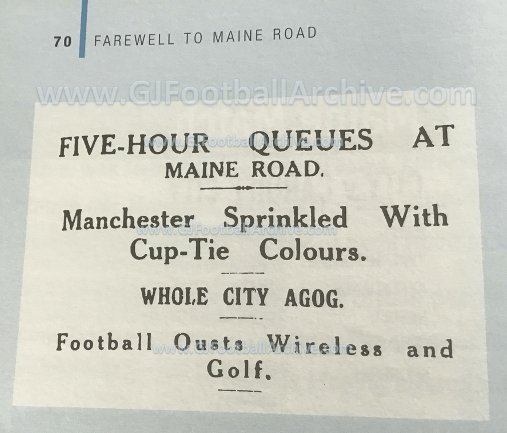
Today (8 March) marks the 102nd anniversary of a record Manchester City set – the record is the highest attendance on a club ground! The record set in 1924 saw 76,166 attend City v Cardiff. Keep reading all those who think ‘don’t you mean 84,569 in 1934?’ – City already held the record… City had moved to their new Maine Road stadium in August 1923. The capacity of the venue was estimated at around 90,000 but was actually approximately 83,000 when the stadium opened (it was enlarged in 1931 and 1935).
In its first season the capacity was tested and, on this day (8 March) in 1924 the largest attendance for any footballing fixture (including three FA Cup Finals) in Manchester gathered to watch the Blues. This was also, at the time, the record crowd for any game played on an English club ground. It was beaten ten years later when 84,569 watched City v Stoke – so It’s 102 years of this record for the Blues!
You can read about the remarkable day in 1924 below:
Subscribe to get access
Read more of this content when you subscribe today. It costs £20 a year (access to everything) or £3 per month (see below).
Read more of this content when you subscribe today. It costs £20 a year (see above) or £3 per month (cancel anytime; access to everything posted since 1 October 2022).
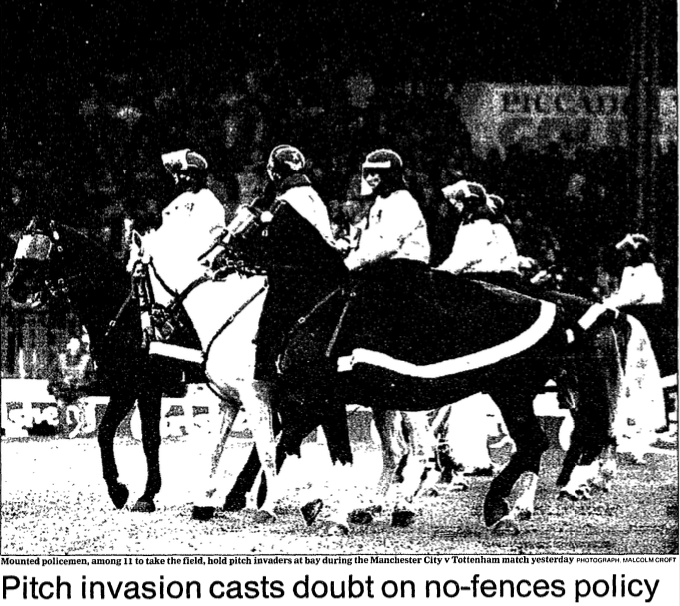
On this day (7 March) in 1993 Manchester City faced Tottenham in the FA Cup Quarter-Final at Maine Road. It was a day that saw the media express shock at the behaviour of City’s fans when they invaded the pitch during the tie with Spurs. They condemned the supporters without understanding the background story. To put the record straight it’s vital the day’s events are covered correctly. Here for subscribers is the full story of that game, including quotes from Niall Quinn and Peter Swales (from my interviews with them in the years since that day…
Subscribe to get access
If you would like to read this and all the in-depth articles on this site (including the entire Manchester A Football History book and the audio interview with John Bond) then please subscribe. It works out about £1.67 a month if you take out a discounted annual subscription (£20 per year) or £3 a month (cancel any time). Each subscriber gets full access to the 2000+ articles posted so far and all others during your subscription..
Manchester City’s meeting with Liverpool on this day (7 February) in 2021 was considered by some as the day the Blues’ run of great results would end. Playing at Anfield against the reigning champions was expected to be tough and, indeed, the first half was tight with little between the sides. In the 37th minute a great opportunity to take the lead was missed when a penalty, given for a foul on Sterling, was fired over by Gundogan. City fans watching at home due to Covid restrictions felt fate was working against them.
However, the second half started positively when, in the 49th minute, Gundogan lashed in a rebound after Liverpool ‘keeper Alisson had parried a Phil Foden shot. The lead didn’t last though as Mo Salah scored from the penalty spot in the 63rd minute. Ten minutes later Gundogan was played in by Foden to convert from close range after a defensive mix-up to make it 2-1. Three minutes later (76th minute) Sterling’s diving header from a clever cross by Bernardo Silva made the score 3-1.
Man of the match Phil Foden completed the scoring in style with a sizzling strike (83rd minute). It was thoroughly deserved as Foden had been outstanding throughout the game.
The 4-1 victory lifted City five points clear of second-placed United and with a game in hand. This was also Pep Guardiola’s first win as a manager at Anfield. He summed up the game well: ‘I have a lot of emotions, many things happening in the game. Gundogan missed a penalty – it’s like a routine against them – but we started really, really well, doing what we want to do. In the second half, the way we reacted to the goal, the way we played with quality, made the difference.’
When asked about the destination of the League title he responded: ‘It is an important win, but it is February. Of course, the gap to fifth is big right now and [qualifying] for the Champions League next season is important – but 10 [League] wins in a row in this period is something exceptional.’
Match Stats
7 February 2021
Liverpool 1 (Salah) City 4 (Gundogan 2, Sterling & Foden)
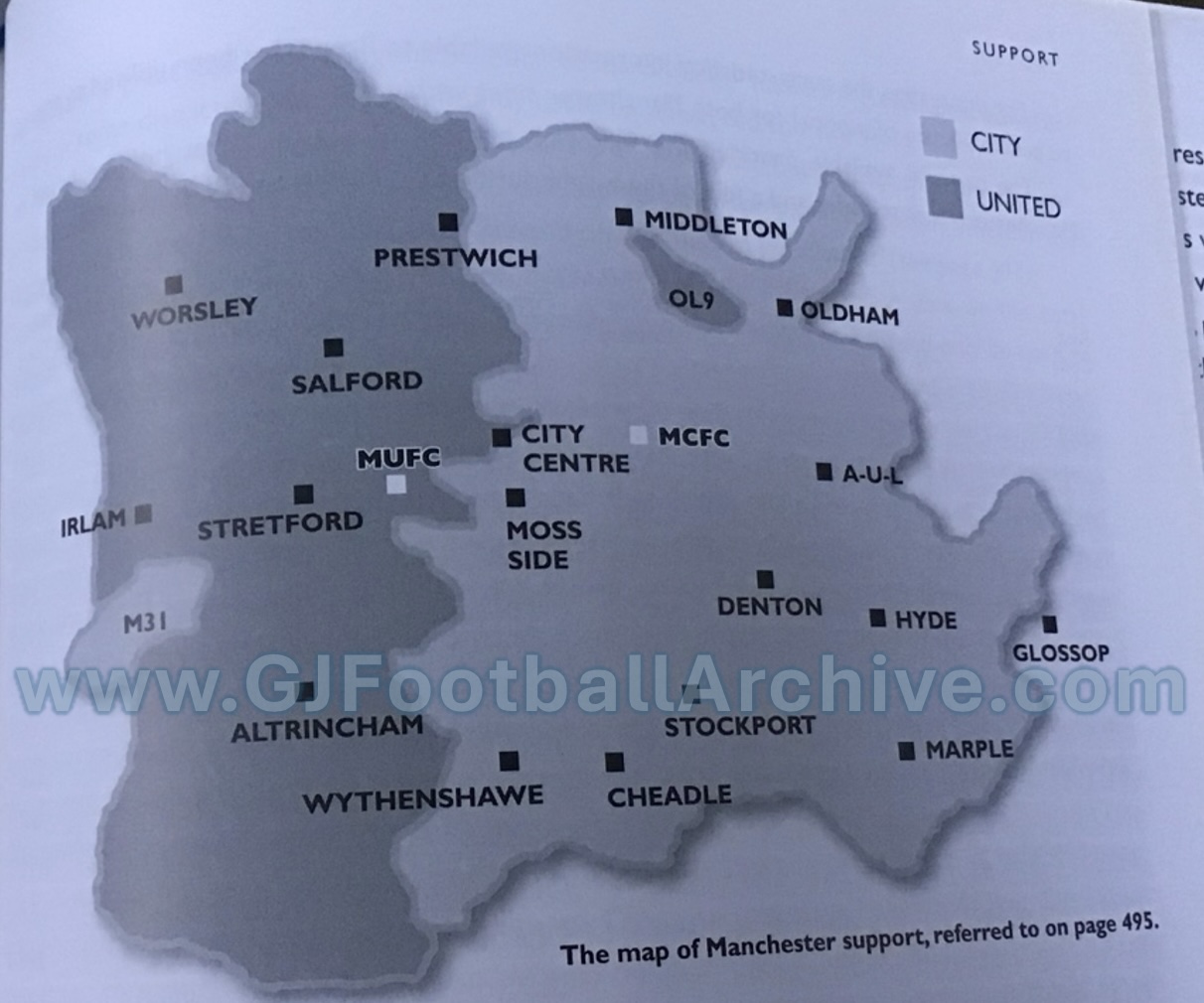
Here’s a map I published in my book Manchester A Football History. It shows the spread of support for both City and United across Manchester as recorded in an academic study back in 2002 (using data from 2001). Basically this was based on season ticket holders in each postcode area of Manchester and shows whether a postcode area was Red or Blue at that time. You can see that back then City had more season ticket holders in almost every district of the city centre and east Manchester while United tended to have more in western districts. However, this was based on the number of season ticket holders in 2001. Since then of course the numbers attending games at both clubs have increased significantly.
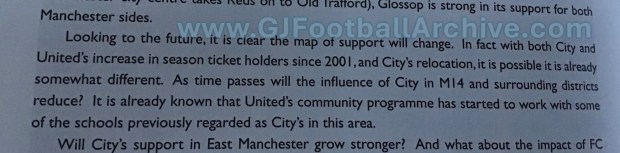
In my chapter I made a comment about how this analysis might change:
The new series of features on Manchester City in the 1910s continues today with a 2800 word article on the 1912-13 season – A season which saw United’s most successful manager (at the time) walk out on the Reds to become City’s manager (he believed that City, with the larger pulling power, was a more ambitious club). If you’re a subscriber you can read all about that and the rest of the season below. If you’re not a subscriber then why not sign up for a month and see what you think?
Subscribe to get access
Read more of this content when you subscribe today. It costs £3 per month (cancel anytime) or sign up a year at a time for the discounted annual fee of £20. This gives access to everything on the site, including PDFs of 3 of my books and various other articles, interviews and audio material. Each subscriber has access to all content posted during their subscription period too. Why not sign up for a month and see what you think?
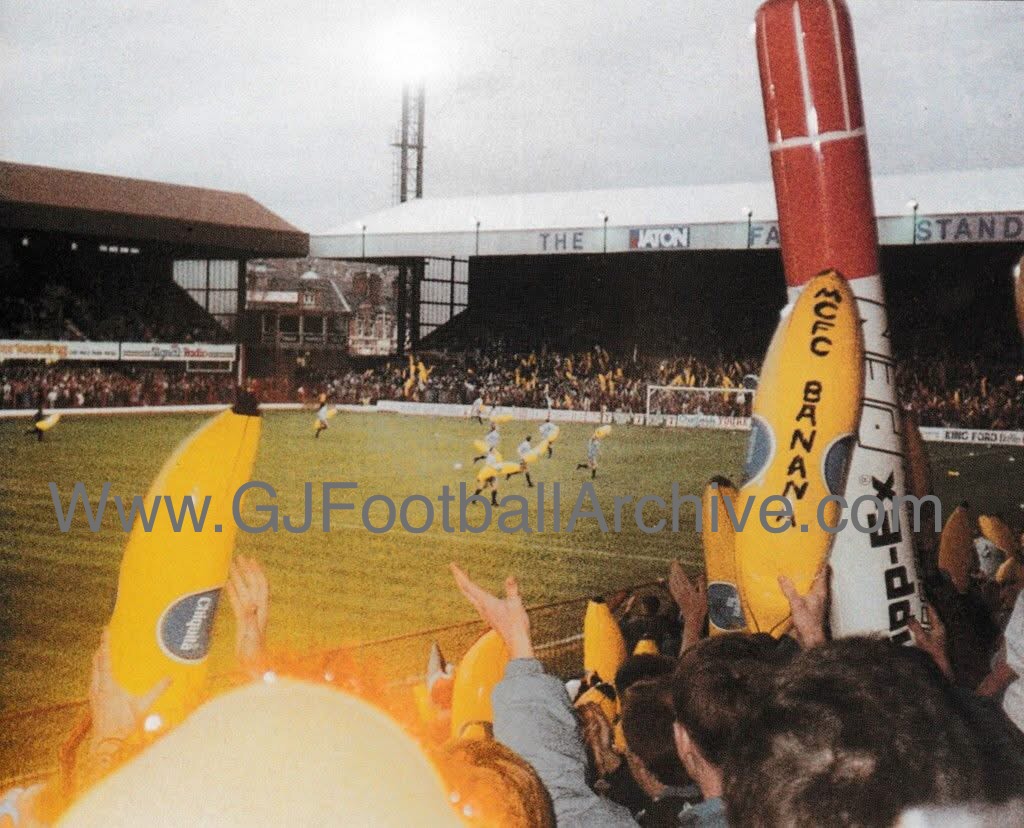
Two items of interest here both connected with a Boxing Day game. First, Heidi’s photo taken at Stoke in 1988. We travelled down and she took quite a few photos that day but this one was always the special one. It’s been used in a few of my books.
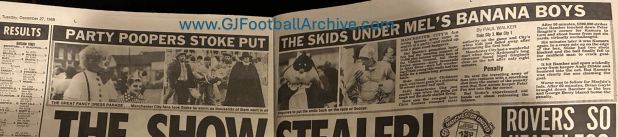
Next, here’s a newspaper cutting from the same day at Christmas 1988. It shows the Boxing Day fancy dress game at Stoke which saw over 12,000 Manchester City fans fill half the stadium. As I mentioned earlier, I was there that day and there were some surreal sights. I won’t mention the score (you can see that from the report!) but this was one of those crazy days when fans injected humour. There was some coverage but not a great deal. My own photos from that day have appeared in a few of my books and when I get chance to dig them out I’ll aim to post some on this site.
Forty years ago today (21 December in 1985) the humour of Manchester City fans was in evidence at Sheffield Wednesday. That day I was stood in the away section behind the goal and Wednesday led 3-1 at half time. City had taken the lead via Mark Lillis in the 13th minute but Wednesday had equalised a minute later (Thompson) then taken the lead (future Blue Gary Megson, 25 mins & Sterland 42 mins). It didn’t look like it was to be City’s day but City fans were in good spirit overall. As the players trudged off the guy running the PA system put on ‘Last Christmas’ by Wham. The song had been released the previous year. A few City fans began moving to the music and there was a bit of laughter. Then the music stopped on the PA as the announcer began reading out the half time scores. City fans immediately began booing.
Then the chant ‘We want Wham!’ started to boom out from the Leppings Lane End and the boos and chanting grew louder and louder. It was one of those surreal football moments. When he’d finished reading out the half times the PA announcer, still drowned out to some extent by our chant of ‘We want Wham!’ said: ‘And now, just for the Man City fans it’s back to Wham and Last Christmas!’
The away section cheered and then what had been a small group of fans bopping along to the song initially was now a significant part of the away section.
I don’t know who the PA announcer was but he certainly ‘got’ the mood of the day and helped create one of those odd, surreal football fan moments that rarely get reported.
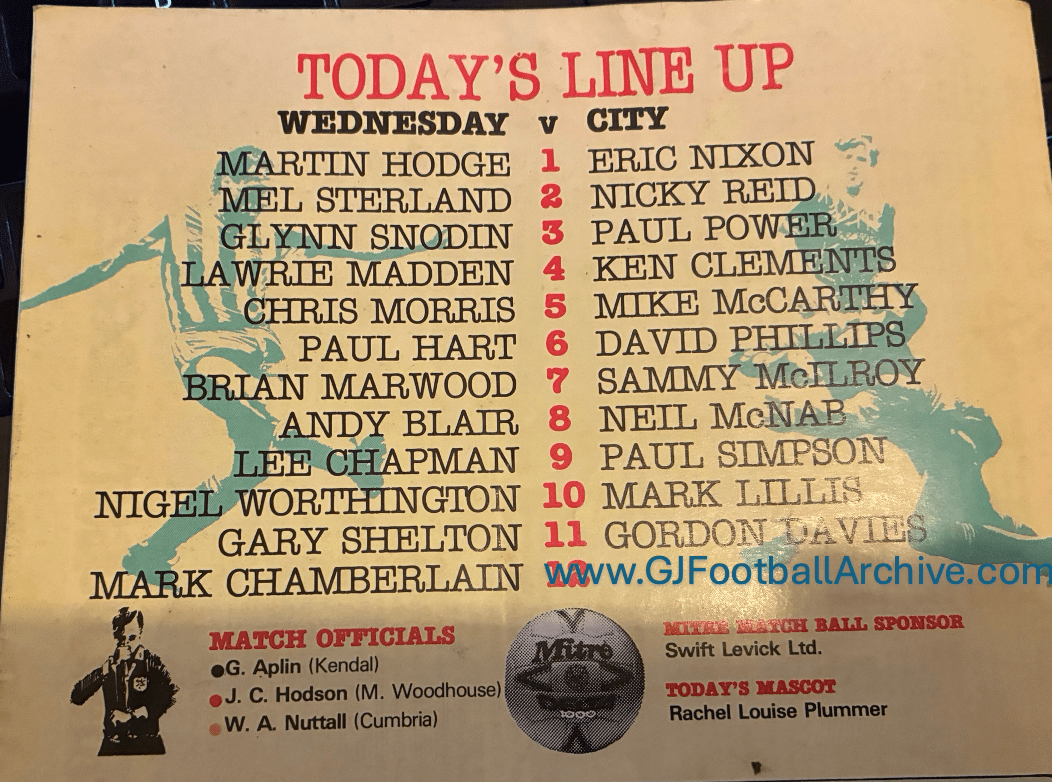
The game ended 3-2 to Wednesday after Neil McNab scored City’s second in the 66th minute before a Hillsborough crowd of 23,177. Here’s my programme from the game:
If you’d like to know more about Manchester City at this time, here’s a 2,500 word subscriber feature on the 1985-86 season. Enjoy!
Subscribe to get access – Monthly
Read more of this content when you subscribe today. It costs £3 per month (cancel anytime) to access everything posted since 1 October 2022 or there’s a special annual rate below which gives greater access and works out much cheaper.
Read more of this content when you subscribe today. It costs £3 per month (above) or £20 a year (here) to access everything posted since the site was created in December 2020. This special rate works out about £1.67 a week and gives access to everything posted, including PDFs of 3 of my books.
Back in 1938 Manchester City introduced a letters page in their match programme. The idea was for supporters to write in with suggestions they would like to see the club implement. It took some time before fans started writing in and here was the first letter the club published. It talked of how the club colours of pale blue and white didn’t offer much of a contrast and how the author preferred to see white and black or the 1934 cup final colours of maroon and white.
Over the years there were lots of suggestions of changing City’s traditional colours. In the late 1960s Malcolm Allison wanted to make the club’s red and black away colours their home colours. Imagine anyone making such a suggestion today!
If you’d like to read more on this season, then here’s a 1,500 word article on the 1950-51 season. Enjoy!
This is a subscriber article and you can read it by subscribing below.
Subscribe to get access
Read more of this content when you subscribe today. It costs £3 per month or you can subscriber for the discounted annual rate of £20 per year. Each subscriber gets access to everything posted so far, including PDFs of a couple of my books.
I’ve been sorting out my writing area and have been going through my collection. I’ll post a few odd bits on here over the coming weeks but I spotted this earlier today and thought I’d get this posted straight away. It’s the first issue of King of the Kippax and I remember buying it when it first came out in 1988. I’d previously bought Blueprint, which had included material from Dave and Sue Wallace (the editors of King of the Kippax), and used to eagerly look for any new fanzine back then. This copy remains part of my collection and probably will do for as long as I have a collection.
Dave and Sue created something special with this fanzine and who would have thought that decades later they would still be producing it. I missed the deadline for the last print edition of King of the Kippax sadly, but here’s something I wrote back in 2013 when there was a series of football anniversaries. I hope it gives a feel of how I felt about fanzines and the role of King of the Kippax over the decades.
It’s a season of footballing anniversaries this year (2013). The FA celebrates 150 years, the Football League 125 and King of the Kippax an amazing 25 years. Of these three anniversaries KK is inevitably getting the least focus but in many ways its significance to football, or at least our team, has been greater during its first 25 years than the FA’s first 25.
The FA did little to support football in Manchester for decades and it wasn’t until Manchester’s clubs started to take the FA Cup seriously that the organisation began to matter. But even then the FA did its upmost to prevent our professional clubs from challenging properly. In 1904 when City became Manchester’s first FA Cup winners how did the FA react? They decided we must be doing something illegal and sent auditors to the club to determine if we had ‘bought’ success. Okay, so they found a few irregularities with a transfer from Glossop, but for the following year or so they relentlessly pursued our club (and to be fair did something similar with Newton Heath, who became United, and with Glossop). Ultimately, we received a devastating punishment and the club could have died. I won’t go on about how unjust all of this was – City were no worse than most sides the difference being that the FA was determined to catch us out! – but if you do want to read an account of it dig out my latest book “Manchester The City Years”.
Despite all of this the FA Cup actually gave City our first success and we should ensure we celebrate 23 April 1904 (the date of the final) every year – make St George’s Day City’s day!
The Football League was more supportive of City during those early years, but prior to 1892 the League had no involvement from either Manchester side despite the League holding its first meeting in Manchester. Our celebrations of the League should really come in 4 years’ time when it’ll be 125 years since City (as Ardwick) joined the League. Although it’s worth pointing out that Ardwick and Manchester City were two separate organisations – and stressed as such at the time – and even existed alongside each other for a short while (personally though, I see MCFC as a continuation of Ardwick in spirit if not in legal terms). From 1892 to 2002 (when City last competed in the Football League) the Football League was central to City’s life. The competition became City’s lifeblood as far as competition was concerned.
What about KK? Well, unlike the other two KK was significant to City and City fans from the start. It was born in an era when fans had much to say but little opportunity to be heard. Alongside the other fanzines born in the late 1980s KK gave us a voice and a shared understanding of what the issues at City and in football were. Before the fanzines our only real outlet was the Piccadilly Radio phone-in on Saturdays which came in to its own during the time James H Reeve was at the helm. We had no forums, blogs, tweets etc. We didn’t have phone-in shows on national radio or fan columns in newspapers. We didn’t have interaction with the club, other than via supporters clubs meetings which some fans saw as being too weak to challenge the club on key issues (I won’t get into all of that here, but it’s worth noting that some fans did feel the Supporters Club was too close to Peter Swales and, as he was often the cause of fan concerns, that caused some issues).
We did also have the Pink postbag in the Saturday sports paper, sadly no longer with us. Unfortunately, journalists on the paper in the late 80s would contact the club to get their views before publishing a controversial or critical letter (this happened with one from me in 1987 which presented evidence about an issue that mattered to fans but was ultimately swept under the carpet). Censorship and club propaganda was an issue at a time when the game was dying and fans were being treated appallingly.
King of the Kippax helped to give us a voice and helped highlight the issues. Staff at City would be sent out to buy the fanzine in its early days, while others would do all they could to limit the fanzine’s opportunity to question what was going on – proving the significance of the fanzine. I don’t want to get too giddy about what KK and the other fanzines achieved but it is important that we all understand what has been achieved. It’s a bit like the electoral system – people fought hard to get the vote in the face of adversity but today we take it all for granted. We think it’s always been like this. Now with social media it would be easy to forget what KK and the other fanzines have achieved. Many fanzines have stopped being produced, which makes it all the more important to celebrate KK’s 25th anniversary and to congratulate Dave, Sue and all the contributors over the years for what they’ve achieved. I still read KK from cover to cover and find all the regular contributors interesting. I don’t always agree with everything I read but, I guess, that’s always been the point. KK has promoted debate and encouraged fans to think about issues, and that’s how it should be.
I hope King Of The Kippax continues to provide a powerful outlet for fans for years to come. It’s important that we remember that before the fanzines we didn’t have a voice. Thanks Dave & Sue, and the others, for all you’ve done and continue to do for us.
If you enjoy all the free material on my website and would like to support my research and keep this website going (but don’t want to subscribe) then why not make a one-time donation (or buy me a coffee). All support for my research is valued and welcome. It allows me to keep some free material available for all. Thanks.




 Gary James' Football Archive