Denis Law at City

Denis Law had such a wonderful footballing career, with so many periods deserving focus. Inevitably – and rightly – many will focus on his exploits with Manchester United and Scotland. Following his death I’d like to add to the tributes out there by highlighting a couple of periods of his career that may be being overlooked. It’s totally understandable, but today I’d like to highlight his Manchester City career. A career that saw him become a City legend. Not many manage to become idolised at both City and United in equal measure (Meredith & Kidd are the other prominent two I can think of) but Law managed it.

He was signed by City in March 1960 from Huddersfield Town for a record figure of £55,000 – £10,000 more than the previous British transfer record.  It was a bold move by Les McDowall but was clear proof that City were still a force to be reckoned with, particularly as they had managed to fight off the likes of Arsenal to sign the 20 year old.

Denis Law signs for City from Huddersfield

Law was a lethal finisher, and a genuine crowd pleaser.  His first goal for the Blues came during his debut match at Leeds United on 19th March 1960, although City were defeated by the odd goal in seven.  His second League game brought another goal as West Ham were defeated 3-1 at Maine Road on 30th March.  He ended the season with 7 appearances.

The following season he was top scorer with 19 League goals – 1 more than Joe Hayes – and again made the headlines with an amazing goalscoring feat in an abandoned cup tie.  On 28th January City were defeating Luton 6-2 with Law scoring all City’s goals, when the match was abandoned.  In the replay, Law again scored but this time City were defeated 3-1 in conditions which Law himself believed were worse than the original game.

In addition to his performances for City, Law was making a name for himself with his country.  He made 5 international appearances during his first two seasons at Maine Road, and was an obvious choice for his beloved Scotland. 

All the media interest which understandably focused on Law helped to make him known throughout the footballing world and, with City still struggling to find consistency during the early sixties, it was perhaps inevitable that he would move on.  In the end he was transferred to Italian side Torino for another record.  This time he became Britain’s first £100,000 footballer when the Italians paid City £110,000 for his signature in July 1961.

After a little over a year in Italy, Law returned to Manchester.  This time to help United.  In his first season there he helped the Reds avoid relegation, but regrettably City suffered as a consequence.  While at Old Trafford, Law found the success that had not seemed possible at Maine Road.

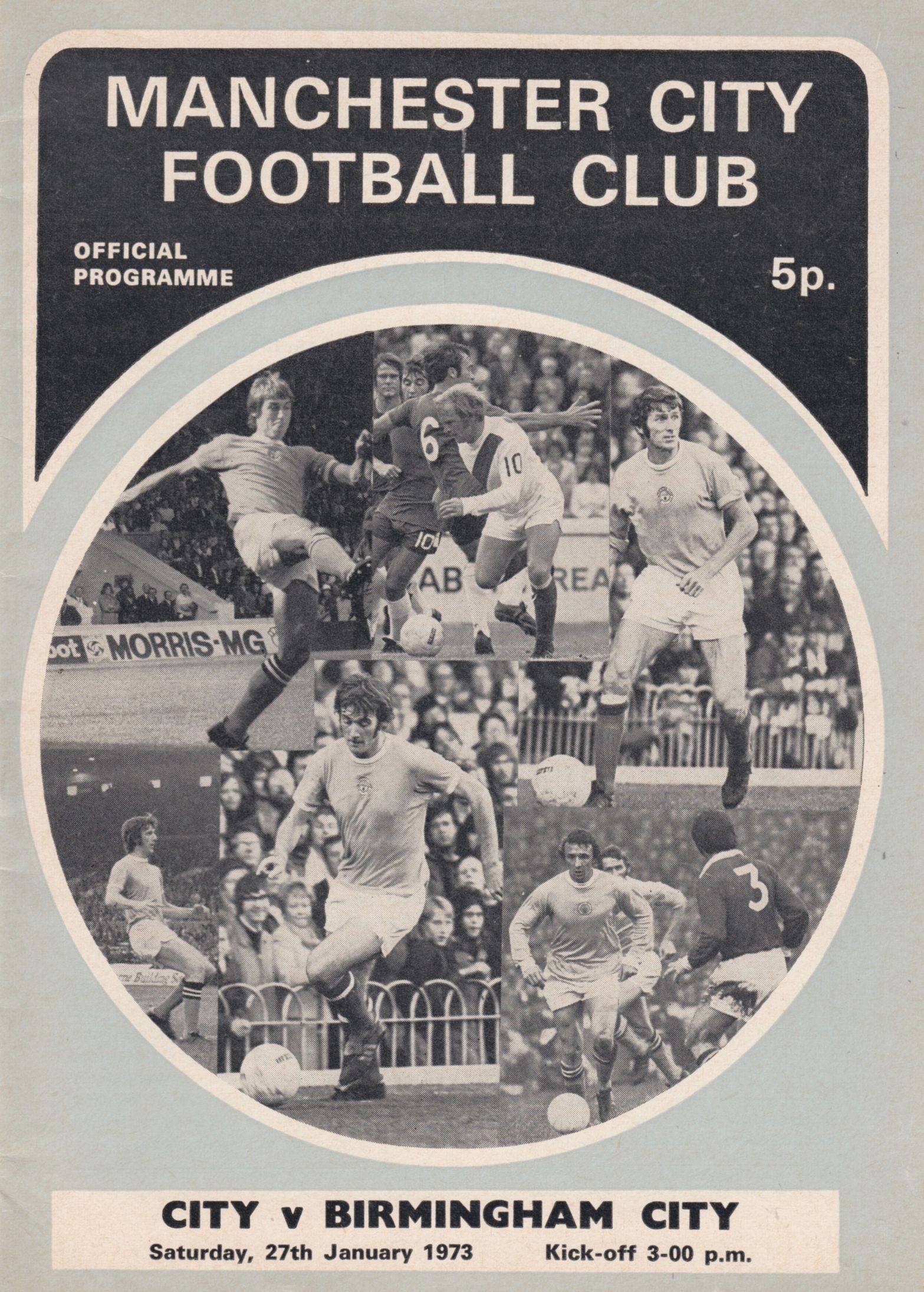
In July 1973 after becoming a legend with the Reds – please go and read everything you can about his career at Old Trafford – he was given a free transfer.  City manager Johnny Hart quickly made arrangements to sign the player, and on his second City debut he again scored (twice) as Birmingham were defeated 3-1.  Of the City side he joined in 1973 only Alan Oakes remained from his final City game in 1961, and the Blues were in an entirely different position.

The late sixties and early seventies had seen City achieve phenomenal success and eclipse Law’s United side, and so rather than join a poor, struggling side, law was now with a team of entertainers capable of tremendous success.  He had also joined a team renowned for its unpredictability!

Johnny Hart was replaced by disciplinarian Ron Saunders as manager, and the entire mood of the club changed.  Saunders seemed to be at odds with many of the club’s more senior professionals and his handling of the stars was often attacked.  For a while there were rumours of player power, especially when City started plummeting down the table.  Inevitably, Saunders was sacked and his replacement, Tony Book, managed to change the approach.  On the final day of the season, it was as a member of Book’s side that Law scored his final – and most memorable – League goal.

It was scored with his last kick in League football, and he often said it was the worst he had ever felt after scoring a goal. It wasn’t his last competitive goal in football or even for City – people often incorrectly claim it was but he played on into the 1974-75 season, scoring for City in a competitive game at the start of that season.

A page from Manchester A Football History by Gary James

City fans usually remember Denis Law more for that particular goal than for any other moment in his City career.  That goal was widely held responsible at the time of ‘sending Manchester United into the Second Division’.  In actual fact, the goal was irrelevant as United would have gone down in any case, but it has become a landmark goal and inevitably keeps the name of Law in the minds of Blues fans everywhere.  Law’s City career deserves to be remembered for much more.

Less than two months earlier he made his final appearance at Wembley as a member of City’s League Cup final team.  That game ended in a 2-1 defeat, but then it did take place during Ron Saunders’ period as manager.  Had the atmosphere of the club changed prior to Wembley then it’s possible Law’s illustrious career would have ended with a League Cup winners’ medal.

1974 League Cup final Tommy Booth, Francis Lee, Frank Munro, Denis Law.

Denis Law only managed three seasons with City in total, but in each of those seasons he did enough to make the headlines and become a member of City’s hall of fame.  During the mid 1970s The King’s Head pub at Crown Point, Denton became a shrine to football and its sign depicted “The King” Denis Law.  Although the nickname was awarded to him at Old Trafford, the pub sign depicted him in a City shirt – the team that first brought him to Manchester.  It should never be forgotten that Law is a hero to both Blues and Reds.  

Crowd Issues At Birmingham

On this day (27 November) in 1976 a goalless game at Birmingham caused Manchester City to drop to fifth place but, with only two defeats coming in the side’s opening 15 games (and conceding only one goal in 6 games), there was still a great deal of optimism about the place.  In fact consistency was perhaps the side’s greatest strength.

On the pitch there had been few changes with Corrigan (1), Donachie (3), Doyle (4), Watson (5), Royle (9), Hartford (10), and Tueart (11) being everpresents at this stage in the season in every competition – League, UEFA Cup, and League Cup.

Off the pitch, the mid 70s was a difficult one for supporter behaviour nationally.  Although the Blues took the lead with their great work with young fans and supporters clubs, nationally hooliganism was strong.  The 1975-76 season had seen British Rail cancel all soccer specials following a number of high profile acts of hooliganism, although City’s supporters’ club took a lead in keeping fans on the move during 1976-77 as they managed to keep rail specials for members of the City travel club going.  In fact they continued to run rail specials until the 1990s.

Supporter behaviour was a major issue and there was the first call, by the Daily Mail, to introduce ID cards for fans.  The previous season the supporters of Manchester United and Chelsea had rioted in an attempt to get games in which they were losing abandoned and so City’s great work with the Junior Blues and Supporters’ Club was trying to buck the trend.  Throughout the 1976-77 season the Blues devoted a two page feature (out of 24) each programme to a different supporters branch.

Sadly, there were still instances of trouble at City games and the Birmingham match was no exception.  Young supporter Ian Hodgkinson (aged 16) was particularly upset at the situation at St. Andrew’s:  “The City fans in the Tilton Road End were attacked by Birmingham supporters.  This caused the City fans to run to the entrance.  The Birmingham police then informed us that it was safe to return, but when we got back, the police vanished and once more we were attacked.  Two of my mates had their scarves stolen and were punched many times.”

Ian’s comments were typical of many that were sent to City and the local media, but sadly despite the strength of City’s relationship with supporters at this time, there was little being done elsewhere in football, other than caging fans in (something the Blues tried to avoid at Maine Road). 

Results

27 Nov 1976 Birmingham City (A) 0-0, Attendance 29,722

Subscribers can read a 2,100 word article on the entire 1976-77 season below – a season which saw City come close to League success. You can read this below. Enjoy!

Subscribe to get access – Monthly

Read more of this content when you subscribe today. It costs £3 per month (cancel anytime) to access everything posted since 1 October 2022 or there’s a special annual rate below which gives greater access and works out much cheaper.

Subscribe to get access – Annual

Read more of this content when you subscribe today. It costs £3 per month (above) or £20 a year (here) to access everything posted since the site was created in December 2020. This special rate works out about £1.67 a week and gives access to everything posted, including PDFs of 3 of my books.

If you’d like to know more about subscribing then see:

If you enjoy all the free material on my website and would like to support my research and keep this website going (but don’t want to subscribe) then why not make a one-time donation (or buy me a coffee). All support for my research is valued and welcome. It allows me to keep some free material available for all. Thanks.

Choose an amount

£2.50
£5.00
£7.50

Or enter a custom amount

£

Your contribution is appreciated.

Donate

The 1970s: A Rare Donachie Goal

Willie Donachie scored two first team goals for Manchester City and his first was captured on film on this day (27 January) in 1973. It was the only goal of City’s Maine Road victory over Birmingham. You can watch it here:

To date I’ve not managed to track down film of his second goal, which was scored in the 2-2 draw with Leeds on 1 March 1975. If you know of any film of that goal please let me know.

This series of articles and features on Manchester City in the 1970s has been running throughout January with indepth articles some days and smaller ‘on this day’ style posts on others. Every day in January will offer something to enjoy.

Subscribers will get access to everything. If you want to know more on this incredible decade for Manchester City Football Club then why not subscribe and read it all? You could even subscribe for a month and see what you think. The following 1,700 word article is on the 1972-73 season and is available to subscribers below. Enjoy!

Subscribe to get access – Monthly

Read more of this content when you subscribe today. It costs £3 per month (cancel anytime) to access everything posted since 1 October 2022 or there’s a special annual rate below which gives greater access and works out much cheaper.

Subscribe to get access – Annual

Read more of this content when you subscribe today. It costs £3 per month (above) or £20 a year (here) to access everything posted since the site was created in December 2020. This special rate works out about £1.67 a week and gives access to everything posted, including PDFs of 3 of my books.

If you’d like to know more about subscribing then see:

If you enjoy all the free material on my website and would like to support my research and keep this website going (but don’t want to subscribe) then why not make a one-time donation (or buy me a coffee). All support for my research is valued and welcome. It allows me to keep some free material available for all. Thanks.

Choose an amount

£2.50
£5.00
£7.50

Or enter a custom amount

£

Your contribution is appreciated.

Donate

The 1970s: Attendance Flashback to 1978

The series of features/articles covering Manchester City in the 1970s continues with this brief post about average attendances. We hear so much baloney these days about which clubs are giants and so on but the truth is that in terms of success no team has ALWAYS been at the top and in terms of support most clubs have had highs and lows. There are some clubs that generation after generation have been popular with fans and this cutting from the Manchester City match programme of 1977-78 may interest some.

I’m not going to point to any club or anything but look at the numbers and make your own minds up. Manchester City, incidentally, tended to be the 3rd best supported club (no matter where they finished) behind United and Liverpool throughout the mid to late 70s and early 1980s. They occasionally dropped to 4th depending on whether Everton or Spurs had a good season and even in City’s 1982-83 relegation season Manchester’s Blues were the 4th best supported club. Not bad for a failing club!

This series of articles and features on Manchester City in the 1970s will run throughout January with indepth articles some days and smaller ‘on this day’ style posts on others. There will be flashbacks to great games, players and more. Every day in January will offer something to enjoy.

Subscribers will get access to everything. If you want to know more on this incredible decade for Manchester City Football Club then why not subscribe and read it all? You could even subscribe for a month and see what you think. The following 5,200 word article is on the 1970-71 season and is available to subscribers below. Enjoy!

Subscribe to get access – Monthly

Read more of this content when you subscribe today. It costs £3 per month (cancel anytime) to access everything posted since 1 October 2022 or there’s a special annual rate below which gives greater access and works out much cheaper.

Subscribe to get access – Annual

Read more of this content when you subscribe today. It costs £3 per month (above) or £20 a year (here) to access everything posted since the site was created in December 2020. This special rate works out about £1.67 a week and gives access to everything posted, including PDFs of 3 of my books.

If you’d like to know more about subscribing then see:

If you enjoy all the free material on my website and would like to support my research and keep this website going (but don’t want to subscribe) then why not make a one-time donation (or buy me a coffee). All support for my research is valued and welcome. It allows me to keep some free material available for all. Thanks.

Choose an amount

£2.50
£5.00
£7.50

Or enter a custom amount

£

Your contribution is appreciated.

Donate

The 1970s: Denis Law Header

Here’s film of Denis Law scoring a header 50 years ago today (19 January 1974) for Manchester City at Birmingham City. Wearing red & black stripes City drew this game 1-1 but it’s worth seeing the goal for that kit and to recognise Law’s final season in League football.

If you enjoy all the free material on my website and would like to support my research and keep this website going (but don’t want to subscribe) then why not make a one-time donation (or buy me a coffee). All support for my research is valued and welcome. It allows me to keep some free material available for all. Thanks.

Choose an amount

£2.50
£5.00
£7.50

Or enter a custom amount

£

Your contribution is appreciated.

Donate

Billy Meredith’s Last Game: 1924 FA Cup Semi

On this day (29 March) in 1924 Manchester City faced Newcastle United in the FA Cup semi-final. Not only that but the game was to be the last competitive game played by City’s legendary winger Billy Meredith. Meredith’s Manchester career began in 1894 when he joined City.

Here for subscribers is the story of that game, plus a contemporary match report and film of Meredith’s last game. Enjoy!

Subscribe to get access – Annual

To read this and all content on this site please subscribe. It works out about £1.67 a month if you take out an annual subscription (£20 per year) or £3 a month if you’d like to sign up for a month at a time (see below). Annual subscribers get full access to everything posted since the site was set up in December 2020 and the hundreds scheduled to be posted during their subscription.

Subscribe to get access – Monthly

It costs £3 per month (or £20 a year – see above) to subscribe. Monthly subscribers get full access to everything posted since 1 October 2022 and everything posted during their subscription. They can also cancel any time. Why not try it for a month?