As part of their All-Manchester FA Cup features the Athletic have asked their writers about the most important FA Cup final. Well, as it’s a City-Utd final then it makes sense to highlight the first ever FA Cup final featuring one of the teams. In 1904 Manchester found its first major trophy success and that led to Manchester being established as a footballing city. It’s part of the reason Manchester City retained a special place in the hearts and minds of Mancunians, even when the success faded.
The captain and goalscorer was the great Billy Meredith. The other year, following the purchase of the oldest surviving FA Cup by Sheikh Mansour (to loan to the National Football Museum) I helped Manchester City with the story of the cup and its significance to Manchester. They’ve produced a video telling the story and it can be viewed here:
This weekend the 2023 FA Cup final at Wembley will be the first all-Manchester FA Cup final but it is not the first all-Manchester FA Final. That came in 1985-86 when the two Manchester clubs reached the FA Youth Cup final. In the build-up to Wembley this final will probably be overlooked but I wanted to make sure we do remember. Here’s a brief piece on the final.
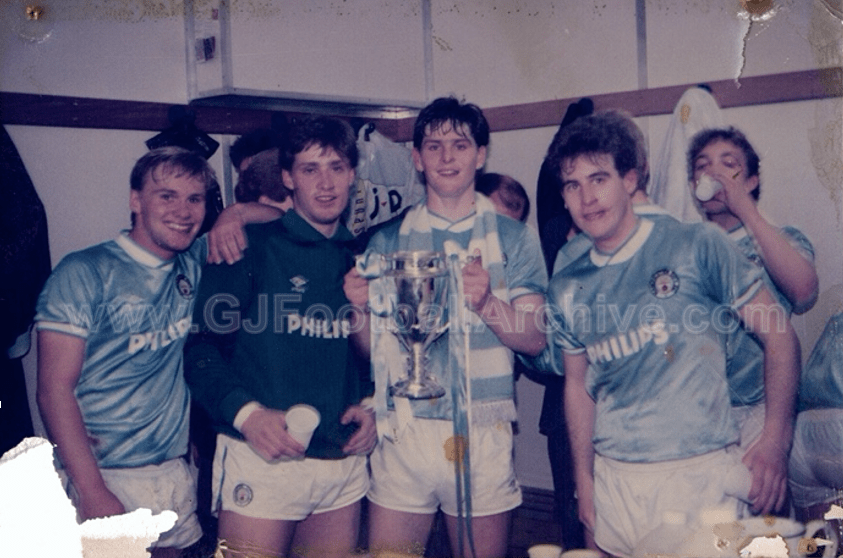
In April 1986 Manchester City’s youth team defeated Manchester United 3-1 on aggregate in the final of the FA Youth Cup. It was a tremendous achievement at the time, and one which proved that it was the Blues, rather than the Reds, who knew how to find and recruit young players – when Alex Ferguson arrived in Manchester later in 1986 he was dismayed that City tended to sweep up all the local talent and put things in place to change the situation. He even chatted to City’s chief scout Ken Barnes about the Blues’ strengths. More on Ken in a moment.
Of the 11 City boys who played in the 1986 final an amazing seven would also appear in the first team. Two of those would captain the Blues; two would play for England; and one would continue to play for the Blues into the late 1990s. For the record the City eleven plus subs were:
Steve Crompton, Steve Mills, Andy Hinchcliffe, Ian Brightwell, Steve Redmond (capt), Andy Thackeray, David White, Paul Moulden, Paul Lake, Ian Scott, David Boyd. Unused subs: Steve Macauley (1st leg) & John Bookbinder (2nd leg).
City’s Chief Scout at the time was 50s Cup winner Ken Barnes and years later I interviewed him about the success. He firmly believed that it was exceptional to find so many young star players at the same time: ‘We were dead lucky. I have to say that I don’t think it will ever happen again. I don’t recall any team having so many of the players coming through from the Youth team. It was only circumstances as such that they all got into the team at the same time. There was no alternative – the club had no money. No money to buy new players – so the young lads were thrown in at the deep end. Maybe if we had had a good team at the time 3 or 4 of them wouldn’t have got into the team and, who knows what would have happened to them. It enlightened me the year they won the Youth Cup. They went throughout the whole season in the Lancashire League and lost only one game.
‘That was a remarkable youth side. In the past we had boys like Tommy Caton, Ray Ranson, Nicky Reid, John Beresford and Darren Beckford but we never had a team like the 1986 one. Most of the youngsters played for our nursery team Midas… Nearly all those who have made it into the first team played with them from the time they were 11 or 12.’
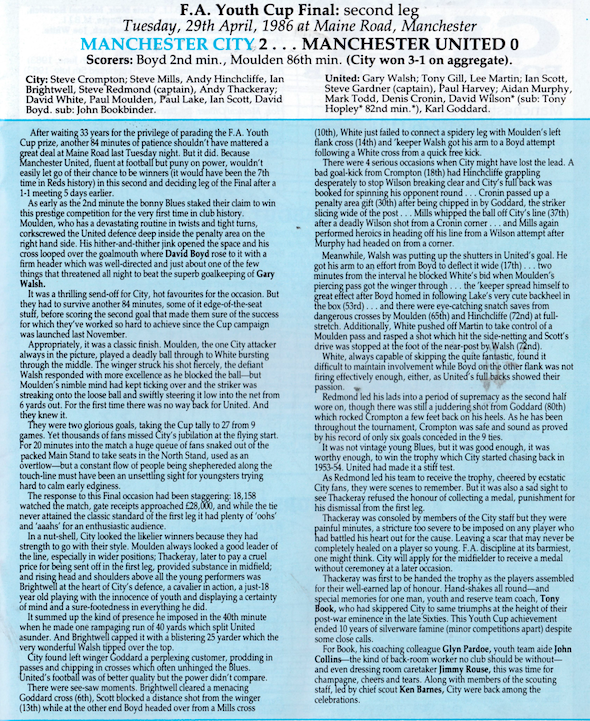
Here is the City first team match programme commenting on the success:
1986 YOUTH CUP STATISTICS
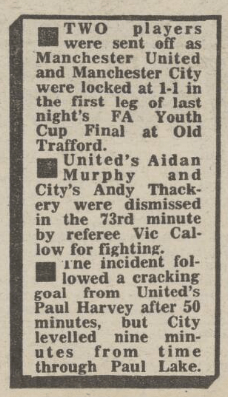
Old Trafford, 24 April 1986 Manchester United – Manchester City 1–1 (0–0) 1-0 49 min. Aidan Murphy 1-1 82 min. Paul Lake (penalty) Attendance: 7,602
Manchester United: Gary Walsh, Tony Gill, Lee Martin, Ian Scott, Steve Gardner (capt), Jon Bottomley, Aidan Murphy (red card, 69 min), Mark Todd, Dennis Cronin, David Wilson (replaced by Tony Hopley), Paul Harvey. Manager Eric Harrison.
Manchester City: Steve Crompton, Steve Mills, Andy Hinchcliffe, Ian Brightwell, Steve Redmond (capt), Andy Thackeray (red card, 69), David White, Paul Moulden, Paul Lake, Ian Scott, David Boyd. Unused sub: Steve Macauley. Manager: Tony Book
Second leg
Maine Road, 29 April 1986 Manchester City – Manchester United 2–0 (1–0) 1-0 02 min. David Boyd 2-0 86 min. Paul Moulden Attendance: 18,158
Manchester City: Steve Crompton, Steve Mills, Andy Hinchcliffe, Ian Brightwell, Steve Redmond (capt), Andy Thackeray, David White, Paul Moulden, Paul Lake, Ian Scott, David Boyd. Unused sub: John Bookbinder. Manager: Tony Book
Manchester United: Gary Walsh, Tony Gill, Lee Martin, Ian Scott, Steve Gardner (capt), Paul Harvey, Aidan Murphy, Mark Todd, Dennis Cronin, Jon Bottomley (replaced by Tony Hopley), Karl Goddard. Manager Eric Harrison.
If you enjoy all the free material on my website and would like to support my research and keep this website going (but don’t want to subscribe) then why not make a one-time donation (or buy me a coffee). All support for my research is valued and welcome. It allows me to keep some free material available for all. Thanks.
My latest article on football for Manchester Confidential is now live. It’s about the All-Manchester FA Cup final. It also asks a simple trivia question: can you name all the previous Greater Manchester FA Cup finals? For the answer to that and the article see:
Well, the Premier League is now over for another year and we know who the Champions are and who has qualified for Europe etc. so it’s time to look forward to the first ever all Manchester FA Cup final. There have been FA Cup finals between two teams from present day Greater Manchester before (the first one being City v Bolton in 1904) but this is the first to involve both Manchester clubs.
Prior to this year’s final, the closest Manchester City and Manchester United have got to playing each other in a Wembley FA Cup final were the FA Cup semi finals in 1926 and 2011. I wasn’t around in 1926 but I definitely was in 2011! So a couple of years ago I made this special audio recording talking about the years building up to the semi and the day itself from a Manchester City perspective. Many of you have listened to this already but if you haven’t then it tells the story of the 2011 FA Cup semi final and the years between 1976 and that moment in 2011 for City.
I include audio from interviews I did with a variety of people including Khaldoon, Peter Swales, Garry Cook, Brain Marwood and many others.
If you have heard it before then maybe you should listen again to remind yourself of how we all felt and why that game was so significant.
I include a few words from Roberto Mancini recorded in 2011 and at one point he talks about the view that was then being expressed that City were ‘trying’ to buy success (now they say City ‘have’ bought success!). His words are a reminder that City have been having that particular criticism thrown at them for over a decade! Oh well, I wonder how long those criticisms were laid at other clubs who had seen major investment which propelled them forward?
Anyway, get yourself a brew and be prepared to be transported back in time. Here’s the recording:
If you enjoy the recording then please let me know, comment or subscribe to the site. If you don’t fancy doing that then there’s also the option to make a welcome donation to keep this site going (see below). I’ve produced videos/talks like this highlighting key points in Manchester City’s footballing history which subscribers can watch too.
If you enjoy all the free material on my website and would like to support my research and keep this website going (but don’t want to subscribe) then why not make a one-time donation (or buy me a coffee). All support for my research is valued and welcome. It allows me to keep some free material available for all. Thanks.
Read more of this content when you subscribe today. It costs £20 a year to subscribe (it works out £1.67 a month) or £3 if you’d like to sign up a month at a time. Annual subscribers get full access for as long as you subscribe (you can always try it for a month). It’s worth bearing in mind that the 2010 Manchester A Football History cost £24.95 and all subscribers will be able to access all of that for as long as they are a subscriber (plus all the other stuff of course).
It costs £3 a month to subscribe a month at a time. Why not give it a try! Monthly subscribers get access to everything posted since 1 October 2022 for as long as you subscribe.
Day 8 of my posts counting down to the centenary of Maine Road’s opening game. Today here’s an image of the Maine Road forecourt in the 1980s. So much to say on this. Notice the Granada TV vehicle and the newspaper adverts hung up for the Sunday Mirror and News of the World. There’s also the advert above the main entrance ‘cage’ – that was covering up the original central mosaic which I wish they’d been able to keep visible but an air conditioning unit was smashed through this at some point. So much for preserving the club’s history back then, hey?
The forecourt looked much the same as this from its opening through to later in the 80s, although there had already been a pebble dash render placed on the lower part of the main stand frontage. Later the decade more render would be place on sections of the front and then in the 1990s the whole stand was clad in metal.
There’s one of the floodlights (second set) showing and this is obviously pre-match as fans are mostly heading to the stands. Also, post match for many games in the 80s the forecourt would have housed a demo!
Those cars are heading towards the directors car park, past the stand, on the left.
This image was from a 1981 Manchester derby.
1981 City v United Maine Road
If you’d like to read more on the history of Maine Road, take a look at Farewell To Maine Road, which can be downloaded from this page:
To help those unfamiliar with Maine Road locate the specific location, the Main Stand is number 1 on this plan and its frontage faced Maine Road, the street running above the stand.
Maine Road aerial 1971 from Farewell To Maine Road
If you enjoy all the free material on my website and would like to support my research and keep this website going (but don’t want to subscribe) then why not make a one-time donation (or buy me a coffee). All support for my research is valued and welcome. It allows me to keep some free material available for all. Thanks.
Today (17 May) in 1892 at the Queens Hotel in Sunderland the Football League accepted two aspiring Manchester clubs into its competitions. Newton Heath applied and were accepted into the First Division and Ardwick applied and were accepted into the new Second Division of the League. Ardwick did not apply to join the top flight and it is believed the two Manchester clubs had an agreement not to go up against each other as in other votes two clubs from the same city had occasionally taken votes from each other. Had they gone head to head it may well have been that either one or no Manchester club would have gained admittance to the League.
City’s penultimate match of the season turned out to be one of the most controversial derby matches of all time. Both clubs were languishing at the foot of the table, and a derby victory would more or less guarantee the victor’s survival.
Subscribe to get access
Read more of this content when you subscribe today.
On this day (9 May) in 1898 the first ever Newton Heath and Salford match programme was produced however all is not what it seems. This was actually a mock up of what a Manchester football programme could look like and was used to officially register the new publication. Everything in this issue was mocked up based on an Everton-Liverpool style programme. The company behind the Manchester programme was Merseyside based.
From 9 May 1898 the first Manchester football programme was a mock up based on Everton Liverpool programme
When the programme properly began the following football season it carried the details of not only Newton Heath and Salford but also Broughton Rangers and Manchester City.
One interesting image the original mock up contained was this scene from an Everton Liverpool game which it described as the finest picture of football ever published (hyperbole, hey?).
From 9 May 1898 the first Manchester football programme was a mock up based on Everton Liverpool programme
On this day (27 April) in 1974 Manchester United hosted Manchester City at Old Trafford for a high profile derby match. A lot has been said about the game over the years with lots of myths and twisting of stories but if you want to know the true story of the day take a look at this:
A few months back I started writing a series of articles on football in the Manchester region for the Manchester Confidential website. If you’ve missed the and are interested here are links to them: