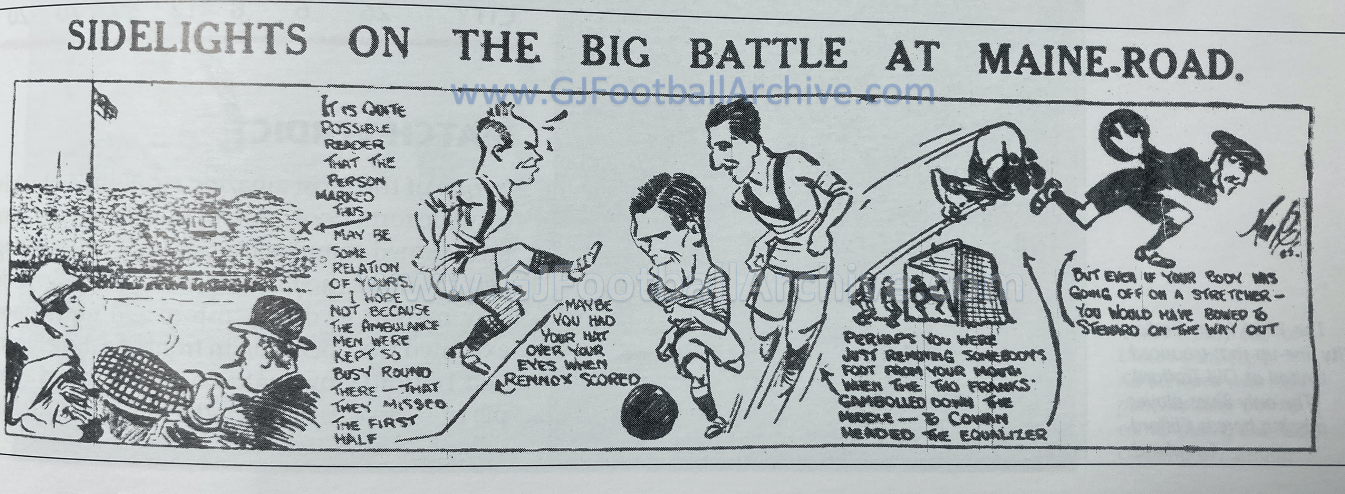
Manchester City dominated the Manchester derby played on this day (19 September) in 1959. That day the Blues defeated the Reds 3-0 with an outstanding performance from Joe Hayes. Enjoy the match report here:
If you have enjoyed this then why not subscribe to the site to see all the other great content or make a donation to keep the site afloat. See below for details.
If you enjoy all the free material on my website and would like to support my research and keep this website going (but don’t want to subscribe) then why not make a one-time donation (or buy me a coffee). All support for my research is valued and welcome. It allows me to keep some free material available for all. Thanks.
On this day (17 September) in 1910 Old Trafford staged its first Manchester derby and City were even awarded a penalty there too! The penalty was saved and the game ended in a 2-1 United win in front of a crowd estimated to be about 60,000. Here’s a brief match report from that day. Note also the preview for City’s next game at Hyde Road:
Manchester City’s Maine Road stadium was opened 100 years ago last month and today (12 September) marks the anniversary of the stadium’s first competitive Manchester derby BUT it’s not the centenary of that game as United were a second tier club when City moved to their old stadium. In fact it wasn’t until the stadium’s third season that United and City met competitively at Maine Road.
You can read about that first Maine Road meeting as part of my Maine Road 100 series of free articles. This one was posted on Day 35 here:
One Manchester club seems to be getting everything right, winning League titles, European trophies and so on while the other appears to be in self-destruct mode with demonstrations against the owner and all sorts of worrying stories appearing in the media. Sound familiar? This was actually the situation on this day (11 September) in 1993 when Manchester City (not United) were the team in crisis and United (not City) were the team winning Leagues and European trophies.
This cutting is from 11 September 1993 and highlights the proposed takeover by Francis Lee of the Blues. Peter Swales had been City’s chairman for twenty years during which he’d taken the club from being a major, profitable power to one that was heavily in debt – debt that was hampering the club’s development – with a stadium that was being downgraded almost every day via a lack of serious investment. Across at United the club appeared relatively stable with a stadium that was being invested in. They also had one of the game’s most talented and successful managers while City had gone through a series of managers in the previous few years. City were a relatively stable top flight team though by 1993. Brian Horton was now City’s boss and he seemed to offer a positive style of football but the wider problems of the club were never far away. All sound familiar still?
I do find it amazing that City and United seem to have swapped roles so emphatically since 1993 in terms of how the clubs are managed, invested in, stadium developments and so on.
For those unaware of what happened to City or those who perhaps support United and are looking to see what happened and whether history will repeat here’s a brief overview: United dominated football for most of the 1990s & 2000s while City’s Lee takeover was successful. Lee, however, was unable to revive City’s fortunes and build on the fifth place finished that had occurred in 1991 and 1992. Although much of the financial infrastructure of City was improved following the takeover, the dismissal of Horton as manager and a poor appointment in Alan Ball led to relegation. Further issues followed as star players left, managers were sacked or left and the Blues ended up in the 3rd tier (for one season – too many believe City were a 3rd tier club who eventually got lucky but they were a top 6 team who fell apart!).
Could history repeat itself with the roles reversed? Unlikely United will ever fall as low as City but it is worth noting that City never expected to fall that low. Also, removing Swales from power was something that fans had been wanting for decades. It only became a possibility when a former hero announced he could take over the club BUT even then the hopes and ambition of all Blues could not be met.
My latest article on football for Manchester Confidential is now live. It’s about the campaign to erect a plaque to the Manchester Corinthians. You can read it here:
On this day (27 August) in 1960 the only Manchester Derby to be abandoned (and the game replayed) took place. It was abandoned at 2-2 with heavy rain at Maine Road.
Strictly speaking another derby (the one at Old Trafford in 1974) was also abandoned but the result for that game was allowed to stand.
27 August 1960 (date on image is incorrect). The abandoned Manchester derby.
It’s Day 95 of my Maine Road 100 countdown (not long to go now!) to the centenary of Maine Road’s first game. Earlier I asked the question: Of all the brilliant players who graced Maine Road over the decades who do you think was the one who scored most goals at the old stadium? Answer later today. Watch this space about 9pm UK time!
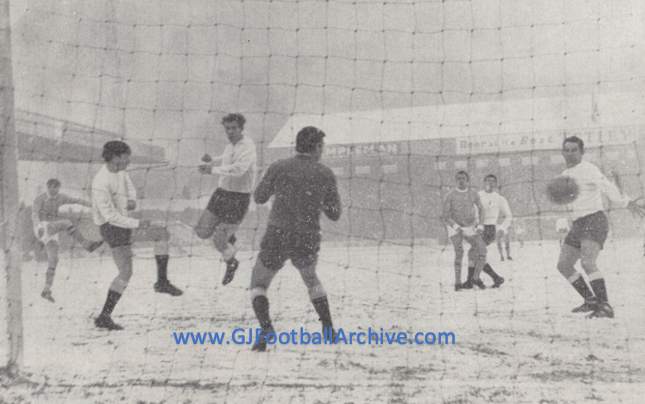
Well, the answer is Colin Bell. Colin scored 107 first team goals at Maine Road with Eric Brook next on 106 first team goals. The main image is Colin scoring v Spurs in December 1967.
I bet there are a few fans out there who saw every one of Colin’s 107 first team Maine Road goals. Feel free to leave comments on the great City star below. Also, why not check out the other articles that mention Colin such as this on his debut for Bury:
Roberto Mancini has left his role as Italy’s men’s football manager. Hopefully, he’ll be back in club management soon and maybe in the Premier League too. His contribution to Manchester City’s history is huge and so I think it’s worth reposting this audio special I did a couple of years ago. It’s a special audio recording talking about the years building up to the 2011 FA Cup success brought to City by Mancini. It includes some audio I did with him back in 2011 too. Enjoy this reminder of a time when Mancini helped transform City’s fortunes.
Restored 2011: The All-Manchester FA Cup Semi Final is a special 1 hour audio recording looks at the game and the years between the 1976 League Cup success and the FA Cup glory of 2011. The 2011 semi-final was a crucial step in City’s journey since the 2008 takeover and I felt it was vital to do a special marking this.
So what’s in this special recording? Well, I’ve included exclusive material from interviews and recordings I’ve done over the years with Garry Cook, Brian Marwood, Roberto Mancini, Peter Barnes and Peter Swales. Why Swales? Well, have a listen and you’ll hear why. Basically though I’m trying to set the tone for why the 2011 FA Cup semi final victory and overcoming Manchester United was so significant.
On Mancini… I include a few words from him recorded in 2011 and at one point he talks about the view that was then being expressed that City were ‘trying’ to buy success (now they say City ‘have’ bought success!). His words are a reminder that City have been having that particular criticism thrown at them for over a decade! Oh well, I wonder how long those criticisms were laid at other clubs who had seen major investment which propelled them forward?
Anyway, get yourself a brew and be prepared to be transported back in time. Here’s the recording:
If you enjoy the recording then please let me know, comment or subscribe to the site. I’ve produced videos/talks like this highlighting key points in Manchester City’s footballing history which subscribers can watch.
Subscribe to get access – Annual
Read more of this content when you subscribe today. It costs £20 a year to subscribe (it works out £1.67 a month) or £3 if you’d like to sign up a month at a time. Annual subscribers get full access for as long as you subscribe (you can always try it for a month). It’s worth bearing in mind that the 2010 Manchester A Football History cost £24.95 and all subscribers will be able to access all of that for as long as they are a subscriber (plus all the other stuff of course).
It costs £3 a month to subscribe a month at a time. Why not give it a try! Monthly subscribers get access to everything posted since 1 October 2022 for as long as you subscribe.
If you enjoy all the free material on my website and would like to support my research and keep this website going (but don’t want to subscribe) then why not make a one-time donation (or buy me a coffee). All support for my research is valued and welcome. It allows me to keep some free material available for all. Thanks.
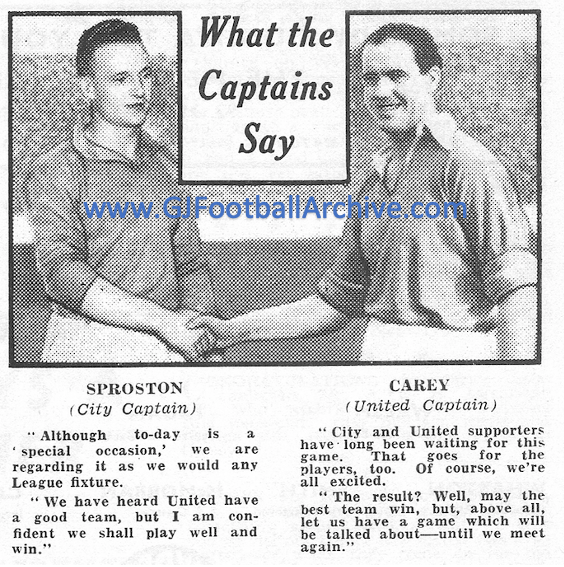
It’s post 82 of my 100 Maine Road countdown and today a reminder of the largest ever Manchester derby crowd for a game at City or United. On 20 September 1947 a crowd of approximately 78,000 witnessed the first post-war Manchester derby. A tense match ended goalless before the derby’s record crowd on a club ground. This attendance remained the highest for a Manchester derby until the 2011 FA Cup semi-final at Wembley Stadium. The return fixture, also played at Maine Road, was watched by 71,690.
Subscribers can read the story of the 1947 game (background, match report, statistics etc.) below:
Subscribe to get access – Annual
You can read this detailed article when you subscriber (plus all other material on the site). It costs £20 a year (£1.67 per month) to subscribe or you can subscribe a month at a time (see below).
You can read this detailed article when you subscribe (plus all other material on the site). It costs £20 a year (above) to subscribe annually or you can subscribe a month at a time for £3 per month (cancel anytime; monthly subscribers get access to everything posted since 1 October 2022).
For post 73 of my Maine Rd 100 countdown I’ve posted this great newspaper cutting from a significant Manchester derby. The game was on 29th January in 1955 and goals from Joe Hayes and Don Revie gave Manchester City a 2-0 victory over Manchester United in the FAC in front of 74,723. I’ve posted it partly because of the game’s significance but mostly because I just love the way newspapers would try to explain everything via images and text like this.
If you’d like to know the story of the game and see some great footage of it too then please subscribe (see below).
Subscribe to get access – Monthly
If you take out a monthly subscription (£3 a month) you get access to everything posted since 1 October 2022 and can cancel anytime). if you’d like to sign up for a month at a time.
If you would like to read this and the blog’s other in-depth, longer articles (including the entire Manchester A Football History book) then please subscribe below. It works out about £1.67 a month if you take out an annual subscription (£20 per year) or £3 a month if you’d like to sign up for a month at a time. Annual subscribers get full access to the 1000+ articles posted so far and the hundreds scheduled to be posted in the coming weeks.