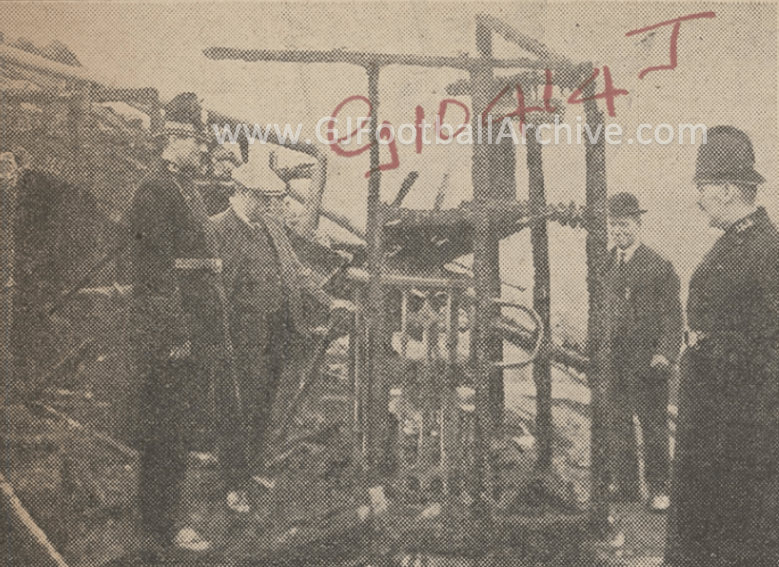
Only a few months after the King had visited Manchester City suffered a major blow when their Main Stand was destroyed by fire (6 November) 1920. Subscribers can read the story of this below (including the story of how City asked United if they could use Old Trafford temporarily which resulted in significant criticism of the Reds in national newspapers) but here’s a rare image that hasn’t been published in any Manchester City publication over the last century or so. It did appear in a contemporary newspaper. Notice the Ellison’s Rush Preventive turnstile that seems to have just about survived.
When City moved to Maine Road quite a few of these turnstiles were taken from Hyde Road and re-erected at Maine Road. In 2003 6 Ellisons turnstiles from the 1890s were still in place and in use during Maine Road’s final season.
In the years that followed the Hyde Rd fire there was a story that developed that the fire was the result of a Irish republican terrorist attack and that both Hyde Rd and Old Trafford were targets. The Old Trafford planned attack was foiled and has been written about in contemporary sources but Hyde Rd’s story cam much later. It doesn’t seem to be the case that the Hyde Rd fire was the result of terrorist activity – if there’s interest then maybe I’ll write the latest research on this in the coming months?
Subscribe to get access: Monthly
Read more of this content when you subscribe today. It costs £3 per month (cancel anytime) and monthly subscribers get access to everything posted since 1 October 2022 and throughout their subscription. Why not try for a month? There’s a special annual subscription for a discounted price and greater access (see below).
Read more of this content when you subscribe today. It costs £20 per year (about £1.67) for this special, discounted annual rate. Annual subscribers get access to everything posted since December 2020 and throughout their subscription.
Today (3 November) is the anniversary of the first ever Manchester derby played in the Football League. The match between Manchester City and Newton Heath was played at City’s Hyde Road ground today in 1894. You can read the story of the game (with all the stats, background etc.) here:
I’m sure some will believe this didn’t happen but on this day (31 October) in 1930 the previous night’s meeting of the so-called Boycotting Committee of the Manchester United Supporters Club met to discuss their next boycott of a first team game. There was widespread dissatisfaction of the plight of the Reds that season and the season would end with United’s Old Trafford average being 11,685 (the lowest average for either United/Newton Heath or City since Newton Heath averaged 4,650 in 1902). Neither side has attracted a lower average since.
What’s significant about this brief article is the mention of the planned boycott v Arsenal – that game attracted the highest crowd of the season to date! This demonstrates how difficult it is to plan a protest and for all fans to join in.
I explored the boycott and fan related issues in Manchester A Football History (my 2008/2010 update) book. This has been out of print for over a decade but PDFs of every chapter are free to download for all who subscribe. See the following for details of how to subscribe:
If you enjoy all the free material on my website and would like to support my research and keep this website going (but don’t want to subscribe) then why not make a one-time donation (or buy me a coffee). All support for my research is valued and welcome. It allows me to keep some free material available for all. Thanks.
Today (26 October) is the anniversary of the first ever Manchester Derby shown live on television. The game was the 109th League derby between the teams and ended in a 1-1 draw (Frank Stapleton for United; Mick McCarthy for City). Subscribers can read a feature on the game, including a match report and background, below:
Subscribe to get access – Monthly
Read more of this content when you subscribe today. It costs £3 per month (cancel anytime) or there’s a special £20 Annual subscription (see below).
Read more of this content when you subscribe today. It costs £20 per year (works £1.67) or £3 per month (above). Annual subscribers get access to everything posted since the site started in December 2020, including the entire contents of 3 books and well over 1000 articles/interviews/features. Do a search to see what’s on the site or sign up for a month to see the benefits.
There have been many wonderful tributes and there are definitely people who can talk better than I can about the great Bobby Charlton. However, I do want to mark this sad time with a brief story about him which I think shows the character of the man. It’s a personal story from 30 years ago.
Back in November 1993 we were preparing for the book launch of my biography of Joe Mercer, which was to take place at the start of December. As well as those that had been interviewed for the book, such as Colin Bell, Tom Finney, Francis Lee etc. Norah Mercer asked me if she could invite a few others. Obviously she could but I didn’t know who she was inviting. I just left it to her.
About a week before the launch I received a phone call at home. I answered it and the voice on the other end said: ‘Hello Gary. It’s Bobby Charlton here. I’ve just spoken with Norah Mercer and told her I can’t make it to your book launch because I’ll be in Kuala Lumpur. She said I should let you know. Sorry I can’t make it. Is that okay? I really am sorry and would be there if I could.’
I was absolutely stunned. Bobby really didn’t need to phone either of us but he certainly didn’t need to call me. He was so polite and apologetic too. It was appreciated and added to the high esteem that I already held him in.
Often it’s the simplest of things that make the biggest impression. There were several people who had been invited who didn’t come to the launch and hadn’t let us know – I don’t expect everyone to be interested or to call – so when Bobby took the time and trouble to phone us both it really was something I treasured (and still do).
I did meet him a few times in the years that followed but it’s the 1993 phone call that remains my strongest non-footballing memory of Bobby.
Without doubt Bobby was a wonderful England international and a major global footballing figure. He was also a wonderful ambassador for Manchester (the reason he was going to Kuala Lumpur too) but most significantly he was a humble, nice man.
On this day (20 October 1934) King Charles III’s grandad attended Maine Road to watch Manchester City face Derby County in the League. It wasn’t the first time a senior member of the royal family attended a City home game, nor was it the last time a future monarch or monarch attended Manchester City’s home. You can read about those visits here:
Subscribe to get access – Monthly
Read this 1,600 word article when you subscribe today. It costs £3 per month (cancel any time) or £20 a year. As well as this article you get to access books, videos, history talks, interviews and other articles.
Annual subscribers access everything since the site went live in December 2020. Monthly subscribers get everything since 1 October 2022. All subscribers access new posts throughout their subscription.
It was a highly memorable day for Manchester City fans as Pep Guardiola’s Blues defeated Manchester United 6-3 before 53,475 on this day (2 October) in 2022. You can watch highlights here:
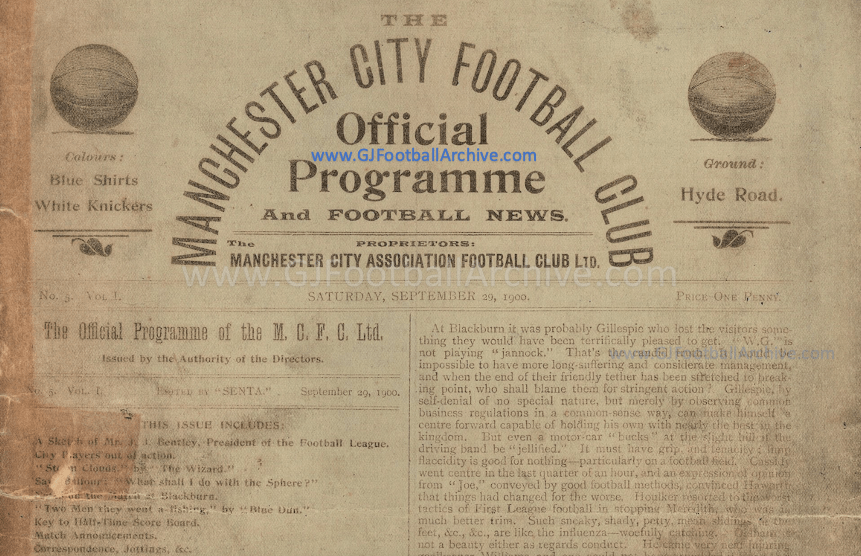
Recently I’ve been contacted by someone who had in their possession a couple of Manchester City match programmes from 123 years ago. These were from the first season the club did its own official match programme (there was an earlier joint effort between 2 rugby and 2 football clubs that was described as official from the 1890s – see below – but 1900-01 was the first for MCFC on their own). He sent me scans of them and one programme was produced for a match played on this day (29 September) in 1900. Here are some images and details from it.
This was a special game for City, though the programme was not produced because it was a special game. This was the fifth issue of the season and contained eight pages, like the others. The significance of the game however was that Arthur Balfour MP was a visitor that day. Balfour would become Prime Minister in 1902 and was still in that role when City won the FA Cup for the first time in 1904 (he wore a City rosette at the final!).
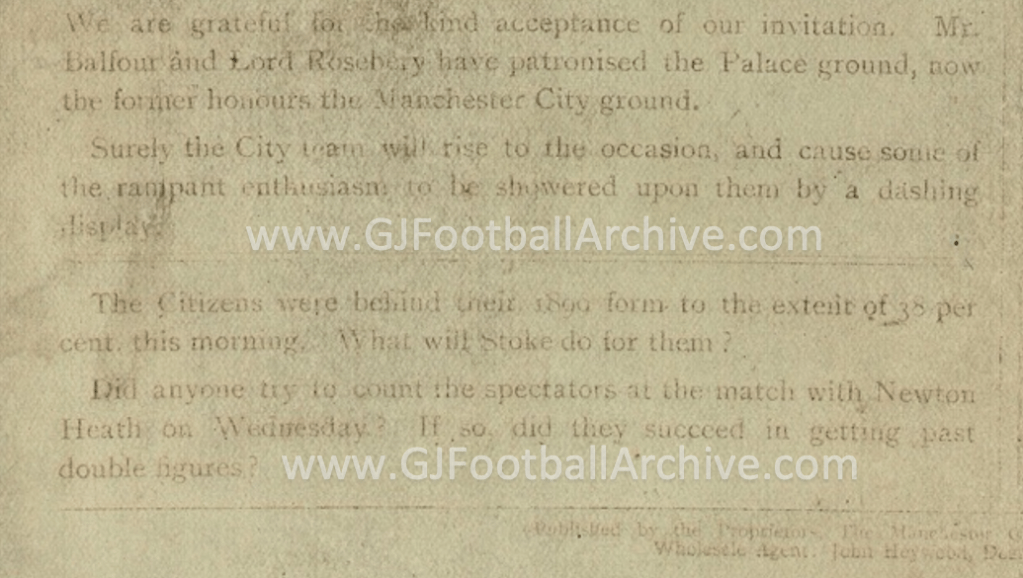
The back page talks about Balfour’s visit. Both the front and the back pages are quite difficult to read as they’ve faded. It is interesting that the club felt able to make light of Balfour’s lack of enthusiasm for ‘socker’ (yes, socker or soccer as we grew to call it, was an English word for association football before the Americans became recognised for their use of it). Balfour preferred golf (after the 1904 FA Cup final he called himself a football ‘ignoramous’. Bob Hulmes, who sent the programme scans to me, managed to transcribe the wording regarding Balfour:
Says Balfour: “What shall I do with the sphere?”
We have specially desired fine weather today as the Right Hon. Arthur James Balfour is due to make his first appearance on the Hyde Road Football enclosure this afternoon. Some little decoration will be made, for the most pleasing sight to the hon. gentleman will be a mighty crowd of enthusiastic well wishers. It is not often that we have a leader of the nation at such functions, and the occasion is historic as far as Manchester is concerned. No doubt our honoured guest wishes he had the opportunity to open a game of golf instead of socker but we are ready to excuse a “miskick” on this occasion. We are grateful for kind acceptance of our invitation. Mr Balfour and Lord Rosebery have patronised the Palace ground, now the former honours the Manchester City ground.
Surely the City Team will rise to the occasion and cause some of the rampant enthusiasm to be showered upon them by a dashing display.
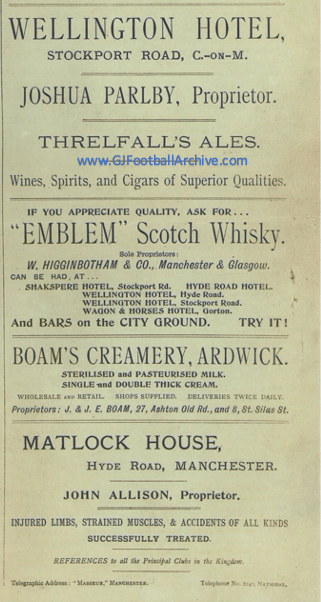
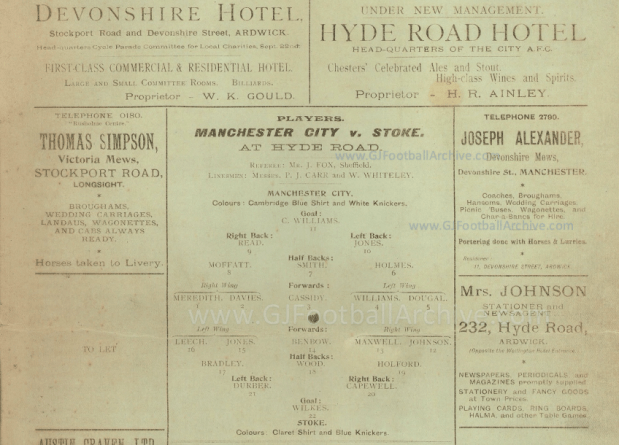
It’s worth noting some of the advertisements. There’s one for Joseph Alexander’s coaches and carriages (the Alexander family business. Note: The Alexanders remained key members of City’s management/directorship/shareholding for most of the 120 years that followed!). There’s also the Wellington Hotel, Stockport Road, which was run by the ever popular City official Joshua Parlby, and the Matlock House Hydro – one of City director John Allison’s business.
The game was against Stoke and they are wearing their then home colours of ‘claret shirts and blue knickers’.
Bob also nudged me towards page 8 which included a wry comment about the previous Wednesday’s friendly at Newton Heath (United):
Did anyone try to count the spectators at the match with Newton Heath on Wednesday? If so, did they succeed in getting past double figures?
The official attendance was estimated by Newton Heath as 600 (I wonder if they had a mickey-take name along the lines of Emptyhad for United’s games at Bank Street?
Before the 1900-01 season there was an official match programme produced for both Newton Heath and Manchester City, alongside a couple of rugby clubs. It was first ‘mocked up’ in May 1898 but went into production for the 1898-1899 season. It continued into the 1900-01 season by which time City were producing their own official programme. Both programmes were in competition throughout that 1900-01 season.
From 9 May 1898 the first Manchester football programme was a mock up based on Everton Liverpool programme
Thanks to Bob Hulmes for allowing me to us images of his match programme. The programme belonged to Bob’s grandfather. He lived in Ardwick, near Hyde Road, and he followed City until his death in 1964. Bob found two programmes from 1900 lining a drawer when his grandfather died in 1964, which shows exactly how rare these images are. It’s a pure fluke in many ways that they survived and fortunately the family looked after them over the decades.
Here’s a video of my latest interview with Dennis Tueart. In this we focus on him leaving Manchester City for the NASL and New York Cosmos; his experiences there and his return to City. Dennis is always a great talker and there are some wonderful moments in this as he talks about this significant time in the changing Manchester City and in the excitement of New York soccer.
The conversation links Tony Book, Leonard Rossiter, Pele, Carlos Alberto, John Cleese, Dave Sexton, Malcolm Allison and Franz Beckenbauer amongst others.
It lasts about 50 minutes so get your self a brew and sit down to watch:
Dennis’s biography is still available (see link below).
If you have enjoyed this interview then why not subscribe to access other interviews in the archive, plus over 1000 articles/features. See below for details.
If you enjoy all the free material on my website and would like to support my research and keep this website going (but don’t want to subscribe) then why not make a one-time donation (or buy me a coffee). All support for my research is valued and welcome. It allows me to keep some free material available for all. Thanks.
This brief comment says everything you need to know about the 23 September 1989 Manchester derby. This was how the New York Post reported on Manchester City’s bargain basement Blues defeated United’s expensive Reds.
Subscribers can read about the 1989-90 season here: