The first part of Manchester City chairman Khaldoon Al Mubarak’s annual message to fans has been posted:
https://www.mancity.com/citytv/mens/chairman-2023-annual-interview-part-one-63822759
Football writing, thoughts and more by Gary James
The first part of Manchester City chairman Khaldoon Al Mubarak’s annual message to fans has been posted:
https://www.mancity.com/citytv/mens/chairman-2023-annual-interview-part-one-63822759
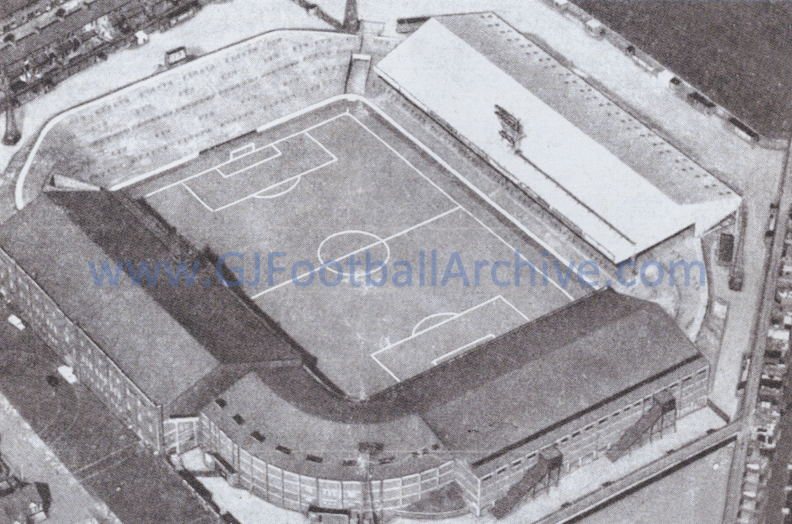
It’s day 33 of my posts counting down to the centenary of Maine Road’s opening game. Today – Notice anything odd about this image? Look at the Main Stand roof….
This photo was taken shortly after World War Two at a time when the adverts and notices on the Main Stand roof had been blacked out to avoid being picked up by enemy bombers during the war.
We all know about Old Trafford being bombed and while the Maine Road stadium did not suffer major damage houses on Thornton Road and other streets around the ground were bombed during the war.
The semi-circular gable on the roof of the stand carried adverts for much of its existence, though initial plans had been to have the club’s name proudly displayed there. I’ve yet to find an image showing any MCFC wording painted on to it but I do believe it did have this early in the stadium’s life, before adverts took over.
This photo shows the gable from the back/air:

This 1971 view shows the second Main Stand roof (actually just the middle section was replaced) and the original gable would have appeared where number 1 is.

If you’d like to read more on the history of Maine Road, take a look at Farewell To Maine Road, which can be downloaded from this page:
Choose an amount
Or enter a custom amount
Your contribution is appreciated.
DonateIt’s day 32 of my posts counting down to the centenary of Maine Road’s opening game. Today – A behind the Kippax image from 1993. This photo has so much going on despite it looking fairly bland. I’ll explain:
When the Kippax was roofed in 1957 the original terracing had to be squared off and so, instead of reducing the terracing City decided to extend it where its started to curve. You can see in this image that the end of the stand is on stilts/stanchions over the original banking where it was extended.
At the time the stand was enlarged in 1957 local residents objected to it. Some claimed they’d lost TV signal and were no longer able to get Granada TV which had started broadcasting in May 1956.
When this photo was taken in 1993 that area was for away fans and if you look carefully you can see the segregation fence to the left of the tunnel and going up the banking.
The tunnel and steps in the foreground of the photo are the original 1923 construction but these steps were no longer in use as an entry point. They were blocked off at the top and tended to be used as a seating area by fans instead. They’d been blocked off after the Ibrox Stadium disaster in 1971 when steps like these had to be remodelled to prevent a build up of fans flowing down at speed. This staircase was not altered but others were and remained in use.
Notice also the paved slope. This had been a simple slope of grass and rubble (as can be seen on the 1971 image lower down this page) for most of the stand’s life but general crowd disorder at football had led to City deciding to pave this section to prevent fans from grabbing stones and lobbing them over the segregation fence at rival fans. When I spoke with Bernard Halford many years ago, he was quite proud of this ‘flagging’ of the slope and said it did prevent some significant issues which could have had repercussions for the club.
This image from 1961 shows this part of the extended/squared off Kippax to the right of the photo.
Here’s a view from 1971 showing the back of the Kippax as it looked. The away staircase is to the left of number 8 and to the left of that you can see the squared off part of the stand on stilts. The staircase that is on the 1993 image is the one between 7 and 8 below.
If you’d like to read more on the history of Maine Road, take a look at Farewell To Maine Road, which can be downloaded from this page:
Choose an amount
Or enter a custom amount
Your contribution is appreciated.
DonateYesterday I asked you to name the year this aerial view was taken. I gave the following clues:
The answer was 1961. Here’s a view from ten years later to compare with the above.
If you’d like to read more on the history of Maine Road, take a look at Farewell To Maine Road, which can be downloaded from this page:
Choose an amount
Or enter a custom amount
Your contribution is appreciated.
DonateToday (17 June) in 2020 the 2019-20 resumed for Manchester City after a pause due to the Covid pandemic with a Premier League game at home to Arsenal. Played without supporters present, the match ended 3-0 with goals from Sterling, De Bruyne and Foden. You can watch highlights here:
https://www.mancity.com/citytv/mens/man-city-3-0-arsenal-long-highlights-63728028
Here for subscribers is the fifth part of Farewell To Maine Road as planned. Subscribers to my website are able to download PDFs of the first four sections of my Farewell To Maine Road book (which retailed at £25) here. So if you’ve not yet had chance, take a look now. Enjoy!
If you would like to read the book and download a PDF of it then you can subscribe now at £3 per month or £20 a year. Monthly subscribers access everything posted to the site since 1 October 2022. All subscribers get everything else posted during their subscription too. You could always try a monthly subscription to see what you think (cancel any time).
As well as Farewell To Maine Road annual subscribers get access to everything posted since the site was created in December 2020 (that’s 100s of articles, videos, history talks and PDFs of two other books: Manchester A Football History and my first book From Maine Men To Banana Citizens).
Next week I’ll be posting the next section of this 320 page, fully illustrated & detailed book for subscribers to enjoy.
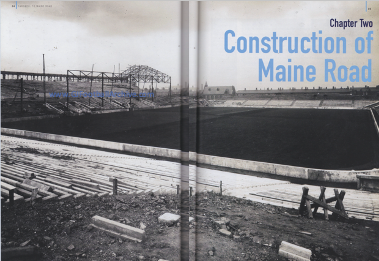
You can see the contents pages to see what’s included in this book, published in 2003, and read the Introduction here:
The book has been out of print since 2004 with every copy sold within about six months of publication. Since then I’ve been keen to bring it up to date with stories about the site and the Etihad but that’s not been possible as no publisher has been prepared to invest in the way that Polar Publishing did to ensure it was the right quality.

Copies occasionally appear in second hand book shops or at online retailers but these often sell for ridiculous sums of money. The last time I checked there was one for about £100 here:
When it was published in 2003 apparently, I commented (though I can’t remember saying this, mind you it was 20 years ago): ‘On 320 beautifully illustrated A4 size pages this book tells the story of Maine Road from conception, right through to its final days as a sporting venue. With excellent photographs – including rare illustrations of the stadium during construction never previously published and images from every era – this has been a very interesting book to research, write and compile. I’ve also tried to ensure the views of ordinary fans are included, and some of the most powerful Maine Road moments are captured by the fans who saw them happen.’
In a review, Hugh Ryden wrote in King of the Kippax: ‘The architecture, the moving memories, the reproduction of rare photos and memorabilia and its extensive quotations, make FTMR a must.’
Another King of the Kippax regular Steve Worthington wrote: ‘Following on in the winning formula of his epic “Manchester The Greatest City”, the highly acclaimed author and Manchester City Football Club Historian Gary James has rolled up his sleeves once more and has produced yet another fabulous football book for all to treasure and enjoy. “Farewell to Maine Road” is not only a must for all Manchester City supporters, it is also an essential for all football fans who possess a genuine interest and passion for the history of our great British past time. It catalogues the birth, evolution and ultimate decline of what was once England’s premier and revolutionary provincial football stadium; Maine Road, Moss Side, Manchester M14. Soon to be demolished into oblivion, Maine Road is vividly remembered in all its former glory in this classic portal to the past. Beautifully written with the knowledge and passion you would expect from a lifelong Moss Side Pilgrim, the book provides a definitive literate and graphic illustration of Maine Road’s long and varied history. It contains a rich tapestry of previously unpublished photographs, one of which, a unique atmospheric shot of the famous ‘Ballet on Ice’ (a famous Manchester City V Spurs clash in the late sixties), is arguably worth the cost of the book on it’s own. Having consumed and digested every morsel of information contained within, it is difficult for me to imagine how much painstaking work and dedication it must take to produce and compile a book of such quality. Whilst they continue to produce triumphs such as this, the marriage of Gary James and Polar Publishing is truly one made in a Sky Blue Heaven. This 320-page masterpiece has pushed the boundaries of football publications to a new and higher level and has already prompted tears of nostalgia in my eyes. But don’t take my word for it, sign up a copy and see for yourself, you’ll not be disappointed.’
The publicity blurb said: ‘The only officially approved history of Maine Road is the perfect book for any supporter of City; Maine Road attendee; or general football enthusiast.
‘The book details the history of the stadium focussing on its development, and on the key games and events which have made Maine Road such a famous and important venue. Using first hand accounts, as told by supporters, players, administrators, and the media this book has been written and designed to the same high quality used in the highly acclaimed Manchester: The Greatest City. With special features on all the big City matches, international games, FA Cup semi-finals, League Cup finals, Rugby finals, concerts, religious meetings, and even on United’s use of the stadium during the forties and for European Cup games in the fifties. In addition both City’s former ground Hyde Road and future venue the City of Manchester Stadium have been covered to provide the complete history of City’s three homes.
‘As with earlier works by Gary James & Polar Publishing this book is destined to be regarded as the definitive history of Maine Road & Manchester City’s other grounds.’
My publisher, Julian Baskcomb, commented: ‘Gary James is the appropriate man to write this work after a lifetime’s research on the club and its stadium. As a boy Gary was a regular in the Platt Lane Stand; then at the age of 16 he bought his own season ticket for the Kippax Stand and has been a season ticket holder ever since. He is also a respected journalist with articles for a wide range of publications including The Times and has recently managed the development of Manchester City’s new museum.’
I don’t know where to start with this but I wanted to get a few thoughts down ahead of the celebration chat I’ve planned for Wednesday (see link below)… This has been an absolutely incredible few weeks for fans of Manchester City and it’s also be mentally and physically draining too. It will be in the coming weeks that we get to relax and look back on it all but I wanted to get some top of the head thoughts down now while they’re buzzing around. So here goes…
The history of football moves at a frantic pace and there are key moments (Tueart, Dickov, Aguerooooooooooooo for example) that are era defining or represent the beginning or the end of an era. This last week is another of those with Rodri’s goal at Istanbul finally bringing City the Champions League that we’ve all craved for so long (but pretended at times that we didn’t).
Manchester City are now Champions Of Europe and, finally, Villa fans can stop singing their song to us! There were many occasions over the decades since City’s last European trophy that the club had a squad of players that were capable of major European success but sadly circumstances worked against them. There were also times when the club suffered major failures but I’ll forget those for the moment.
Depending on when you were born you tend to fall into three rough categories of City fan (there’s more than this but I hope you get my point):
The media tend to portray City as a failing 3rd tier club that got lucky, but the truth is that that was only one season and it was only in the late 1990s that United overtook City in terms of number of seasons at the highest level (I’ll explain the numbers another day but prior to the late 1990s United had spent more seasons between 1894 and then in the second tier than City had !).
In the 1970s City won three times as many trophies as United and even in the 1990s/2000s the Blues only spent 6 seasons out of the top flight. This was two spells (5 years and 1 year) and that 5 year spell was the longest period the Blues had ever endured out of the top flight.
This season finding European success has lifted everything in a global sense. I’ve talked previously (way back in 2012) about City being the club for the new generation and that is absolutely how it is panning out. Add to the Champions League the FA Cup – where City’s traditional rivals United were vanquished – and the Premier League (where City’s old rival from the 1930s looked certain to win the League for much of the season) and this has been a truly brilliant season.
https://gjfootballarchive.com/wp-content/uploads/2023/06/2023-champions-league-final-sd-480p.mov
City and United are now the only clubs ever to have achieved THE treble – a truly great achievement that many thought impossible. Add to that that Guardiola’s Blues have previously become the ONLY team to win a domestic treble and you get to see that this isn’t simply the greatest ever Manchester City side but one of, if not THE, greatest ever side in English football.
We’ve had the Viking Call (the best team in the land and all the world) chant for almost 50 years now but, for the first time, the words are absolutely true (though we haven’t yet had a competitive fixture to determine the best world team of course – that will come!).
If you’d like to come and join me for an online celebration then please do:
These are truly great times to be a Blue. Enjoy!
On Wednesday 21 June at 6pm (UK time) come and join me for one hour of discussion on Manchester City FC’s 2023 Champions League final. Let’s celebrate and remember the positives of this remarkable achievement.
As with previous Manchester City history talks I’ll spend a bit of time discussing the significance of the success and will then open the session up. I’m keen to hear your experiences of the night and what this meant to you as a City fan, whether you travelled to Istanbul or watched from home. Every Blue is welcome!
Come and celebrate this incredible and historic achievement.
Sign up to join this free online event where I will discuss the significance of this momentous night in Mancunian history. This hour will include the opportunity to share your stories and memories as I am keen to hear your thoughts.
Lots suffered horrendous conditions both before and after the match BUT this night won’t be discussing those (maybe we’ll do that another day?). You can add your comments/experiences here:
Champions League Final: UEFA’s Travel Incompetence
Instead the idea is to celebrate and remember the stuff that might get lost along the way. Make no mistake this was a truly significant occasion and one we should celebrate for the rest of our lives.
To ensure we have enough opportunity to hear from each other the capacity is restricted to the first 40 people who register. This is free to join but there’s also the opportunity to pay a donation if you’d like to support my website, work and research. No obligation though – this is about celebrating a wonderful event!
The event will be live on Zoom on 21/6/23 at 6pm and a link will be sent to all those who have registered for the event beforehand (probably earlier that day). THIS WILL BE EMAILED OUT SEPARATELY – NOT VIA EVENTBRITE.
The session will be recorded and a recording will appear on my website at a later date. There is the possibility that everyone who speaks will be recorded and included in the video.
You can find out more about previous talks here:
https://gjfootballarchive.com/tag/history-talks/
You can register for Wednesday’s celebration here:
It’s day 30 of my posts counting down to the centenary of Maine Road’s opening game. Today – The first time seats were installed on the Kippax. Anyone want to guess when this was? This was actually 62 years ago this week!
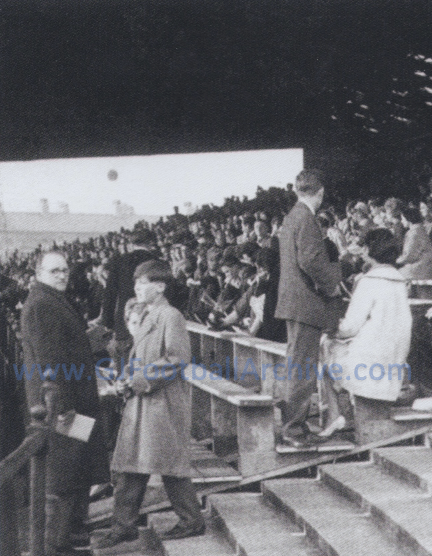
Maine Road staged one of the religious events where American evangelist Billy Graham came to preach to thousands in 1961. I cover the story in detail in Farewell To Maine Road but these images show that temporary seating was installed on the Kippax for the event, which took place between 29 May and 17 June 1961.
At this time there were no gates in the Kippax’ perimeter wall leading to the pitch and so special scaffolding steps were erected to allow attendees to climb over the wall and on to the pitch for blessings etc.
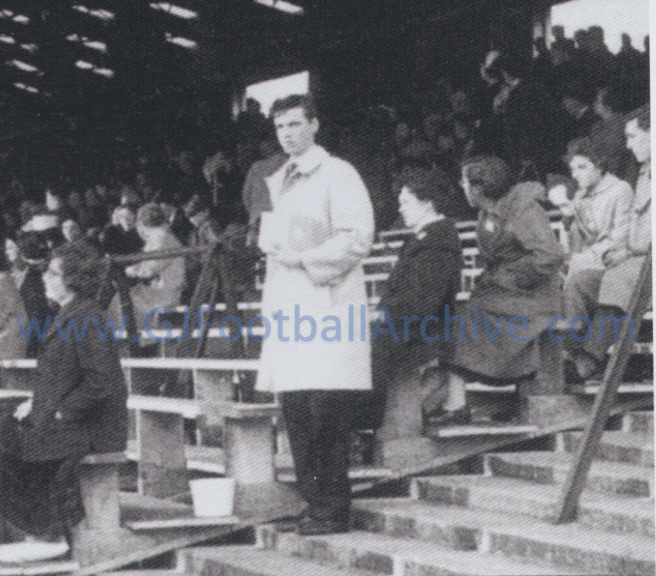
Were you at one of these religious events? If so leave your comments about the day below.
For those unfamiliar with Maine Road’s layout at the time, the photo was taken from about a third of the way up the Kippax between number & and 8 on this photo.
If you’d like to read more on the history of Maine Road, take a look at Farewell To Maine Road, which can be downloaded from this page:
Choose an amount
Or enter a custom amount
Your contribution is appreciated.
DonateIt’s day 29 of my posts counting down to the centenary of Maine Road’s opening game. Today – it’s a simple photo of the floodlights being dismantled in 1990.
Crosland Ward senior just happened to have his camera with him while at Maine Road one day and caught sight of the floodlights being dismantled. He took several photos that day (I’m sure I have others somewhere) and asked the men dismantling the lights if they were okay with him taking the photos. This was in 1990.
These were the second set of lights at the ground and these were the ones that could be seen for miles around. I remember getting on the 53 at Belle Vue and seeing the lights from the top deck straight away.
The lights were replaced roof roof lights on the Main Stand and Kippax roofs. You can see a couple of the floodlights on these images from the late 1970s/early 1980s.


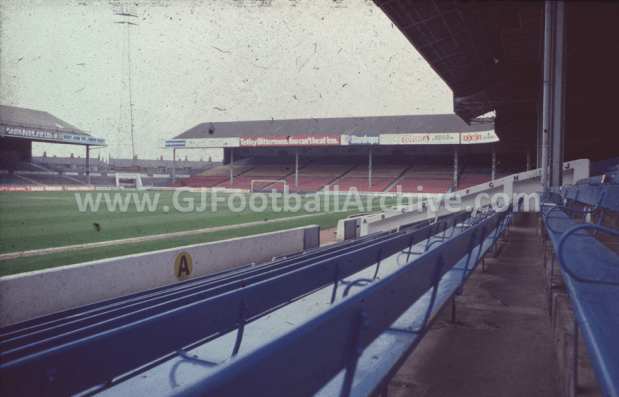
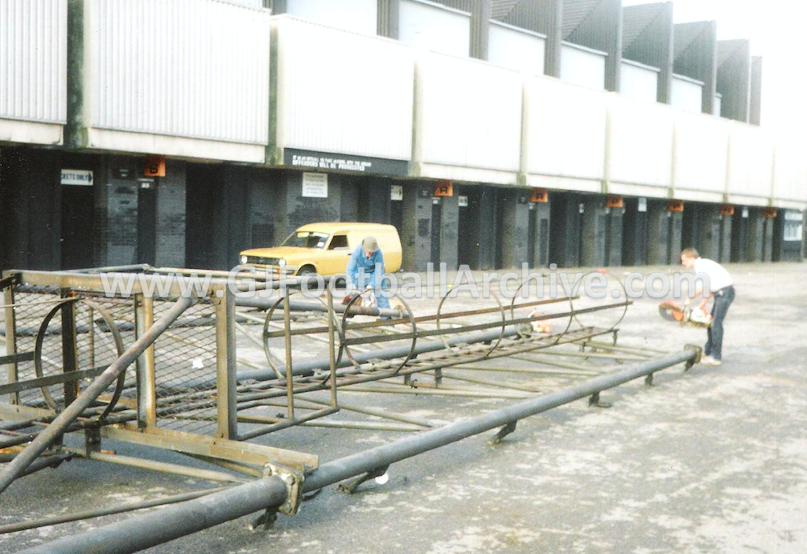
The floodlight being dismantled is the one that stood in between the North Stand and Kippax on this 1971 photo (near number 9) and the men are dismantling it behind the North Stand (number 10).
If you’d like to read more on the history of Maine Road, take a look at Farewell To Maine Road, which can be downloaded from this page:
Choose an amount
Or enter a custom amount
Your contribution is appreciated.
Donate


 Gary James' Football Archive