For day 43 of my posts counting down to the centenary of Maine Road’s opening game I’ve posted an unusual image of a screen on the Maine Road pitch. Can you work out what it was for?
This is a photo I took back in May 1999 of the Play Off semi-final away leg at Wigan. It was Springfield Park’s last competitive fixture and demand for tickets was high. I couldn’t get a ticket to be there but, because of the significance of the game, City decided to put a screen up at Maine Road and sell tickets for the Kippax.
Around 10,000 of us attended the game at Maine Road and we booed and cheered as you would if you were actually at the game. At one point Joe Royle appeared on the screen and we all chanted for him to ‘give us a wave’. Of course, Royle was at Springfield Park and couldn’t hear us but that didn’t stop us from booing when he seemingly ignored us! Football humour, hey?
Here’s an aerial photo of Maine Road from 1971. The Main Stand roof is different (as is the Platt Lane Stand and the Kippax Stand) but hopefully this will give an idea of where the screen was for those unfamiliar with Maine Road. It was positioned in front of the players’ tunnel (near 1 on the image) and I was sat in the new Kippax, roughly in between numbers 7 and 8 on this image.
Maine Road aerial 1971 from Farewell To Maine Road
If you’d like to read more on the history of Maine Road, take a look at Farewell To Maine Road, which can be downloaded from this page:
If you enjoy all the free material on my website and would like to support my research and keep this website going (but don’t want to subscribe) then why not make a one-time donation (or buy me a coffee). All support for my research is valued and welcome. It allows me to keep some free material available for all. Thanks.
It’s day 40 of my posts counting down to the centenary of Maine Road’s opening game and today’s feature concerns ticket prices for the 1998-99 season: The only season MCFC spent in the third tier.
Maine Road was all-seater by this point and the most expensive seat was in the centre blocks B & C at £18 for the highest category game. The cheapest adult seat was £9 for the uncovered temporary stand UU, also known as the Gene Kelly Stand as fans there were used to ‘singing in the rain’ – do an internet search on the reference if you’re baffled or think that Gene Kelly played in the 1937 title winning season. Actually, when I set up the original museum in 2003-04 a Manchester tourist using our ‘Virtual Tour of Maine Road’ interactive asked if Gene Kelly had played international football for Scotland!).
Other temporary stands were erected over the next couple of years as Maine Road struggled to cope with demand. This ticket price plan shows that there isn’t yet an uncovered stand between the Kippax and the Platt Lane for example. It also shows where away fans were housed – this had varied over the years but for most of Maine Road’s last 25 years they had been housed in the Kippax away section of the old stand with some seats in either the Main Stand or in block J (there’s a whole series of possible articles on where the away fans were placed game after game – it did vary and I do remember arriving one day and being surprised at a group segregated in a section of the Main Stand that was normally home fans only).
To help with the flashback to 1998 here’s a newspaper cutting on Ian Bishop’s return in 1997-98:
The Manchester Metro News highlights the return of Ian Bishop
Of course the 1998-99 season ended with promotion at Wembley – a stadium that had been built by the same builders as Maine Road and in the same year.
If you’d like to read more on the history of Maine Road, take a look at Farewell To Maine Road, which can be downloaded from this page:
If you enjoy all the free material on my website and would like to support my research and keep this website going (but don’t want to subscribe) then why not make a one-time donation (or buy me a coffee). All support for my research is valued and welcome. It allows me to keep some free material available for all. Thanks.
I don’t know where to start with this but I wanted to get a few thoughts down ahead of the celebration chat I’ve planned for Wednesday (see link below)… This has been an absolutely incredible few weeks for fans of Manchester City and it’s also be mentally and physically draining too. It will be in the coming weeks that we get to relax and look back on it all but I wanted to get some top of the head thoughts down now while they’re buzzing around. So here goes…
The history of football moves at a frantic pace and there are key moments (Tueart, Dickov, Aguerooooooooooooo for example) that are era defining or represent the beginning or the end of an era. This last week is another of those with Rodri’s goal at Istanbul finally bringing City the Champions League that we’ve all craved for so long (but pretended at times that we didn’t).
Manchester City are now Champions Of Europe and, finally, Villa fans can stop singing their song to us! There were many occasions over the decades since City’s last European trophy that the club had a squad of players that were capable of major European success but sadly circumstances worked against them. There were also times when the club suffered major failures but I’ll forget those for the moment.
Depending on when you were born you tend to fall into three rough categories of City fan (there’s more than this but I hope you get my point):
Those who remember City as a major power, winning trophies and being ahead of United, Liverpool & others; then falling apart under bad chairmanship; then resurrected; then takeover and what we have today.
Those who remember the failures of the 80s/90s; the lack of chance of competing then the takeover and the glory that’s followed.
Those who have only known City as a dominant, trophy winning force.
The media tend to portray City as a failing 3rd tier club that got lucky, but the truth is that that was only one season and it was only in the late 1990s that United overtook City in terms of number of seasons at the highest level (I’ll explain the numbers another day but prior to the late 1990s United had spent more seasons between 1894 and then in the second tier than City had !).
In the 1970s City won three times as many trophies as United and even in the 1990s/2000s the Blues only spent 6 seasons out of the top flight. This was two spells (5 years and 1 year) and that 5 year spell was the longest period the Blues had ever endured out of the top flight.
This season finding European success has lifted everything in a global sense. I’ve talked previously (way back in 2012) about City being the club for the new generation and that is absolutely how it is panning out. Add to the Champions League the FA Cup – where City’s traditional rivals United were vanquished – and the Premier League (where City’s old rival from the 1930s looked certain to win the League for much of the season) and this has been a truly brilliant season.
City and United are now the only clubs ever to have achieved THE treble – a truly great achievement that many thought impossible. Add to that that Guardiola’s Blues have previously become the ONLY team to win a domestic treble and you get to see that this isn’t simply the greatest ever Manchester City side but one of, if not THE, greatest ever side in English football.
We’ve had the Viking Call (the best team in the land and all the world) chant for almost 50 years now but, for the first time, the words are absolutely true (though we haven’t yet had a competitive fixture to determine the best world team of course – that will come!).
If you’d like to come and join me for an online celebration then please do:
Driving back from Wembley last Saturday both Talksport and BBC Radio 5 Live had phone-in shows where the question kept being brought up about comparing Manchester United’s treble in 1999 with the possibility of City managing the same achievement this year. Obviously, a football game can go any direction and no success is guaranteed ever, so I am absolutely not going to talk as if something has been achieved when it hasn’t. If City do manage this incredible feat then the comparisons are likely to be made again BUT how sensible is this?
I am against making these comparisons because I think they’re futile. A bit like when I asked former City player Johnny Williamson, who had played with both Frank Swift and Bert Trautmann, which was best. He said: ‘It doesn’t matter. You pick one and I’ll pick the other because the two of them were head and shoulders above the rest!’
United’s treble in 1999 was absolutely incredible and a major achievement. If City manage the same this weekend then that will also be incredible and a major achievement. Which is best doesn’t matter and even if it did can we really do an accurate comparison? 24 years is a long time in football and the game changes so much in that time.
Much has been made about where City were in 1999 (winning promotion from ‘new’ Division Two) when United won their treble. People have said: ‘How can a team go from promotion challengers to potential treble winners in 24 years?’ Well, guess where United were 24 years before their treble…. they were promotion challengers in ‘old’ Division Two!
Martin Buchan and Alex Stepney celebrating United’s promotion in 1975 at Old Trafford
In the years that followed United’s promotion in 1975 they had a few peaks and troughs as City have. It wasn’t until 1993 (18 years after promotion) that they won the League for the first time since the 1960s but they had won the FA Cup 2 years after promotion. It took City only 13 years after their 1999 promotion to win the League but the FA Cup came in 2011 (12 years after the 1999 promotion). Both clubs spent a lot of money to find those first successes with City receiving Abu Dhabi investment and United borrowing heavily (the increasing level of debt was frequently raised by shareholders back then who questioned whether the club could sustain making purchases like they had to create the most expensive British team ever up to that point) to fund Ferguson’s first successful team.
Comparisons would need to look into every aspect of both clubs – for example Pep’s team are the only team to win a domestic treble as well, so does that elevate their current achievements? Similarly, Ferguson led United to a period of sustained success and dominance that no one else has matched so far. Comparisons are really fairly pointless.
To United fans their treble will always be the best and to City fans, if the club is lucky enough to achieve the same, that will be the best. For most neutrals it will be ‘so what?’, although they’ll downplay any success by a rival. I remember in 1999 someone phoning in a BBC radio show after United had won the Champions League for the second time. The caller was a Nottingham Forest fan who had got fed up with all the praise being heaped on United and, like many United fans today about City, he felt his club was more worthy. He said something like: ‘You keep going on about this United team but what have they done? They’ve just matched what Forest and Brian Clough achieved years ago. We’ve had two European Cups for years and our team was better and cheaper than this lot!’
It’s all a game to fill programmes and articles. It’s not needed. If you think about it 24 years is an extremely long time. If both Manchester clubs can go from promotion chasing teams to European finals in those years then that’s some journey. You have to be well into your 30s to stand a chance of being able to compare 1999 and 2023 and for anyone under that age it’s ancient history and another ‘so what?’.
When United won the treble in 1999 I was an adult with two kids and was just in my 30s. I’d written four major books on Manchester football (including the Pride of Manchester on Manchester derby matches) by this time and had researched the history of both clubs in-depth, so I did get interviewed a lot by TV and radio. I was perceived as an expert, but if you’d have asked me to compare United’s 1975 promotion team with City’s 1999 promotion team I would’ve had to admit I was too young to appreciate what United’s 1975 achievement was like. I’d be able to quote journalists and interviewees but I couldn’t give an honest view which group of players was better. It’s the same now, yet we’ve a whole range of people offering views who are either invested in one club or who are too young to be able to talk with knowledge about it. In any case football in 2023 is somewhat different to football in 1999 – just as that was so different from 1975 and that so different from 1951.
Paul Dickov at Wembley 1999
Maybe we should have filled phone-ins after City had won the double on Saturday with questions like: ‘How does City’s League and Cup double compare with past doubles? Was this City team better than Preston in 1889?’ It’s ludicrous to even try.
On this day (30 May) in 1999 Manchester City won the Second Division Play Off final at Wembley in a tense, dramatic day. Understandably, Paul Dickov’s goal in that Play Off final has often been described as the most important Manchester City goal of all time. That goal does deserve significant recognition, however it is also important to remember the other contributing factors on that day all those years ago, including the opening City goal scored by Kevin Horlock.
The late 1990s had been a very difficult period for City and Horlock’s goal came at a moment when all hope that the Club could resurrect itself seemed to have vanished. This goal was obviously important as it gave City hope and ultimately that transferred into achievement.
The following article, covering Horlock’s goal and the story of that day, is available for subscribers to the website. It costs £20 a year (it works out £1.67 per month) and you get full access to all articles posted, including PDFs of the out of print Manchester A Football History and my first ever book about Manchester City. There are also audio interviews & more. Do a few searches on past content to see what’s available.
Subscribe to get access
Read more of this content when you subscribe today.
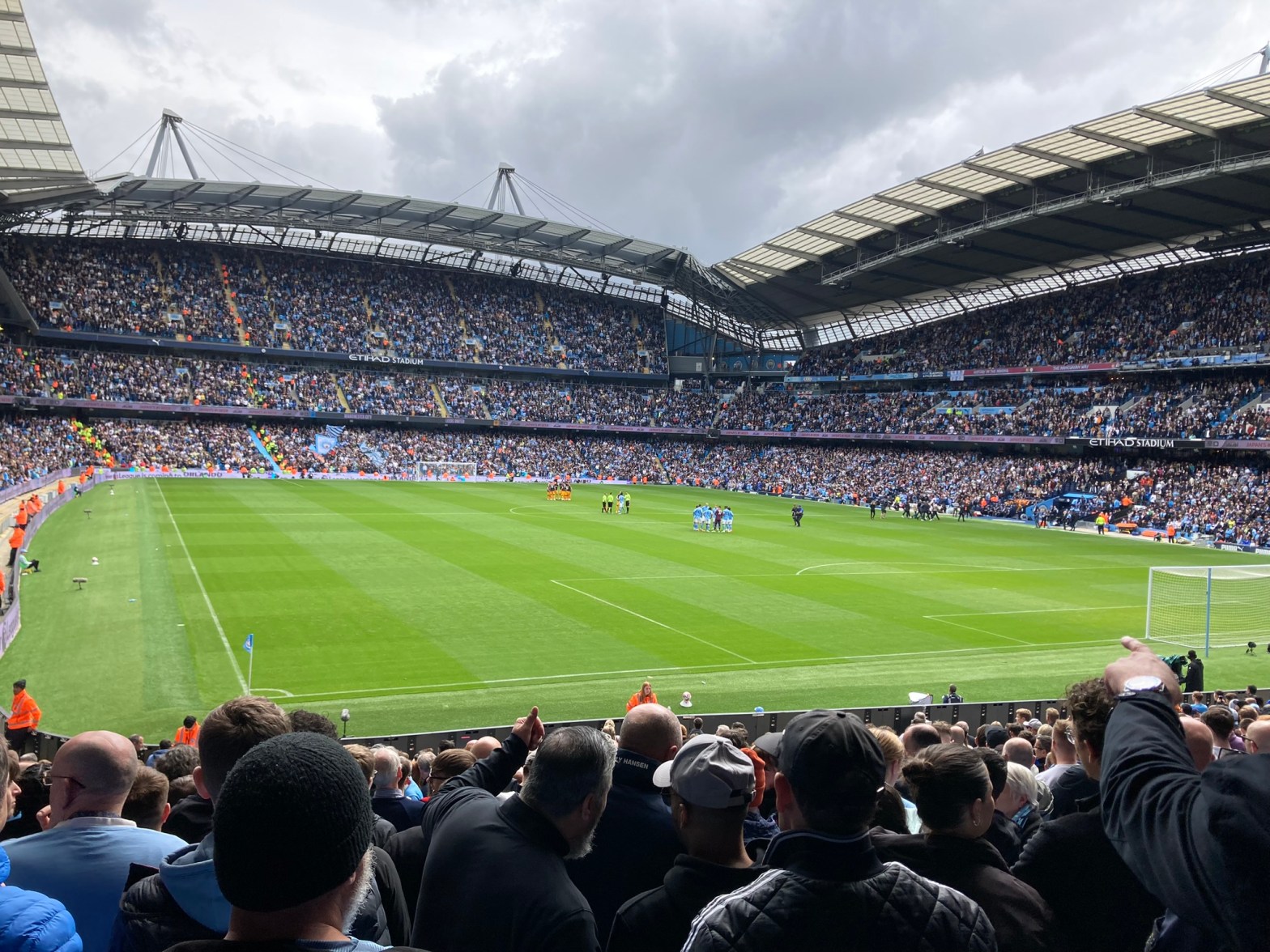
An easy first half for Manchester City today, going 2-0 up thanks to Gundogan v Leeds at the Etihad. It could so easily have been more with shots hitting the bar and the post, plus a penalty which Haaland insisted Gundogan take that was saved. In the end Leeds pulled one back to make it 2-1 but it was a relatively easy game for the Blues and the score flattered Sam Allardyce’s new team.
There was an interesting moment when City fans chanted ‘you’re getting sacked in the morning.’
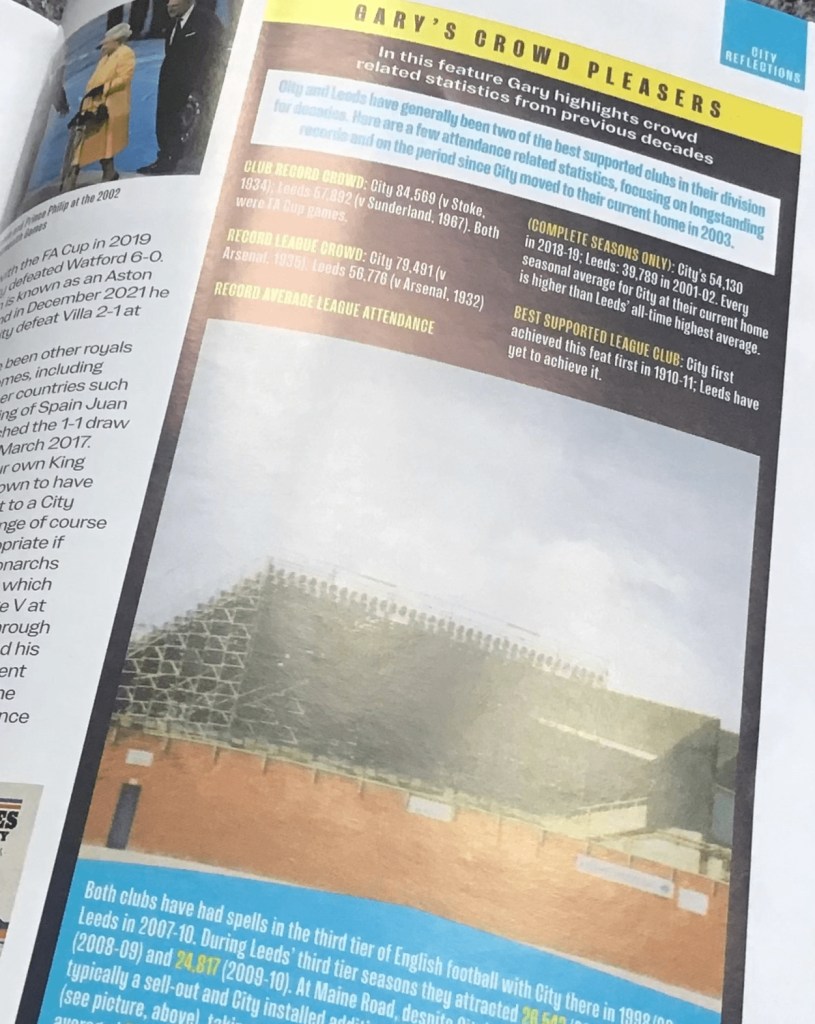
As seems to be customary these days the away fans chanted the ‘Where Were You’ chant. Surprisingly. It was within the first five minutes of the start. If only those fans chanting had read my programme articles today. One of them was my comparison of City & Leeds crowds. Reproduced below you can see how City actually increased the stadium’s capacity to cope with crowds when they dropped to their lowest point. The other attendance comparisons all work in City’s favour too.
On this day (25 March) in 1998 cult hero Ian Bishop returned to Maine Road for his second spell with Manchester City. At the time fans saw that as further evidence new manager Joe Royle understood the club and its fans. Bishop was idolised in his previous spell almost nine years earlier, and his departure provoked demonstrations against then manager Howard Kendall.
Bishop loved the support he got during his first brief spell: ‘I remember we were playing Norwich and the crowd sang my name. I cannot describe how that felt. I never wanted to leave but I knew that there was no future for me at City. Ever since then I have hoped I would get another chance at the Club but you begin to wonder if it will ever happen. Whenever I have returned to Maine Road with West Ham the reception has been amazing.
‘I feel I have at least three or four good years in me because my game has never been based on pace alone. I want to make up for the time I lost because I have always regretted that my first spell here only lasted six months. Nothing would give me greater pleasure than to end my career here, although I am not planning to hang up my boots for some time.’
I’ve been doing quite a bit of research into attendance figures this week and thought I’d share a couple of findings which may surprise some. There has been a lot of talk in recent years about certain clubs having ‘empty seats’ and I think many Manchester City fans will remember the Manchester Evening News feature where a young journalist used a red highlighter to circle every empty seat he saw at a particular game. This was challenged by fans, including myself, who questioned the time the image he utilised had been taken and the purpose of the article.
Since then fans of rival clubs have often pointed their finger at City and accused the club of having ‘empty seats’ at every game and so I’ve decided to look at the last 30 years and compare each top flight team. Obviously, I could compare average attendances and leave it at that, but as so many people talk about ‘empty seats’ I’ve decided to take a different approach and look at the difference between the highest crowd for each club in a season and that club’s average attendance. I’ve taken the highest attendance as this gets over any potential issue with the reported capacity of a ground.
The average attendance for each club is inevitably lower than the highest crowd and with away support typically being about 3,000, any difference of a few hundred between the figures could simply be additional segregation for high profile games or maybe away allocations not selling out. Once we get into the thousands then that would suggest the home allocations have not sold out.
Comparing the highest crowd with the average may not necessarily be the best way to compare clubs but it does give an indication of how full a stadium is or not, so it fits with those who obsess about ‘empty seats’.
As well as comparing those figures I’ve also compared the highest crowd with the lowest crowd for each club. The difference between these attendances shows how many ‘empty seats’ (to use that awful phrase) a club has for certain games each season.
Okay, so what does all this show? Well, I’ll be explaining more in another article soon but a few headlines to include here that may surprise some fans are:
Manchester City have generally had one of the ‘fuller’ stadia over the last 30 years since the Premier League was established, even during seasons when the Blues were out of the top division.
In 2000-01 (a relegation season for City) the difference between City’s highest crowd and average attendance was 571 and the difference between their highest and lowest crowds was 2576. At Liverpool the equivalent differences were 1,107 and 6,332, meaning that typically there were about twice as many ‘empty seats’ at Anfield than at City and that the worst attended League fixture at Anfield had 6,332 less people at it than their best. At Everton the differences were even greater: 6,130 between highest and average with 12,590 the difference between the highest and lowest attended games. Aston Villa’s figures were even more extreme.
In 1998-99 (City’s only season in the third tier) some games were, quite frankly, poorly attended when compared with the best in the Premier League but remember this was the 3rd tier. Those crowds were extraordinary for that league. City fans often believe the ground sold out every week but sadly it didn’t and the difference between City’s best crowd and worst attendance was 8,180, which seems excessive. However, comparing this to the Premier League clubs of the era or today’s giants shows that some had even greater differences. For example, Aston Villa (9,682 difference), Everton (9,828), Leeds (10,243), Liverpool (8,833), Wolves (9,109) and so on. Ultimately, City’s figures in the third tier were absolutely astounding compared to some of those clubs who were in the Premier League or 2nd tier.
In 2004-05 the difference between City’s highest and lowest attendances was 4,768. Aston Villa’s was 11,281; Everton’s was 8,146; Leeds’ was 9,911; Leicester was 8,982; Liverpool’s was 9,160 etc.
These are just a few examples of attendance analysis I’m currently performing and there is so much more to say. Often fans of some clubs will say that the capacity of their stadium limits attendances and there is obviously truth in that, but if a club’s lowest attendance is almost 9,000 lower than their best (as with Liverpool in 2004-05) then the capacity of the stadium is not an issue on that day. A few hundred and it’s an issue, but almost 9,000?
Watch this space for more information over the coming months. The whole ‘empty seats’ accusations are ridiculous and statistics show that all clubs have experienced this phenomenon on occasion during the Premier League era.
On this day (8 August) in 1998 Nicky Weaver made his Manchester City debut at home to Blackpool. City won their first match in the third tier of English football 3-0. The attendance was 32,134. Here for subscribers is a profile of Weaver:
Subscribe to get access
Read more of this content when you subscribe today.




 Gary James' Football Archive