Franny Lee Scored 2 v West Ham

This day (21 November) in 1970 saw England international Francis Lee score twice as Manchester City defeated West Ham United 2-0 at Maine Road. Franny was a wonderful, attacking player and a statue of him alongside Colin Bell and Mike Summerbee has been erected at the Etihad Stadium. I met Francis a lot over the years and interviewed him frequently. So, if you’ve not seen this before, here’s an interview I did with him at his home in February 2010. This was published in the City match programme back then and you can read Franny’s views on his career here as published at the time. Enjoy!

In a glittering career Francis won two League Championships, the ECWC, League Cup and the FA Cup.

Francis, let’s begin with your early career at Bolton.  Is it true you started on the groundstaff?

That’s right.  I set myself a target that I had to get into the first team by the time I was 17 or 18.  If I didn’t I was going to go back to college and train as a draughtsman.  That was my plan, but I managed to get into the first team at 16 and I made my debut against City (5/11/60).  We won 3-1 and I scored a header at 3.15 against Bert Trautmann – I think Bert must have thought he was getting over the hill for me to score a header past him! 

I had about a dozen games over two seasons, then in 1962-63 I was top scorer with 12 goals from 23 League games.

You topped the goalscoring charts each season at Bolton from 1962 until you left.  You were playing on the wing.  Was that your preferred position?

I think my best position was as support striker to a big fella.  I only played in that role twice really – at Bolton with Wyn Davies when I scored 23 League goals one season and then at City with Wyn again when I scored 33 League goals in 1971-72.  A lot of my career was spent at centre-forward which is a bit of a difficult position to play if you’re only 5ft 7.  When I played for England I was support to Geoff Hurst and that suited me.  At centre-forward I had my back to the ball but when I was support striker – the free player – that suited me fine.  I could pick up the ball going forward and that was great.

At Bolton you scored 106 goals in 210 appearances.  A great record, but when you left the club the stories were that you were in dispute.  Is that true?

Well, what happened is that we were relegated in 1964 and, despite a near-miss in 1965 when we finished third, it didn’t feel as if we were going forward.  My ambition was still to see how far I could develop in the game and in the back of my mind I had the ambition to play for England, but I wasn’t even selected for the under 23s.  The story was going around that I was difficult to handle – which is funny because Joe Mercer said that I was the easiest player to handle at one point.

Were you difficult to handle at Bolton?

I was opinionated and ambitious, but not difficult.  I think that message was going around because I was on a weekly contract at that time.  The club knew that it would be difficult for them to stop me moving on if another club came in.  So any player with a reputation for being difficult would not be on anyone else’s shopping list, would they?  Bolton offered me a new contract worth something like £150 a week but my wage was only £35.  That actually upset me and I said: “if you now think I’m worth £150 a week what about all those years you’ve been underpaying me?”  It wasn’t the money that was an issue it was the way they handled it.  What they were doing was trying to get me on that contract and then my value would increase if someone came in to buy me.   Once they saw how dissatisfied I was with the way they were handling it, they said that it’d be best if we made a clean break, and so I said I’d pack the game in.  I had my business by then and so I said:  “give me my employment cards and I’ll pack it in.”  They thought I was bluffing. 

It’d been a decent season – I’d scored 9 goals in 11 games including when we beat the great Liverpool side in the League Cup – but then it ended in September 1967.  They gave me my cards and that was it.

Were you absolutely certain you’d pack it all in at that point?

I kept myself fit but I was working on my business.  I was driving my lorry around, collecting the waste paper and so on.  The business was growing and I felt that if I wasn’t wanted then I’d concentrate on that.  It was always my fallback. 

I know how stories can get exaggerated over the years, but is it true that in between games you were going around collecting the waste paper?

I used to drive my lorry during the week and even on the Thursday or Friday before a game I’d be collecting waste paper.  I used to put on a flat cap and muffler so that nobody would recognise me!  In the end I was driving articulated lorries and it was getting to be a very good business.  My last pick up was the day before I signed for City!  I roped and sheeted about 15 ton of paper and cardboard from a spinning mill in Bolton.  Took it to the Sun Paper Mill in Blackburn and when I got back about 5pm I got a call from Joe Mercer.  He didn’t give his name at first but I recognised him.  “Who is that?”  He said:  “Tom Jones.”  I said: “It doesn’t sound like Tom Jones, sounds more like a man called Mercer!” and he asked:  “Where’ve you been?”  I told him I’d been playing golf – I couldn’t play the game at all then but I couldn’t tell him what I had been doing! 

This is Your Life Joe Mercer 1970 MCFC squad

Did you immediately want to sign for City?

Other teams had shown interest in signing me.  Liverpool offered £100,000 I understand but then when I wasn’t playing it affected my price.  In later years Shanks often used to grab me and say in that strong Scottish accent:  “Son, I should’ve signed ya the night I saw ya!”

City was just right of course.  It meant the business could carry on.  I don’t know if Bolton had told Joe about my contract or the £150 offer but the first thing he said to me before we talked it through was:  “I’ll be honest with you son.  We’ve no money.  We’re skint!”  I said:  “It doesn’t matter.  I’ll just be delighted to start playing again.”  I meant it as well.

I signed for City for £60 a week – remember I’d turned down £150 at Bolton!  But it was well worth it.  The way the team developed and, of course, when I realised my ambition and played for England.

I left a lot of friends of mine at Bolton – Freddie Hill, Tommy Banks, Roy Hartle, Gordon Taylor – and we had some great times.  Those of us who had come through the ranks were poorly paid for the job we were doing at the time, but we enjoyed ourselves.  I never had any argument with the players, fans or people at Bolton, it was just those that ran it.  I loved my time at Bolton.

When you joined City the Blues were ninth in Division One after losing 5 of the 11 games played.  But the side was transformed from the moment you came.  Unbeaten in your first 11 League games.  Were you the difference?

The team just clicked and I was only part of a good group of players.  We had that great run up to Christmas, then a bit of a blip, but in the New Year we just rattled on.  It was a terrific period.  Mike Summerbee was playing at centre-forward and our culture at the time was to play with five forwards.  It was very unusual for the time.  The only system we played was that we all played – we had ten players who went up together, and ten who defended together.  When we won the League at Newcastle at the end of the season it was wonderful and particularly special because none of us had ever won anything significant.  This was our first major success and that’s why the following season the ordeal of playing a European Cup tie was so tough.

Francis Lee after scoring at Newcastle

Was it just inexperience that caused City to lose the Fenerbahce European Cup tie 2-1 on aggregate?

None of us had played in Europe before.  Mike Summerbee had only made his England debut against Scotland in February 1968.  Colin Bell had played in two England friendlies, but apart from that none of us had any concept of what it could be like in Turkey.  Had we played the first leg in Istanbul and the second at Maine Road I think we’d have gone through, but the goalless 1st leg at Maine Road killed us really.  We worked hard in Istanbul and it was a creditable result over there but we were out and it was because we were inexperienced.  It was a culture shock.

Confidence was at a real low after that game.  We’d had a bad run and only had a small squad so we struggled.  But that was the way it was.  Back then the motivation for all of us was to be in the team and to keep your place. 

I think younger readers may be surprised to read that City tried to keep the same eleven players game after game, competition after competition.  Would you have enjoyed a squad rotation policy when you played?

The aim of a footballer is to play.  Why would anyone want to be rested?  If a manager had said to me ten minutes before full time that he wanted to bring me off even though I was playing well, I’d have told him “no way!  I’m enjoying myself.  This is what you bought me for, now let me do it!”  It wouldn’t matter what the manager says I’d want to stay on.  That’s what the game is about – enjoyment!  Every player wanted to play.  None of us wanted to be on the bench. 

People talk about the number of games played today but in 1969-70, ignoring friendlies, you played 72 competitive games for England and City.  Would squad rotation have helped?

No. Playing is always better than being on the training pitch and I used to love playing, so I tried not to miss a game.  It didn’t matter whether it was an England friendly, Anglo-Italian cup or whatever, I wanted to play and represent my club and my country.  I think it’s best for all players.  Look at Tevez.  He’s improved his fitness and form by playing, and I think a lot of players are like that.  He needs to play, and that’s what I always wanted. 

Francis Lee v Schalke 15 April 1970

Some of the other players from the 1969-70 season have talked about Franny’s Grand Slam.  Your aim to win four trophies in one season inspired them.  What do you remember of that?

Well, we wanted to win every game so it seemed natural to me that we should go for all four.  We won the League Cup and Cup Winners’ Cup, so that wasn’t bad.  In the FA Cup we ended up suffering a rare defeat at United.  We were doing okay in the League then we had a few injuries – Mike, Colin Bell and Neil Young were injured at key times – otherwise I think we would have won three trophies.  But the thing about the ‘Grand Slam’ was that it was the ambition of the place.  I remember we were going to London on the train and could see Wembley, and I shouted to the lads to take a look because two of our ‘Grand Slam’ games would be played there!

1970 ECWC

Moving forward a couple of years, we missed the title by a point in 1972.  Why?

Rodney Marsh has told you himself that his signing affected the 1971-72 season.  Malcolm played Rodney and disrupted a team that I’m convinced would have won the League that year.  I don’t blame Rodney.  There was one game near the end where we should have had a couple of penalties for hand ball but, because this was the season when we got that record number of penalties, they weren’t given.  That season our luck changed and everything went against us. 

A lot has been made about you ‘diving’ but the factual evidence is that the majority of those penalties were given for things like handball or fouls on other players.  Nevertheless, the myths survive.  So, big question, did you ever dive?

I couldn’t say that I always stayed on my feet unless I was absolutely knocked down.  In those days you used to get some horrendous treatment by the defenders, but I will tell you that the season before those penalties we only had a couple, and before that I think it was one.  The reason we got so many in 1971-72 is that they had changed the law, plus we were going for the title so we were putting sides under a lot of pressure and they reacted.  I was fouled only 5 times out of the 13 league penalties we got.

When I was attacking I used to play the odds.  If a defender was coming towards me I’d carry on, or I’d run towards the defender because there were only three things that could happen – he pulls me down, he gets the ball off me – well done, or I get a cracking shot at goal.  So the odds were in my favour.  You have to play them.

I think the reason people go on about penalties with me is because I was the one taking them.  It didn’t seem to matter what they were given for, the headlines were that I had scored from a penalty.  The season after I think we only got one penalty.  I would say that for every dubious penalty that was awarded there were another twenty that we should have had.
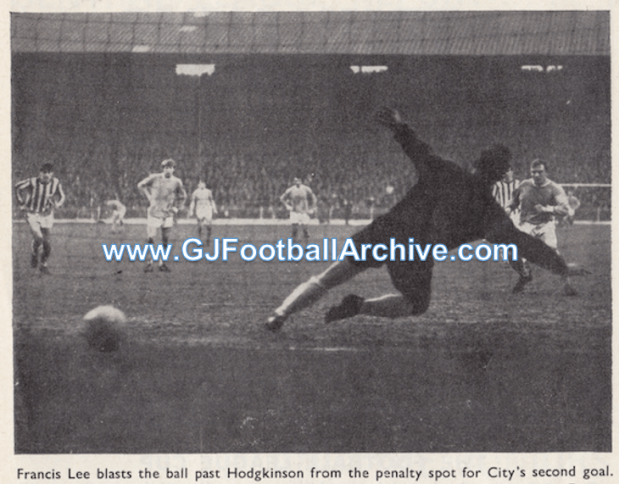
Francis Lee’s first penalty for City January 1968 v Sheffield United

Was the move to Derby something you really wanted?

By that time my business was substantial so going to Derby was going to cause problems.  Derby offered City more than anyone else and that was that.  We won the title in my first season – I’d only signed a contract for a year – and they were a very good side, so I stayed with them for another season.  The pitch was awful – even Maine Road’s pitch was better – but I felt we could have won the European Cup that second season.  We beat Real Madrid 4-1 but I missed the return game because I’d been sent off in the Hunter incident against Leeds.  We lost 5-1.

They actually changed the rule after that saying it was unfair to automatically ban a player from a European game after a domestic match when the player had yet to be proved to be guilty.  There wasn’t much chance of me being ‘not guilty’ – the footage was there for everyone to see!

People often suggest that City sold you too soon and that had you stayed a couple of seasons longer we might have won the title again.  Do you hold this view?

I think if I’d have stayed and Mike Summerbee – remember he was sold a year after me – then I do think we’d have mounted a serious challenge for the title.  Mike had plenty to offer and should not have been sold.

You came back to Maine Road and scored for Derby (28/12/74).  I was in Platt Lane that day and I remember a surreal moment when City fans cheered your goal.  Did that actually happen?

Yes, it did.  Then I think they thought:  “What have we done, he’s playing for them!”

I enjoyed my football and I loved scoring.  I loved that goal.  I picked it up with my back to the line, went through two people and on to score the goal.  The film shows me smiling because I’d scored what I thought was a good goal.  It had nothing to do with City or revenge or anything like that.  I think I enjoyed about 95% of every game I ever played.  It was fun.  A great way to earn a living, so on that day I was happy.

Why did you retire in 1976 only a few weeks after your 32nd birthday?

My business was taking over.  I had about 110 people working for me and was travelling all over the country.  Had I been playing closer to Bolton then I may have carried on.  Derby wanted me to stay on, and I made a promise to Dave Mackay that if I was to play again then I’d do it for him.  Tommy Docherty tried to persuade me to join United but I wouldn’t break my promise to Derby.

Your business and horse racing interests grew, but then in 1993 you were back, mounting a takeover of City.  Why?

I wasn’t looking to get back into the game at all during those years.  I had a successful career and was happy.  But City were in a desperate state and I genuinely felt that I could not let a club I cared passionately for struggle like that.

When we finally gained control there were so many issues.  So many skeletons coming out of the cupboards.  The financial state of the club was appalling.  I should have known then that it wouldn’t work! 

The biggest problem at the start was having to build the new Kippax Stand –there really wasn’t a workable plan in place before we arrived and yet the stand had to be replaced within months of us arriving.  We ended up spending about £16m in the end – even removing the waste from underneath the old terracing cost £1.8m because it was contaminated.  I thought then that my luck had changed.  Everything we tried to do became an issue and the Kippax was a millstone.  

1994-95 the new Kippax takes shape

It’s extraordinary when you think that prior to us, Blackburn and Everton, no one ever put money into a football club.  People bought shares but never invested, we did invest. 

Off the pitch things did improve significantly, but on the pitch we struggled.  What’s your view?

People like John Dunkerley worked very hard during that spell and the training facilities were improved and so on.  Then, just when we finished the Kippax, Manchester Council started to talk to me about becoming tenants of the new stadium – now that turned out to be the best thing that happened to City during the decade that followed.  We spent a lot of time working with them and talking with various people to make it happen.  Full marks must go to the Council for having the foresight and it became very important for City to become anchor tenants.  I think I had a lot of bad luck as Chairman and things certainly didn’t work on the pitch, but I do think that was one thing that the club got right.

Finally, thinking of your time as a player, many people claim the 1970 League Cup Final was your greatest City game, do you feel that?

I don’t think of individual games in that way.  You have to look at the club during your time there and see what that club won and what you contributed to the overall success of the club, not necessarily individual games. 

1970 League Cup final. Francis Lee facing ball and Glyn Pardoe

My role was to make things happen, and if I was making things happen, especially if it was causing some aggravation for the opposition, then I was happy.  When you hear the opposition players shouting things like: “don’t let him turn!” that’s a real pat on the back.  You know you’re getting to them.

In terms of individual games or goals…  I think one of the goals I scored at West Ham (18/11/67) was the best goal I’ve ever scored.  I was playing against Bobby Moore and I think I had a fantastic game.

I always think that a top class player should go on to the pitch and have enough confidence in his own ability to know that it is very rare for him to have a bad game.  It’s not arrogance or anything, but it is the mark of a top class player.  If you go onto the pitch feeling that then more often than not you will have a good game.  The next step is to take it up the levels until you walk on to the pitch believing you’ll have a great game and score a couple of goals. 

At City most of us developed that confidence and on some days, when the entire team was at that level, we had some tremendous games.  There are signs that the current side are heading in that same direction.

You can read more on Francis throughout the website. Use the Francis Lee tab lower down on this page or search using his name. As an example, here’s a detailed profile of him I wrote a few years back:

Subscribe to access great content and support Gary’s research

If you’ve enjoyed this piece then why not subscribe and read the rest of the great material on here. At the same time you’ll be supporting my research and writing (I’m not employed by anyone and my research/writing is self-funded). It costs £3 per month (here; access everything posted since 1 October 2022) or £20 per year (below; access everything posted since December 2020). You’ll also get to read all content posted during your subscription. Thanks.

Subscribe to access great content and support Gary’s research

If you’ve enjoyed this piece then why not subscribe and read the rest of the great material on here. At the same time you’ll be supporting my research and writing (I’m not employed by anyone and my research/writing is self-funded). It costs £3 per month (above) or £20 per year (here; access everything posted since December 2020). You’ll also get to read all content posted during your subscription. Thanks.

Wearing Alternative Kits At Home

There’s a lot of furore this week about Manchester City’s decision to wear their new Oasis inspired kit instead of their home kit for their Champions League game with Inter Milan. Lots are talking about tradition, heritage and the like, so I thought I’d add a few words here that might have been overlooked or forgotten. So here goes…

Firstly, my position is clear that I’ve always been keen to see City wear home colours/blue for every fixture possible (whether home, away or at a neutral venue) but I’m a pragmatist and know that’s no longer likely. History and tradition does mean something but of course, when it comes to football, traditions change frequently. People may think City have only ever worn a particular colour at home or that the traditional away colours are red & black but these things are not true. Times change.

When it comes to wearing alternative kits at home it has been done more often than perhaps people realise. In fact the only decade when it hasn’t happened appears to be the 2010s – I say appeared because I haven’t got evidence of every home game in the 1890s and 1900s!

These last few days have caused some to recall the Middlesbrough game when David James went up front and the two Tottenham games at Maine Road in 80s/90s when the referee felt the kits were too close and City ended up changing. But there have been many other occasions. In fact it’s well over 100 years since City first chose to wear away colours/alternative strips at home when they didn’t need to!

The image above of Neil Young comes from the 1971 ECWC semi-final v Chelsea. Notice that Young is wearing City’s away colours.

Often when there was a clash of colours in a cup game City would wear their away strip. Games in the 1920s right through to 1970s saw the Blues don maroon, red/black and even scarlet at times at Maine Road.

Here’s another image from that Chelsea semi final:

1971 ECWC v Chelsea. Francis Lee. Photo by Alan Jubb

To the right you can see the North Stand under construction, as you can in the Young image.

Other games in living memory (not necessarily mine, but living memory for many older blues) include:

January 1971 – City v Wigan in FA Cup (red & black)

September 1970 – City v Bologna in Anglo-Italian Cup (red & black)

January 1968 – City v Reading in FA Cup (all maroon)

March 1966 – City v Everton in FA Cup (all maroon)

March 1966 – City v Leicester in FA Cup (all maroon)

March 1956 – City v Everton in FA Cup (maroon shirts, white shorts)

In earlier decades City often chose to wear an away shirt for cup ties where there was a clash. Prior to 1921 the FA rule was that home teams would have to change if there was a clash.

In March 1924 City chose to wear a kit they described as ‘Lucky scarlet’ for a FA Cup tie with Cardiff at Maine Road. So for well over 100 years City have often chosen to wear alternative kits at home instead of traditional blue when they didn’t need to.

Personally, I’d still prefer City to always wear blue no matter where they play, but that’s never going to happen anyway.

Incidentally, if you’d like to read more on the history of Maine Road, take a look at Farewell To Maine Road, which can be downloaded from this page:

If you enjoy all the free material on my website and would like to support my research and keep this website going (but don’t want to subscribe) then why not make a one-time donation (or buy me a coffee). All support for my research is valued and welcome. It allows me to keep some free material available for all. Thanks.

Choose an amount

£2.50
£5.00
£7.50

Or enter a custom amount

£

Your contribution is appreciated.

Donate

Happy 90th Birthday Tony Book

On this day (4 September) in 1934 Tony Book was born. Happy 90th birthday Tony! Tony was of course a major footballing star of the 60s and early 70s. It seems appropriate today to highlight some of his achievements with quotes here from interviews I’ve performed over the years. Enjoy!

Tony arrived at Maine Road in 1966 and captained Manchester City to phenomenal success.  When he arrived at City Book he was in his thirties:  “I hoped I’d get a couple of years and I would have been very happy with two years at City, of course.  Because of what happened and the way the success came in my second year, I felt I could go on again. Winning the League in 1968 was like a spark and I wanted to keep the flame going.”

Book lifted more trophies as captain than any other Blue, until the incredible success experienced during Vincent Kompany’s time. Back in 2015-16 as Kompany was nearing Book’s record, Book told me: “Next time he lifts a major trophy he’ll have matched my record as captain. I hope that success comes soon, and that he then goes on to pass my record this season.” 

His time as captain and player was incredible and this was a golden era for City. What is often overlooked though is Tony’s contribution as a manager. In 1973-74 he became manager of City for the final month of the season – a spell that was noteworthy for the infamous Manchester derby when Denis Law netted against United in the Reds’ relegation match.  In the years that followed, Book developed a squad of real talent, blending well-regarded internationals with enthusiastic youth to create a flamboyant and entertaining team.  

Book’s second full season saw his team of entertainers annihilate United 4-0 in the 4th round of the League Cup – on a night remembered more for the devastating injury to Colin Bell – and progress to the competition’s final where they defeated Newcastle 2-1.  The victory meant Book was the first man to win the trophy as a player and as a manager.  He said at the time:  “Two weeks ago I met Gordon Lee (Newcastle manager) and we agreed that whoever won, it was more important for us to provide a good final.  I think we have done that.  This was my greatest moment.  It was a tremendous final and Tueart’s goal was something special… quite out of this world.”

Looking back on 1976 Book believes the key to the success lay in City’s preparation: “We wanted everything to be low key and travelled down early in the week.  We did simple training and tried to build an environment around us that was positive.  It worked well and by the day of the final we were ready.”

City were missing Kenny Clements, and Colin Bell was still out of action, causing Book to bring youngster Ged Keegan in. There had been media talk that Keegan and another youngster, Peter Barnes, would feel the pressure but Book felt differently: “I had total faith in my lads. Barnes scored the first – in a move that we’d worked on in training – and Keegan more than justified his place.  I never had a doubt.”

Book managed City through one of the club’s most exciting periods: “As a manager I was proud that in five years we won the League Cup; finished runners up by a point to Liverpool; we were in Europe for three consecutive seasons; and we reached the quarter-finals of the UEFA Cup. I had some good players that came in – Dave Watson, Brian Kidd, Joe Royle, Asa Hartford – and did an excellent job for me.”

City fans loved what he had brought the club and at the 1976 League Cup homecoming they chanted ‘Tony, Tony’ repeatedly for some time.  At various film shows over the last decade I’ve shown (together with Will McTaggart from the North West Film Archive) a rediscovered film of the homecoming parade which shows exactly what the success meant to the City boss: “I wanted to win the League Cup for them and I remember looking out over the crowd in Albert Square. They were celebrating and singing. Everything we did was for the fans.  These fans have been so loyal over the years and they had made me so welcome when I arrived in 1966.  Such a special club and wonderful fans. They deserved that success – and so many more for the way they stood by this club during the painful years that came later.”

Almost sixty years after he first arrived at City, Tony Book is still a regular and popular presence around the club:  “I love this club and am grateful to all those who brought me here and involved me for so long.  Whenever I’ve been given a job to do I’ve always tried to give my best.” 

Book certainly represents all that is good about football and he is a powerful reminder of the successes Manchester City achieved during his captaincy and as manager.

While you’re here why not read other content. There are plenty of free articles here but also there are many, many more only available to subscribers. Subscribers have access to everything. You could even subscribe for a month and see what you think. The following 1,700 word article is on the 1973-74 season and is available to subscribers below. Enjoy!

Subscribe to get access – Monthly

Read more of this content when you subscribe today. It costs £3 per month (cancel anytime) to access everything posted since 1 October 2022 or there’s a special annual rate below which gives greater access and works out much cheaper.

Subscribe to get access – Annual

Read more of this content when you subscribe today. It costs £3 per month (above) or £20 a year (here) to access everything posted since the site was created in December 2020. This special rate works out about £1.67 a week and gives access to everything posted, including PDFs of 3 of my books.

If you enjoy all the free material on my website and would like to support my research and keep this website going (but don’t want to subscribe) then why not make a one-time donation (or buy me a coffee). All support for my research is valued and welcome. It allows me to keep some free material available for all. Thanks.

Choose an amount

£2.50
£5.00
£7.50

Or enter a custom amount

£

Your contribution is appreciated.

Donate

If you’d like to know more about subscribing then see:

Howard White and a Liverpool Controversial Game

On this day (25 May) in 1971 defender Howard White signed professional forms for Manchester City.  White had a very unlucky career at Maine Road.  He had alread made his debut on 24 April 1971 in a controversial League game with Liverpool. 

Basically, Liverpool were enjoying a busy, competitive season and decided to rest several key players.  This was against League rules and as City had also fielded a side that seemed to be relatively inexperienced, the League investigated. 

The game ended 2-2 and the League eventually fined Liverpool for fielding a weakened side, but judged that City had managed to field their strongest side considering injuries etc.  For White the game was a low point as he suffered a broken ankle shortly before half time and was never again able to make a first team appearance.     

Ian ‘Spider’ Mellor

I’ve heard the news that Ian Mellor has passed away at the age of 74 and so I wanted to pay tribute by publishing an interview I did with him several years ago and also provide a few biographical details too. As always, I think it’s best in these moments to remember the player by using their own comments and thoughts, so I’ll start with that.

In December 2003 I interviewed Ian for a feature in the Manchester City match programme. Here is the interview as it was written and published back then:

IN SEARCH OF THE BLUES – IAN MELLOR

Ian Mellor made his debut in March 1971 and went on to make a total of 48 League and Cup appearances for the Blues.  In 1973 he moved on to Norwich.  Gary James, author of Farewell To Maine Road, caught up with Ian last week.

Let’s start with your role today, you’re still very much involved in football.  Can you explain your role and how it came about?

I’m the Commercial Executive to the Professional Footballers’ Association (PFA).   I suppose it started when I first finished playing.  I was 34 and unemployed for about four months.  I needed to find something new and like any former player it can be difficult at first, but I got myself on to an intensive sales course and really tried to push myself in that direction. 

I was in the Sheffield area – I’d been a player with Wednesday and so that helped to some extent – but it was a very tough time to be selling there.  The industry had been decimated.

Eventually the athlete Derek Ibbotson – who had been involved with fitness training at City when I was a player – brought me in to work for Puma and my involvement with sports commercial activities really started then.  One of my main activities was to persuade key League players to wear Puma goods. 

Did your playing career help?

Yes, of course.  The fact that I’d played did help, but it wasn’t too difficult.  Paul Gascoigne was signed up and, like with any major sports company today, it’s great if a major star wears your products.  From that I went on to work for Gola and I’d also spent some time talking with the PFA about providing sportswear for their various initiatives.  One thing led to another and, through Mickey Burns, Gordon Taylor asked me to join the PFA as its first Commercial Manager about ten years ago.

As a player did you feel the PFA was important?

Like many unions you don’t appreciate what they do until you need them. As an ex-player the game took its toll on my body and I’ve had to have 2 new hip joints replaced and without the support of the PFA I would have been a cripple. I’m just one of thousands of members of the PFA who have received vital assistance when needed. As a player I didn’t really think about it at the time, but now I have come to realise how much the union helps present and former players, and is involved in so many areas such as community programmes, anti racism campaigns and supporters’ organisations.  As you get older you also start to understand how football’s developed and what the union has achieved.  The PFA has a major role in football and it puts so much back into the game that we all love.

Going back to your early career, did your elevation to the first team come easily?

I was certainly worried – I’d been sent to Altrincham on loan and was paid something like £2 a week.  I played two games and started to wonder what was going on.  When that happens you can’t help but feel your career is not going to be in the first team.  Then Ken Barnes started working closely with the City youngsters and he started to look at me.  That got things moving.

Your debut came against Coventry in March 1971.  Do you feel you performed well?

It was a lot to handle really.  I was nervous, very nervous.  I knew I’d be facing Wilf Smith who I think was the most expensive fullback in the game at the time.  I became a nervous wreck, and in the first half I think that was obvious.  I just wasn’t right.  Malcolm Allison had a real go at me at half time and warned: “If you don’t pull your finger out, you’ll be off!”  So that got me playing!  The second half I really worked hard and played my normal game.  I tried not to worry.  I just got on and did it.

You must have performed well enough because you kept your place.

Well the Coventry draw was on 20th March and four days later I played in the second leg of the European Cup Winners’ Cup and managed to score, so it was a great start really.   I still wasn’t a regular, but I played in another five league games and even scored against United in the derby match on the last day of the season.  As a City fan the derby meant an awful lot and scoring your first League goal in a derby is something special, especially for a local lad.

Was that your biggest moment?

I suppose my biggest moment came when I actually signed professional forms.  Johnny Hart took me into a little room hidden away under the Main Stand at Maine Road and I signed the forms.  All the time I was thinking where’s the press?  Where’s Granada?  Instead of the hype you always imagine surrounds these things there were Johnny and I in a damp, cold corner of the ground.  Johnny though said something which has stuck with me ever since, he said: “I wish you all that you wish yourself”.  Which is a great comment because in football… and in life for that matter… you have to have aims and dreams.  You need to want to be a player to be a player. 

Who would you say was the biggest influence in your playing career?

Well, we were very fortunate at City to have Johnny Hart, Ken Barnes, and Dave Ewing in the coaching set up.  They were very knowledgeable and men of real quality.  They knew what they were talking about and they also cared passionately about the game and the Club.  They’d all had great careers and as a young player you listened and learned. 

At times they could be very hard.  They pushed you because they knew you had to be hard to survive in football, and they certainly made you work.  They gave me the right sort of grounding.

The biggest coaching influence though has to be Malcolm Allison.  In those days he was the best as a coach and motivator and I learnt so much from him.  Again he could be tough, but you listened because he had already delivered so much by the time I got into the first team.

As players did you socialise as a group?

There were quite a few of us who came up the ranks together so people like Donachie, Carrodus, Gibbons, McBeth, and Jeffries were the ones I went out with.  I suppose there were two age groups.  The older players were married and had also come through the Sixties team together, and then there were the younger single guys.  Naturally, as in any environment, you stick in your peer groups, but obviously on the pitch you’re one team and work hard for each other.

Willie Donachie was probably the closest to me.  Our wives went to the same school and he was the Best Man at my wedding, and we get on really well.

Was it one of the players who gave you the nickname ‘Spider’?

Ah yes.  Spider’s been my nickname since those early days at City.  It was Ken Mulhearn who gave it to me, although he probably doesn’t realise that now.  On a Saturday morning if we were at an away match and sat in the hotel, we’d usually watch a bit of television and it always seemed to be that Spiderman was on.  Ken shouted “look it’s Ian Mellor” and the name Spider then stuck because of my long legs and the comparison with Spiderman! 

The funny thing is there are many, many of my business contacts who don’t really know my proper name.  It’s always Spider.  I always get introduced as Spider, and so if I ever give my name as Ian Mellor when I’m calling someone I deal with they get confused.  It’s amazing how these things stick, but it’s great.

How did the fans treat you?

Always well.  It was a great side to join, and as long as you put the effort in the fans loved you.  I never received any stick and the fans have always loved to see players who attack.  Once I’d made my first appearance I started to get recognised.  Being tall and thin helps you get noticed, and I enjoyed the support they gave.

The team was great as well.  There was tremendous camaraderie and the success must have helped to create that spirit.

Clearly, there must have been a downside.  What was your biggest regret?

Leaving!  I should never have gone to Norwich.  I went from a top five side to a bottom five side overnight and it was such an alien environment.  Norwich is a nice place, and a good club, but at that time the move was totally the wrong move to make.  Because they were struggling there was no confidence.  The contrast with City was unbelievable.

At City everything was so positive, and as a Blue I shouldn’t have gone.

You come from a family of Blues, don’t you?

Yes.  We were season ticket holders and I used to stand on the Kippax.

Naturally, I have to ask how you felt when your son Neil played for Liverpool against City in the FA Cup last season?

It was great to see him play at Maine Road, and I felt very proud.  It was a very strange feeling really though because he was playing against the family’s team.  We’re all Blues and the best result would have been for him to score but for City to win.  It didn’t go that way of course, but it was great to see him play in that match.  A great feeling.

I hope that gave a sense of the man and now here’s a brief career overview:

Ian Mellor Career Detail

Ian was with Manchester City between July 1968 and March 1973. He also played for Norwich City (joined 7 Mar 1973), Brighton & Hove Albion (6 May 1974), Chester City (24 Feb 1978), Sheffield Wednesday (11 June 1979), Bradford City (24 June 1982), Hong Kong (Jan 1984) and Worksop Town. and here is a brief profile of him:

Known affectionately as Spider, Ian Mellor was recognised for his speed and dedication. He signed for City first as an amateur (July 1968) then as a professional (16 Dec 1969), making his Reserve debut in October 1970 away at Aston Villa. A former Cheshire Boys player, he won an England youth cap with City.

In March 1971 there was an injury crisis at Maine Road and Spider was given his debut against Coventry City (h) on 20 March. City drew 1-1 with Franny Lee scoring.

Ian scored his first League goal in the last match of the 1970-71 season against United. He was virtually an ever-present for the first half of the following season until replaced by Tony Towers.

You can see a goal he scored at Arsenal in 1971 here:

In 1972-73 his appearances were limited and then came a controversial transfer to Norwich City in March for £70,000. This transfer was often cited as the cause of the resignation of Malcolm Allison who felt that the player had been sold behind his back. Spider’s last City appearance was against Wolves on 3 March 1973.

Later Ian was employed by a sportswear company and also for the PFA in Manchester.

Francis Lee CBE 80th Anniversary

Today (29 April 2024) marks the 80th anniversary of Francis Lee’s birth. I met Francis a lot over they years and interviewed him frequently. So, to mark this anniversary, here’s an interview I did with him at his home in February 2010. This was published in the City match programme back then and you can read Franny’s views on his career here as published at the time. Enjoy!

In a glittering career Francis won two League Championships, the ECWC, League Cup and the FA Cup.

Francis, let’s begin with your early career at Bolton.  Is it true you started on the groundstaff?

That’s right.  I set myself a target that I had to get into the first team by the time I was 17 or 18.  If I didn’t I was going to go back to college and train as a draughtsman.  That was my plan, but I managed to get into the first team at 16 and I made my debut against City (5/11/60).  We won 3-1 and I scored a header at 3.15 against Bert Trautmann – I think Bert must have thought he was getting over the hill for me to score a header past him! 

I had about a dozen games over two seasons, then in 1962-63 I was top scorer with 12 goals from 23 League games.

You topped the goalscoring charts each season at Bolton from 1962 until you left.  You were playing on the wing.  Was that your preferred position?

I think my best position was as support striker to a big fella.  I only played in that role twice really – at Bolton with Wyn Davies when I scored 23 League goals one season and then at City with Wyn again when I scored 33 League goals in 1971-72.  A lot of my career was spent at centre-forward which is a bit of a difficult position to play if you’re only 5ft 7.  When I played for England I was support to Geoff Hurst and that suited me.  At centre-forward I had my back to the ball but when I was support striker – the free player – that suited me fine.  I could pick up the ball going forward and that was great.

At Bolton you scored 106 goals in 210 appearances.  A great record, but when you left the club the stories were that you were in dispute.  Is that true?

Well, what happened is that we were relegated in 1964 and, despite a near-miss in 1965 when we finished third, it didn’t feel as if we were going forward.  My ambition was still to see how far I could develop in the game and in the back of my mind I had the ambition to play for England, but I wasn’t even selected for the under 23s.  The story was going around that I was difficult to handle – which is funny because Joe Mercer said that I was the easiest player to handle at one point.

Were you difficult to handle at Bolton?

I was opinionated and ambitious, but not difficult.  I think that message was going around because I was on a weekly contract at that time.  The club knew that it would be difficult for them to stop me moving on if another club came in.  So any player with a reputation for being difficult would not be on anyone else’s shopping list, would they?  Bolton offered me a new contract worth something like £150 a week but my wage was only £35.  That actually upset me and I said: “if you now think I’m worth £150 a week what about all those years you’ve been underpaying me?”  It wasn’t the money that was an issue it was the way they handled it.  What they were doing was trying to get me on that contract and then my value would increase if someone came in to buy me.   Once they saw how dissatisfied I was with the way they were handling it, they said that it’d be best if we made a clean break, and so I said I’d pack the game in.  I had my business by then and so I said:  “give me my employment cards and I’ll pack it in.”  They thought I was bluffing. 

It’d been a decent season – I’d scored 9 goals in 11 games including when we beat the great Liverpool side in the League Cup – but then it ended in September 1967.  They gave me my cards and that was it.

Were you absolutely certain you’d pack it all in at that point?

I kept myself fit but I was working on my business.  I was driving my lorry around, collecting the waste paper and so on.  The business was growing and I felt that if I wasn’t wanted then I’d concentrate on that.  It was always my fallback. 

I know how stories can get exaggerated over the years, but is it true that in between games you were going around collecting the waste paper?

I used to drive my lorry during the week and even on the Thursday or Friday before a game I’d be collecting waste paper.  I used to put on a flat cap and muffler so that nobody would recognise me!  In the end I was driving articulated lorries and it was getting to be a very good business.  My last pick up was the day before I signed for City!  I roped and sheeted about 15 ton of paper and cardboard from a spinning mill in Bolton.  Took it to the Sun Paper Mill in Blackburn and when I got back about 5pm I got a call from Joe Mercer.  He didn’t give his name at first but I recognised him.  “Who is that?”  He said:  “Tom Jones.”  I said: “It doesn’t sound like Tom Jones, sounds more like a man called Mercer!” and he asked:  “Where’ve you been?”  I told him I’d been playing golf – I couldn’t play the game at all then but I couldn’t tell him what I had been doing! 

This is Your Life Joe Mercer 1970 MCFC squad

Did you immediately want to sign for City?

Other teams had shown interest in signing me.  Liverpool offered £100,000 I understand but then when I wasn’t playing it affected my price.  In later years Shanks often used to grab me and say in that strong Scottish accent:  “Son, I should’ve signed ya the night I saw ya!”

City was just right of course.  It meant the business could carry on.  I don’t know if Bolton had told Joe about my contract or the £150 offer but the first thing he said to me before we talked it through was:  “I’ll be honest with you son.  We’ve no money.  We’re skint!”  I said:  “It doesn’t matter.  I’ll just be delighted to start playing again.”  I meant it as well.

I signed for City for £60 a week – remember I’d turned down £150 at Bolton!  But it was well worth it.  The way the team developed and, of course, when I realised my ambition and played for England.

I left a lot of friends of mine at Bolton – Freddie Hill, Tommy Banks, Roy Hartle, Gordon Taylor – and we had some great times.  Those of us who had come through the ranks were poorly paid for the job we were doing at the time, but we enjoyed ourselves.  I never had any argument with the players, fans or people at Bolton, it was just those that ran it.  I loved my time at Bolton.

When you joined City the Blues were ninth in Division One after losing 5 of the 11 games played.  But the side was transformed from the moment you came.  Unbeaten in your first 11 League games.  Were you the difference?

The team just clicked and I was only part of a good group of players.  We had that great run up to Christmas, then a bit of a blip, but in the New Year we just rattled on.  It was a terrific period.  Mike Summerbee was playing at centre-forward and our culture at the time was to play with five forwards.  It was very unusual for the time.  The only system we played was that we all played – we had ten players who went up together, and ten who defended together.  When we won the League at Newcastle at the end of the season it was wonderful and particularly special because none of us had ever won anything significant.  This was our first major success and that’s why the following season the ordeal of playing a European Cup tie was so tough.

Francis Lee after scoring at Newcastle

Was it just inexperience that caused City to lose the Fenerbahce European Cup tie 2-1 on aggregate?

None of us had played in Europe before.  Mike Summerbee had only made his England debut against Scotland in February 1968.  Colin Bell had played in two England friendlies, but apart from that none of us had any concept of what it could be like in Turkey.  Had we played the first leg in Istanbul and the second at Maine Road I think we’d have gone through, but the goalless 1st leg at Maine Road killed us really.  We worked hard in Istanbul and it was a creditable result over there but we were out and it was because we were inexperienced.  It was a culture shock.

Confidence was at a real low after that game.  We’d had a bad run and only had a small squad so we struggled.  But that was the way it was.  Back then the motivation for all of us was to be in the team and to keep your place. 

I think younger readers may be surprised to read that City tried to keep the same eleven players game after game, competition after competition.  Would you have enjoyed a squad rotation policy when you played?

The aim of a footballer is to play.  Why would anyone want to be rested?  If a manager had said to me ten minutes before full time that he wanted to bring me off even though I was playing well, I’d have told him “no way!  I’m enjoying myself.  This is what you bought me for, now let me do it!”  It wouldn’t matter what the manager says I’d want to stay on.  That’s what the game is about – enjoyment!  Every player wanted to play.  None of us wanted to be on the bench. 

People talk about the number of games played today but in 1969-70, ignoring friendlies, you played 72 competitive games for England and City.  Would squad rotation have helped?

No. Playing is always better than being on the training pitch and I used to love playing, so I tried not to miss a game.  It didn’t matter whether it was an England friendly, Anglo-Italian cup or whatever, I wanted to play and represent my club and my country.  I think it’s best for all players.  Look at Tevez.  He’s improved his fitness and form by playing, and I think a lot of players are like that.  He needs to play, and that’s what I always wanted. 

Some of the other players from the 1969-70 season have talked about Franny’s Grand Slam.  Your aim to win four trophies in one season inspired them.  What do you remember of that?

Well, we wanted to win every game so it seemed natural to me that we should go for all four.  We won the League Cup and Cup Winners’ Cup, so that wasn’t bad.  In the FA Cup we ended up suffering a rare defeat at United.  We were doing okay in the League then we had a few injuries – Mike, Colin Bell and Neil Young were injured at key times – otherwise I think we would have won three trophies.  But the thing about the ‘Grand Slam’ was that it was the ambition of the place.  I remember we were going to London on the train and could see Wembley, and I shouted to the lads to take a look because two of our ‘Grand Slam’ games would be played there!

1970 ECWC

Moving forward a couple of years, we missed the title by a point in 1972.  Why?

Rodney Marsh has told you himself that his signing affected the 1971-72 season.  Malcolm played Rodney and disrupted a team that I’m convinced would have won the League that year.  I don’t blame Rodney.  There was one game near the end where we should have had a couple of penalties for hand ball but, because this was the season when we got that record number of penalties, they weren’t given.  That season our luck changed and everything went against us. 

A lot has been made about you ‘diving’ but the factual evidence is that the majority of those penalties were given for things like handball or fouls on other players.  Nevertheless, the myths survive.  So, big question, did you ever dive?

I couldn’t say that I always stayed on my feet unless I was absolutely knocked down.  In those days you used to get some horrendous treatment by the defenders, but I will tell you that the season before those penalties we only had a couple, and before that I think it was one.  The reason we got so many in 1971-72 is that they had changed the law, plus we were going for the title so we were putting sides under a lot of pressure and they reacted.  I was fouled only 5 times out of the 13 league penalties we got.

When I was attacking I used to play the odds.  If a defender was coming towards me I’d carry on, or I’d run towards the defender because there were only three things that could happen – he pulls me down, he gets the ball off me – well done, or I get a cracking shot at goal.  So the odds were in my favour.  You have to play them.

I think the reason people go on about penalties with me is because I was the one taking them.  It didn’t seem to matter what they were given for, the headlines were that I had scored from a penalty.  The season after I think we only got one penalty.  I would say that for every dubious penalty that was awarded there were another twenty that we should have had.

Francis Lee’s first penalty for City January 1968 v Sheffield United

Was the move to Derby something you really wanted?

By that time my business was substantial so going to Derby was going to cause problems.  Derby offered City more than anyone else and that was that.  We won the title in my first season – I’d only signed a contract for a year – and they were a very good side, so I stayed with them for another season.  The pitch was awful – even Maine Road’s pitch was better – but I felt we could have won the European Cup that second season.  We beat Real Madrid 4-1 but I missed the return game because I’d been sent off in the Hunter incident against Leeds.  We lost 5-1.

They actually changed the rule after that saying it was unfair to automatically ban a player from a European game after a domestic match when the player had yet to be proved to be guilty.  There wasn’t much chance of me being ‘not guilty’ – the footage was there for everyone to see!

People often suggest that City sold you too soon and that had you stayed a couple of seasons longer we might have won the title again.  Do you hold this view?

I think if I’d have stayed and Mike Summerbee – remember he was sold a year after me – then I do think we’d have mounted a serious challenge for the title.  Mike had plenty to offer and should not have been sold.

You came back to Maine Road and scored for Derby (28/12/74).  I was in Platt Lane that day and I remember a surreal moment when City fans cheered your goal.  Did that actually happen?

Yes, it did.  Then I think they thought:  “What have we done, he’s playing for them!”

I enjoyed my football and I loved scoring.  I loved that goal.  I picked it up with my back to the line, went through two people and on to score the goal.  The film shows me smiling because I’d scored what I thought was a good goal.  It had nothing to do with City or revenge or anything like that.  I think I enjoyed about 95% of every game I ever played.  It was fun.  A great way to earn a living, so on that day I was happy.

Why did you retire in 1976 only a few weeks after your 32nd birthday?

My business was taking over.  I had about 110 people working for me and was travelling all over the country.  Had I been playing closer to Bolton then I may have carried on.  Derby wanted me to stay on, and I made a promise to Dave Mackay that if I was to play again then I’d do it for him.  Tommy Docherty tried to persuade me to join United but I wouldn’t break my promise to Derby.

Your business and horse racing interests grew, but then in 1993 you were back, mounting a takeover of City.  Why?

I wasn’t looking to get back into the game at all during those years.  I had a successful career and was happy.  But City were in a desperate state and I genuinely felt that I could not let a club I cared passionately for struggle like that.

When we finally gained control there were so many issues.  So many skeletons coming out of the cupboards.  The financial state of the club was appalling.  I should have known then that it wouldn’t work! 

The biggest problem at the start was having to build the new Kippax Stand –there really wasn’t a workable plan in place before we arrived and yet the stand had to be replaced within months of us arriving.  We ended up spending about £16m in the end – even removing the waste from underneath the old terracing cost £1.8m because it was contaminated.  I thought then that my luck had changed.  Everything we tried to do became an issue and the Kippax was a millstone.  

1994-95 the new Kippax takes shape

It’s extraordinary when you think that prior to us, Blackburn and Everton, no one ever put money into a football club.  People bought shares but never invested, we did invest. 

Off the pitch things did improve significantly, but on the pitch we struggled.  What’s your view?

People like John Dunkerley worked very hard during that spell and the training facilities were improved and so on.  Then, just when we finished the Kippax, Manchester Council started to talk to me about becoming tenants of the new stadium – now that turned out to be the best thing that happened to City during the decade that followed.  We spent a lot of time working with them and talking with various people to make it happen.  Full marks must go to the Council for having the foresight and it became very important for City to become anchor tenants.  I think I had a lot of bad luck as Chairman and things certainly didn’t work on the pitch, but I do think that was one thing that the club got right.

Finally, thinking of your time as a player, many people claim the 1970 League Cup Final was your greatest City game, do you feel that?

I don’t think of individual games in that way.  You have to look at the club during your time there and see what that club won and what you contributed to the overall success of the club, not necessarily individual games. 

1970 League Cup final. Francis Lee facing ball and Glyn Pardoe

My role was to make things happen, and if I was making things happen, especially if it was causing some aggravation for the opposition, then I was happy.  When you hear the opposition players shouting things like: “don’t let him turn!” that’s a real pat on the back.  You know you’re getting to them.

In terms of individual games or goals…  I think one of the goals I scored at West Ham (18/11/67) was the best goal I’ve ever scored.  I was playing against Bobby Moore and I think I had a fantastic game.

I always think that a top class player should go on to the pitch and have enough confidence in his own ability to know that it is very rare for him to have a bad game.  It’s not arrogance or anything, but it is the mark of a top class player.  If you go onto the pitch feeling that then more often than not you will have a good game.  The next step is to take it up the levels until you walk on to the pitch believing you’ll have a great game and score a couple of goals. 

At City most of us developed that confidence and on some days, when the entire team was at that level, we had some tremendous games.  There are signs that the current side are heading in that same direction.

You can read more on Francis throughout the website. Use the Francis Lee tab lower down on this page or search using his name. As an example, here’s a detailed profile of him I wrote a few years back:

Subscribe to access great content and support Gary’s research

If you’ve enjoyed this piece then why not subscribe and read the rest of the great material on here. At the same time you’ll be supporting my research and writing (I’m not employed by anyone and my research/writing is self-funded). It costs £3 per month (here; access everything posted since 1 October 2022) or £20 per year (below; access everything posted since December 2020). You’ll also get to read all content posted during your subscription. Thanks.
Subscribe to access great content and support Gary’s research

If you’ve enjoyed this piece then why not subscribe and read the rest of the great material on here. At the same time you’ll be supporting my research and writing (I’m not employed by anyone and my research/writing is self-funded). It costs £3 per month (above) or £20 per year (here; access everything posted since December 2020). You’ll also get to read all content posted during your subscription. Thanks.
The 1970s: Corrigan Congratulates Opposition ‘Keeper

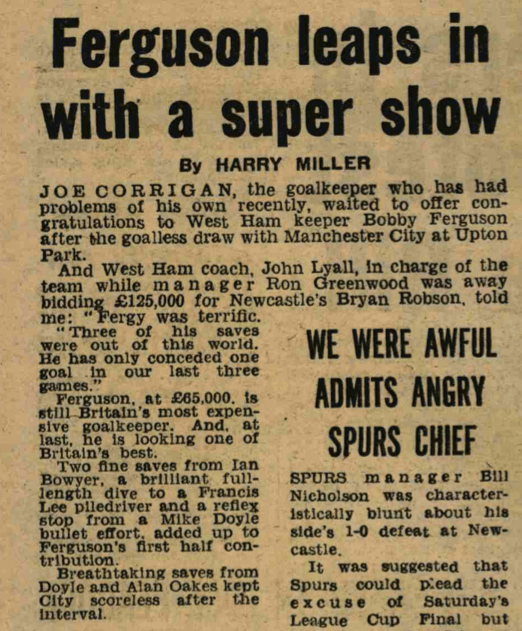
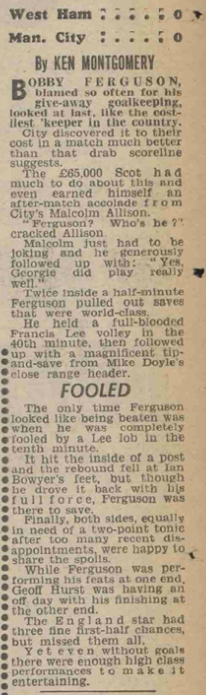
On this day (20 February) in 1971 Manchester City played out a goalless game at West Ham United. Often games without goals are perceived as dull but this match was full of goal action – even if no actual goals were scored. The brilliance of West Ham’s ‘keeper ensured Manchester City could not score and at the end of the game City’s Joe Corrigan ensured he congratulated Ferguson, even if Malcolm Allison joked that he had no idea who journalists were talking about when they asked him about the Hammers’ goalie. Here’s a report of the game:

Every day in January and February so far has offered something to enjoy in this series focusing on Manchester City in the 1970s. Subscribers can access everything. If you want to know more on this incredible decade for Manchester City Football Club then why not subscribe and read it all? You could even subscribe for a month and see what you think. The following 5,200 word article is on the 1970-71 season and is available to subscribers below. Enjoy!

Subscribe to get access – Monthly

Read more of this content when you subscribe today. It costs £3 per month (cancel anytime) to access everything posted since 1 October 2022 or there’s a special annual rate below which gives greater access and works out much cheaper.

Subscribe to get access – Annual

Read more of this content when you subscribe today. It costs £3 per month (above) or £20 a year (here) to access everything posted since the site was created in December 2020. This special rate works out about £1.67 a week and gives access to everything posted, including PDFs of 3 of my books.

If you’d like to know more about subscribing then see:

If you enjoy all the free material on my website and would like to support my research and keep this website going (but don’t want to subscribe) then why not make a one-time donation (or buy me a coffee). All support for my research is valued and welcome. It allows me to keep some free material available for all. Thanks.

Choose an amount

£2.50
£5.00
£7.50

Or enter a custom amount

£

Your contribution is appreciated.

Donate

The 1970s: Power Cut City!

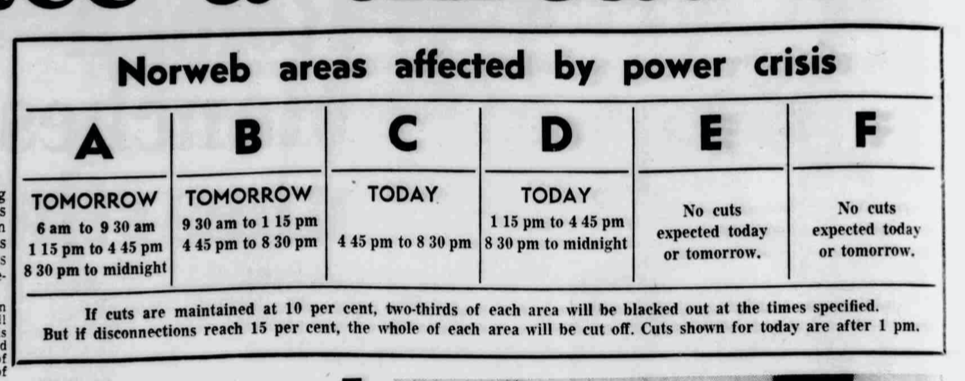
The series of features/articles covering Manchester City in the 1970s continues with a brief flashback to a time when industrial action and power cuts led to us all having to look in the local newspaper to see when our electricity would be available. It feels like an alien world today but in February 1971 (and at other times in the years that followed) electricity was provided at certain times of the day in certain areas. This led to games being re-arranged for afternoon kick offs or postponed altogether.

On this day (15 February) Liverpool newspapers carried the story that LFC’s match with Manchester City would be one game played earlier in the day.

These newspaper cuttings give a brief idea of how it all was. If there’s interest I may do a more detailed piece on this later. There’s a famous gave v Coventry a few years later that I remember being at. That day a generator ensured the match went ahead but we also had a bomb scare. We were asked to look under our seats and around us to see if there was a bomb there (seriously!) and play was halted. Mike Summerbee (in my memory but others say it was the referee) picked up the ball and shook it to see if it was a bomb! More of that another day. Here are the cuttings from today in 1971:

There have been flashbacks to great 1970s games, players and more every day in January & February. Subscribers get access to everything. If you want to know more on this incredible decade for Manchester City Football Club then why not subscribe and read it all? You could even subscribe for a month and see what you think. The following 5,200 word article is on the 1970-71 season and is available to subscribers below. Enjoy!

Subscribe to get access – Monthly

Read more of this content when you subscribe today. It costs £3 per month (cancel anytime) to access everything posted since 1 October 2022 or there’s a special annual rate below which gives greater access and works out much cheaper.

Subscribe to get access – Annual

Read more of this content when you subscribe today. It costs £3 per month (above) or £20 a year (here) to access everything posted since the site was created in December 2020. This special rate works out about £1.67 a week and gives access to everything posted, including PDFs of 3 of my books.

If you’d like to know more about subscribing then see:

If you enjoy all the free material on my website and would like to support my research and keep this website going (but don’t want to subscribe) then why not make a one-time donation (or buy me a coffee). All support for my research is valued and welcome. It allows me to keep some free material available for all. Thanks.

Choose an amount

£2.50
£5.00
£7.50

Or enter a custom amount

£

Your contribution is appreciated.

Donate

The 1970s: Malcolm Allison

The series of features/articles covering Manchester City in the 1970s continues with this article on Malcolm Allison. Allison’s two spells as City manager only saw the Blues receive one trophy – the 1972 Charity Shield – however he deserves to be profiled as his contribution during the glory years of 1965 to 1972 was equal to that of manager Joe Mercer.

Allison arrived at Maine Road in July 1965 as assistant manager to Mercer, and by the time he left for the first time over seven years later, City had won almost every trophy possible. 

During that time Allison worked closely with the players and it’s worth noting that the close relationship he developed with the players fostered a great team spirit which, possibly above all else, helped the Blues succeed.  Allison’s influence was felt throughout the club and his approach was refreshing.  He was like a breath of fresh air and helped bring life to the club after a particularly depressing spell – remember earlier in 1965 the club attracted only eight thousand for a couple of League games and some felt the Blues would never return to the top flight never mind find trophy success.

Allison was a major influence throughout the club and his ‘fortune favours the brave’ swashbuckling approach helped sweep aside all opposition.  In fact as the 1960s progressed Allison typified Sixties Manchester, and he became a man idolised by most Blues and many neutrals.  He had a certain charisma which few leading footballing figures possessed at the time, and his dynamism was infectious.  If Allison said City was going to win everybody believed him; when he said City would terrify Europe no one doubted him.  Of course, the terrify Europe comment came to haunt him when the Blues were defeated by Fenerbahce in their first European tie, however Allison had the last laugh when City won the European Cup Winners’ Cup the following season.  When I interviewed him in the early 1990s he laughed: “I said we’d terrify Europe, but I didn’t say when!”

During his time at Maine Road Allison was responsible for a number of the key transfers which transformed the club’s fortunes.  Colin Bell and Francis Lee were two signings he claimed personal credit for when I interviewed him: “When I signed Bell I had to pretend he was no good to put the other clubs off because we didn’t have enough money and couldn’t afford to get into a bidding war.  With Francis Lee I told him I’d make him a great player, and when I left the room he told everyone I was an arrogant so and so!  But he did join us and he was a great player, perhaps the key to the Championship success.”

Allison was also responsible for the arrival of captain Tony Book.  Book brought a steadying influence to City both in defence and across the pitch, and flourished at Maine Road as a player and later as a manager.

Another great aspect of Allison’s time at City was his ability to grab the headlines for the club. Prior to his arrival, City struggled to get positive coverage in the local press but, together with Joe Mercer, Allison knew how to bring attention to the club.  Mercer was the all-smiling public establishment type figure who would provide a serious story in a light-hearted way, while Allison was more boastful and always likely to make the bold statements many supporters demanded.  Allison would often taunt the opposition.  He once walked up to the Stretford End before an early seventies derby match and held up four fingers to indicate how many goals he expected City to score against the Reds.  Understandably, the United fans hurled abuse at him, but by the end of the match the confident Allison was laughing as City won 4-1. That’s why he was such an important figure. He understood what made City tick.

Sadly, the early seventies saw a rift between Mercer and Allison – they supported different groups during a takeover battle – and the partnership fell apart.  Allison became Manager in his own right but he was no longer able to motivate himself in the right way. In 1992 he told me: “Kenny Dalglish wanted a sabbatical at Liverpool to ease the pressure a few years back, and I think if I’d been offered something similar I’d have come back stronger but in those days you either managed or left.  There was no choice.”

Allison then started a journey which would see him return to Maine Road in 1979, as well as have spells at Crystal Palace, Lisbon, Istanbul, Middlesbrough, Kuwait, and a whole host of other locations.  Some like his image were exotic, others were not.  He achieved some real success – most notably in Portugal – and some abject failure but he always remained the ‘Big Mal’ every City fan loved. His last public managerial role saw him help Bristol Rovers face Ron Atkinson’s Aston Villa in the Cup during the 1992-3 season. The media had described it as ‘Big Mal V Big Ron’ but Allison insisted on telling the BBC that he was the only ‘Big’ in football and that his opponent was ‘Fat Ron’.  It didn’t alter the result of the game, but it gained the headlines.

Of course, despite Allison’s enormous role in Manchester football it has to be stressed that his second spell at Maine Road was not a successful period.  With hindsight Allison should never have returned, but when the announcement had initially been made there wasn’t a single supporter who complained.  Everybody wanted him back.

Allison remains one of the most important figures in the history of the club and in European football.

This series of articles and features on Manchester City in the 1970s has been running throughout January and February with indepth articles some days and smaller ‘on this day’ style posts on others. Every day offered something to enjoy.

Subscribers have access to everything. If you want to know more on this incredible decade for Manchester City Football Club then why not subscribe and read it all? You could even subscribe for a month and see what you think. The following 1,700 word article is on the 1972-73 season and is available to subscribers below. Enjoy!

Subscribe to get access – Monthly

Read more of this content when you subscribe today. It costs £3 per month (cancel anytime) to access everything posted since 1 October 2022 or there’s a special annual rate below which gives greater access and works out much cheaper.

Subscribe to get access – Annual

Read more of this content when you subscribe today. It costs £3 per month (above) or £20 a year (here) to access everything posted since the site was created in December 2020. This special rate works out about £1.67 a week and gives access to everything posted, including PDFs of 3 of my books.

If you’d like to know more about subscribing then see:

If you enjoy all the free material on my website and would like to support my research and keep this website going (but don’t want to subscribe) then why not make a one-time donation (or buy me a coffee). All support for my research is valued and welcome. It allows me to keep some free material available for all. Thanks.

Choose an amount

£2.50
£5.00
£7.50

Or enter a custom amount

£

Your contribution is appreciated.

Donate

The 1970s: A Tight Game at Arsenal

The series of features/articles covering Manchester City in the 1970s continues with this video flashback to a game at Arsenal on this day (6 February) in 1971. It’s a Manchester City defeat but well worth watching for several great saves/goalline clearances in what was an extremely close match. Watch out also for Arthur Mann and Freddie Hill – two players who are not often seen on film during their City days.

Corrigan did not deserve to lose this game!

This series of articles and features on Manchester City in the 1970s has been running during January and February 2024 with indepth articles some days and smaller ‘on this day’ style posts on others.

Subscribers will get access to everything. If you want to know more on this incredible decade for Manchester City Football Club then why not subscribe and read it all? You could even subscribe for a month and see what you think. The following 5,200 word article is on the 1970-71 season and is available to subscribers below. Enjoy!

Subscribe to get access – Monthly

Read more of this content when you subscribe today. It costs £3 per month (cancel anytime) to access everything posted since 1 October 2022 or there’s a special annual rate below which gives greater access and works out much cheaper.

Subscribe to get access – Annual

Read more of this content when you subscribe today. It costs £3 per month (above) or £20 a year (here) to access everything posted since the site was created in December 2020. This special rate works out about £1.67 a week and gives access to everything posted, including PDFs of 3 of my books.

If you’d like to know more about subscribing then see:

If you enjoy all the free material on my website and would like to support my research and keep this website going (but don’t want to subscribe) then why not make a one-time donation (or buy me a coffee). All support for my research is valued and welcome. It allows me to keep some free material available for all. Thanks.

Choose an amount

£2.50
£5.00
£7.50

Or enter a custom amount

£

Your contribution is appreciated.

Donate