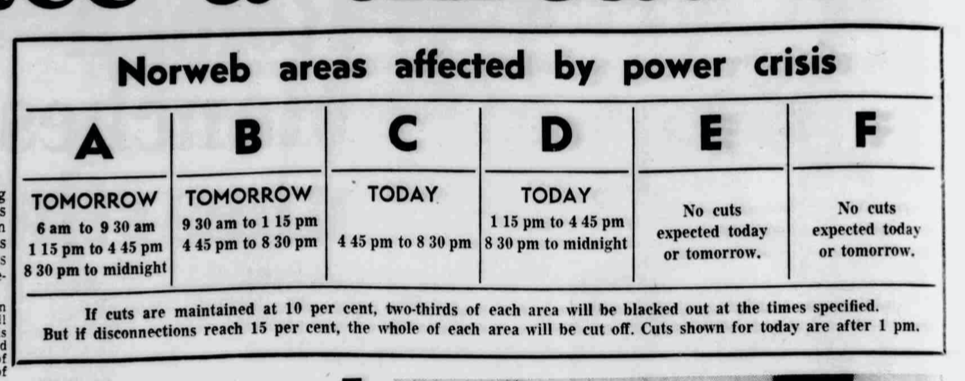
The series of features/articles covering Manchester City in the 1970s continues with a brief flashback to a time when industrial action and power cuts led to us all having to look in the local newspaper to see when our electricity would be available. It feels like an alien world today but in February 1971 (and at other times in the years that followed) electricity was provided at certain times of the day in certain areas. This led to games being re-arranged for afternoon kick offs or postponed altogether.
On this day (15 February) Liverpool newspapers carried the story that LFC’s match with Manchester City would be one game played earlier in the day.
These newspaper cuttings give a brief idea of how it all was. If there’s interest I may do a more detailed piece on this later. There’s a famous gave v Coventry a few years later that I remember being at. That day a generator ensured the match went ahead but we also had a bomb scare. We were asked to look under our seats and around us to see if there was a bomb there (seriously!) and play was halted. Mike Summerbee (in my memory but others say it was the referee) picked up the ball and shook it to see if it was a bomb! More of that another day. Here are the cuttings from today in 1971:
There have been flashbacks to great 1970s games, players and more every day in January & February. Subscribers get access to everything. If you want to know more on this incredible decade for Manchester City Football Club then why not subscribe and read it all? You could even subscribe for a month and see what you think. The following 5,200 word article is on the 1970-71 season and is available to subscribers below. Enjoy!
Subscribe to get access – Monthly
Read more of this content when you subscribe today. It costs £3 per month (cancel anytime) to access everything posted since 1 October 2022 or there’s a special annual rate below which gives greater access and works out much cheaper.
Read more of this content when you subscribe today. It costs £3 per month (above) or £20 a year (here) to access everything posted since the site was created in December 2020. This special rate works out about £1.67 a week and gives access to everything posted, including PDFs of 3 of my books.
If you enjoy all the free material on my website and would like to support my research and keep this website going (but don’t want to subscribe) then why not make a one-time donation (or buy me a coffee). All support for my research is valued and welcome. It allows me to keep some free material available for all. Thanks.
The series of features/articles covering Manchester City in the 1970s continues with this article on Malcolm Allison. Allison’s two spells as City manager only saw the Blues receive one trophy – the 1972 Charity Shield – however he deserves to be profiled as his contribution during the glory years of 1965 to 1972 was equal to that of manager Joe Mercer.
Allison arrived at Maine Road in July 1965 as assistant manager to Mercer, and by the time he left for the first time over seven years later, City had won almost every trophy possible.
During that time Allison worked closely with the players and it’s worth noting that the close relationship he developed with the players fostered a great team spirit which, possibly above all else, helped the Blues succeed. Allison’s influence was felt throughout the club and his approach was refreshing. He was like a breath of fresh air and helped bring life to the club after a particularly depressing spell – remember earlier in 1965 the club attracted only eight thousand for a couple of League games and some felt the Blues would never return to the top flight never mind find trophy success.
Allison was a major influence throughout the club and his ‘fortune favours the brave’ swashbuckling approach helped sweep aside all opposition. In fact as the 1960s progressed Allison typified Sixties Manchester, and he became a man idolised by most Blues and many neutrals. He had a certain charisma which few leading footballing figures possessed at the time, and his dynamism was infectious. If Allison said City was going to win everybody believed him; when he said City would terrify Europe no one doubted him. Of course, the terrify Europe comment came to haunt him when the Blues were defeated by Fenerbahce in their first European tie, however Allison had the last laugh when City won the European Cup Winners’ Cup the following season. When I interviewed him in the early 1990s he laughed: “I said we’d terrify Europe, but I didn’t say when!”
During his time at Maine Road Allison was responsible for a number of the key transfers which transformed the club’s fortunes. Colin Bell and Francis Lee were two signings he claimed personal credit for when I interviewed him: “When I signed Bell I had to pretend he was no good to put the other clubs off because we didn’t have enough money and couldn’t afford to get into a bidding war. With Francis Lee I told him I’d make him a great player, and when I left the room he told everyone I was an arrogant so and so! But he did join us and he was a great player, perhaps the key to the Championship success.”
Allison was also responsible for the arrival of captain Tony Book. Book brought a steadying influence to City both in defence and across the pitch, and flourished at Maine Road as a player and later as a manager.
Another great aspect of Allison’s time at City was his ability to grab the headlines for the club. Prior to his arrival, City struggled to get positive coverage in the local press but, together with Joe Mercer, Allison knew how to bring attention to the club. Mercer was the all-smiling public establishment type figure who would provide a serious story in a light-hearted way, while Allison was more boastful and always likely to make the bold statements many supporters demanded. Allison would often taunt the opposition. He once walked up to the Stretford End before an early seventies derby match and held up four fingers to indicate how many goals he expected City to score against the Reds. Understandably, the United fans hurled abuse at him, but by the end of the match the confident Allison was laughing as City won 4-1. That’s why he was such an important figure. He understood what made City tick.
Sadly, the early seventies saw a rift between Mercer and Allison – they supported different groups during a takeover battle – and the partnership fell apart. Allison became Manager in his own right but he was no longer able to motivate himself in the right way. In 1992 he told me: “Kenny Dalglish wanted a sabbatical at Liverpool to ease the pressure a few years back, and I think if I’d been offered something similar I’d have come back stronger but in those days you either managed or left. There was no choice.”
Allison then started a journey which would see him return to Maine Road in 1979, as well as have spells at Crystal Palace, Lisbon, Istanbul, Middlesbrough, Kuwait, and a whole host of other locations. Some like his image were exotic, others were not. He achieved some real success – most notably in Portugal – and some abject failure but he always remained the ‘Big Mal’ every City fan loved. His last public managerial role saw him help Bristol Rovers face Ron Atkinson’s Aston Villa in the Cup during the 1992-3 season. The media had described it as ‘Big Mal V Big Ron’ but Allison insisted on telling the BBC that he was the only ‘Big’ in football and that his opponent was ‘Fat Ron’. It didn’t alter the result of the game, but it gained the headlines.
Of course, despite Allison’s enormous role in Manchester football it has to be stressed that his second spell at Maine Road was not a successful period. With hindsight Allison should never have returned, but when the announcement had initially been made there wasn’t a single supporter who complained. Everybody wanted him back.
Allison remains one of the most important figures in the history of the club and in European football.
This series of articles and features on Manchester City in the 1970s has been running throughout January and February with indepth articles some days and smaller ‘on this day’ style posts on others. Every day offered something to enjoy.
Subscribers have access to everything. If you want to know more on this incredible decade for Manchester City Football Club then why not subscribe and read it all? You could even subscribe for a month and see what you think. The following 1,700 word article is on the 1972-73 season and is available to subscribers below. Enjoy!
Subscribe to get access – Monthly
Read more of this content when you subscribe today. It costs £3 per month (cancel anytime) to access everything posted since 1 October 2022 or there’s a special annual rate below which gives greater access and works out much cheaper.
Read more of this content when you subscribe today. It costs £3 per month (above) or £20 a year (here) to access everything posted since the site was created in December 2020. This special rate works out about £1.67 a week and gives access to everything posted, including PDFs of 3 of my books.
If you enjoy all the free material on my website and would like to support my research and keep this website going (but don’t want to subscribe) then why not make a one-time donation (or buy me a coffee). All support for my research is valued and welcome. It allows me to keep some free material available for all. Thanks.
The series of features/articles covering Manchester City in the 1970s continues with this video flashback to a game at Arsenal on this day (6 February) in 1971. It’s a Manchester City defeat but well worth watching for several great saves/goalline clearances in what was an extremely close match. Watch out also for Arthur Mann and Freddie Hill – two players who are not often seen on film during their City days.
Corrigan did not deserve to lose this game!
This series of articles and features on Manchester City in the 1970s has been running during January and February 2024 with indepth articles some days and smaller ‘on this day’ style posts on others.
Subscribers will get access to everything. If you want to know more on this incredible decade for Manchester City Football Club then why not subscribe and read it all? You could even subscribe for a month and see what you think. The following 5,200 word article is on the 1970-71 season and is available to subscribers below. Enjoy!
Subscribe to get access – Monthly
Read more of this content when you subscribe today. It costs £3 per month (cancel anytime) to access everything posted since 1 October 2022 or there’s a special annual rate below which gives greater access and works out much cheaper.
Read more of this content when you subscribe today. It costs £3 per month (above) or £20 a year (here) to access everything posted since the site was created in December 2020. This special rate works out about £1.67 a week and gives access to everything posted, including PDFs of 3 of my books.
If you enjoy all the free material on my website and would like to support my research and keep this website going (but don’t want to subscribe) then why not make a one-time donation (or buy me a coffee). All support for my research is valued and welcome. It allows me to keep some free material available for all. Thanks.
Colin Bell getting angry in a game? No, never! Err, yes actually. The unassuming, introverted Colin Bell had had enough on this day (30 January) in 1971 and you can see exactly why and his reaction in this video clip.
It’s actually a City defeat at home to Leeds but it is worth watching for Bell’s reaction – a nice reminder that all players have moments when they get angry with the ref. In the clip you’ll notice that it’s Francis Lee who acts as the calming influence with Bell – you’d expect it to be the other way around!
Also, look out for the old Invacar disabled cars parked pitchside in the corner between Kippax and Platt Lane. Just before Leeds score their second you can see that one of the guys in an Invacar has his windscreen wiper on – looking at the conditions it must have been difficult to see at times from inside those vehicles. Prior to this clip ITV presenter Brian Moore had told viewers that this was third placed City v leaders Leeds and that there was no game of more significance in the League that week.
This is part of my series of features/articles covering Manchester City in the 1970s. Watch the highlights of this game here:
Were you at the game and do you remember it? Feel free to give your story in the comments.
This series of articles and features on Manchester City in the 1970s will run throughout January with indepth articles some days and smaller ‘on this day’ style posts on others. There will be flashbacks to great games, players and more. Every day in January will offer something to enjoy.
Subscribers will get access to everything. If you want to know more on this incredible decade for Manchester City Football Club then why not subscribe and read it all? You could even subscribe for a month and see what you think. The following 5,200 word article is on the 1970-71 season and is available to subscribers below. Enjoy!
Subscribe to get access – Monthly
Read more of this content when you subscribe today. It costs £3 per month (cancel anytime) to access everything posted since 1 October 2022 or there’s a special annual rate below which gives greater access and works out much cheaper.
Read more of this content when you subscribe today. It costs £3 per month (above) or £20 a year (here) to access everything posted since the site was created in December 2020. This special rate works out about £1.67 a week and gives access to everything posted, including PDFs of 3 of my books.
If you enjoy all the free material on my website and would like to support my research and keep this website going (but don’t want to subscribe) then why not make a one-time donation (or buy me a coffee). All support for my research is valued and welcome. It allows me to keep some free material available for all. Thanks.
The series of features/articles covering Manchester City in the 1970s continues with this video clip of City away at Chelsea in the FA Cup on this day (23 January) in 1971. Watch the footage below to see two nice goals from Colin Bell and another from Ian Bowyer, which owed much to Bell too. Bell was wonderful this day but sadly only these brief black and white highlights remain. Watch it here:
Were you at the game and do you remember it? Feel free to give your story in the comments.
This series of articles and features on Manchester City in the 1970s will run throughout January with indepth articles some days and smaller ‘on this day’ style posts on others. There will be flashbacks to great games, players and more. Every day in January will offer something to enjoy.
Subscribers will get access to everything. If you want to know more on this incredible decade for Manchester City Football Club then why not subscribe and read it all? You could even subscribe for a month and see what you think. The following 5,200 word article is on the 1970-71 season and is available to subscribers below. Enjoy!
Subscribe to get access – Monthly
Read more of this content when you subscribe today. It costs £3 per month (cancel anytime) to access everything posted since 1 October 2022 or there’s a special annual rate below which gives greater access and works out much cheaper.
Read more of this content when you subscribe today. It costs £3 per month (above) or £20 a year (here) to access everything posted since the site was created in December 2020. This special rate works out about £1.67 a week and gives access to everything posted, including PDFs of 3 of my books.
If you enjoy all the free material on my website and would like to support my research and keep this website going (but don’t want to subscribe) then why not make a one-time donation (or buy me a coffee). All support for my research is valued and welcome. It allows me to keep some free material available for all. Thanks.
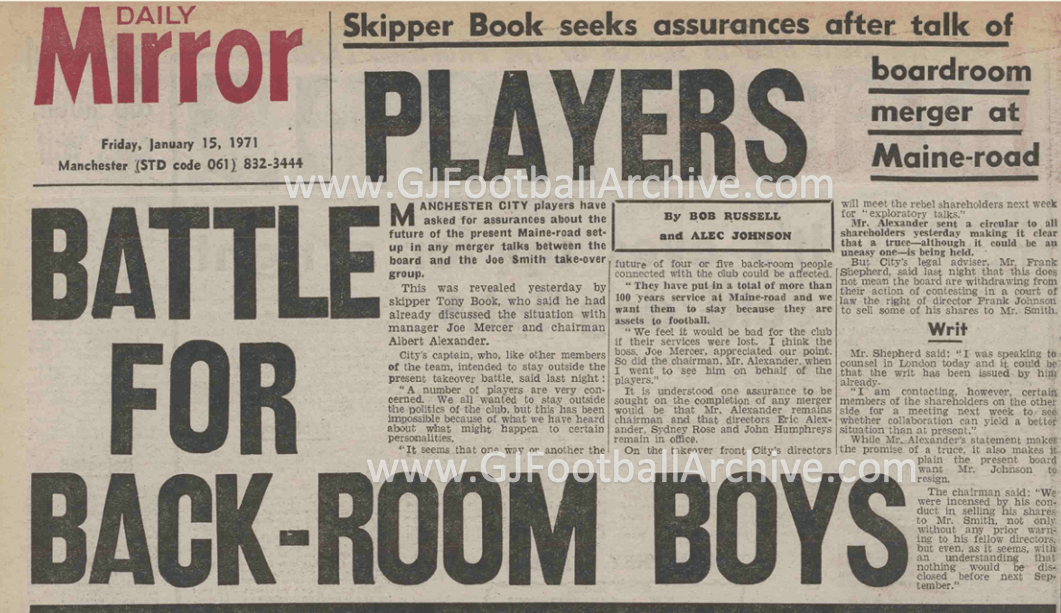
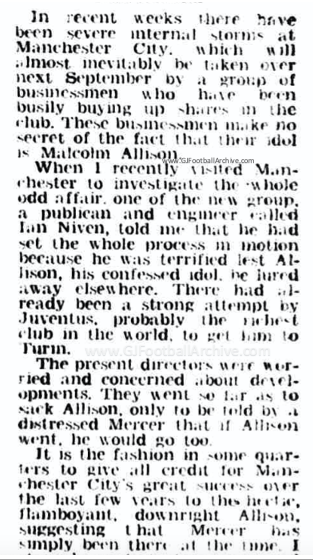
The series of features/articles covering Manchester City in the 1970s continues with this newspaper reminder (published on this day – 15 January – in 1971) of the bitter takeover that killed off Manchester City’s period of trophy-winning dominance and ultimately led to Peter Swales becoming chairman. It’s something that dragged the first team into the takeover battle and pitted manager Joe Mercer and assistant Malcolm Allison on opposite sides. Those seeking to takeover the club, including future director Ian Niven, believed Joe Mercer contributed nothing to MCFC (he told me this himself in April 1989 – at that time Mercer remained the most successful City manager ever) and they split up the partnership. Not only that but they started the process which led to City being downgraded and becoming a fallen giant. Here’s another cutting from January 1971 which fits with the comments I’ve just made (that end line seems to be referring to Niven & others involved with the takeover):
Some of those involved with the takeover managed to create positions for themselves which gave them status for decades at the club, while men like Mercer were cast aside. Oh, I could go on for hours about this period! If you would like to know more then this 5,200 word article on the entire 1970-71 season may help explain some of these points.
Subscribe to get access – Monthly
Read more of this content when you subscribe today. It costs £3 per month (cancel anytime) to access everything posted since 1 October 2022 or there’s a special annual rate below which gives greater access and works out much cheaper.
Read more of this content when you subscribe today. It costs £3 per month (above) or £20 a year (here) to access everything posted since the site was created in December 2020. This special rate works out about £1.67 a week and gives access to everything posted, including PDFs of 3 of my books.
If you enjoy all the free material on my website and would like to support my research and keep this website going (but don’t want to subscribe) then why not make a one-time donation (or buy me a coffee). All support for my research is valued and welcome. It allows me to keep some free material available for all. Thanks.
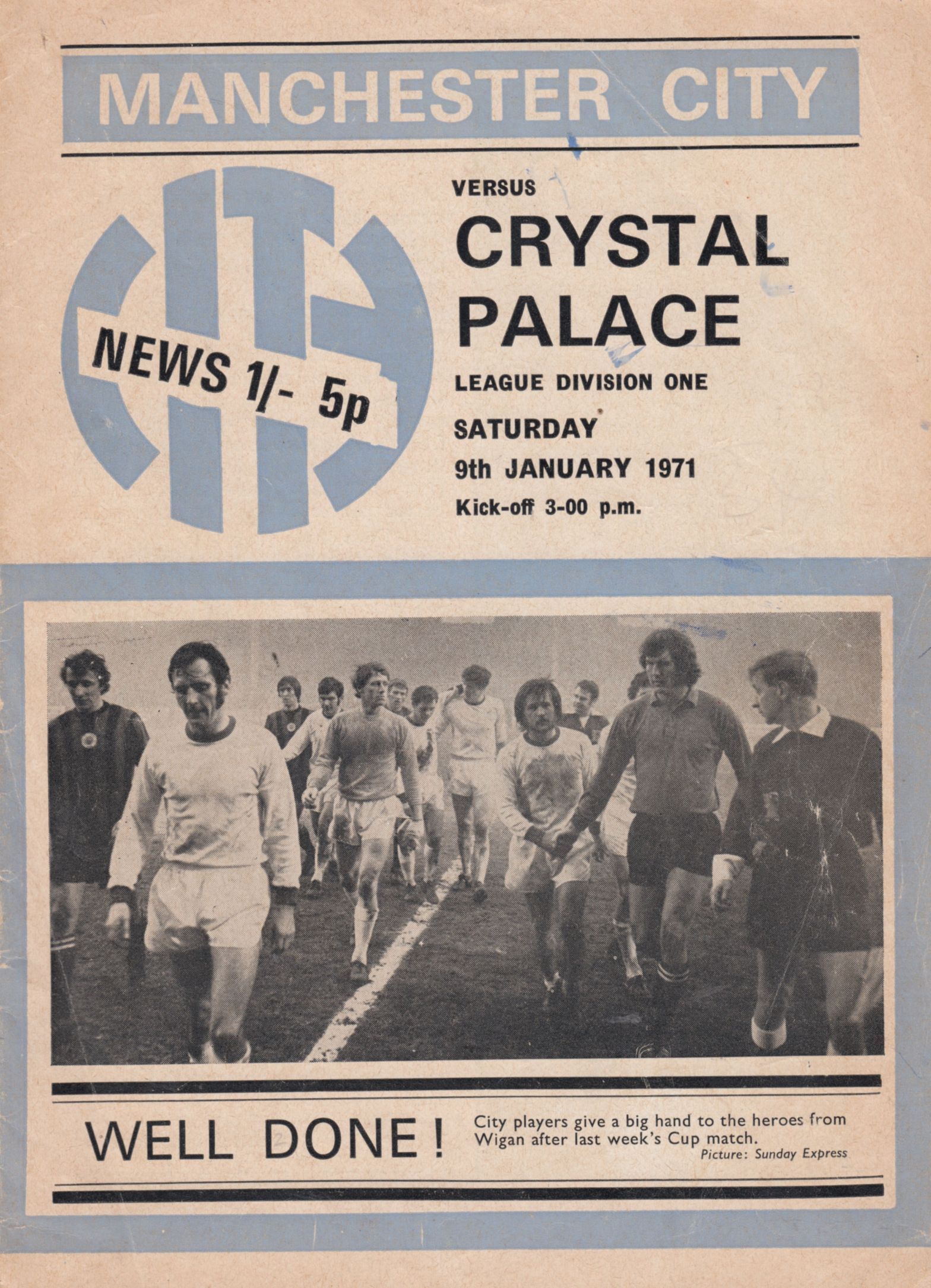
The series of features/articles covering Manchester City in the 1970s continues with this video clip of Tony Book scoring on this day (9 January) in 1971 against against Crystal Palace in the League. Substitute Freddie Hill, who had just come on for Neil Young, made the goal with his first kick according to the commentary. Watch it here:
Were you at the game and do you remember it? Feel free to give your story in the comments.
This series of articles and features on Manchester City in the 1970s will run throughout January with indepth articles some days and smaller ‘on this day’ style posts on others. There will be flashbacks to great games, players and more. Every day in January will offer something to enjoy.
Subscribers will get access to everything. If you want to know more on this incredible decade for Manchester City Football Club then why not subscribe and read it all? You could even subscribe for a month and see what you think. The following 5,200 word article is on the 1970-71 season and is available to subscribers below. Enjoy!
Subscribe to get access – Monthly
Read more of this content when you subscribe today. It costs £3 per month (cancel anytime) to access everything posted since 1 October 2022 or there’s a special annual rate below which gives greater access and works out much cheaper.
Read more of this content when you subscribe today. It costs £3 per month (above) or £20 a year (here) to access everything posted since the site was created in December 2020. This special rate works out about £1.67 a week and gives access to everything posted, including PDFs of 3 of my books.
If you enjoy all the free material on my website and would like to support my research and keep this website going (but don’t want to subscribe) then why not make a one-time donation (or buy me a coffee). All support for my research is valued and welcome. It allows me to keep some free material available for all. Thanks.
The series of features/articles covering Manchester City in the 1970s continues with a 5,200 word article on the entire 1970-71 season. You can read this below. This series of articles and features on Manchester City in the 1970s will run throughout January with indepth articles some days and smaller ‘on this day’ style posts on others. There will be flashbacks to great games, players and more. Every day in January will offer something to enjoy.
Subscribers will get access to everything. If you want to know more on this incredible decade for Manchester City Football Club then why not subscribe and read it all? You could even subscribe for a month and see what you think. The following 5,200 word article is on the 1970-71 season and is available to subscribers below. Enjoy!
Subscribe to get access – Monthly
Read more of this content when you subscribe today. It costs £3 per month (cancel anytime) to access everything posted since 1 October 2022 or there’s a special annual rate below which gives greater access and works out much cheaper.
Read more of this content when you subscribe today. It costs £3 per month (above) or £20 a year (here) to access everything posted since the site was created in December 2020. This special rate works out about £1.67 a week and gives access to everything posted, including PDFs of 3 of my books.
If you enjoy all the free material on my website and would like to support my research and keep this website going (but don’t want to subscribe) then why not make a one-time donation (or buy me a coffee). All support for my research is valued and welcome. It allows me to keep some free material available for all. Thanks.
The series of features/articles covering Manchester City in the 1970s continues with the day the Northern Premier League’s Wigan Athletic came to Maine Road to face the ECWC & League Cup holders City. Who’d have thought that one day these two clubs would meet in a FA Cup final and that Wigan would be victorious? Hang on, let’s not talk about that. Let’s get back to the 1970s…
Colin Bell netted the only goal of this day (2 January) in 1971 and you can watch it here:
The Wigan Athletic Supporters Club website tells the Wigan perspective on this day and is well worth reading:
‘The third round draw pitted them against Manchester City away at Maine Road. City at the time were holders of the League Cup and European Cup-Winners Cup and were doing well in the League. Their team that day, 2 January 1971, was full of star names: Joe Corrigan in goal; Tony Book, Arthur Mann, Mike Doyle, Tommy Booth, Alan Oakes, Mike Summerbee, Colin Bell, Francis Lee, Neil Young and Derek Jeffries, with Frank Carrodus on the bench.
‘Latics had in their line-up Dennis Reeves; Alan Turner, Billy Sutherland, Gordon Milne, Doug Coutts, Ian Gillibrand, Derek Temple, Bobby Todd, Geoff Davies, Jim Fleming and Graham Oates with sub Ian Ledgard.
‘The referee was one of the top officials of the time, Pat Partridge from Middlesbrough.
‘Both teams changed their strip, City into their renowned (at the time) black and red striped shirts with black shorts – the colours they’d worn to victory in both the FA Cup in 1969 and the European Cup-Winners Cup in 1970. Latics wore all white with blue trim. But best of all, BBC’s “Match of the Day” cameras were there to record the scene.
‘Not being overawed by their European trophy-holding opponents, or by the 46,212 fans, Latics held out until the 72nd minute when goalkeeper Dennis Reeves’ boot split when taking a goal-kick. The ball went to Neil Young, who flicked it inside to Colin Bell, who made no mistake. One goal was enough for City, and two late fine saves from Joe Corrigan put paid to Latics’ dreams. They received a standing ovation from the crowd.‘
You can read more on Wigan’s season and history at the Wigan Athletic Supporters Club website:
This series of articles and features on Manchester City in the 1970s will run throughout January with indepth articles some days and smaller ‘on this day’ style posts on others. There will be flashbacks to great games, players and more. Every day in January will offer something to enjoy.
If you enjoy all the free material on my website and would like to support my research and keep this website going (but don’t want to subscribe) then why not make a one-time donation (or buy me a coffee). All support for my research is valued and welcome. It allows me to keep some free material available for all. Thanks.
Subscribers will get access to everything. If you want to know more on this incredible decade for Manchester City Football Club then why not subscribe and read it all? You could even subscribe for a month and see what you think. The following 5,600 word article is on the successes of 1970 and is available to subscribers below. Enjoy!
Subscribe to get access – Monthly
Read more of this content when you subscribe today. It costs £3 per month (cancel anytime) to access everything posted since 1 October 2022 or there’s a special annual rate below which gives greater access and works out much cheaper.
Read more of this content when you subscribe today. It costs £3 per month (above) or £20 a year (here) to access everything posted since the site was created in December 2020. This special rate works out about £1.67 a week and gives access to everything posted, including PDFs of 3 of my books.
Following the unveiling of the Bell, Lee and Summerbee statue earlier this week I’ve decided to re-publish here interviews I did with each player at some point over the last decade or so. These interviews are written in a question and answer style and I hope they help give a flavour of each man. For older fans it’s a chance to remember them in their pomp. Today it’s the turn of Mike Summerbee. I’ve never posted this before on here – It’s an interview I did with him City in April 2005. This was published in the City match programme back then and you can read Mike’s views on his career here as published at the time. Enjoy!
Mike Summerbee was the second player, after Ralph Brand to join Joe Mercer’s City in 1965. Over the following decade he became a major star and played a significant role throughout the Mercer-Allison glory years. Always the entertainer, Mike featured in the classic footballing wartime adventure film “Escape To Victory” and today assists the Club’s commercial activities. Last week author Gary James caught up with him at the Manchester City Experience.
Let’s start with “Escape To Victory”. How did you get involved in the filming of that movie?
It was Bobby Moore who got me involved. We’d known each other since I was 16, and we both had a similar outlook. The makers of the film had got several Ipswich Town players involved, plus Pele and of course Bobby. They needed another familiar British player and Bobby suggested me. He called me and said: “How do you fancy being in a movie with Michael Caine?” And that was it. Within three weeks I was on my way to Budapest for filming. I had no idea at the time that this would become one of those films still being shown and talked about twenty odd years later, but it has become a cult movie with websites dedicated to it. It’s the sort of film that many other people would have wanted to be in. I know for a fact that Rod Stewart wanted to be in it.
Why do you think the film is remembered so affectionately?
I don’t want to give too much away – everyone should come to our special showing and see the movie and hear my reasons then – but the film is like a Boys’ Own adventure. It’s got drama, excitement, and is a traditional film. It doesn’t rely on bad language, sex, or extreme violence, and it really does appeal to everyone. Don’t forget it also contains some great actors – everyone remembers Stallone and Caine but look at the other cast members as well – and then there are some very well known footballers including Pele.
I loved making the film and one of the great aspects for me was that when we came to the football scenes we were told to go out and play the game. John Huston – a great director – wanted it to look as realistic as possible and so we played a real game. Inevitably we had spells concentrating on tackling or shooting but much of the game came from real play. Pele’s wonderful overhead kick goal was natural and was done only once. We didn’t take ages setting up, re-shooting etc. It was done for real and only in one take. John Huston had cameras everywhere and tried to make sure everything that took place on the pitch was filmed from every angle. That makes it so much more real.
You have a speaking part in the film, did you know about that before you accepted?
We were told to let the actors act and they were told to let the footballers play. That way we all did what we were good at. Then when it came to the dressing room scenes Michael Caine said to Huston that it didn’t feel right for only the actors to talk and he said that a couple of us should speak. When it came to half time, I congratulated a couple of players on their play – that was natural not planned – and that stayed in, and then other lines were given to us. It felt strange, but when you watch the film it makes much more sense to have us speaking. I loved making the film and there are so many different aspects to talk about, but we’ll save that for the 5th May event.
Moving back to your playing career, we all know that you came from a footballing family, but did that mean it was something you had to do?
My dad played professionally and so from an early age it seemed natural to play. All boys loved playing back then anyway, so there was nothing strange about that, but I suppose when you are young whatever your father does has a greater importance. My brother was a better player than I, although he stopped playing when my Dad died, and we used to play whenever and wherever we could. I’d get to school as early as possible – not for the lessons, I was a dunce! – but for the kickabout. We’d have a tennis ball and play until we had to go in. I also played cricket, athletics and other sports, but football was my best.
Your progression into professional football seems rapid – you were a key feature of the Swindon team in your teens – were there any setbacks?
I’d had a spell at Bristol City when I was 15, but I was so homesick I had to give up on it. My mother worried about me and suggested I kept out of the game. She knew about the problems and difficulties a footballer could have because of my father’s career, and then the opportunity came with Swindon and everything started going right for me. I joined them at a time when they were ready to give youth a chance and I made my debut at 17.
Was life relatively easy for you then?
The life of a footballer was not as glamorous or financially rewarding as it is today. I loved playing and I loved the camaraderie of it all, but we all had to have other jobs to keep us going outside of the season. I used to end up working for the Corporation cutting grass, painting, oddjobs, and digging graves! It kept you in touch with the fans – both the living and the dead! – and I actually loved all of that time. We didn’t have flash cars or anything then. In fact Ernie Hunt and I had a tandem, and we used to cycle together on our tandem to the ground. It was a great, fun time, and I have very fond memories of it all.
One of the significant angles is that Joe Mercer was interested in signing you from fairly early in your career, were you aware of his interest?
To some extent yes. Joe had played with my father at Aldershot, and then Swindon played Joe’s Aston Villa in a testimonial game. We won and I scored a couple, and Joe even played wing-half for Villa. After that I was told he wanted to sign me for Villa and that he’d made a bid but nothing further happened. I don’t know if it was problems at Villa or what but some time after that Joe moved on, and then in 1965 he got the City job. I was in Torquay and I gave him a call – I thought it was time to make the move and chance my arm a little. Joe said he’d be in touch. Then serious interest came from City and I was off.
Did City mean much to you as a boy?
Because of where I lived I’d travel to Birmingham to watch games and whenever City played Villa I used to enjoy seeing Bobby Johnstone, Ken Barnes, Bert Trautmann and the rest. They were such a great and in many ways glamorous side to watch, and the pale blue shirt – a colour I still don’t believe we’ve managed to recreate properly – was so memorable. No other side could match that colour and City were unique. All of those great memories were in my head and I was desperate to play for City when Joe came here. Although they were in Division Two when I arrived they were a major, major side with a great stadium. I loved Swindon, but City were something else.
Everyone talks about the atmosphere around the place, how did you find it?
Joe lifted the spirits of everybody, that was clear, and Malcolm Allison was so ahead of his time and knew all about psychology. He knew what players needed, and he always knew the best way of getting more out of me was by winding me up. I think I was a consistent player, and at half time in one game we’d had a bit of a bad spell. I’d played well, but one or two players had struggled and we all knew it, but in the dressing room Mal went up to the two players and told them they were doing well and that they just had to keep plugging away. He was boosting their confidence I guess and they certainly were more confident in the second half. When he came to me he said I was playing the worst game ever and that I was letting everybody down! It wound me up so much I had a go back at him, and then when we got on the pitch I pushed and fought for everything to prove how wrong he was and I gave 120% – his trick had worked!
During your first year at City (1965-66) England manager Alf Ramsey came to watch you play, and eventually you became the first City man since Don Revie in 1956 to play for England. Were you aware of the attention?
When Ramsey came to watch me the attention was good and, considering Alf concentrated on his ‘wingless wonders’, it was great for me a winger to be considered. I’d been included in the squad from almost immediately after the World Cup win, then I made my England debut against Scotland at Hampden (February 1968) in front of about 150,000, alongside the likes of Moore & Charlton. I was very nervous but they helped to calm me and at half time both Bobbys told me I was doing well, so that helped. In the end every one of my England appearances came at centre-forward, so I guess the style of play limited my opportunities, but I loved playing for England.
What was Alf Ramsey like as a manager?
He was definitely a ‘player’s manager’. He handled us well, and I believe that he was, in the end, treated appallingly be the FA. He treated us exceptionally well and he was a great man to play for – I don’t believe that England have ever managed to find a permanent manager who can match him. He had the same sort of authority as Joe Mercer, but they were different characters. Joe was wonderful with the media and the public, while Alf was primarily a players’ man. There was one time, we’d lost 2-0 at Katowice (1973) and I’d been on the bench. We were pretty down. Alf knew how low we were but because we were playing in Moscow a couple of days later he told everybody to get to bed early, no drinking or anything.
We all sneaked into Bobby Moore’s room and had a few gins. Sir Alf caught us and we thought he was going to have a go. He said: “I thought I’d told you not to drink! But in the circumstances I’ll have a large gin and tonic please.”
Throughout the Sixties and Seventies, City never seemed to fear any opposition, is that something that came from the players?
Obviously, Joe and Malcolm bred a certain atmosphere which boosted confidence. Whenever we played United we’d get to Trafford at 12.30 simply to soak up the atmosphere and to be ready. Mal would swagger to the Stretford End before the game to tell them how many we’d win by, and we’d go out there and match his score, although we used to encourage him to keep the expectation down a little! For us it didn’t matter whether we played Shankly’s Liverpool, Busby’s United, or any other team because we knew we were more than a match for any of them. Some of these teams possessed better individual players but, particularly at Old Trafford, we were always the better side. We had a great team spirit. People always talk about Lee, Bell and Summerbee like Charlton, Law and Best, but our side wasn’t about three players, it was about the whole team. Oakes, Pardoe, Young…. You know all the players. Unfortunately the 3 player line is a good one for the media to focus on, but for the players it was always about the team. I always think it’s wrong to talk about Lee, Bell, & Summerbee. We were part of a great, strong side and, although the 3 of us were well known, we needed that entire side to bring City success.
Finally, you’ve always been known as an entertainer, and always had a great rapport with fans and the media, presumably this is a very important aspect to your life?
As a player I used to meet the fans as often as possible – we all would. We’d have lunch in the old Social Club all mixed together, we’d attend supporters & Junior Blues meetings; take part in the pantomime every year; and generally be out and about. We also used to get on well with the media. The journalists were always good honest judges back then – people like Frank McGhee and Richard Bott always talked truthfully about your performance. If they said I’d had a bad game, I knew I had. They weren’t out to knock you, or to build you up. They spoke honestly and so I enjoyed talking with them.
Mike Summerbee receiving his OBE from Prince William March 2023
For me football is entertainment and the game itself is sometimes less important than everything that surrounds it. I don’t miss playing, but I do miss the camaraderie we had. I miss the team spirit we had with City, England, and even during the filming of Escape To Victory. It’s the same camaraderie fans feel on the terraces. That’s why I enjoy my involvement with the Club today because it’s all about the fans, the City spirit, and the wonderful life that surrounds the game.
Subscribe to access great content and support Gary’s research
If you’ve enjoyed this piece then why not subscribe and read the rest of the great material on here. At the same time you’ll be supporting my research and writing (I’m not employed by anyone and my research/writing is self-funded). It costs £3 per month (here; access everything posted since 1 October 2022) or £20 per year (below; access everything posted since December 2020). You’ll also get to read all content posted during your subscription. Thanks.
Subscribe to access great content and support Gary’s research
If you’ve enjoyed this piece then why not subscribe and read the rest of the great material on here. At the same time you’ll be supporting my research and writing (I’m not employed by anyone and my research/writing is self-funded). It costs £3 per month (above) or £20 per year (here; access everything posted since December 2020). You’ll also get to read all content posted during your subscription. Thanks.