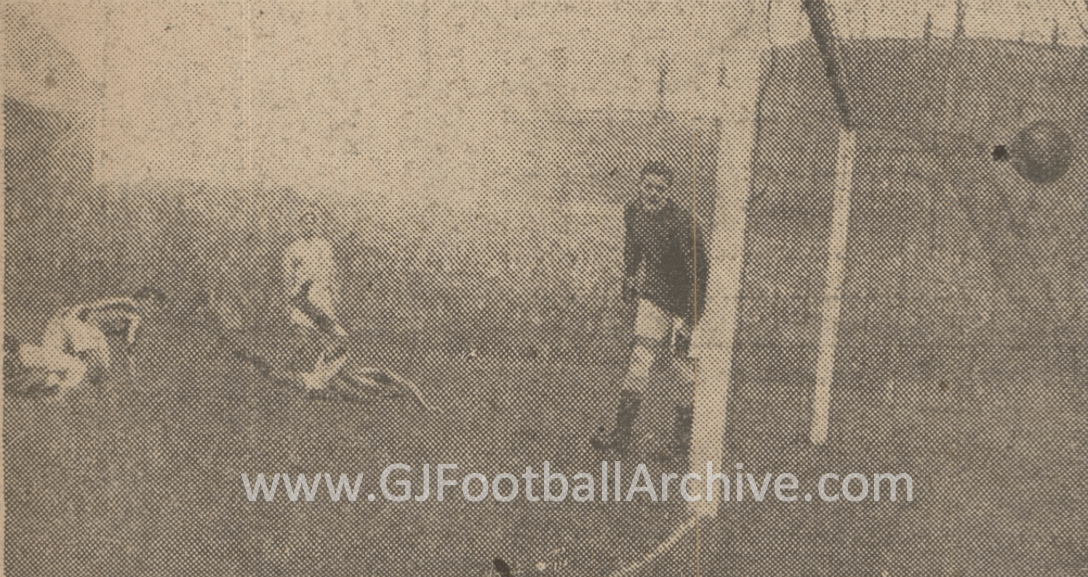
Former Manchester City player Jimmy Broad, whose dad was a popular City coach for decades, scores for Stoke against City on this day (7 October) in 1922. The game ended in a 1-1 draw. The goalkeeper is Mitchell and the City scorer was the great Tommy Johnson. The game took place at the Victoria ground before about 20,000.
Category Archives: 1922-23
Newcastle v Manchester City: The Story So Far
City v Newcastle is one of the most enduring fixtures in English football. There have been cup finals, title deciders, dramatic games, shared heroes and so much more. The two clubs first met in the League in October 1893 (Ardwick/MCFC’s 2nd season in the League) and have since played each other 189 times overall with City winning 76 and Newcastle 72 games.
As tonight is a League Cup tie, the most famous meeting of the teams in that competition came in 1976 at Wembley when Peter Barnes and Dennis Tueart both scored for the Blues.
Anyone at Maine Road on the day City played away against Newcastle at Maine Road? See:
100 years ago there was the last meeting at City’s famous old Hyde Road ground:
In 2012 a Newcastle v City game was crucial in the Blues’ title charge:
Elano’s wonder goal in 2007:
In 2021-22 there was a memorable City victory:
Most Blues of my age and above will remember where they were when our King returned to action on Boxing Day 1977. Here’s an interview I did with him a few years back when we talked about that special day:
When I was a teenager there was a second tier meeting that attracted a significant crowd for the period:
My Dad’s generation will remember the 1955 FA Cup final:
During 1956-57 there was a ‘game of the season’ in the FA Cup between the clubs:
My grandad’s generation would’ve remembered Billy Meredith’s last game:
Who remembers the title decider at Newcastle? Details:
There was a really odd thing a while back where a Newcastle paper claimed that their local team had first worn bar scarves at games. A few simple searches soon proved there were much earlier bar scarfs:
Some of the above are free to read and some are for subscribers only. Follow the link below if you want to find out more about subscribing:
If you enjoy all the free material on my website and would like to support my research and keep this website going (but don’t want to subscribe) then why not make a one-time donation (or buy me a coffee). All support for my research is valued and welcome. It allows me to keep some free material available for all. Thanks.
Choose an amount
£2.50
£5.00
£7.50
Or enter a custom amount
£
Your contribution is appreciated.
DonateMaine Road 100 – Bonus Article!
As Manchester City are playing Newcastle today (19 August 2023) and I’ve been doing a 100 day countdown to the centenary of Maine Road’s first game, it’s worth pausing to remember that before Maine Road City had another major venue that had staged games at an international level; semi-finals; been the best supported League club at; and had welcomed the King to. That ground was Hyde Road and the old stadium’s last ever League game came on 28 April 1923 when City drew 0-0 with Newcastle United (hence me doing this reminder today!).
The match was watched by a crowd of around 20,000. On the same date Wembley Stadium, built by the same people who were building Maine Road, hosted its first FA Cup final and, because of the extraordinary scenes, very little space was given over to the City game in the national ‘papers. Instead they concentrated on Bolton’s performance and the exploits of Billy, the white horse, in clearing the Wembley pitch.
Three months after the last Hyde Road League match, on 18 August, the last ever game, a practice match, was staged on the pitch. Afterwards the goal posts and a few turnstiles were taken from the old ground and erected at Maine Road – about 6 were still at Maine Road in 2003 when it was demolished. Attempts were made to keep one of the oldest (from 1896) and re-erect it in a public area at the new stadium. Sadly, the day before it was to be removed the external wall was smashed and the turnstile was stolen.
One of the Hyde Road stand roofs was dismantled and sold to Halifax Town to be re-erected at the Shay.
The Shay had opened approximately twelve months before Hyde Road’s last League match, and a stand had already been constructed. When this stand was extended it coincided with the demolition of City’s ground. Basically, it appears that the metalwork from one of City’s multi-span roofs was dismantled and re-erected along the touchline at the Shay. It was linked to the existing roof, and formed one traditional style roof. The roof still exists at the Shay today, although during the early 1990s it was re-clad.
The front stanchions look suspiciously like those at Hyde Road, while my investigations in the late 1990s highlighted that the metalwork matched that of similar roofing at a factory in Sale. That factory’s roof was also a former stand roof from Hyde Road. Both the Shay roof and that in Sale were so similar that it seems likely they had previously been erected at Hyde Road.
The Sale factory was dismantled and sections of the roof given to Manchester City for possible re-use in a City museum. Sadly, by 2002 the metalwork had vanished from Maine Road and its whereabouts unknown.
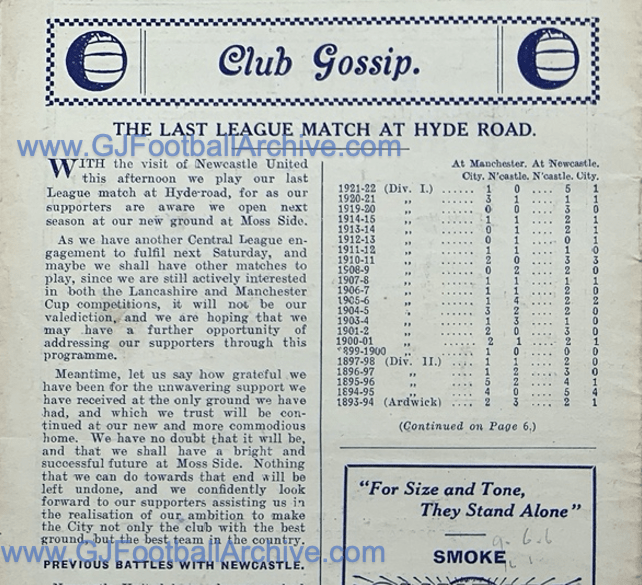
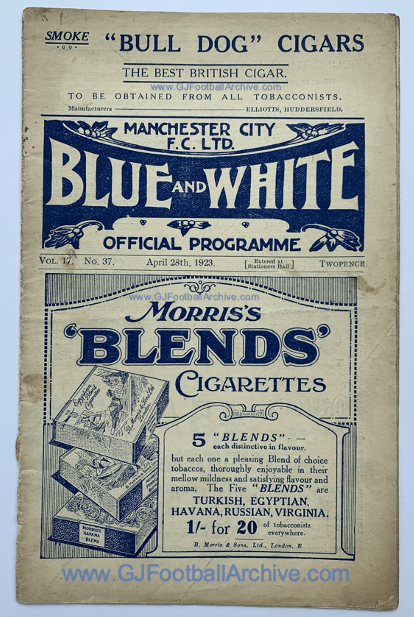
100 Years Ago Today!
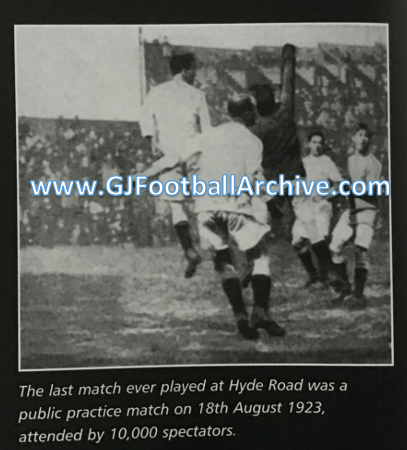
On 18 August 1923 the last ever game, a practice match, was staged at Manchester City’s Hyde Road ground with a crowd of about 10,000. Afterwards the goal posts and a few turnstiles were taken from the old ground and erected at Maine Road – about 6 were still at Maine Road in 2003 when it was demolished. Attempts were made to keep one of the oldest (from 1896) and re-erect it in a public area at the new stadium. Sadly, the day before it was to be removed the external wall was smashed and the turnstile was stolen.
Maine Road 100 – Day 74

For post 74 of my Maine Rd 100 countdown I’m posting this image of the original Scoreboard End being built at the old ground. The Scoreboard End lasted from 1923 until 1970 when it was demolished and replaced by the North Stand. Here’s an aerial photo from almost 40 years later showing the Scoreboard End as the last remaining uncovered stand.
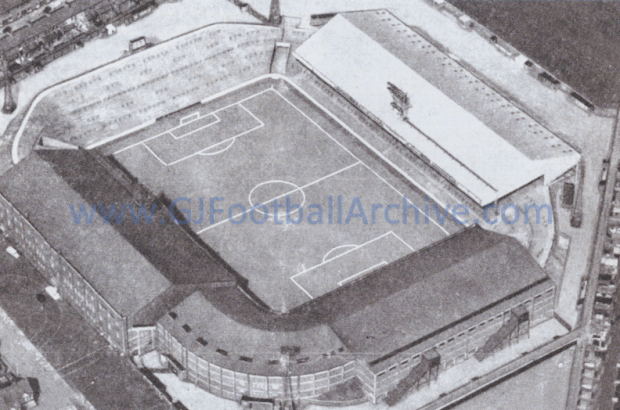
A couple of years ago (and going on for the following 35 weeks) I posted the Scoreboard End being built image as part of my Name That Historic Ground series. Every Monday I challenged readers to see if they could recognise a different ground each week from an old photo. Some were easy, others not so. If you missed them you can now go through each week’s ground and the answers. You can start here:
You can find the answer to that and then page back through all the past quizzes here:
https://gjfootballarchive.com/category/historic-name-that-ground/page/8/
While you’re here why not subscribe to my site and you can then access every article, interview, audio recording etc. already posted and those that will be posted during your subscription. It costs £20 per year (about £1.67 a month). You can subscribe below:
Subscribe to get access
Read more of this content when you subscribe today.
Maine Road 100 – Day 60
Day 60 of my posts counting down to the centenary of Maine Road’s opening game is a simple map, showing the Maine Road area before any of the terraced housing was built.
The dark blue shape I’ve placed on the map is approximately where the stadium was built. Maine Road was initially known as Dog Kennel Lane and was renamed in stages as terraced housing was built on it. The lane originally had a bend where the current Maine Road ends and the old lane veered off towards modern day Princess Parkway.
I explain a lot more about this in Farewell To Maine Road and in the Big Book of City. In the MCFC-Chelsea match programme last season I explained:
Maine Road itself was a relatively insignificant street in 1923, but in the previous century the road had the name ‘Dog Kennel Lane’ and it had for many decades been a fairly significant but meandering route south of the city. The street was renamed in stages when the area was developed during the late 1800s. For years the reason Maine Road was picked was not clear, but in 2009 I discovered the truth.
The Maine Road name came indirectly from the US State of Maine but this was a compromise. The following newspaper article explains: ‘Dog Kennel Lane took its name from the kennel where hounds were kept. It stood on the right-hand side at the bend about a thousand yards from Moss Lane, opposite to the road which tracked off to the left and led to Demesne Farm. The common name of this lane is so common and unattractive that when the Temperance Company bought the Trafford land they asked the local board to change the name to Demesne Road, and the subject was compromised by calling it Maine Road out of compliment to the Temperance principles of the petitioners.’
The idea of the Temperance movement was to discourage people from drinking alcohol. On 2 June 1851 the State of Maine passed the first recognised prohibition law, and two years later the United Kingdom Alliance was founded in Manchester, pledging to badger Parliament to outlaw liquor in England.
The ‘Temperance Company’ mentioned in the article was actually part of the movement and had bought some land at the top of Dog Kennel Lane – this area is close to the junction with Moss Lane East. They wanted to create a better standard of living and within that area they erected buildings in keeping with their approach to life, such as the Temperance Billiard Hall. However, the ‘Dog Kennel Lane’ name was clearly an issue and so the selection of the name ‘Maine Road’ was made. So the name Maine Road refers to the US State and the part that Maine played in the Temperance movement.

If you’d like to read more on the history of Maine Road, take a look at Farewell To Maine Road, which can be downloaded from this page:
If you enjoy all the free material on my website and would like to support my research and keep this website going (but don’t want to subscribe) then why not make a one-time donation (or buy me a coffee). All support for my research is valued and welcome. It allows me to keep some free material available for all. Thanks.
Choose an amount
£2.50
£5.00
£7.50
Or enter a custom amount
£
Your contribution is appreciated.
DonateMaine Road 100 – Day 4
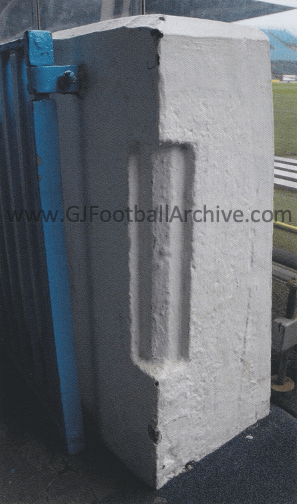
The fourth of my posts counting down to the centenary of Maine Road’s opening game. Today it’s a couple of odd design features that lasted until the end…
Most City fans will know of the semi-circular mosaics that featured above the exit gates (I’ll discuss them and another one later in the year) but these didn’t quite make it to the last game, being removed in the build up to it. There were a few other design features that did and, although these don’t look particularly impressive or significant, they do give clues to the style architect Charles Swain tried to use throughout his planning for the venue.
Below you can see the rectangles and carved edges of these wooden posts. These were typical of the style Swain adopted throughout the ground. Most of the woodwork and large scale stonework (such as the pitch side pillar also seen) used similar patterning when first constructed.
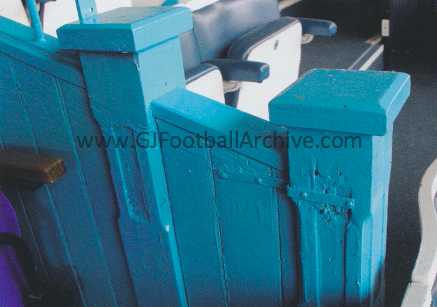
The carved edge style is also seen here on this stone post marking the entrance to the pitch for the players. Originally there were two impressive stone posts, one either side of the tunnel entrance. But by 2003 these had been remodelled extensively to match the rest of the white perimeter wall. However, this carved corners still showed an element of the styling used throughout the stadium at the time of construction.
It was said that architect Charles Swain adopted an Art deco style, but if he did his planning was at the cutting edge of design as Art Deco didn’t become prominent until after 1926. He certainly used styling he’d have been familiar with from his days as a theatre architect.
If you’d like to read more on the history of Maine Road, take a look at Farewell To Maine Road, which can be downloaded from this page:
You can find lots of material on Maine Road throughout this website. Some of it is only available to subscribers but there’s also a lot of free stuff on here.
If you enjoy all the free material on my website and would like to support my research and keep this website going (but don’t want to subscribe) then why not make a one-time donation (or buy me a coffee). All support for my research is valued and welcome. It allows me to keep some free material available for all. Thanks.
Choose an amount
£2.50
£5.00
£7.50
Or enter a custom amount
£
Your contribution is appreciated.
Donate100 Years Ago Today: Hyde Road’s Last
Today (28 April) in 1923 Hyde Road staged its last League game as Manchester City drew 0-0 with Newcastle United.
The match was watched by a crowd of around 20,000. On the same date Wembley Stadium, built by the same people who were building Maine Road, hosted its first FA Cup final and, because of the extraordinary scenes, very little space was given over to the City game in the national ‘papers. Instead they concentrated on Bolton’s performance and the exploits of Billy, the white horse, in clearing the Wembley pitch.
Three months after the last Hyde Road League match, on 18 August, the last ever game, a practice match, was staged on the pitch. Afterwards the goal posts and a few turnstiles were taken from the old ground and erected at Maine Road – about 6 were still at Maine Road in 2003 when it was demolished. Attempts were made to keep one of the oldest (from 1896) and re-erect it in a public area at the new stadium. Sadly, the day before it was to be removed the external wall was smashed and the turnstile was stolen.
One of the Hyde Road stand roofs was dismantled and sold to Halifax Town to be re-erected at the Shay.
The Shay had opened approximately twelve months before Hyde Road’s last League match, and a stand had already been constructed. When this stand was extended it coincided with the demolition of City’s ground. Basically, it appears that the metalwork from one of City’s multi-span roofs was dismantled and re-erected along the touchline at the Shay. It was linked to the existing roof, and formed one traditional style roof. The roof still exists at the Shay today, although during the early 1990s it was re-clad.
The front stanchions look suspiciously like those at Hyde Road, while my investigations in the late 1990s highlighted that the metalwork matched that of similar roofing at a factory in Sale. That factory’s roof was also a former stand roof from Hyde Road. Both the Shay roof and that in Sale were so similar that it seems likely they had previously been erected at Hyde Road.
The Sale factory was dismantled and sections of the roof given to Manchester City for possible re-use in a City museum. Sadly, by 2002 the metalwork had vanished from Maine Road and its whereabouts unknown.
100 Years Ago Today: Hyde Road’s Last City Victory!
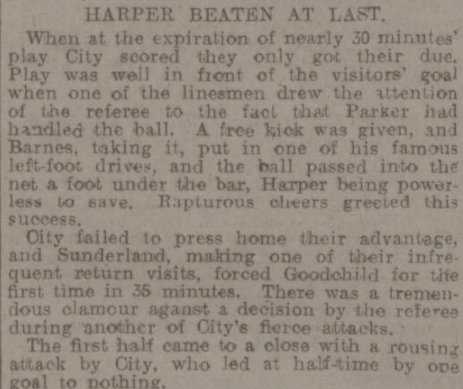
100 years ago today (April 2 1923) Manchester City won a first team game at Hyde Road for the last time. They defeated Sunderland 1-0 with a goal from Horace Barnes after about thirty minutes. The above is a report of that goal (I love the way these things used to be described – ‘the linesmen drew the attention of the referee…’).
It was a controversial game which angered City’s Hyde Road fans, as this section of the report shows:

Also worth bearing in mind that this was the 3rd game in four days – what would today’s managers make of that! Even in the 1980s I remember games being played on Good Friday, Easter Saturday and Easter Monday.
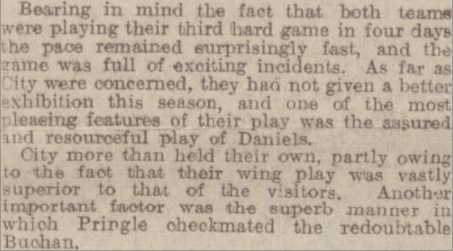
In the other games City had lost 2-0 at Sunderland (March 30) and beaten Chelsea 3-0 (March 31)at Hyde Road.
The gate receipts at Sunderland on Good Friday we’re said to be quite substantial from a 35,000 crowd. So substantial that the Roger Park offices were broken into that night BUT, fortunately for Sunderland, the takings had already been taken from the ground (presumably by staff not fans!).
After this last win at Hyde Rd two further top flight games were played there – a 1-1 with Nottingham Forest and a 0-0 with Newcastle United. Neither of which attracted particularly significant crowds and there was no great ‘Farewell To Hyde Road’ commemoration (if I’d have been around I’d have tried to write a book on the old place). Maybe fans felt the move still wouldn’t happen as Maine Road was some way off completion?
Interesting note: Maine Road’s last victory was against Sunderland on 21/4/2003 and again there were two further home games to come after it!
True Blues – Billy Meredith

Continuing the weekly series of ‘True Blue’ figures associated with the early years of Manchester City, here’s an article on Billy Meredith who was the captain and goalscorer for Manchester’s first major trophy success. You can find out why this man was such an important figure in Manchester City history below:
Subscribe to get access – Annual
Read more of this content when you subscribe today. Annual subscribers can access all the articles, talks, books and interviews posted since December 2020 for an annual subscription of £20 (works out about £1.67 per month). There’s also a monthly subscription (see below).
Subscribe to get access – Monthly
Monthly subscribers can access all the articles, talks, books and interviews posted since 1 October 2022 for a monthly subscription of £3 (cancel any time).
There will be another ‘True Blue’ featured next Monday. Use the tag ‘True Blues’ to find other profiles in this series.
 Gary James' Football Archive