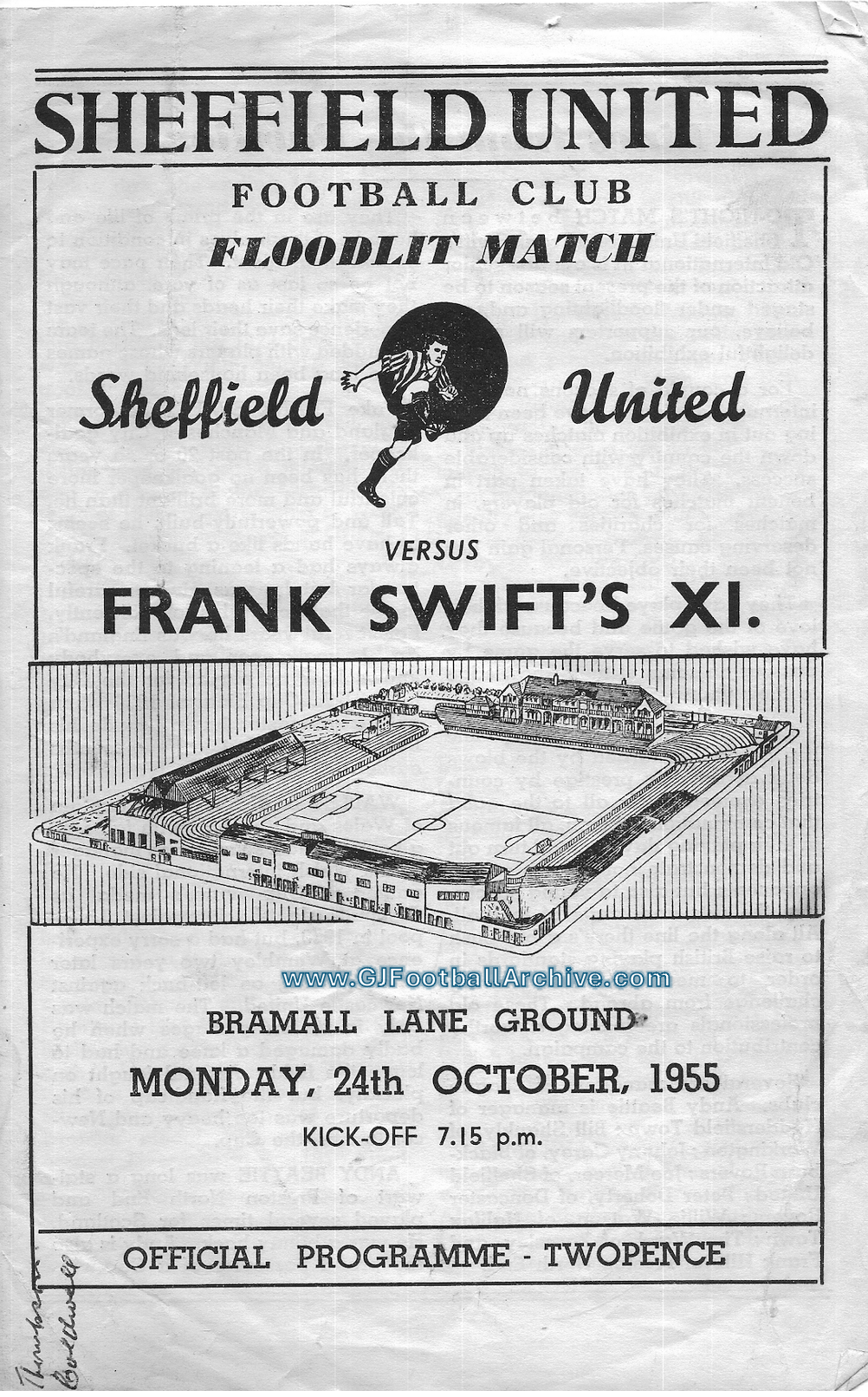
Frank Swift XI For Mercer’s Sheffield United

Here’s an interesting piece of floodlit football history from 70 years ago. On 24 October 1955 Joe Mercer’s Sheffield United played a team of former internationals selected by Frank Swift, the ex-Manchester City ‘keeper. Mercer was selected by Swift to play for the old internationals against the team he was manager of.

The game ended in a 4-1 victory to Sheffield United, though the Swift XI goal owed much to Mercer and was scored by ex-Manchester City star Peter Doherty.

Here’s a report of the game:

“Stanley’s Match” – England 8 Scotland 0 16th October 1943

“When I heard the team I said two prayers.  One of thanks to the Scots for leaving me out, and one on behalf of Adam Little who had taken my place.  I knew then we’d do well to get away with less than five goals against.”  So said Bill Shankly referring to the selection of the England team to face Scotland at Maine Road in October 1943. You can read the story of this incredible game here:

Subscribe to get access

Read more of this content when you subscribe today.

Subscribe to get access

Read more of this content when you subscribe today. You can subscribe at either £20 per year (above) or at £3 per month here (cancel any time). For those subscribing £3 per month you will be able to access all content from October 2022 onwards for as long as you are a subscriber. Those subscribing £20 a year have access to everything posted since December 2020.

Albert Alexander (Junior): MCFC Chairman

Back in the late 1960s there was a popular Manchester City chairman whose family had been involved with the club since the very beginning of the club. That was Albert Alexander. Here’s a profile I wrote in 2012 on him. It’s about 900 words long and is free to read. Enjoy!

Albert Alexander was the second generation of the Alexander family to play a prominent role in the development and history of Manchester City.  His father, also Albert, had been involved with the Club from the 1890s and had held various positions including vice-chairman, and even manager for a spell in 1925-26.

Like his father, the younger Albert dedicated his life to the Blues.  Inevitably, he spent most of his boyhood watching the Club develop and, as he grew, he became more involved with behind the scenes work at the Club’s first home Hyde Road.  He was a member of the Ground Committee which performed crucial activities such as stewarding and ground maintenance.

Alexander also managed the Club’s A team and provided support in whatever way necessary to ensure the Blues succeeded.  He was more than happy to work through the ranks and take on any duty necessary.  His son Eric, who was Chairman in the early 1970s, remembers that his father had suffered during the First World War but that didn’t stop him from putting his energies into the Blues:  “He was a very good footballer and cricketer but he was gassed in the Great War and had to give it up.  It affected him throughout his life, although it’s fair to say he recovered enough to fulfil a happy normal life apart from playing of course. 

“He took up golf, but his love for football was such that he started the ‘A’ team at City.  He started it in 1921 and ran it through until 1963.  He enjoyed working with the youngsters and developing them.  He gained an awful lot of satisfaction from that, particularly when players like Matt Busby developed their skills and style as part of the ‘A’ team.”

Ultimately, after many years of loyal service Alexander became a City director.  This came after the Blues became aware that Manchester United were hoping he would join their board.  It is highly likely Alexander would have turned the Reds down, and it was appropriate that he became a director at Maine Road.  It was an honour he deserved for years of dedication to the City cause.

While director he felt the passion all fans feel for the Blues and he also felt the pain and worries during the Club’s struggles in the early Sixties.  He wanted better and, in 1965 as fans demonstrated following City’s lowest attended League game, he came out to face them and talk with them about his hopes and ambitions for the Club.  He apologised for City’s appalling decline.  It says much about his courage and the respect fans had for him that they dispersed.  It is doubtful whether any other director would have been respected in this manner at such a low point.

Understandably, Alexander who was City’s Chairman by this point wanted to see his side successful and later that summer he appointed Joe Mercer as manager.  It was a brave decision as Mercer had been out of work for a year and had suffered a stroke at Aston Villa.  Other names, such as former City hero Peter Doherty and Liverpool manager Bill Shankly, had been expected to be appointed by the media, so this move could easily have been seen negatively.

Alexander guided City through the successful years of the Mercer-Allison period and was probably the first Chairman to be hugely popular with fans.  Everyone seemed to love ‘Little Albert’ as Mercer dubbed him.

Many of City’s achievements during these years were dedicated to Alexander by Mercer, while journalist Bill Fryer commented in 1970:  “He is highly revered in the game and by the public, and I have no doubt good deals have been done for City out of Albert’s friendships because in reality the whole of football is a ‘club’.”

Sadly, despite the Chairman’s popularity, his final years saw him suffer at the hands of the 1970 takeover battle.  Alexander found out about the takeover when he received a knock on his door at breakfast one day.  It was a complete shock to him.

The takeover destroyed much that was good about City at this point, including the Mercer-Allison partnership.  However, it is rarely mentioned how the takeover affected Alexander, the man who had guided City with distinction through some dark days when no one else wanted to know.  He had taken the Club from the lowest point it had experienced since joining the League, to a position of strength with trophies galore.  Those bidding for control wanted the glory, Alexander’s motives were somewhat different – like all true fans he wanted City no matter what. 

Alexander stood down as Chairman and was made Life President – an honour first given to Lawrence Furniss seven decades earlier, proving the significance of this recognition.  Unfortunately, Alexander’s health was deteriorating by this point and he passed away soon after.

Manchester City owes a great deal to the dedication of Albert Alexander and the other members of his family.  The Alexanders helped guide the Blues from the 1890s through to the reign of Peter Swales, and in some ways on via the continuing involvement of Eric Alexander (still a regular attendee until his death in 2019).  Their contribution should never be forgotten.

If you enjoy all the free material on my website and would like to support my research and keep this website going (but don’t want to subscribe) then why not make a one-time donation (or buy me a coffee). All support for my research is valued and welcome. It allows me to keep some free material available for all. Thanks.

Choose an amount

£2.50
£5.00
£7.50

Or enter a custom amount

£

Your contribution is appreciated.

Donate

Subscribe to get access – Annual

Read more of this content when you subscribe today. It costs £20 a year to subscribe (it works out £1.67 a month) or £3 if you’d like to sign up a month at a time. Annual subscribers get full access for as long as you subscribe (you can always try it for a month). It’s worth bearing in mind that the 2010 Manchester A Football History cost £24.95 and all subscribers will be able to access all of that for as long as they are a subscriber (plus all the other stuff of course).

Subscribe to get access – Monthly

It costs £3 a month to subscribe a month at a time. Why not give it a try! Monthly subscribers get access to everything posted since 1 October 2022 for as long as you subscribe.

The 1960s: 1967-1968 Leeds v Manchester City

On this day (23 March) in 1968 came a game between two title challenging teams – Leeds Utd and Manchester City. The view was that this game could knock City out of the title race if it went Leeds’ way. So what happened? Here’s film of the game:

You can find out more aboutthe potential impact of this game by reading this subscriber article on Manchester City during the 1967-68 season. If you’d like to read this 7,600 word article (yes, 7,600 words on one season!), plus all other articles on the site, then please subscribe (see below). As with most of the other features in this series it includes words from interviews I have performed with those who were there.

Subscribe to get access

Read more of this content when you subscribe today. It costs £3 per month (cancel anytime) or sign up for a year at the discounted price of £20 per year (works out £1.67 per month). Subscribers access the 1000+ articles posted so far and the others scheduled during the life of your subscription.

An Interview About Joe Mercer

I was interviewed on this day (17 February) in 2021 about the great Joe Mercer for the ‘esk podcast’ – an Everton podcast. I talk about meeting Joe; about writing his biography; about Joe’s time at Everton, Arsenal, Manchester City and so on. I also tell the story of Norah Mercer insisting that Bobby Charlton phones me to apologize (it was somewhat of a shock at the time)! We also discussed Everton and City in preparation for their game that night (17th February 2021). No matter who you support it’s well worth listening to.

The podcast can be accessed here:

https://play.acast.com/s/1c7cca11-92ad-58f8-b31b-49145958bc80/602d41a1c5f50f5b203f5312

While you’re here why not see what else has been posted on City and Everton: https://gjfootballarchive.com/tag/everton/

You can access other esk podcasts here: https://shows.acast.com/the-esk-podcasts

If you enjoy all the free material on my website and would like to support my research and keep this website going (but don’t want to subscribe) then why not make a one-time donation (or buy me a coffee). All support for my research is valued and welcome. It allows me to keep some free material available for all. Thanks.

Choose an amount

£2.50
£5.00
£7.50

Or enter a custom amount

£

Your contribution is appreciated.

Donate

The 1960s: Summerbee Treble

On this day (31 January) in 1968 Manchester City defeated Reading 7-0 in a FA Cup replay. As the players left the field the Elm Park tannoy announcer claimed:  ‘Ladies and Gentlemen, you have just seen one of the greatest teams England has produced in a long time.’

Goalscorers were Mike Summerbee (3), Colin Bell, Tony Coleman, George Heslop and Neil Young. This photo is of the Bell, Lee & Summerbee statue at the Etihad today.

Dozens of letters arrived at Maine Road commenting on City’s performance.  Many Reading fans wrote in saying they could have watched the Blues all night.  Other letters arrived commenting on how well behaved the City supporters were, while fans themselves commented on the cheerfulness of the Reading police.  

These points may seem trivial today, but in 1968 football had already begun to enter its hooligan period.  Football supporters had started to be seen as trouble causers and incidents of violence, or of vandalism, soon found their way into national newspapers.  Although City supporters were never totally blameless, during the late 1960s Blues fans continued to gain commendations rather than condemnation.

You can read more on this remarkable, trophy winning season below. If you’d like to read this 7,600 word article (yes, 7,600 words on one season!), plus all other articles on the site, then please subscribe (see below). As with most of the other features in this series it includes words from interviews I have performed with those who were there.

Subscribe to get access

Read more of this content when you subscribe today. It costs £3 per month (cancel anytime) or sign up for a year at the discounted price of £20 per year (works out £1.67 per month). Subscribers access the 1000+ articles posted so far and the others scheduled during the life of your subscription.

The 1960s: 1968-1969 The Fourth FA Cup

Continuing the series of features on the 1960s, here’s a subscriber article on Manchester City during the 1968-69 season. Another trophy winning season. If you’d like to read this 6,000 word article , plus all other articles on the site, then please subscribe (see below). As with most of the other features in this series it includes words from interviews I have performed with those who were there.

Subscribe to get access

Read more of this content when you subscribe today. It costs £3 per month (cancel anytime) or sign up for a year at the discounted price of £20 per year (works out £1.67 per month). Subscribers access the 1000+ articles posted so far and the others scheduled during the life of your subscription.

The 1960s: 1967-1968 Congratulations

Continuing the series of features on the 1960s, here’s a subscriber article on Manchester City during the 1967-68 season. A trophy winning season. If you’d like to read this 7,600 word article (yes, 7,600 words on one season!), plus all other articles on the site, then please subscribe (see below). As with most of the other features in this series it includes words from interviews I have performed with those who were there.

Subscribe to get access

Read more of this content when you subscribe today. It costs £3 per month (cancel anytime) or sign up for a year at the discounted price of £20 per year (works out £1.67 per month). Subscribers access the 1000+ articles posted so far and the others scheduled during the life of your subscription.

Stan Horne Debut

Three days after making his Manchester City debut in a League Cup tie with Leicester (22 September 1965, 3-1 City win) Stan Horne made his League debut for Joe Mercer’s Blues. The game, played on this day (25th) in 1965 ended in a 1-0 City win over Derby County at Maine Road. The scorer was Jimmy Murray.

Horne had previously played for Mercer’s Aston Villa too.

George Graham Interview – March 1993

As it’s Manchester City v Arsenal here’s a flashback to March 1993 with a connection to both clubs. Back then I travelled to Arsenal’s old stadium, Highbury, to interview the Arsenal manager George Graham, not about the Gunners’ form that season or about a game with City but about his former boss – and Arsenal and Manchester City legend – Joe Mercer.

Joe was the Aston Villa manager who brought George to England many, many years before George had found fame as a footballer and Joe had taken Manchester City to their first European honour. Joe did win the League Cup as Aston Villa boss, but these were not great days for the former Everton and Arsenal playing legend, but he did always feel responsible for bringing George to England (and loved the success he brought Arsenal).

My interview with George had been arranged for Tuesday 30 March 1993 some time in advance but then Arsenal’s FA Cup semi-final with Tottenham was scheduled for the following Sunday at Wembley (a highly unusual occurrence at the time!). I expected to get a call cancelling the interview but instead George decided to go ahead with it.

On the day I parked up outside Highbury quite early but as I pulled up I saw George leave the stadium and jump into a car. I was early, so wasn’t too worried. Then I remembered the FA Cup semi-final and assumed that George would be busy with plans. I expected to be told when I entered the marble hall at Highbury that the meeting would be off.

When I spoke with the reception staff they told me to take a seat. They said that George had been called away and so could be a few minutes late (which he was). I was relieved because I’d been convinced he would cancel (it’s happened often with other busy managers).

I sat in reception thinking about the chat and then, a few minutes after we were due to meet, George walked in. He spoke with the receptionist and then came towards me, hand out, saying ‘I’m George Graham’ (I remember thinking ‘I know’ but I did love the fact that he introduced himself). He took me up to his impressive office at Highbury – no other offices at any ground I had been to at that time could match the quality and status of that room.

We then did the interview. It’s not my best – I think I was overawed by the situation – but I was appreciative of George’s time. During the interview Stewart Houston, his assistant, popped in to check something with George (I turned off my recorder) and George ushered him away, telling him that he was busy. Again, I loved this – other managers have sometimes disappeared and not come back but for George he’d set this time aside to see me and chat about Joe Mercer and that’s what he was doing.

Arsenal beat Spurs that weekend so, I suppose, George knew what he was doing but I do remember watching that game on TV thinking that if Arsenal lose I’d never be able to tell anyone that George had spent time being pestered about Joe Mercer when he should’ve been preparing for Tottenham!

If you subscribe to this site you can hear the interview below. I have been researching and writing for a long time and my Joe Mercer book was my third (first published in 1993). I am not employed by anyone and I do not have sponsorship either and so I’ve set up this website to help share my writing and research. The intention is to develop the archive and to provide access to as much of my material as possible over the coming weeks, months & years. Subscribers can already access over 1600 articles/posts including the entire Manchester A Football History book and audio interviews with Malcolm Allison and John Bond.

It costs £20 a year (it works out £1.67 a month) or £3 if you’d like to sign up a month at a time to get full access for as long as you subscribe.

Anyway, here’s the George Graham interview:

Subscribe to Listen

To listen please subscribe. Each subscriber gets full access to the 1600 articles posted so far and everything posted during your subscription..

An update hardback edition of my Joe Mercer biography can be bought here:

Shop