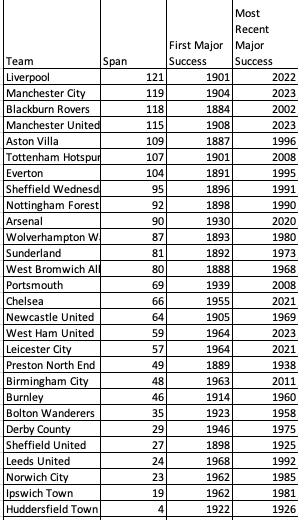
Following Sevilla’s, West Ham’s and Manchester City’s successes in major UEFA competition this season I’ve updated the UEFA European Span of Success table. What is this? It’s a list of those clubs who have won two or more major UEFA tournaments showing the span between their first UEFA success and their most recent. The list may surprise some who think that football is all about those perceived as European giants with ‘history’.
The ‘history’ ‘no history’ thing really irritates me. All clubs have history and even when that’s recognised some still go on about history as if it started in 1992, 1999 or 2008 etc. depending on whether your club was successful or your rivals were failing. Both West Ham and Manchester City found major European success before some of those clubs recognised today as Europe’s elite and while this table does not show the number of major trophies won, it does give an indication of trophy winning longevity for those who obsess on ‘my cup’s bigger than yours’ and similar debates. Personally, I think we should all be proud of our club’s achievements and not worry about what a rival has won.
West Ham have the second longest span of all Europe’s clubs and City have the fifth. Nice work Hammers and Blues!
Anyway, here’s the table showing all those with two or more successes:
European span of success 2023, showing EC/CL, ECWC, UEFA/Europa & Europa Conference
The table includes the four major UEFA tournaments: European Cup/Champions League; European Cup Winner’s Cup; UEFA Cup/Europa League & the Europa Conference League. It does not include non-UEFA tournaments such as the Mitropa Cup and Fairs Cup. Nor does it include the Intertoto Cup or similar.
I’m sure some will say but why aren’t the Mitropa or Fairs Cups in there? It’s a good point but these were not UEFA tournaments, though I recognise that the Mitropa Cup had some significant clubs competing in it. It was predominantly an East European competition and participants were not spread over the entire continent.
With the Fairs Cup… It is true that this was later transformed into the UEFA Cup and I have included all UEFA Cup finals in my analysis. But the Fairs Cup had an odd series of entry rules at times. Cities, rather than clubs, often entered with Barcelona beating London in one final for example. It was set up as a friendly type of competition with cities that had staged trade fairs playing each other. As time wore on entry came via the League Cup or League position in England, which added significance to it. But two teams from the same city were not allowed to participate, which meant that teams finishing way down the table could be (and were) included if those above them were multiple clubs from the same city.
In 1970 Manchester City’s Mike Doyle joked that by winning the League Cup he was satisfying his aim of ‘keeping United out of Europe’ (he joked about creating car stickers with that slogan!) because it appeared at that time that United’s only chance of Europe had gone with City’s qualification for the Fairs Cup.
1970 ECWC
City went on to win the ECWC that season, meaning that Fairs Cup place was opened up to League position, but United had finished lower down the table anyway and qualified for the Watney Cup instead. Actually, the Watney Cup is one worth talking about, but I’ll save that for another day. In 1970 Fourth placed Derby County qualified for the Watney Cup, while 5th to 7th (Liverpool, Coventry and Newcastle) all got a Fairs Cup place, alongside 12th placed Arsenal (Fairs Cup winners). I’ve not investigated this fully but it does seem odd that the Watney Cup took precedence over the Fairs Cup.
Arsenal’s 1970 Fairs Cup success was their first European trophy but is not included in the span, neither are those Fairs Cup wins of Barcelona. As an example of the odd qualification rules at times it’s worth looking at the 1969 qualification via the English League system.
In 1969 champions Leeds entered the European Cup. The ECWC place went to FA Cup winners Manchester City and the Fairs Cup places went to: Arsenal (4th), Southampton (7th) and Newcastle (9th). Swindon had won the League Cup, beating Arsenal in the final, but the Fairs Cup organisers wouldn’t allow them to participate as they were not a top flight club! This adds to the reason the competition is not included.
Similarly, Everton (3rd), Chelsea (5th), Spurs (6th) and West Ham (8th) who all finished above Newcastle were denied because of the rule that only one club from each city be allowed. So Liverpool and Arsenal’s inclusion meant their rivals stood less chance of winning the trophy than Newcastle simply because there were multiple clubs in their cities.
That rule does make me wonder what would have happened if both Manchester clubs had qualified for the competition as City are within the city of Manchester boundaries and United are not. Would the two clubs have challenged any decision not to include one of them based on the age old argument of Manchester’s boundaries?
Maybe I’ll post more on the odd rules of football competitions and tell the story of some of those long forgotten competitions.
If you enjoy all the free material on my website and would like to support my research and keep this website going (but don’t want to subscribe) then why not make a one-time donation (or buy me a coffee). All support for my research is valued and welcome. It allows me to keep some free material available for all. Thanks.
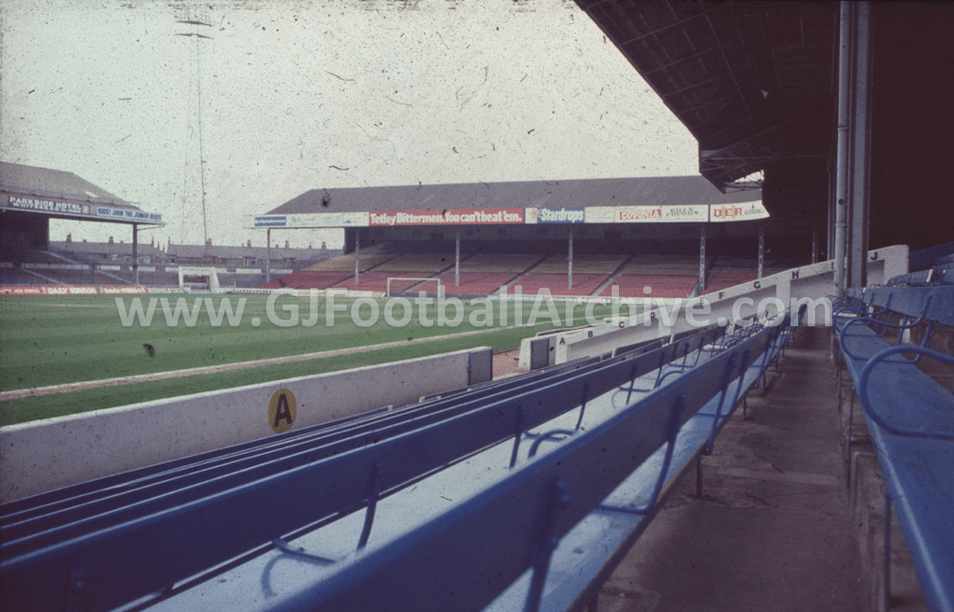
It’s day 27 of my posts counting down to the centenary of Maine Road’s opening game. Today – the wooden benches! Many a fan’s first experience of Maine Road was sitting on the benches in the old Platt Lane Stand.
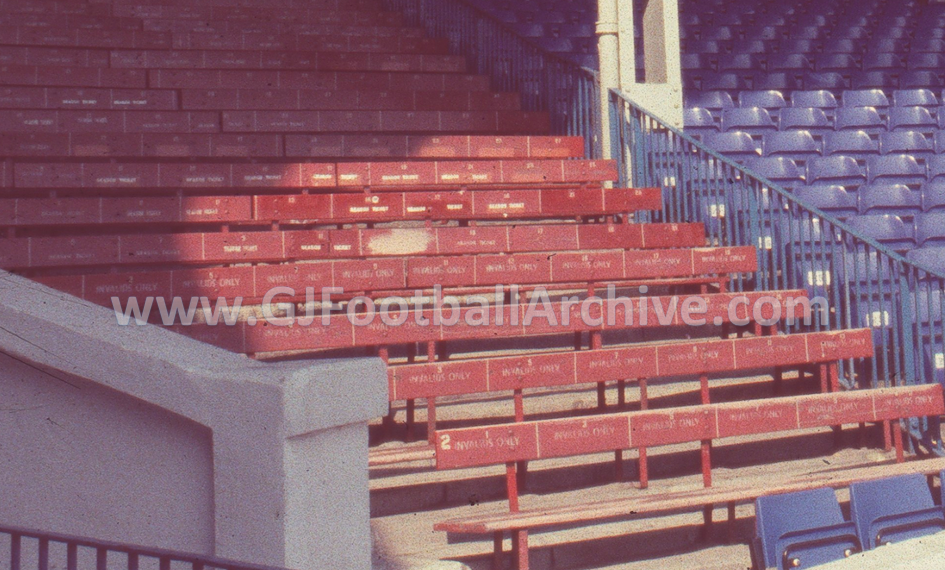
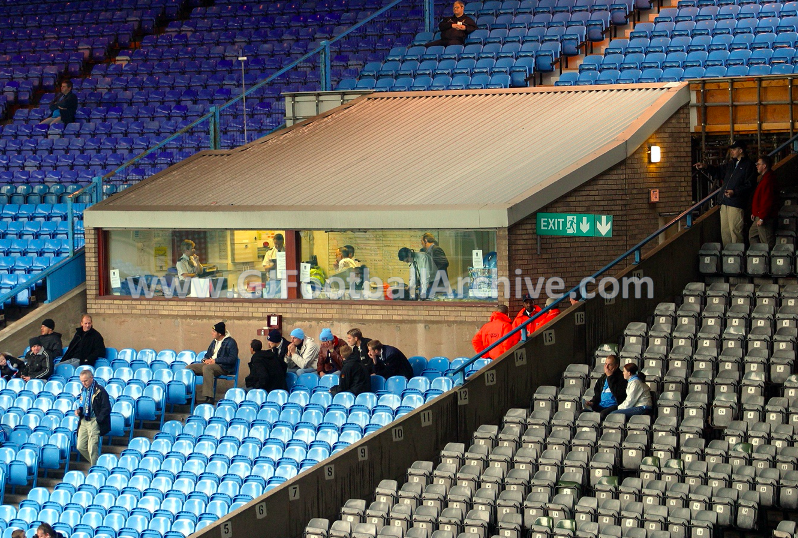
These images may bring back a few memories. The Platt Lane benches were painted maroon and yellow for many years – I’m not certain if they were originally that colour. Older fans may know the answer but if they were maybe it was because they were installed at a time, the early 1960s, when those two colours had been used as City’s second choice kit?
Maroon is City’s traditional away colour but in 1959 a yellow shirt with maroon cuffs and V was used. If there was a link then that was not obvious by the time my Dad was taking me on to the Platt Lane as a young boy.
For me it seemed so odd, but then again the new North Stand had grey seats, and back in 1923 much of Maine Road was painted green. So I suppose there was never much logic around football grounds.
City used to paint on to the seats whether they were for season ticket holders, ‘invalids’ (obviously the wording back then, not today’s wording!) or if they were just numbered you could either sit there if it was an unreserved seating game or the number would match a ticket holder.
Platt Lane corner benches – note the wording on the seats. Some say season ticket; some ‘invalid’ and some are numbered/unreserved.
Most of the benches lasted about 40 years, but some were destroyed when Leeds United fans visited in November 1990 and were replaced for the stand’s final season or so with blue plastic seats. The stand was demolished in 1992.
November 1990: Jimmy Frizzell inspects the damage after Leeds fans smashed up some of the Platt Lane benches.
The Main Stand also had benches for much of its existence. These were painted blue and in some cases had arm rests. They had been part of the original build in 1923 and were replaced in phases during the 1970s and 1980s.
The Main Stand’s benches with the Platt Lane Stand’s maroon and yellow benches in the background
For those unfamiliar with Maine Road this photo may help. This shows the original Platt Lane Stand corner (number 3) where the maroon seating with ‘invalid’ wording image was taken. The benches damaged by Leeds fans were near the front of the stand under number 5. The Main Stand bench image is taken to the left of number 2 looking towards the floodlight near 5 and 6.
Maine Road aerial 1971 from Farewell To Maine Road
If you’d like to read more on the history of Maine Road, take a look at Farewell To Maine Road, which can be downloaded from this page:
If you enjoy all the free material on my website and would like to support my research and keep this website going (but don’t want to subscribe) then why not make a one-time donation (or buy me a coffee). All support for my research is valued and welcome. It allows me to keep some free material available for all. Thanks.
On Saturday June 10 2023 I attended the Champions League final in Istanbul. It was a wonderful experience and I’m absolutely delighted with City’s success. People will talk about this team and these players for ever.
It’s brilliant being at these history making moments and I cannot stress how much ‘us’ fans have enjoyed this journey (the wider journey, not the travel on the night – more of that later!).
I’ve decided to post here my story of the weekend and I hope you don’t mind this indulgence. I know every one of us who attended had a different experience but I hope this gives those who were unfortunately not able to be there a taste of what the trip was like. I know many Blues who would have loved to have been there but simply could not afford it, or take the time off work or were physically unable.
If you did attend and would like to talk about your experiences then please post them as comments to this piece. I’m contemplating doing a special history session on the journey and maybe would involve fan stories in that. Not certain yet but if I do I’ll mention it here soon.
Istanbul 2023 was always anticipated to be a historic moment in the history of Manchester City and, unlike, Porto two years earlier it felt the time was right. I shouldn’t care too much about opposition clubs but in truth playing Chelsea in 2021 did not have the glamour of Inter in 2023. Also, it always seemed to feel that when we played an English club in past seasons – LFC, Spurs and Chelsea – there was always going to be something fairly mundane and typically PL about it all. I always felt that when the day came for City to win another major European honour that they had to face a Real Madrid, Bayern Munich, Barcelona or one of the Milan clubs to achieve it. This season City not only faced three of these giant clubs but, especially against Bayern and Real, they proved they were more than ready to be European champions.
When we qualified for the final I, like all fans, worried about cost, flights, hotels and, most significantly, match tickets. I didn’t know if I’d be able to buy tickets and held off for a while booking anything but then I decided to take the plunge and book flights etc. To keep costs down I booked flights from Heathrow airport for the Friday morning, with return flight on Sunday about 1pm. I managed to get a cheap Travelodge near Heathrow and I then searched for hotels in Istanbul.
Initially, I found hotels via Booking.com but after being let down once before when we arrived at a UK hotel to find the owner had ‘double booked’ us (this was just after things started opening up post Covid and we got it cheap, by the time we went there several weeks later he could command a higher price and I think some profiteering went on), I decided to book direct with the hotel we’d seen. It actually turned out cheaper to go direct.
In recent weeks I’ve heard lots of tales from Blues of Istanbul hotels being cancelled at the last minute by owners saying there were issues with bank cards etc.
Eventually I managed to buy tickets and was fortunate to buy the cheapest unobscured view. I was in block 327 (row 12) with a 70 Euros ticket. I just had to be there.
View towards the main stand from row 12 block 327
Somehow it seemed appropriate that this journey to the Champions League final was to take place in Istanbul – the city of City’s first away European Cup tie in 1968 when I was a few months old.
The journey down to Heathrow was disrupted with lots of traffic issues (the weekend had many more of those!) but after a decent sleep I was able to drop off my car at Heathrow and wait for the flight.
At the airport everything went smoothly and several other City fans were waiting for this flight too. As was the commentator Alastair Mann who I’ve known for many years and it was nice to have a few words with him.
The flight was fine and once we landed we made use of the free City fan bus to Taksim Square. We were actually staying near the Grand Bazaar across the river but we wanted to see the other side and felt this would be a good way to do it. So, we walked through Taksim and down the side streets with our cases. The number of City themed bars for the day was great and the mood was extremely positive. Every one was having a great time and each shop, restaurant or bar seemed to have some staff member wearing a City shirt, obviously trying to get our business but it was nice to experience.
We had something to eat and then we walked towards the river and on beyond the back streets to our hotel. It was great to see so many City fans in and around Istanbul, not just in one or two areas but everywhere. Inevitably there would have been as many Milan fans at the stadium but the day before the game it felt as if there was only one team in town.
We spent the night enjoying the city and taking in the sights.
On Saturday I couldn’t wait for the game and we wandered the bazaar, enjoying the banter with locals and rival fans. We went to the blue mosque area and other sites too. Everything was positive, good natured and wonderful.
With Inter fans
After lunch we went down to Yenikapı to see the Champions League festival stuff, but mostly to get our bus to the stadium. We boarded it about 14.45 and then the fun started! Lots of travel and UEFA chaos – I’ll post a separate piece on that. I don’t want to distract us from what an incredible night this was.
On the bus to the stadium before the driver got lost, tried reversing on a busy motorway, got lost again and before the breakdown!
At the stadium we were sat on row 12 behind the goal and got in as early as we could after the earlier UEFA issues. I saw quite a few Blues I know of course, including Simon Clegg from the West Yorkshire supporters club and Will McTaggart from the North West Film Archive. A couple of rows in front was ‘Badger’ – a 70+ year old Blue many will know who used to wear a scarf with lots of badges (not Pete the Badge). Sadly, he told me one of his usual travel companions to City games had died and another had medical issues, and so he was travelling on his own. He’d had all sorts of issues with logistics and so it was great to see that he had made it. It was nice to see several regular away Blues go and say ‘hi’ to him and to check in with him.
The prematch entertainment was, as always, not really for the fans in the stadium. I don’t think the sound system was set up for us to hear it and while I personally wasn’t that bothered – and most people wanted to chant our own City/Inter songs anyway – there will have been some in the stadium who did want to listen. It seems to be all geared around the global audience not the ones who have paid to be there.
UEFA fooled us by getting a pianist to play the Champions League anthem – I think we all expected the usual fanfare recording and those who wanted to show their displeasure at UEFA didn’t get their usual chance.
The match itself was quite tense. I don’t need to go into it all but I did feel much more nervous than I was pre-match. Kevin De Bruyne going off injured felt like a deja vu moment. Fortunately it wasn’t but things didn’t seem to click. Maybe the significance of the occasion affected the players and us fans? Whatever it was, it was one of those tense days where we just needed to see a goal to lift things. When it came it was delirium in 327 and all other City blocks around me.
The bloke who stood next to me was on his own and we hugged and celebrated as if we’d known each other for decades. It’s really odd but, for those of us who go to games regularly, there are often those people you stand or sit next to who become your best buddy for a couple of hours and then you don’t see them again. That’s how it was – sorry I didn’t get your name but you were sat in 327 row 12 seat 241, though you mostly stood at seat 242. Thanks for sharing this experience.
Things were tense even after the Rodri goal. Ederson’s knee and the bar kept us safe at times! At 85 minutes the bloke next to me said ‘ten minutes to go’. I said ‘5!” He said ‘and 5 minutes of added time. Keep with the script!’ Sure enough he was right.
After the whistle. 2023 Champions League Final Istanbul v Inter Milan
When the whistle went it was another marvellous celebration. The lads behind had been muttering about getting on the pitch for a celebratory pitch invasion but there was no way that was possible with the set up. In the end the players climbed over the adverts and photo positions to get as close to us as possible. That was certainly appreciated and it was wonderful to see them all get so giddy with the success.
Winning the Champions League is a major landmark. I remember a decade or so ago people were saying: ‘you may have won the League but you’ll only be considered a great team when you retain it.’ City retained it. Then it became: ‘you’ll only be considered a great team when you win three in a row.’ City managed that. Then it became: ‘you’ll only be considered a great team when you win the Champions League and the treble’. Well, this means that Manchester City are a truly great team then!
It finally happened!
The celebrations were superb and everyone left the stadium buzzing. What a night! Then it was chaos again (as I said earlier, more on that another day).
About 3am on the Champions League return buses. Sat on the floor
After the bus journey we arrived back at Yenikapi about 4am (we were out of the stadium about 12.35am). Walking back to our hotel I saw Noel Bayley, who I’ve known since the 80s when he first created the fanzine Blue Print. It seemed fitting in some way that I’d bump into someone who was there with us in the 80s demanding Swales Out on a night when we’d achieved our biggest success.
Just after 4am after City’s Champions League final win – Noel Bayley and Gary James
Hardly any sleep followed as we had to be on our way to the airport at 9.30. Our taxi was late – no surprise the way transport had been this weekend – and as we waited two lads who had clearly been out all night staggered into the hotel. Two match programmes were in one lad’s back pockets but they seemed somewhat lost. They weren’t. They were in the right hotel but they’d lost the key to their room and had no identification either for some reason, so we tried to help and they got a duplicate key. They’d certainly had a good night in Istanbul!
We shared our taxi with another fan who had heard there were problems with his flight, so. he was heading to the airport early.
At the airport everything seemed to go well. Both Shaun Wright-Phillips and Peter Crouch were on our flight, and by coincidence I was sat next to a City fan I know via twitter: https://twitter.com/BertiefulSouth
Getting home from Heathrow yesterday brought its own traffic issues but the knowledge that City had won the Champions League and the treble kept us positive throughout.
So City have won the trophy after 15 years of planning, building and development. This is a major achievement and lifts things considerably – and it stops Villa singing that song to us!
City’s first major European trophy came in 1970 before Liverpool, Juventus and Chelsea for example. Now, 53 years later they have added the Champions League to their impressive trophy haul. Only Liverpool have a longer span of success from their first major trophy to their most recent, proving that City have. a rich footballing history.
1970 ECWC
Finally, I know this has been a lengthy piece but I just wanted to throw a few thoughts, memories and comments down. If you’re one of the people who managed to get to Istanbul I hope you managed to stay safe and enjoy it. It was difficult for many to be there and so I am so grateful that I managed to get the chance to buy tickets and afford travel to attend this landmark moment in football history.
Thanks to all those involved in the journey over the years. This has been special and I’m glad I saw so many Blues from various phases of my life out there and I feel for those who couldn’t make it this time.
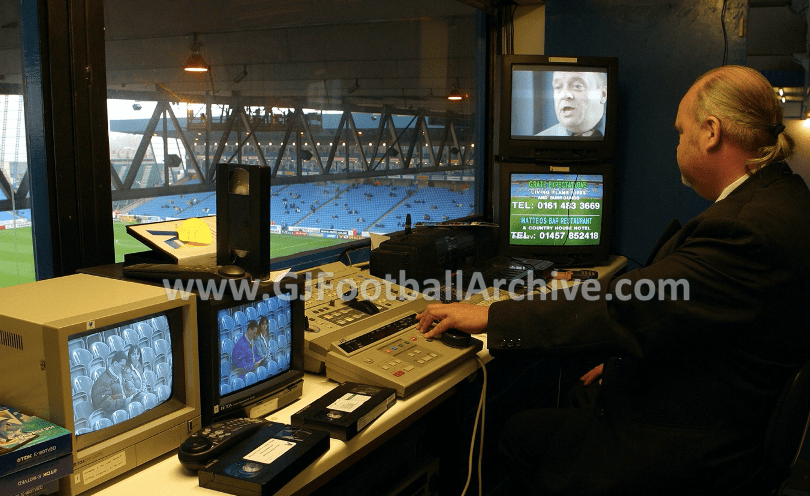
It’s day 26 of my posts counting down to the centenary of Maine Road’s opening game. Today – the Control Room. It’s something few ever went in but it was an important part of the stadium’s last couple of decades.
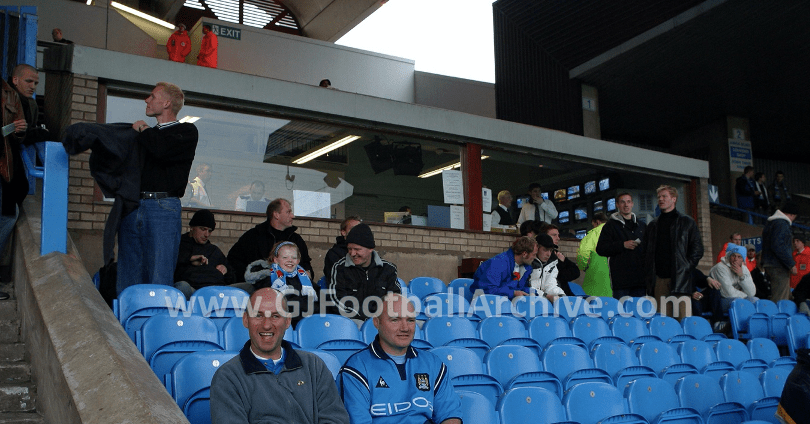
It was erected behind the block between the Main Stand and the North Stand. This was an uncovered section of seats until 1982.
The control room housed the screens monitoring crowd behaviour and the match commander would be sat in there with other staff, police etc. watching the crowd. These images show the control room as it looked during Maine Road’s final season. It had been expanded by then and these photos were taken by Ed Garvey, club photographer, for my book Farewell To Maine Road (though we didn’t use them all).
Photo by Ed Garvey
You’ll notice in the following photo that one of the temporary stands had been constructed behind the control box to cope with demand for tickets. This stand was erected on scaffolding and was squeezed in above the control box and next to the Maine Stand. I never sat in that temporary stand, though I was often in the block below the control room (when it was uncovered it was the cheapest seats in the stadium and I was there when Bobby McDonald went in nets in 1982.
Photo by Ed GarveyPhoto by Ed Garvey
For those unfamiliar with Maine Road this photo may help. This shows number 2, the uncovered section, before it was seated. The control room was roughly to the left of the North Stand roof.
Maine Road aerial 1971 from Farewell To Maine Road
If you’d like to read more on the history of Maine Road, take a look at Farewell To Maine Road, which can be downloaded from this page:
If you enjoy all the free material on my website and would like to support my research and keep this website going (but don’t want to subscribe) then why not make a one-time donation (or buy me a coffee). All support for my research is valued and welcome. It allows me to keep some free material available for all. Thanks.
Congratulations Manchester City. So many thoughts, emotions and memories this weekend as the Blues won the Champions League for the first time. In one of those wonderful coincidences of fate it’s significant that City’s first ever European Cup away game was against a team from Istanbul (Fenerbahce) in 1968 and that the trophy was finally won there almost 55 years later.
If you’ve not seen it before have a look at City goalkeeper Harry Dowd’s cine film from 1968 and that first European Cup trip. Will McTaggart and I were grateful to Harry’s family when they loaned this to the North West Film Archive for preservation and copying. We were able to show some of it (and Harry’s other films) in our Boys in Blue film show a few years back. So many of the sites will be familiar but so much has changed too.
I was only a baby when City first competed in Istanbul but now, as a grown adult with adult children of my own, I was able to experience the final in the flesh. Nothing beats that!
It has been a wonderful journey over these decades. I was born at a time when Manchester City were a power. A major club with a significant trophy-winning pedigree and glamour. They were one of Europe’s finest and they won their first major European trophy in 1970 (the European Cup Winners’ Cup – at the time UEFA’s second most important competition).
1970 ECWC
In my life City have now won: 1 European Cup, 1 ECWC, 8 League titles, 4 FA Cups and 8 League Cups but it’s not been easy.
People will talk about investment and money and, like the majority of trophy-winning clubs, that has happened of course. But there’s also been considerable years of under-investment, of people benefiting from the club in terms of prestige, status and personal finance, and not putting anything back.
The City that was swashbuckling and winning trophies of my early childhood was cast aside by those running my club. They allowed others to seize the initiative – In the 1970s City won three times as many trophies as United; by the time I was 15 City had not spent any time during my life outside the top flight (United had) and remained the 3rd best supported club; When I was 25 City were still the last Manchester side to win the League… I could go on my club was downgraded by those in charge during the late 1970s & 1980s who placed a club that had been profitable into one that was in debt with a stadium that was needing investment. They treated some injured players, like Paul Lake, appallingly. Penny-pinching all the way while they had their ‘status’.
A shock relegation in 1983, exacerbated by the penny-pinching and debts being piled on (oh, and some directors then buying up large numbers of shares at low prices which they would later profit enormously from!), meant City were starting to fall behind.
Our chairman Peter Swales appeared on TV often saying things like: ‘You can’t plan in football. You take every game, every week and every season as it comes.’ How we all thought ‘you’re the top man, if you’ve got no plan – any plan – we’re doomed!’
Youth development helped City compete at the end of the 80s and early 90s, finishing 5th two years running and building for a positive future. Then our directors messed it all up with managerial changes and a takeover was launched by former hero Francis Lee. After a bitter battle, which also split our supporters club, Lee gained control but the club had been badly managed and was in a worse state than he’d expected. A new stand had to be built (the old board’s ‘plan’ was going to include some plastic seats being bolted on to the old Kippax terracing – that’s the kind of forward looking ‘plan’ those guys specialised in!) and the club’s merchandising set-up meant that individuals gained more than the club. There appeared to be lots of ‘dodgy’ contracts issued during the final weeks of the old board’s reign if the material Lee showed me several years back is correct.
Lee made a massive mistake – appointing Alan Ball as manager – and after that the playing side collapsed and the real fall from grace followed. The Swales days had robbed the club of its assets and then we fell. Thankfully, David Bernstein, Chris Bird, David Makin and John Wardle, plus supporting figures like Dennis Tueart and Alastair Mackintosh, saved the club and the rebirth happened. I would like to stress though that City were only out of the PL from 1996 to 2000 and then again 2001-02. Five years and only one of which was in the third tier, so when people talk about City as coming from the 3rd tier that’s true but it was not the club’s normal position – that was as a leading top flight team.
The years 1983 to 2002 were the ones out of character (in general) with the club’s 143 year history, not 2008 onwards – though these are now incredibly special times at a level not experienced before despite the success the club has previously enjoyed.
Since 2002 City have been a Premier League club once more and then of course there’s the investment from 2008 which has not only got City back to a period of strength within the game that it held when I was a toddler, but those in charge have planned and grown the club to a level never before seen. Their planning and direction – evidenced from day one – has taken City to a new height. People will talk about money but if it was just about money then why didn’t the club find League success 2 years after being purchased like Chelsea did? Or reach a CL final within 5 years like Chelsea did? This was never just about money. It was about planning and changing the way football clubs operate for the long term.
All these years after the investment City have finally found European success at the highest level and it’s incredible. It has been a long journey from Istanbul to Istanbul.
It’s day 25 of my posts counting down to the centenary of Maine Road’s opening game. Today – the Maine Road cage!
For years the front of the Main Stand at Maine Road was a simple doorway above a set of stairs. There was nothing particularly remarkable about it, although there was a wonderful mosaic above the entrance. However, by the early 1970s vandalism was taking its toll and the doorway was perceived as being particularly vulnerable. Whether it was or not is open to debate but the decision was taken in the 1970s to solve the problem by erecting a cage around the main entrance. These images of John Bond and John Benson show the cage as it looked in 1983.
John Bond, 1983
The ‘Sponsor a Match’ sign covers the original central mosaic. You can read about that here:
When City fans demonstrated during the 1980s and beyond the cage doors would be closed and locked to prevent fans from getting in to the offices, though they didn’t always manage it in time as this image shows:
Mirrorpix photo
In this image below John Benson and John Bond are stood in front of the players’ entrance which, at this time, was not within the cage (a later development changed that). I find it remarkable that the door for the players to go through was seen as being less important and that the players would not be protected.
John Benson and john Bond, 1983
For those unfamiliar with Maine Road this photo may help. The main entrance was on the Maine Road side of the Main Stand, above number 1.
Maine Road aerial 1971 from Farewell To Maine Road
If you’d like to read more on the history of Maine Road, take a look at Farewell To Maine Road, which can be downloaded from this page:
If you enjoy all the free material on my website and would like to support my research and keep this website going (but don’t want to subscribe) then why not make a one-time donation (or buy me a coffee). All support for my research is valued and welcome. It allows me to keep some free material available for all. Thanks.
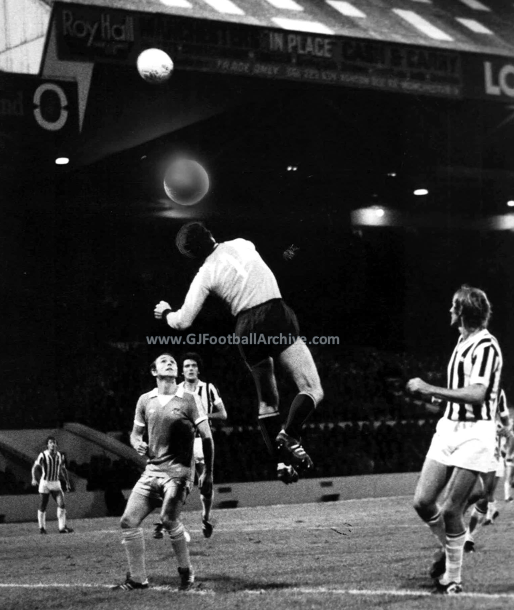
It’s day 24 of my posts counting down to the centenary of Maine Road’s opening game. With many Manchester City fans currently in Istanbul getting ready for tonight’s final I thought I’d post another Maine Road image with a European theme. Today’s feature is on this image of City facing Juventus in 1976.
That night Brian Kidd scored the only goal in City’s 1-0 UEFA Cup victory, played on 15 September. But, look at the photo closely and you’ll see there are two balls! Why? Well, often in the days of black and white press photos newspapers wouldn’t quite get the shot they wanted. They’d sometime tippex on, or even cut and stick a ball on an action photo to create either a more dramatic image, or simply to ensure they could fit the image on the space available.
Modern technology has made it easier to ‘move’ the ball to a more convenient place, but it has also allowed photos to be taken quickly and in bursts. Also, once colour photography was used in national newspapers any cutting and pasting or tippexing seemed too obvious. Although this added ball definitely looks fake so I’m not certain any reader would have been fooled.
I’ve seen plenty of images like this over the years and I find them both fascinating and frustrating. I’d like the true image to be shown, but I also am intrigued as to how they felt they made the image better. For those wondering the City player is Dennis Tueart and the stand in the background is the Main Stand.
For those unfamiliar with Maine Road this photo may help. The roof shown is to the left of number 1 below – you can see the bit where it drops down to the next level. The tunnel is the one on the far left of the Main Stand below where the roof line changes. City were attacking the Platt Lane (stand is numbered 4 & 5) in the image.
Maine Road aerial 1971 from Farewell To Maine Road
If you’d like to read more on the history of Maine Road, take a look at Farewell To Maine Road, which can be downloaded from this page:
If you enjoy all the free material on my website and would like to support my research and keep this website going (but don’t want to subscribe) then why not make a one-time donation (or buy me a coffee). All support for my research is valued and welcome. It allows me to keep some free material available for all. Thanks.
It’s day 23 of my posts counting down to the centenary of Maine Road’s opening game and today’s feature is on the building of the North Stand. As Manchester City are about to appear in the 2023 Champions League final I thought I’d post images from a much earlier European game. This image of Neil Young comes from the 1971 ECWC semi-final v Chelsea. Notice Young is wearing City’s away colours. People often assume that City rarely wore away colours at Maine Road, but the truth is somewhat different.
Often when there was a clash of colours in a cup game City would wear their away strip. Games in the 1920s right through to 1970s saw the Blues don maroon, red/black and even scarlet at times at Maine Road.
The main image shows that North Stand being constructed in the background. You can see that the roof is not yet complete but that the terracing is in use for this ECWC semi final. The terracing was new concrete and the stand housed bars underneath. It was a terraced stand until summer 1972 when the decision was taken to make it a seated stand.
City chairman Eric Alexander was the main man responsible for the stand’s development and he was a passionate believer in giving fans the best facilities possible. He also had ambitious plans to redevelop the Kippax, however Peter Swales became the chairman soon after and he put Ian Niven in charge of ground developments. From then on, until 1993, the only major development was the erection of a new Main Stand roof in 1982. In the 1990s the club was forced to build – or condemn – the Platt Lane Stand.
Maine Road was a major ground for most of its existence and, even with little investment during from 1973 onwards, it was still selected as a cup semi-final venue. BUT I often wonder how spectacular the stadium would have been had Eric Alexander been left in charge of stadium developments. Instead of penny-pinching and devaluing the ground maybe it would have eclipsed Old Trafford as it had for the first 40 years of its existence?
People always focus on Swales as the cause of all the problems and it is true that he was the chairman and the man ultimately responsible, but he was not the major shareholder. In fact he often talked of how he only had a small number of shares until 1983 (when he made a major purchase following City’s relegation he often said). He was supported by directors who often held many more shares than he did. They could’ve ousted him, but instead supported him. Each director had responsibilities for different elements of the club – Swales often talked of this and the match programme frequently told us who was responsible and what they did – yet once Swales did stand down and Franny Lee took over some of those who had worked with Swales swapped sides and retained their positions. I know, from my own interviews with Swales, Alexander and others, that Swales felt let down and betrayed. Every issue was suddenly made to be ‘his’ fault. He accepted this, saying that he was the main man, but others needed to hold their hands up for the lack of investment in Maine Road etc.
1971 ECWC v Chelsea. Francis Lee. Photo by Alan Jubb
The above image shows Francis Lee at this same game and to the right you can see more of the North Stand under construction.
For those unfamiliar with Maine Road this photo may help. The North Stand can be seen with a completed roof on this image (number 10). This was later in 1971 and the stand is still a terraced one.
Maine Road aerial 1971 from Farewell To Maine Road
If you’d like to read more on the history of Maine Road, take a look at Farewell To Maine Road, which can be downloaded from this page:
If you enjoy all the free material on my website and would like to support my research and keep this website going (but don’t want to subscribe) then why not make a one-time donation (or buy me a coffee). All support for my research is valued and welcome. It allows me to keep some free material available for all. Thanks.
I’ve been asked whether Gundogan’s goal in the FA Cup final was the fastest Manchester City goal of all time. Sadly, it’s impossible to prove as we do not have accurate times for the majority of goals scored throughout football history. Often in the past reports would say things like: ‘From the kick-off City rushed forward and scored.’ No time and even when this is said in reports highlights that have been found often show that this was not the case, so it’s impossible to say conclusively.
We know it’s the fastest FA Cup final goal of all time and, at 12 seconds, it’s also the fastest goal in a Manchester derby. Back in 1975 Dennis Tueart netted what was claimed to be the fastest derby goal at 35 seconds. I interviewed him about it a few years ago:
GJ: ‘You played in lots of significant derbies over the years, but there is one, above all others, that we should mention – the November 1975 League Cup tie at Maine Road.‘
DT: ‘I scored the first goal after about 35 seconds and that is the fastest goal in a Manchester derby. It was a midweek game at Maine Road and I loved night matches, under the floodlights, packed stadium. Incredible. The lights meant that the stadium shone out amongst the dark streets – it was the whole focus.
Dennis Tueart scores after 35 seconds v United, 1975
‘We were 1-0 up and played great football. 3-0 up after 36 minutes when I got my second goal after Asa Hartford had got City’s second. Colin Bell was injured and stretchered off which was by far the worst moment of the evening and would impact us for the next few years.
‘After the game we went to Cellar Vie in the city centre, and I walked in and I got a standing ovation from everyone in there. Again it hit home how important the derby was to the city of Manchester.’
Now Gundogan holds the record but we should also mention Shaun Goater who in 2003 netted after only 9 seconds of coming on as substitute. You can read about that here:
Gundogan’s goal is the fastest in a derby, while Goater’s goal was the fastest ever netted in a derby from a player’s arrival on the pitch, regardless of stage of the game.
If you’d like to read the indepth material on this website, or download the entire Manchester A Football History, Farewell to Maine Road or my first book then why not subscribe? Details here:
If you enjoy all the free material on my website and would like to support my research and keep this website going (but don’t want to subscribe) then why not make a one-time donation (or buy me a coffee). All support for my research is valued and welcome. It allows me to keep some free material available for all. Thanks.
Congratulations to West Ham on your success in last night’s Europa Conference League. Great news for your club and for those clubs who wonder whether competitions like this are a drain or something to aim for. I’ve now updated the table showing the span of success – i.e. the number of years between a club’s first major success (FA Cup, League, League Cup, European trophy) and their most recent. West Ham have jumped some way up that list.
Okay, the span of success does not show how many trophies each club has won or how frequently that club has experienced great eras of success, but it does demonstrate how wrong those people are who believe certain clubs were unsuccessful until recent years, or those who think certain clubs have always been giants. The column on first major success helps to show when some clubs first became trophy-winning significant (often after transformational investment).
West Ham have proved that if you’re a club that hasn’t won a major trophy for a while putting your focus on achieving trophy success ahead of the odd Premier League position can bring significant reward. In future decades no one will remember who finished seventh, tenth or fifteenth but they will remember the trophies.
I know clubs focus on their financials but winning a trophy has longevity, gaining the odd Premier League place provides a bit of extra cash now but no long term kudos. Winning a trophy attracts new fans and brings money-spinning opportunities too.
If I was a supporter of Everton, Aston Villa or any of the other major clubs who have not found significant success in recent decades then I would absolutely want my team to go for whichever cup competition seems most likely to win. That’s what I always wanted from City before they were able to compete for the League again. Winning the FA Cup in 2011 helped everything that followed happen.
While you’re here… why not take a look at the free to read daily Maine Road features counting down to the old stadium’s 100th anniversary of its first game? Here are a sample couple of features (follow the Maine Road tag or search for more):








 Gary James' Football Archive