On this day (13 October) in 1979 Kaziu Deyna scored the only goal of the City-Nottingham Forest League game at Maine Road. A crowd of 41,683 witnessed the City win with future Spanish TV presenter Michael Robinson wearing the number 9 shirt for the Blues that day.
Back in 2003 I wrote this profile of former Manchester City player and Polish World Cup star Kazimierz Deyna. Deyna was such an important and unusual signing at the time he joined City in November 1978 that I feel this article is still appropriate and of interest to subscribers to my blog today.
Subscribe to get access – Annual
If you would like to read this in-depth article and all the others on this site (including the entire Manchester A Football History book) then please subscribe. It works out about £1.67 a month if you take out an annual subscription (£20 per year) or £3 a month (see below) if you’d like to sign up for a month at a time. Each subscriber gets full access to the 1000+ articles posted so far and the hundreds scheduled to be posted in the coming weeks.
If you would like to read this in-depth article and all the others on this site (including the entire Manchester A Football History book) then please subscribe. It costs £3 a month (cancel anytime) of take out a special annual subscription for £20 (above).
Here’s a video of my latest interview with Dennis Tueart. In this we focus on him leaving Manchester City for the NASL and New York Cosmos; his experiences there and his return to City. Dennis is always a great talker and there are some wonderful moments in this as he talks about this significant time in the changing Manchester City and in the excitement of New York soccer.
The conversation links Tony Book, Leonard Rossiter, Pele, Carlos Alberto, John Cleese, Dave Sexton, Malcolm Allison and Franz Beckenbauer amongst others.
It lasts about 50 minutes so get your self a brew and sit down to watch:
Dennis’s biography is still available (see link below).
If you have enjoyed this interview then why not subscribe to access other interviews in the archive, plus over 1000 articles/features. See below for details.
If you enjoy all the free material on my website and would like to support my research and keep this website going (but don’t want to subscribe) then why not make a one-time donation (or buy me a coffee). All support for my research is valued and welcome. It allows me to keep some free material available for all. Thanks.
Here’s a report and film of Manchester City beating Juventus in their first competitive meeting on this day (15 September) in 1976. That day Brian Kidd scored the only goal (a header) and you can see that goal here:
The match report expresses the disappointment City felt at only taking a 1-0 lead to Italy for the 2nd leg.
Here’s a photo from the game. Notice anything odd? Follow the link after the photo for the story.
Yesterday (6 September 2023) I posted a story highlighting the transfer of Steve Daley to Manchester City in 1979. Today I’d like to expand on that by posting here an interview I did with Steve where we discuss that transfer, City fans and the spending City were doing at the time we did the interview. It was a great time to interview Steve and I enjoyed it immensely, helping fill in some gaps.
This interview is available to subscribers below.
Subscribe to get access – Monthly
Read more of this content when you subscribe today. It costs £3 per month to subscribe or sign up for a year at the special price of £20 (works out about £1.67 a month). Monthly subscribers can cancel anytime, so why not give it a try for a month? Monthly subscribers access everything posted since 1 October 2022 whereas annual subscribers get everything posted since the site started in December 2020 (see below).
It costs £20 to subscribe for a year (here). Books, interviews (audio and written), images, features and more have been posted to this site so far. More to come.
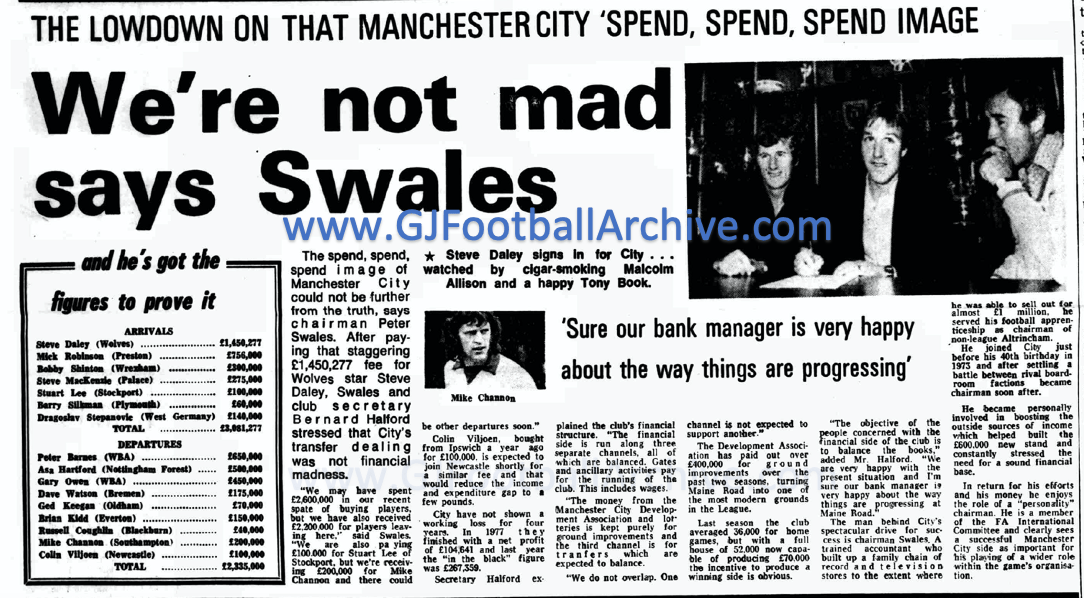
Well, it seems the norm today to talk about the cost of Manchester City’s squad with TV commentators frequently talking about the price of City’s bench. It gets tiring. However, this is not the first time the media talked of City as a ‘spend, spend, spend’ club. Today marks the anniversary of one day in particular when City’s spending caught the media’s attention. That day was on 6 September 1979 when Steve Daley signed for the Blues at a cost of £1,450,277.
City had to defend this spending which – and I know it’s difficult to understand in the modern world of £100m+ footballers – absolutely stunned football. This transfer was the British record but it was perceived as huge.
Chairman Peter Swales’ defence for the spending was that City was a profitable club (see the article) and this is true. City were a hugely profitable club in the 1970s but that all changed over the coming years with Swales, his supporting directors and managers getting giddy trying to buy success. As we all know it takes more than money to generate success and this period of City’s history is the one that actually created the club’s fall from grace, leading to some to believe in the 2010s & 2020s that the club had ‘no history’ and was not a ‘giant’. All that is balderdash. City were a giant who fell unlucky through poor management by a board of directors who did not plan for long term development.
Anyway, lots to say on this but read the article here from 1979 and hopefully that will show the position of strength the club was in (but soon messed up!).
While you’re here why not listen to one of my interviews with Malcolm Allison. You can hear a taster here:
On this day (5 September) in 1927 legendary Manchester City coach Malcolm Allison was born. To commemorate that day and remember his life here’s a 2500+ word article for subscribers on the great man. Enjoy! The article includes comments from a variety of interviews I have performed. Allison’s views on then young footballer Shaun Wright-Phillips are captured and comments from various people who know Allison well are included.
Subscribe to get access – Annual
Read more of this content when you subscribe today. It costs £20 per year (equivalent to about £1.67 a month) to subscribe annually or if you’d prefer a month at a time then it’s £3 per month (see below). Annual subscribers access all the interviews, books, articles and features posted here since the site was launched in December 2020.
Read more of this content when you subscribe today. It costs £3 per month (cancel any time) or £20. a year (see above). Monthly subscribers access all the interviews, books, articles and features posted here since 1st October 2022.
For post 86 of my Maine Rd 100 a photo of Tony Book, Peter Swales and Kaz Deyna. They were photographed at Deyna’s signing in the Maine Rd boardroom. Swales was the City chairman for what became a quarter of Maine Road’s existence, but who were the other chairmen? For the benefit of subscribers to my website I decided to compile for the first time ever a full list of Manchester City’s chairmen since the club’s earliest known game in 1880 through to today. Here goes:
Subscribe to get access
If you would like to read this and all the in-depth articles on this site (including the entire Manchester A Football History book and the audio interview with John Bond) then please subscribe. It works out about £1.67 a month if you take out an annual subscription (£20 per year) or £3 a month if you’d like to sign up for a month at a time. Annual subscribers get full access to the 1000+ articles posted so far and the hundreds scheduled to be posted in the coming weeks.
If you would like to read this and all the in-depth articles on this site (including the entire Manchester A Football History book) then please subscribe. Monthly subscription costs £3 a month if you’d like to sign up for a month at a time. Monthly subscribers get full access to everything posted since 1 October 2022 and the hundreds scheduled to be posted in the coming weeks.
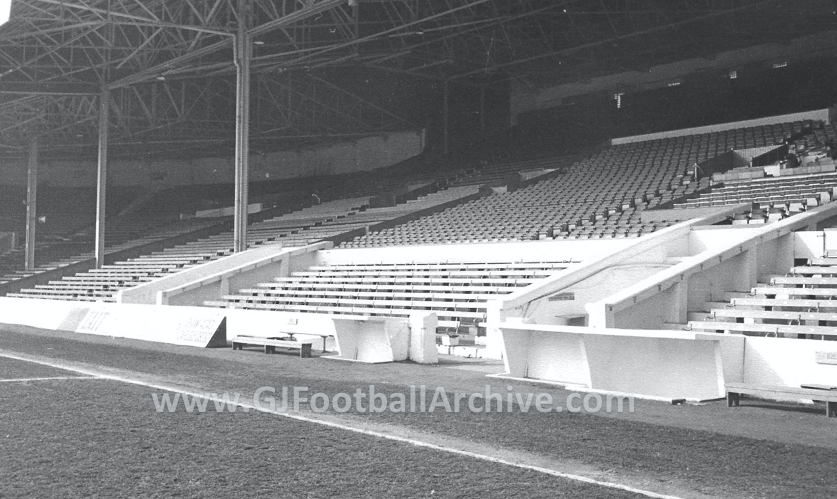
It’s day 20 of my posts counting down to the centenary of Maine Road’s opening game and today’s feature is on the original Maine Road dug outs. Nowadays the playing staff areas take up considerable space wither side of the tunnel at most stadia but for most of Maine Road’s existence there were two concrete bunkers dug out for the manager, physio and maybe one other to sit on. When substitutes were allowed in the 1960s then the sub would also sit there. Inevitably they were cramped and gave an extremely poor view of the game. Basically, the manager would be looking out at leg level.
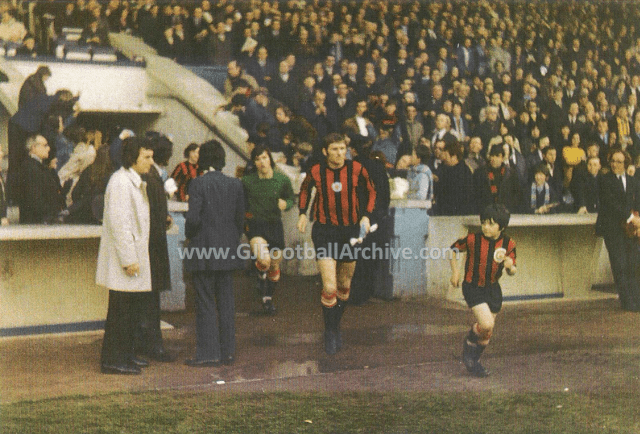
The main image shows that the City dug out (on the right) had been extended by the time this image was taken in the 1970s. The away dug out (left of the tunnel) is the original size.
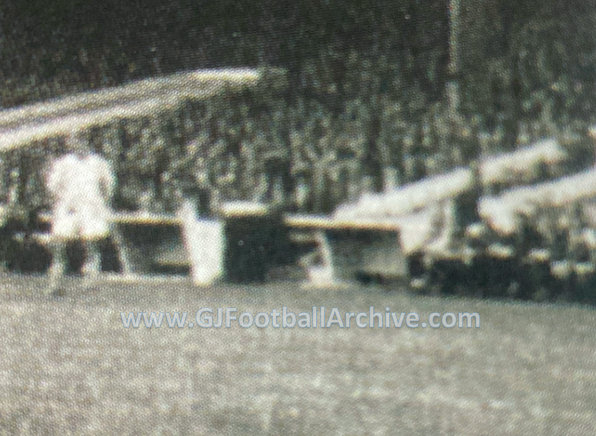
City’s dugouts – which actually were dug out – were built at some point after the main construction of the stadium but I’m not exactly certain when. This image from 1926 shows that small benches were originally positioned/built either side of the tunnel.
1926 City v Fulham, Maine Road. Jimmy McMullan with the ball.
The concrete dugout lasted into the 1970s when more modern bus shelter style ‘dugouts’ (but not ‘dug out’) were erected. This image shows the home bus shelter style dugout in 1983 with manager John Benson. The man with the perm hidden mostly by John Benson is comedian Eddie Large. Physio Roy Bailey is the man closest to the camera.
Mirrorpix photo
Even then the originals remained for some time before being demolished when parts of the white wall were rebuilt. I think they’d been fairly redundant for years though. I have photos of them being used at times during the 1960s and 1970s but this image from the 1950s shows they were empty on many matchdays.
1971 ECWC v Chelsea. Tony Book and mascot Paul Todd. Photo by Alan Jubb
The above image is of the same dugouts in 1971. I tend to think that by this time they were only used if it was a wet day as they provided a little bit of shelter. Notice the bar scarfs in the crowd – blue & white; red & black and one that’s blue & white with a thinner maroon bar too.
For decades, the manager’s dugouts weren’t the only ‘dugouts’ at the ground as there were also similar arrangements for the police and/or St John Ambulance personnel in Maine Road’s corners. These seemed to be in use into the 1960s as this image shows. Look carefully to the right of the player on the right and you can see two police or St John’s Ambulance staff in a corner dug out near the Kippax. This image is from the early 1960s.
These also disappeared when parts of the white wall were rebuilt and gates added in the corners.
For those unfamiliar with Maine Road this photo may help locate the player dugouts. You can’t really see them but one was positioned in the white wall in front of number 1 and one to the left as we look of the central tunnel next to 1.
Maine Road aerial 1971 from Farewell To Maine Road
If you’d like to read more on the history of Maine Road, take a look at Farewell To Maine Road, which can be downloaded from this page:
If you enjoy all the free material on my website and would like to support my research and keep this website going (but don’t want to subscribe) then why not make a one-time donation (or buy me a coffee). All support for my research is valued and welcome. It allows me to keep some free material available for all. Thanks.
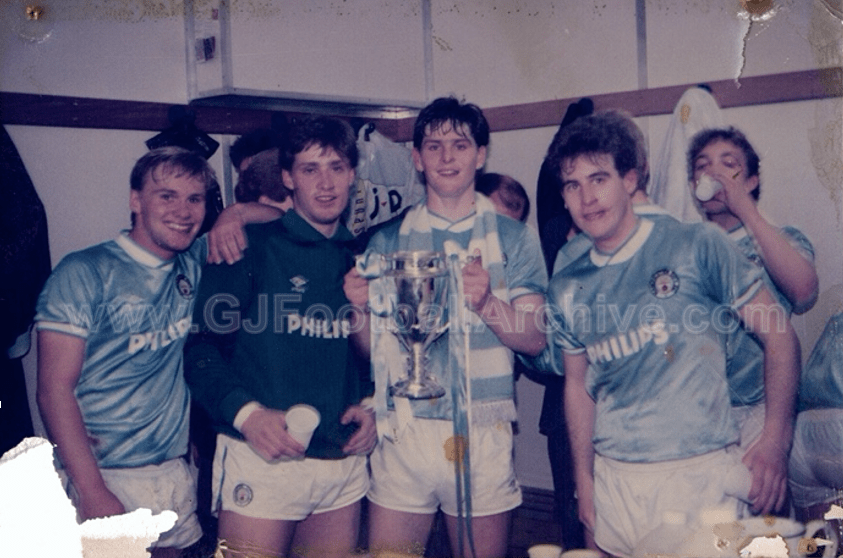
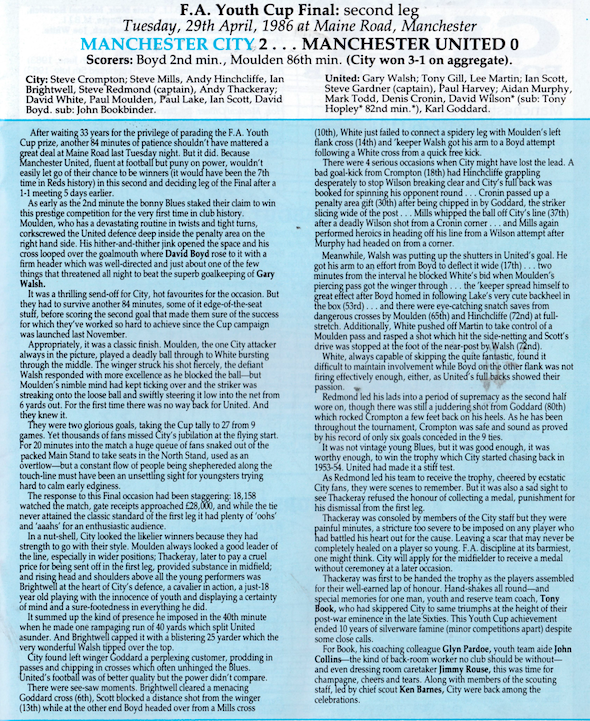
This weekend the 2023 FA Cup final at Wembley will be the first all-Manchester FA Cup final but it is not the first all-Manchester FA Final. That came in 1985-86 when the two Manchester clubs reached the FA Youth Cup final. In the build-up to Wembley this final will probably be overlooked but I wanted to make sure we do remember. Here’s a brief piece on the final.
In April 1986 Manchester City’s youth team defeated Manchester United 3-1 on aggregate in the final of the FA Youth Cup. It was a tremendous achievement at the time, and one which proved that it was the Blues, rather than the Reds, who knew how to find and recruit young players – when Alex Ferguson arrived in Manchester later in 1986 he was dismayed that City tended to sweep up all the local talent and put things in place to change the situation. He even chatted to City’s chief scout Ken Barnes about the Blues’ strengths. More on Ken in a moment.
Of the 11 City boys who played in the 1986 final an amazing seven would also appear in the first team. Two of those would captain the Blues; two would play for England; and one would continue to play for the Blues into the late 1990s. For the record the City eleven plus subs were:
Steve Crompton, Steve Mills, Andy Hinchcliffe, Ian Brightwell, Steve Redmond (capt), Andy Thackeray, David White, Paul Moulden, Paul Lake, Ian Scott, David Boyd. Unused subs: Steve Macauley (1st leg) & John Bookbinder (2nd leg).
City’s Chief Scout at the time was 50s Cup winner Ken Barnes and years later I interviewed him about the success. He firmly believed that it was exceptional to find so many young star players at the same time: ‘We were dead lucky. I have to say that I don’t think it will ever happen again. I don’t recall any team having so many of the players coming through from the Youth team. It was only circumstances as such that they all got into the team at the same time. There was no alternative – the club had no money. No money to buy new players – so the young lads were thrown in at the deep end. Maybe if we had had a good team at the time 3 or 4 of them wouldn’t have got into the team and, who knows what would have happened to them. It enlightened me the year they won the Youth Cup. They went throughout the whole season in the Lancashire League and lost only one game.
‘That was a remarkable youth side. In the past we had boys like Tommy Caton, Ray Ranson, Nicky Reid, John Beresford and Darren Beckford but we never had a team like the 1986 one. Most of the youngsters played for our nursery team Midas… Nearly all those who have made it into the first team played with them from the time they were 11 or 12.’
Here is the City first team match programme commenting on the success:
1986 YOUTH CUP STATISTICS
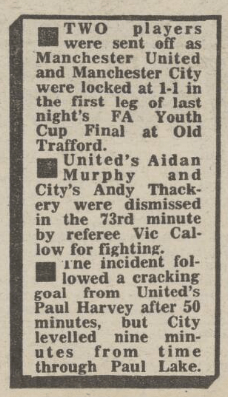
Old Trafford, 24 April 1986 Manchester United – Manchester City 1–1 (0–0) 1-0 49 min. Aidan Murphy 1-1 82 min. Paul Lake (penalty) Attendance: 7,602
Manchester United: Gary Walsh, Tony Gill, Lee Martin, Ian Scott, Steve Gardner (capt), Jon Bottomley, Aidan Murphy (red card, 69 min), Mark Todd, Dennis Cronin, David Wilson (replaced by Tony Hopley), Paul Harvey. Manager Eric Harrison.
Manchester City: Steve Crompton, Steve Mills, Andy Hinchcliffe, Ian Brightwell, Steve Redmond (capt), Andy Thackeray (red card, 69), David White, Paul Moulden, Paul Lake, Ian Scott, David Boyd. Unused sub: Steve Macauley. Manager: Tony Book
Second leg
Maine Road, 29 April 1986 Manchester City – Manchester United 2–0 (1–0) 1-0 02 min. David Boyd 2-0 86 min. Paul Moulden Attendance: 18,158
Manchester City: Steve Crompton, Steve Mills, Andy Hinchcliffe, Ian Brightwell, Steve Redmond (capt), Andy Thackeray, David White, Paul Moulden, Paul Lake, Ian Scott, David Boyd. Unused sub: John Bookbinder. Manager: Tony Book
Manchester United: Gary Walsh, Tony Gill, Lee Martin, Ian Scott, Steve Gardner (capt), Paul Harvey, Aidan Murphy, Mark Todd, Dennis Cronin, Jon Bottomley (replaced by Tony Hopley), Karl Goddard. Manager Eric Harrison.
If you enjoy all the free material on my website and would like to support my research and keep this website going (but don’t want to subscribe) then why not make a one-time donation (or buy me a coffee). All support for my research is valued and welcome. It allows me to keep some free material available for all. Thanks.
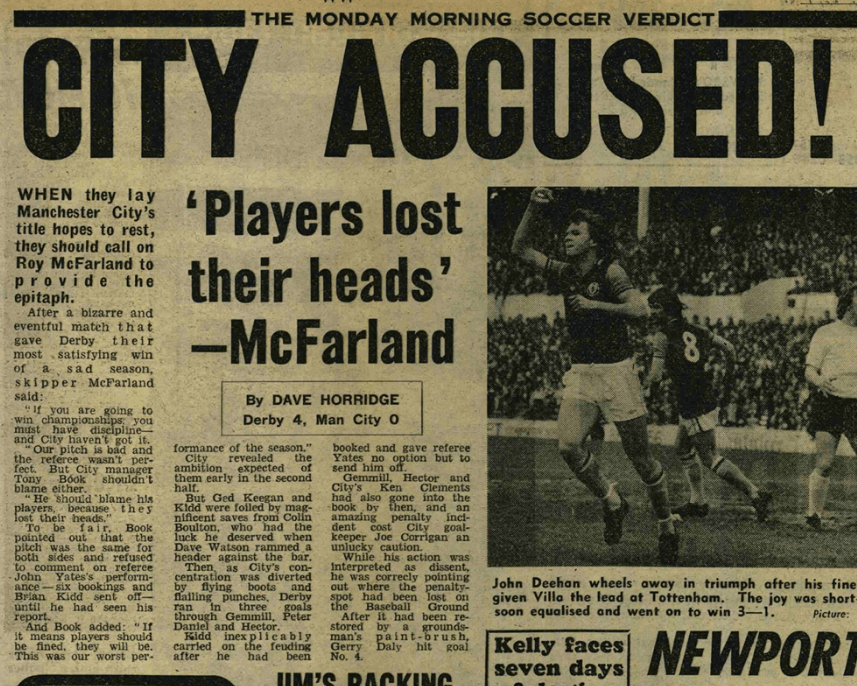
City were still in with a shout of the title after three successive victories against Middlesbrough (1-0), West Bromwich Albion (2-0), and Birmingham (2-1) when they went to the Baseball ground to face Derby County on this day (30 April) in 1977. The game was televised and it included one of those moments that made commentator John Motson quite giddy.
The pitch was quite muddy and when Derby got a penalty City ‘keeper Joe Corrigan challenged where the penalty spot was believed to be and insisted on it being properly measured. At one point he counted out the steps, much to the delight of the crowd.
Unfortunately, this had been a bad tempered game against a team struggling. It ended in 4-0 City defeat at Derby and it was a huge set back, especially as Derby scored all four in the last 25 minutes. In addition Brian Kidd was sent off.
The Blues remained second however, two points behind reigning champions Liverpool, one point above Ipswich, and Tony Book remained determined. The truth was, however, that with four games to go, time was running out. As with European competition at this time, Liverpool were used to surviving the League marathon, City were not and the Blues missed the title by a point. It would’ve been different had this game gone City’s way.
Follow this link to watch the highlights on youtube:







 Gary James' Football Archive