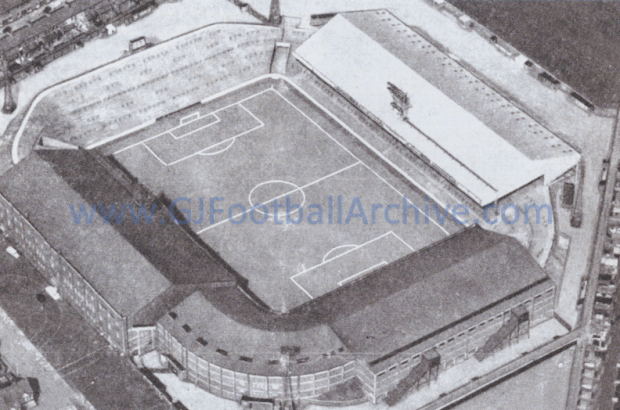
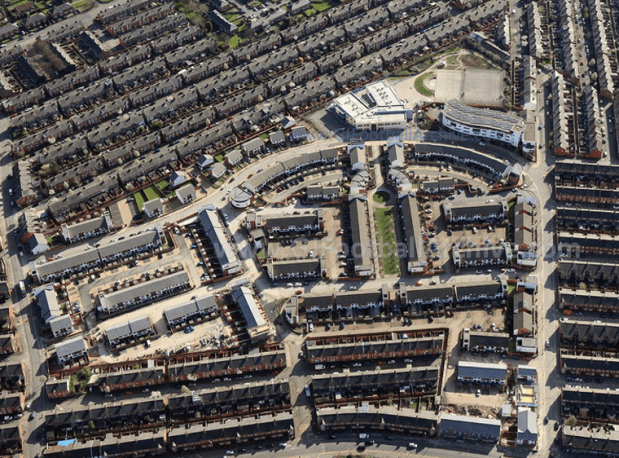
It’s worth comparing this image from recent years, showing the housing and school now built on Maine Road, with this 1940s image of the Maine Road site. The boundary lines are visible, demonstrating how the site changed usage.
This 1971 aerial image shows the stadium from another angle, looking west.
Maine Road aerial 1971 from Farewell To Maine Road
If you’d like to read more on the history of Maine Road, take a look at Farewell To Maine Road, which can be downloaded from this page:
If you enjoy all the free material on my website and would like to support my research and keep this website going (but don’t want to subscribe) then why not make a one-time donation (or buy me a coffee). All support for my research is valued and welcome. It allows me to keep some free material available for all. Thanks.
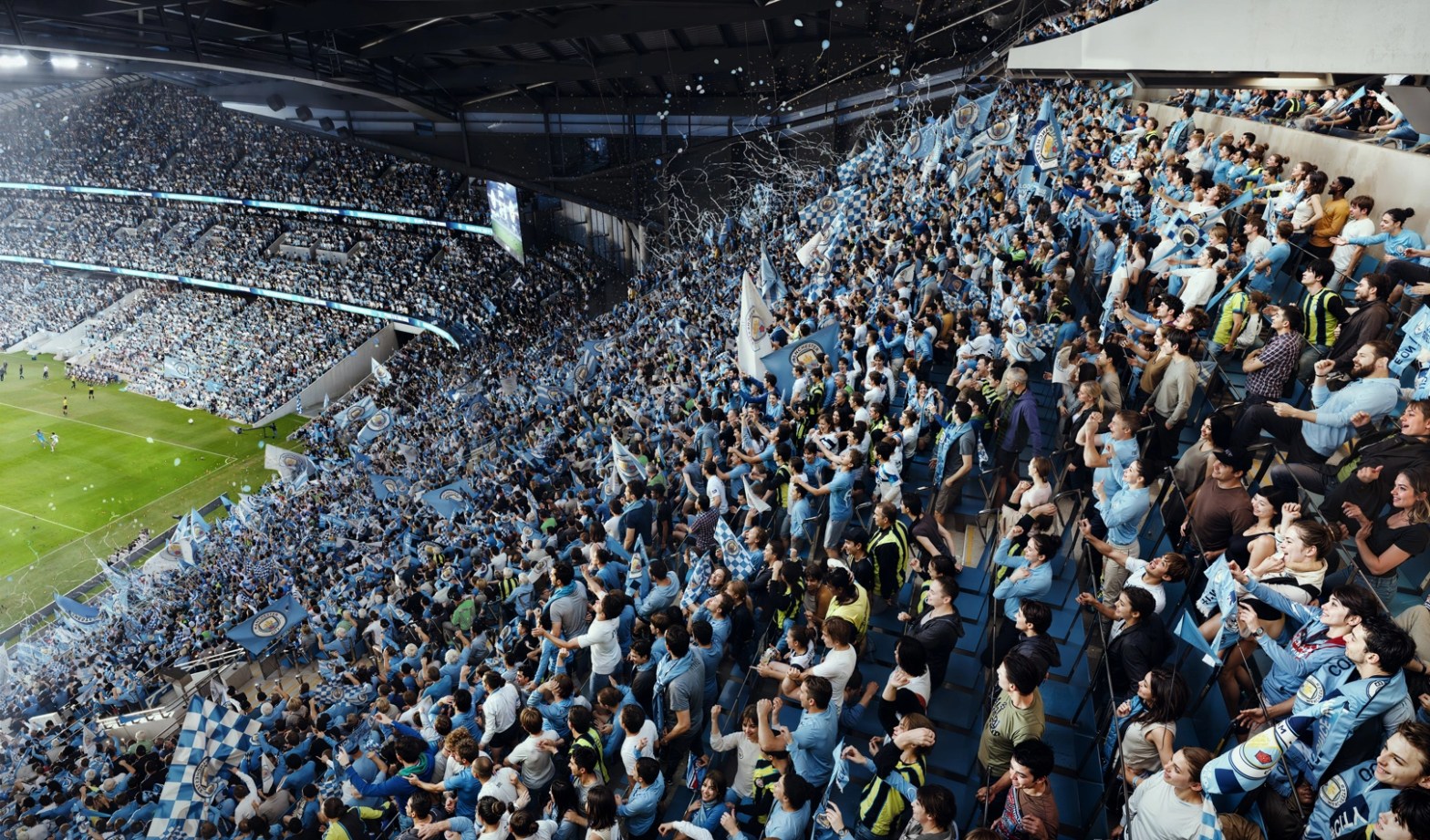
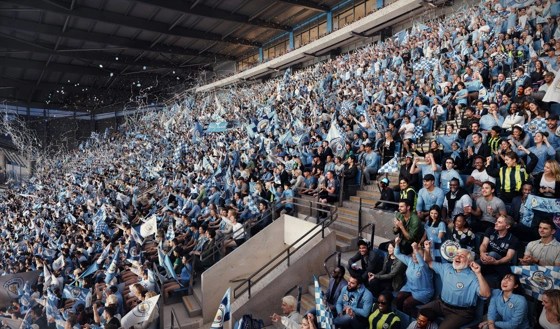
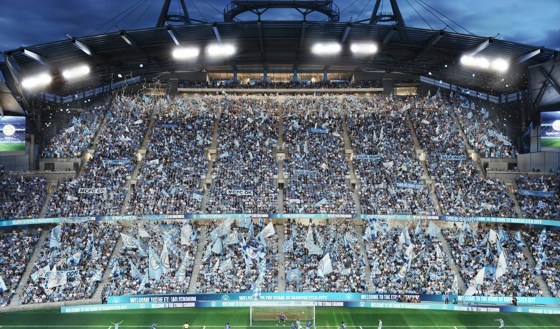
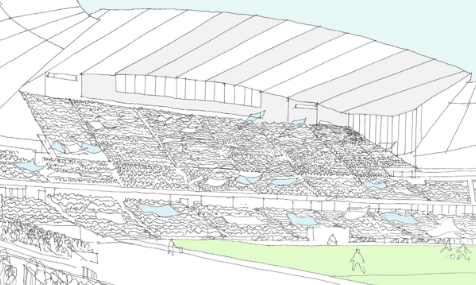
Yesterday’s release of the plans for the newly extended North Stand looked excellent. There’s a long way to go before anyone can sit or stand in the new extension of course, but it does look like it’s going to boost almost every area of support: New rail seating, an emphasis on under 21s, hospitality, families… interesting times. Looking at the images released it looks as though the new 3,000 rail seats will be at the back of the 2nd tier. If that’s the case any noise generated up there should bounce down off the roof and encourage others to join in.
If you enjoy all the free material on my website and would like to support my research and keep this website going (but don’t want to subscribe) then why not make a one-time donation (or buy me a coffee). All support for my research is valued and welcome. It allows me to keep some free material available for all. Thanks.
There’s a lot of furore this week about Manchester City’s decision to wear their new Oasis inspired kit instead of their home kit for their Champions League game with Inter Milan. Lots are talking about tradition, heritage and the like, so I thought I’d add a few words here that might have been overlooked or forgotten. So here goes…
Firstly, my position is clear that I’ve always been keen to see City wear home colours/blue for every fixture possible (whether home, away or at a neutral venue) but I’m a pragmatist and know that’s no longer likely. History and tradition does mean something but of course, when it comes to football, traditions change frequently. People may think City have only ever worn a particular colour at home or that the traditional away colours are red & black but these things are not true. Times change.
When it comes to wearing alternative kits at home it has been done more often than perhaps people realise. In fact the only decade when it hasn’t happened appears to be the 2010s – I say appeared because I haven’t got evidence of every home game in the 1890s and 1900s!
These last few days have caused some to recall the Middlesbrough game when David James went up front and the two Tottenham games at Maine Road in 80s/90s when the referee felt the kits were too close and City ended up changing. But there have been many other occasions. In fact it’s well over 100 years since City first chose to wear away colours/alternative strips at home when they didn’t need to!
The image above of Neil Young comes from the 1971 ECWC semi-final v Chelsea. Notice that Young is wearing City’s away colours.
Often when there was a clash of colours in a cup game City would wear their away strip. Games in the 1920s right through to 1970s saw the Blues don maroon, red/black and even scarlet at times at Maine Road.
Here’s another image from that Chelsea semi final:
1971 ECWC v Chelsea. Francis Lee. Photo by Alan Jubb
To the right you can see the North Stand under construction, as you can in the Young image.
Other games in living memory (not necessarily mine, but living memory for many older blues) include:
January 1971 – City v Wigan in FA Cup (red & black)
September 1970 – City v Bologna in Anglo-Italian Cup (red & black)
January 1968 – City v Reading in FA Cup (all maroon)
March 1966 – City v Everton in FA Cup (all maroon)
March 1966 – City v Leicester in FA Cup (all maroon)
March 1956 – City v Everton in FA Cup (maroon shirts, white shorts)
In earlier decades City often chose to wear an away shirt for cup ties where there was a clash. Prior to 1921 the FA rule was that home teams would have to change if there was a clash.
In March 1924 City chose to wear a kit they described as ‘Lucky scarlet’ for a FA Cup tie with Cardiff at Maine Road. So for well over 100 years City have often chosen to wear alternative kits at home instead of traditional blue when they didn’t need to.
Personally, I’d still prefer City to always wear blue no matter where they play, but that’s never going to happen anyway.
Incidentally, if you’d like to read more on the history of Maine Road, take a look at Farewell To Maine Road, which can be downloaded from this page:
If you enjoy all the free material on my website and would like to support my research and keep this website going (but don’t want to subscribe) then why not make a one-time donation (or buy me a coffee). All support for my research is valued and welcome. It allows me to keep some free material available for all. Thanks.
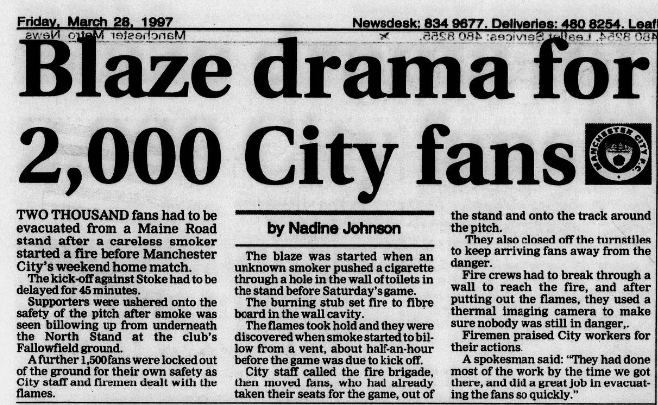
The series of features covering Manchester City in the 1990s continues today with this reminder of a day when fans had to be evacuated from Maine Road’s North Stand due to a fire. I remember the day well – I was sat at the opposite end – and it did seem a little worrying for a time. I remember seeing some smoke coming out of the stand. This cutting is from today (28 March) in 1997 and highlights the day of the fire (previous weekend).
The article claims the fire was started because a fan had pushed a cigarette into a cavity which set fire to materials behind the wall. I don’t think I ever knew this at the time (the rumour was that a chip fryer or burger stand had overheated in some way) but reading this all these years later is a little chilling. In 1985 the cause of the Bradford fire was believed to be a stray cigarette going through a whole and setting waste material under the stand on fire.
Unlike at Bradford the North Stand fire was soon extinguished and City’s game was delayed but played. Nevertheless, reading that brief report now does make you think of what could have happened.
This was not the first time a stand at Manchester City experienced a fire of course. Elsewhere on this site you can read about the Hyde Road fire.
While you’re here why not read a 4,900 word long article on the 1996-97 season? It’s available to subscribers, so why not subscribe and relive this season and an extraordinary decade? As with all these 1990s subscriber features it contains material from interviews I’ve performed with key figures from that time, including Phil Neal who talks about Steve Coppell’s shock resignation.
Here’s the 4900 word article on that season:
Subscribe to get access – Monthly
Read more of this content when you subscribe today. It costs £3 per month (cancel anytime) to access everything posted since 1 October 2022 or there’s a special annual rate below which gives greater access and works out much cheaper.
Read more of this content when you subscribe today. It costs £3 per month (above) or £20 a year (here) to access everything posted since the site was created in December 2020. This special rate works out about £1.67 a week and gives access to everything posted, including PDFs of 3 of my books.
This series of articles and features will run throughout March with indepth articles some days and smaller ‘on this day’ style posts on others. There will be flashbacks to great games, players and more. Every day in March will offer something to enjoy.
Subscribers will get access to everything, while some on this day material will be free for all to view.
If you want to know more on this incredible decade for Manchester City Football Club then why not subscribe and read it all? If you’d like to know more about subscribing then see:
The series of features/articles covering Manchester City in the 1970s continues with a 5,200 word article on the entire 1970-71 season. You can read this below. This series of articles and features on Manchester City in the 1970s will run throughout January with indepth articles some days and smaller ‘on this day’ style posts on others. There will be flashbacks to great games, players and more. Every day in January will offer something to enjoy.
Subscribers will get access to everything. If you want to know more on this incredible decade for Manchester City Football Club then why not subscribe and read it all? You could even subscribe for a month and see what you think. The following 5,200 word article is on the 1970-71 season and is available to subscribers below. Enjoy!
Subscribe to get access – Monthly
Read more of this content when you subscribe today. It costs £3 per month (cancel anytime) to access everything posted since 1 October 2022 or there’s a special annual rate below which gives greater access and works out much cheaper.
Read more of this content when you subscribe today. It costs £3 per month (above) or £20 a year (here) to access everything posted since the site was created in December 2020. This special rate works out about £1.67 a week and gives access to everything posted, including PDFs of 3 of my books.
If you enjoy all the free material on my website and would like to support my research and keep this website going (but don’t want to subscribe) then why not make a one-time donation (or buy me a coffee). All support for my research is valued and welcome. It allows me to keep some free material available for all. Thanks.
A new daily series of articles for subscribers started yesterday covering the 1980s. This is a seasonal journey through a truly important decade in the history of Manchester City Football Club. Today’s article is a 2,500 word feature on the 1981-82 season. Enjoy!
Subscribe to get access – Monthly
Read more of this content when you subscribe today. It costs £3 per month (cancel anytime) to access everything posted since 1 October 2022 or there’s a special annual rate below which gives greater access and works out much cheaper.
Read more of this content when you subscribe today. It costs £3 per month (above) or £20 a year (here) to access everything posted since the site was created in December 2020. This special rate works out about £1.67 a week and gives access to everything posted, including PDFs of 3 of my books.
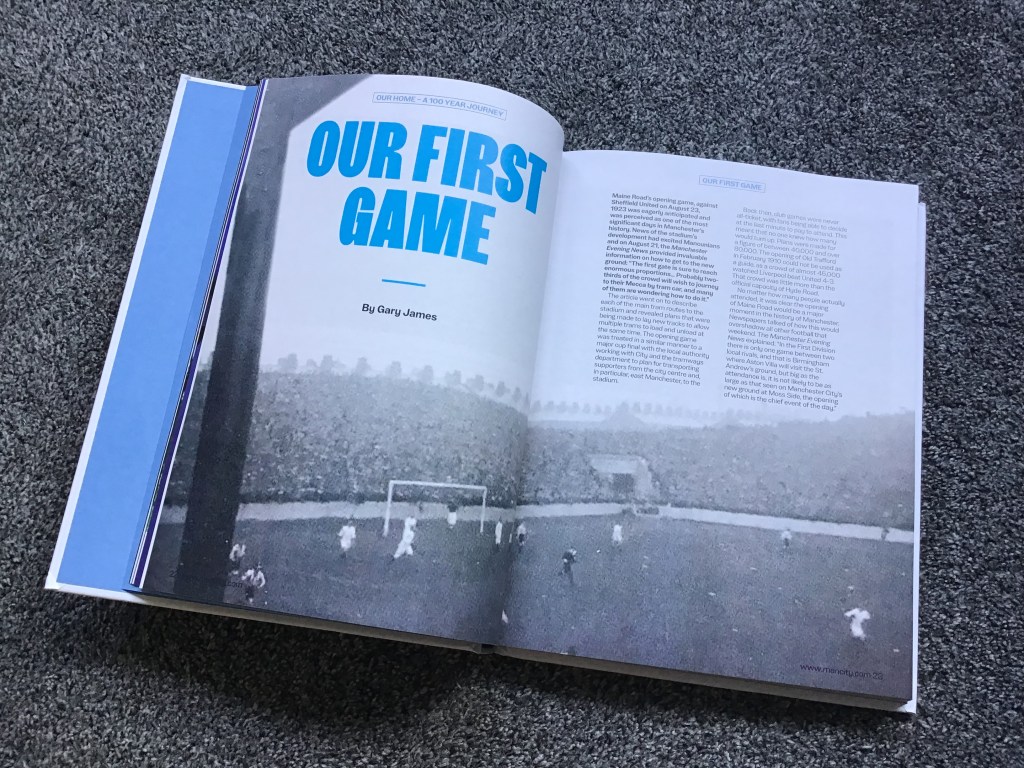
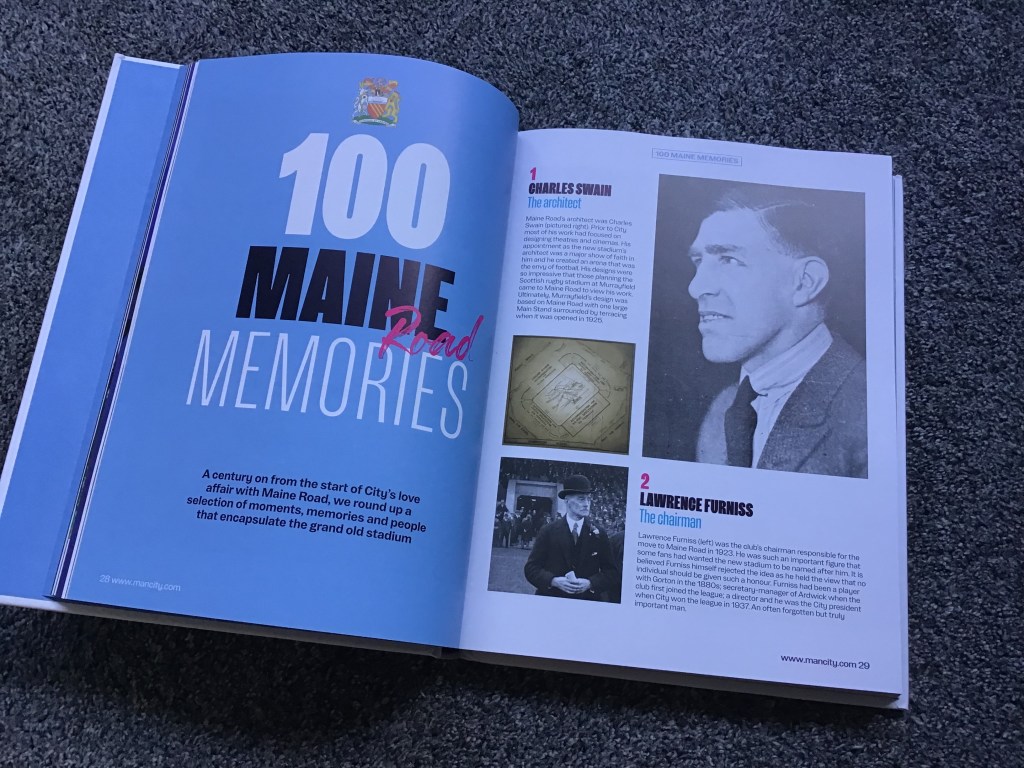
I’m delighted to say I’m one of the co-authors on a new book on the stadia of Manchester City. I’ve contributed the Introduction, the story of Maine Road’s first game and the 100 Maine Memories of Maine Road. I tried to make sure the 100 Maine Memories cover both the great and the unusual so, inevitably, Colin Bell is featured but so is the wonky North Stand scoreboard! If you attended Maine Road it will all make sense and if you didn’t it’ll give you a great feel for what life was like at the old place.
Post 85 of my Maine Road 100 countdown is a FA Cup reminder of a day that I know I loved as a kid. It was the day (24 January) in 1981 when John Bond’s Manchester City defeated his former club Norwich 6-0 in the FA Cup fourth round tie. I was sat in that uncovered bit between the Main Stand and the North Stand (it was cheaper but if it rained it was somewhat unpleasant, especially when the rain blew off the Main Stand roof on to us!).
This 1971 image shows the area I was sat in (number 2) that day:
Maine Road aerial 1971 from Farewell To Maine Road
Subscribers can read a report and watch highlights of the game here:
Subscribe to get access
If you would like to read this and all the other great content on here then please subscribe. Annual subscribers (£20 per year, sign up here) get access to everything posted on the site including PDFs of 2 of my out of print books and archived content like my exclusive audio interviews with John Bond, Malcolm Allison etc. Not only that but you’ll be helping to support this site’s development.
If you would like to read this and all other great content on here then please subscribe. Monthly subscribers (£3 per month, cancel anytime and sign up here) get access to everything posted on the site since 1 October 2022. Not only that but you’ll be helping to support this site’s development.
For post 74 of my Maine Rd 100 countdown I’m posting this image of the original Scoreboard End being built at the old ground. The Scoreboard End lasted from 1923 until 1970 when it was demolished and replaced by the North Stand. Here’s an aerial photo from almost 40 years later showing the Scoreboard End as the last remaining uncovered stand.
A couple of years ago (and going on for the following 35 weeks) I posted the Scoreboard End being built image as part of my Name That Historic Ground series. Every Monday I challenged readers to see if they could recognise a different ground each week from an old photo. Some were easy, others not so. If you missed them you can now go through each week’s ground and the answers. You can start here:
While you’re here why not subscribe to my site and you can then access every article, interview, audio recording etc. already posted and those that will be posted during your subscription. It costs £20 per year (about £1.67 a month). You can subscribe below:
Subscribe to get access
Read more of this content when you subscribe today.
Day 58 of my posts counting down to the centenary of Maine Road’s opening game is an aerial photo of the ground from about 1973. Unusually this image looks towards the ground from behind the North Stand (from the city centre direction looking south) and shows the streets that would soon disappear as part of the area’s housing developments.
I’ve highlighted what became recognised as MCFC property with blue lines – that’s the stadium site plus the Platt Lane training complex, which became City’s during the 1970s.
The two areas marked in yellow on either side of Lloyd Street South were redeveloped into Walks and Closes named after former City players. Many of these new Walks & Closes still exist, although some have been remodelled and the names of some, for example the one named after Frank Swift, have disappeared altogether.
The are marked in pink between the player streets and the stadium became the Claremont Road School playing fields which, on match day, provided extra car parking for supporters.
c.1973 Maine Road
It’s worth comparing that 1970s image with this one from recent years, showing the housing and school now built on Maine Road.
And compare both to this 1940s image of the Maine Road site too:
This 1971 aerial image shows the stadium from another angle, looking west.
Maine Road aerial 1971 from Farewell To Maine Road
If you’d like to read more on the history of Maine Road, take a look at Farewell To Maine Road, which can be downloaded from this page:
If you enjoy all the free material on my website and would like to support my research and keep this website going (but don’t want to subscribe) then why not make a one-time donation (or buy me a coffee). All support for my research is valued and welcome. It allows me to keep some free material available for all. Thanks.










 Gary James' Football Archive