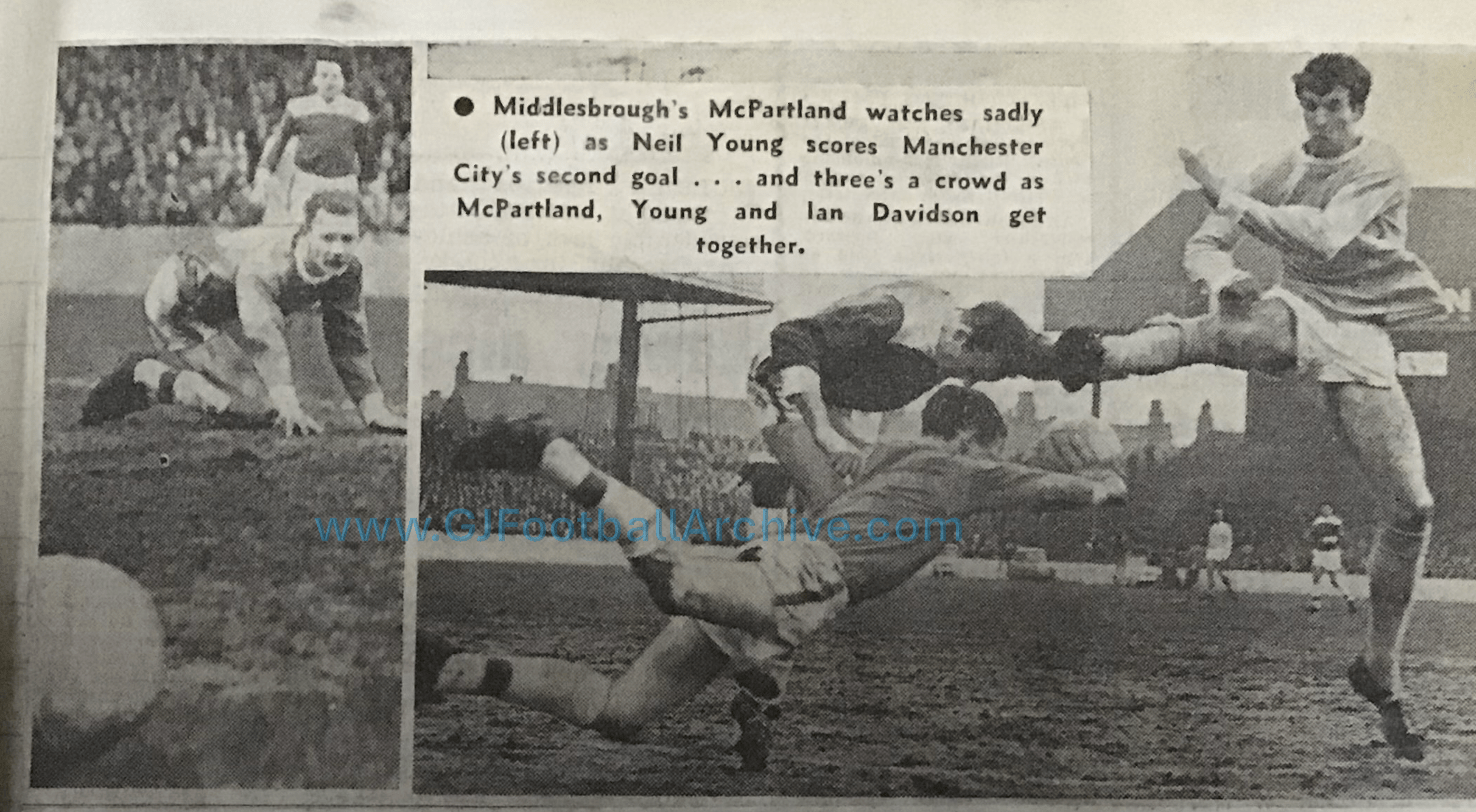
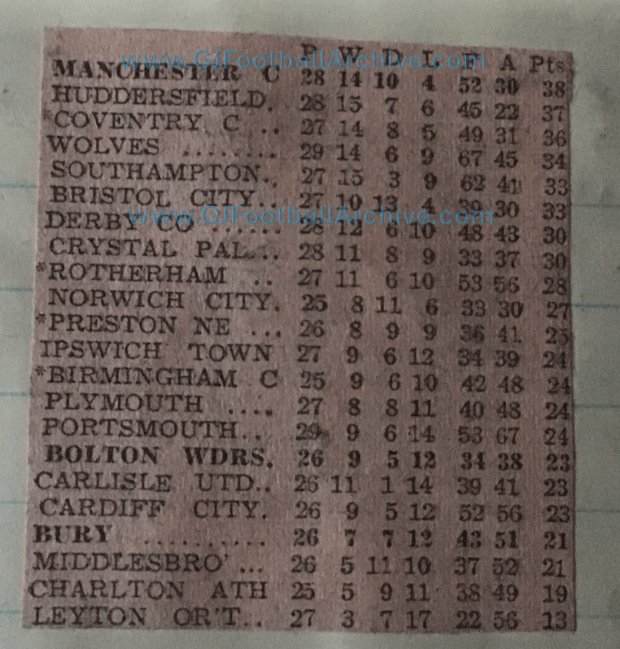
Today (29 January) in 1966 goals from Mike Summerbee (2) and Neil Young brought City a 3-1 victory over Middlesbrough and left City top of Division Two. It was a convincing win (Malcolm Allison boasted how City could have scored 6) but fans actually felt dissatisfied at the end as the Blues had eased off. Here’s the League table from after that game:
Here for subscribers are match reports from this game:
Subscribe to get access
Read more of this content when you subscribe today. It costs £3 per month (cancel anytime) or sign up for a year at a time at a discounted price of £20 per year. This gives access to every article, book, interview etc. posted to the site so far. Why not sign up for a month and see what you think?
You can find out more on Manchester City during the 1965-66 season by reading the following 4100 word article. As with most of the other features in this series it includes words from interviews I have performed with those who were there. This is a subscriber article (see below).
Subscribe to get access
Read more of this content when you subscribe today. It costs £3 per month (cancel anytime) or sign up for a year at the discounted price of £20 per year (works out £1.67 per month). Subscribers access the 1000+ articles posted so far and the others scheduled during the life of your subscription.
If you enjoy all the free material on my website and would like to support my research and keep this website going (but don’t want to subscribe) then why not make a one-time donation (or buy me a coffee). All support for my research is valued and welcome. It allows me to keep some free material available for all. Thanks.
Jack Charlton’s Middlesbrough arrived at Maine Road on this day (21 January) in 1976 for the second leg of the League Cup Semi final 1-0 up after a tense first leg match. The majority of the first leg had been played out in midfield with Alan Oakes, Asa Hartford and the emerging Paul Power putting up a good fight on City’s behalf. Boro had found it difficult to break through City’s powerful defence until John Hickton (I had previously said David Armstrong had scored but he’d netted for them in the 1-0 League meeting 3 days earlier) gave them the lead in the 66th minute. Despite the advantage Middlesbrough’s Evening Gazette predicted a difficult return game.
At Maine Road a youthful City side destroyed Boro. As early as the 5th minute 19 year old Peter Barnes – now working for GMR – crossed the ball to 20 year old Ged Keegan, who headed home his first senior goal. Six minutes later Keegan laid the ball off for Oakes to fire a left foot shot past ‘keeper Jim Platt. A minute into the 2nd half Barnes made it 3-1 on aggregate. Shortly before the end Joe Royle made it 4-1 and maintained his record of scoring in every round.
Stats: League Cup semi-final 2nd leg. 21st January 1976.
While you’re here why not subscribe and read a 5,320 word article on the entire 1975-76 season – a season which saw Tony Book guide the club to major success. You can read this below.
Subscribe to get access – Monthly
Read more of this content when you subscribe today. It costs £3 per month (cancel anytime) to access everything posted since 1 October 2022 or there’s a special annual rate below which gives greater access and works out much cheaper.
Read more of this content when you subscribe today. It costs £3 per month (above) or £20 a year (here) to access everything posted since the site was created in December 2020. This special rate works out about £1.67 a week and gives access to everything posted, including PDFs of 3 of my books.
If you enjoy all the free material on my website and would like to support my research and keep this website going (but don’t want to subscribe) then why not make a one-time donation (or buy me a coffee). All support for my research is valued and welcome. It allows me to keep some free material available for all. Thanks.
The new series of features on Manchester City in the 1910s continues today with a 1500 word article on the 1910-11 season. If you’re a subscriber you can read this below.
If you’re not a subscriber then why not sign up for a month and see what you think?
Subscribe to get access
Read more of this content when you subscribe today. It costs £3 per month (cancel anytime) or sign up a year at a time for the discounted annual fee of £20. This gives access to everything on the site, including PDFs of 3 of my books and various other articles, interviews and audio material. Each subscriber has access to all content posted during their subscription period too. Why not sign up for a month and see what you think?
Uwe Rosler scored a memorable 17th minute penalty in Manchester City’s 2-0 victory over Middlesbrough on this day (20 December) in 1997. Paul Dickov netted the other goal. That was one of only six victories for the Blues that season as City headed towards Division Two and Boro towards the Premier League.
While you’re here, why not subscribe and read an indepth article on the 1997-98 season? The article is almost 9,500 words long – there’s so much to say! Some people write entire football club histories that are shorter than that. It’s available to subscribers, so why not subscribe and relive this season and an extraordinary decade? As with many other subscriber features it contains material from interviews I’ve performed with key figures from that time.
Here’s the 9500 word article on that season:
Subscribe to get access – Monthly
Read more of this content when you subscribe today. It costs £3 per month (cancel anytime) to access everything posted since 1 October 2022 or there’s a special annual rate below which gives greater access and works out much cheaper.
Read more of this content when you subscribe today. It costs £3 per month (above) or £20 a year (here) to access everything posted since the site was created in December 2020. This special rate works out about £1.67 a week and gives access to everything posted, including PDFs of 3 of my books.
If you enjoy all the free material on my website and would like to support my research and keep this website going (but don’t want to subscribe) then why not make a one-time donation (or buy me a coffee). All support for my research is valued and welcome. It allows me to keep some free material available for all. Thanks.
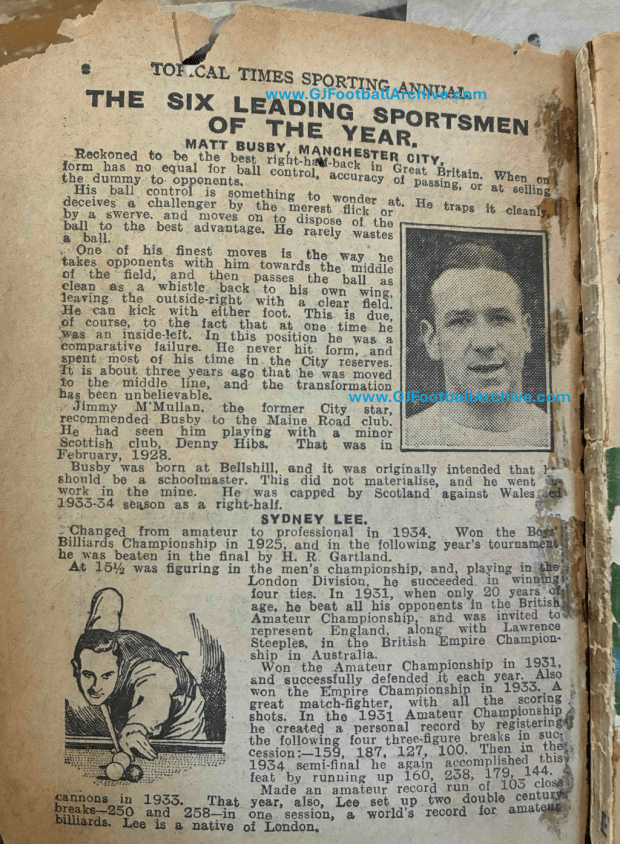
During my tidy-up of my writing space I’ve rediscovered items I’ve used in my research over the years and thought I’d post some on here. Today here are some images and information from the Topical Times Sporting Annual 1934-35. There’s some interesting aspects and information that I’m sure some of you will find interesting. let’s start with the cover…
The player in the blue shirt is Manchester City’s Matt Busby who the yearbook regarded as one of the 6 sporting stars of 1934. Here’s what they said about him:
The book included a small section on each team. City’s looked like this (notice the record attendance has a typo; it should be 84,569. Also, look at Middlesbrough’s record crowd. It has since been passed though!):
For those wondering why this alphabetical list of clubs went from City to Middlesbrough and not Manchester United, the list was by division. At that time City were in the top tier and United were in the second. Here’s their profile:
At that time United’s record crowd was for a game staged at Old Trafford but not featuring United. That has since been surpassed but Old Trafford’s record is still for a game not featuring United (Wolves v Grimsby FAC tie). Note also the official colours of United.
If you enjoy all the free material on my website and would like to support my research and keep this website going (but don’t want to subscribe) then why not make a one-time donation (or buy me a coffee). All support for my research is valued and welcome. It allows me to keep some free material available for all. Thanks.
On this day (6 December) in 2004 Bradley Wright-Phillips marks his first League appearance for Manchester Cuty with an 80th minute goal against Middlesbrough. The game ended in a 3-2 defeat for City (Robbie Fowler scored the other City goal) but, if you fancy a flashback, you can watch highlights here: https://www.youtube.com/watch?v=IYEYZF118Ao
If you enjoy all the free material on my website and would like to support my research and keep this website going (but don’t want to subscribe) then why not make a one-time donation (or buy me a coffee). All support for my research is valued and welcome. It allows me to keep some free material available for all. Thanks.
Fifty years ago today (3 December 1975) Manchester City defeated Mansfield Town 4-2 in the League Cup. Subscribers can read all about the game below.
Subscribe to get access
Read more of this content when you subscribe today. It costs £3 per week (cancel anytime) or sign up on a yearly basis for the discounted price of £20 per year. Subscribers access every article, interview, feature etc. on the site throughout their subscription.
On this day (21 November) in 1953 John McTavish made his Manchester City debut at Middlesbrough. The game ended in a 1-0 City win (an own goal). For this game John played as City’s right half, allowing Don Revie to move into the forward line. John retained his place pretty well throughout the rest of the season.
The following season saw the introduction of the “Revie Plan”, with John part of the initial team, away at Preston. Unfortunately, City were defeated 5-0 and John was dropped for the next game in favour of Ken Barnes. Barnes was viewed by players of the period as the main reason the plan had succeeded in the reserves, and so his selection helped transform the club’s fortunes that season. It was a shame for John, who then found opportunities became limited.
You can read more on John’s debut season of 1953-54 below. This 1,700 word article on the 1953-54 season is a subscriber article and you can read it by subscribing below.
Subscribe to get access
Read more of this content when you subscribe today. It costs £3 per month or you can subscriber for the discounted annual rate of £20 per year. Each subscriber gets access to everything posted so far, including PDFs of a couple of my books.
Continuing the series on Manchester City in the 1920s here’s a free to read 1100 word article on 1920s City (and 1930s Everton) star Tommy Johnson. Enjoy!
Tommy Johnson was a huge favourite with City supporters throughout his eleven year career with the Blues. Their love affair with the Dalton-in-Furness born goalscorer was borne out of a tremendous appreciation of his contribution to the Blue cause. They also recognised that despite the fame and adulation Johnson was from the same background as they were. For much of his City life he lived in the Gorton area and was often seen in the pubs and clubs talking and mixing with supporters.
In an interview I did with him two decades ago, Johnson’s son Alan remembered his father being a familiar presence in Gorton: “My father was proud of being an ordinary bloke. The players didn’t get paid large wages and life at times was tough, and I think most of his neighbours and friends understood that he really wasn’t any different from them. After he’d left City and joined Everton he would sometimes bring Dixie Dean to Gorton and the two of them would sit in the Plough or one of the other pubs chatting away. In fact Dixie became as well known in the pubs of Gorton as my Dad was!”
Around 1918 City full back Eli Fletcher spotted the promise of Dalton-In-Furness born Johnson when he saw him play. He contacted the Blues and urged them to sign the exciting 17 year old. Johnson joined the Blues in February 1919, and he immediately made an impression during that final season of wartime football.
Once the full League programme resumed in August 1919 Johnson had to wait for his opportunity to impress in the First Division. His chance did not come until the following February, but when it did he scored both goals in City’s 2-0 defeat of Middlesbrough. It wasn’t however until the 1922-3 season that the striker could be regarded as a regular. That season he played 35 of City’s 42 League games and scored on 14 occasions.
In 1926 Johnson appeared in the FA Cup final and a few weeks later he made his England debut at inside left against Belgium in Antwerp. He scored as England won 5-3. A journalist of the period described him as: “an inside forward with a left foot shot few players have equalled and a penchant for the telling cross-field pass.”
During 1926-7 Johnson broke the twenty goals a season barrier when he scored 25 in 38 League appearances, including a hat-trick in the 8-0 victory over Bradford on the final day of the season. The following season he became recognised across the country as a major striker as he managed to score a Club record 38 goals in 39 League appearances. Five of those goals came in one incredible match with Everton at Goodison when City defeated the home side 6-2.
Tommy Johnson’s record breaking 38th League goal of the season as drawn for the Liverpool Echo.
The following season was to be his last at Maine Road despite his role as the fans’ favourite. There were plenty of magical moments from Johnson. The Manchester derby of October 1929 saw one of Johnson’s most memorable performances. According to the renowned Manchester journalist Ivan Sharpe writing in the Athletic News: “Johnson should have been a fairly happy man. He has the credit of making the match come to life. It was going to pieces early in the second half when Moore thoughtlessly pulled up while appealing for off-side and Johnson – with his right foot – scored and set the game alight.”
The game with United ended in a 3-1 City victory but it also saw one of the more controversial moments of the season when the referee blew for full-time a good two minutes before time was actually up. This was particularly galling for Johnson as he netted the ball after an amazing run just at the moment the whistle went. Ivan Sharpe gave his entertaining thoughts on the incident in his match report: “When Thomas CF Johnson was a boy he dreamed of playing for a First Division team, and like every youngster, of playing at centre-forward.
“On his night of nights he was playing against his own club’s deadly rivals, and over 100,000 eyes were riveted upon him as he darted through the defence – ‘Go on Johnson!’ – dodged this man and that man, drew out the goalkeeper, dribbled the ball round the other side’s last hope and with the roars of the delighted populace acclaiming his performance, rolled the ball through the untenanted goal. I have not asked him, but I know it’s true, because every schoolboy gets those midnight, alone-I-did-it goals.
“But isn’t it a hard world? The once-in-a-lifetime goal dribbled around the goalkeeper on the aforesaid deadly rivals’ very own ground all came true in this battle of Manchester, and the referee said the time had expired a moment before the ball had crossed the line! And that’s not all. Time had not expired. My watch and every watch around me – plus the carefully compiled record I invariably keep of the minutes of the passing show – definitely established that the referee was two and a half minutes too soon. And this is making no allowance whatever for lost time.
“How curious that the referee got in a muddle with his minutes on the day the clock goes back. He provided the last ‘rows’ of summer!”
The following March, Johnson was transferred to Everton for £6,000. The supporters were furious. Petitions were written. Demonstrations were made, and even a boycott of the Blues was threatened, but there was nothing the fans could do to actually stop the transfer. City’s average attendance did drop by several thousand however.
At Everton Johnson won the Second Division Championship and the FA Cup – beating City 3-0 in the final. A spell at Liverpool followed before he became player-manager of Darwen.
In the late 1940s he became licensee of a pub in Gorton and attended Maine Road regularly. He purchased his own season ticket for several years. According to his son Alan, Tommy Johnson was a dedicated City fan: “At Everton he had a lot of success – he won more trophies than he had in Manchester – but City remained his club. In fact, after he’d left City he kept coming back to Maine Road and sometimes paid to stand on the Kippax side of the ground. He was often recognised and was usually congratulated simply for being ‘Tosh’ Johnson!”
Johnson passed away in 1973 at the age of 71. Four years later Manchester City Council named part of a new Moss Side housing development ‘Tommy Johnson Walk’ in his honour close to Maine Road.
If you enjoy all the free material on my website and would like to support my research and keep this website going (but don’t want to subscribe) then why not make a one-time donation (or buy me a coffee). All support for my research is valued and welcome. It allows me to keep some free material available for all. Thanks.
Read more of this content when you subscribe today. It costs £20 a year to subscribe (it works out £1.67 a month) or £3 if you’d like to sign up a month at a time. Annual subscribers get full access for as long as you subscribe (you can always try it for a month). It’s worth bearing in mind that the 2010 Manchester A Football History cost £24.95 and all subscribers will be able to access all of that for as long as they are a subscriber (plus all the other stuff of course).
It costs £3 a month to subscribe a month at a time. Why not give it a try! Monthly subscribers get access to everything posted since 1 October 2022 for as long as you subscribe.
I’ve included this in some of my books over the years and I think it’s a great crowd shot which leads to the odd question too. Take a close look at it. This is from 1912-13 season and shows a section of the crowd in the Main Stand paddock. There are definitely men, women and children in there, but is there also one of the earliest non-white faces to be seen at a home City game too? It’s difficult to tell but look at the complexion of the man above the word ‘archive’… We’ll never know sadly.





 Gary James' Football Archive