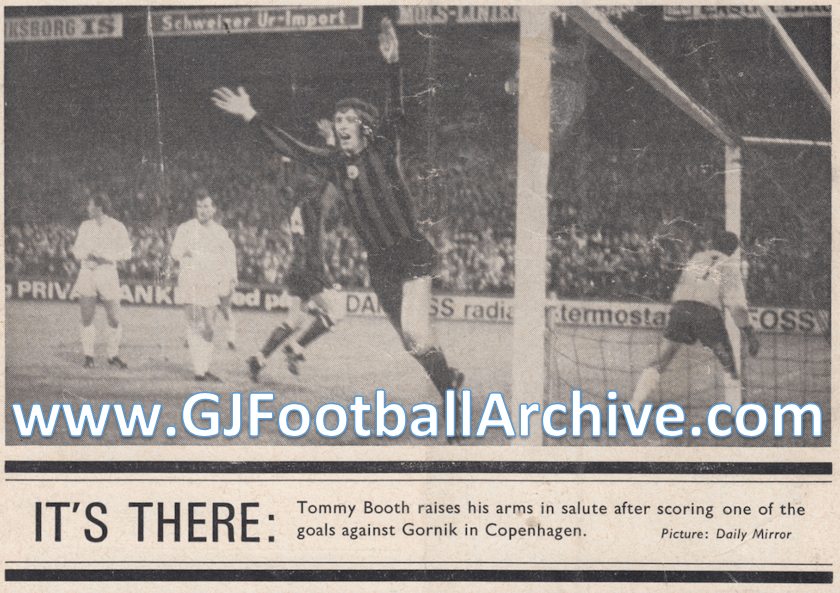
Today (31 March) is the anniversary of a 1971 European Cup Winners’ Cup between Manchester City and Gornik Zabrze played in Copenhagen. This was a replay after the earlier games had ended 2-2 on aggregate. Back then replays were used instead of penalty shootouts to decide games like this. For subscribers, here’s an article looking back at this day.
This 1500 word article is available for subscribers…
Subscribe to get access – Annual
Read more of this content when you subscribe today. It costs £3 per month (cancel any time, see below) or £20 a year. Annual subscribers get full access to ALL the content on here throughout their membership. Do a few searches and see what’s on here.
It costs £3 per month (cancel any time) or £20 a year (see above). Monthly subscribers get access to everything posted since 1 October 2022 and everything posted throughout their membership. Why not sign up for a month and see what you think?
On this day (1 October) in 1969 Manchester City’s first ever home tie in the ECWC (at the time Europe’s second most important competition) ended 3-0 (6-3 on aggregate) as the Blues defeated Athletic Bilbao. City scorers were Alan Oakes, Colin Bell and Ian Bowyer. Attendance 49,665. You can read more (and watch a video) about the game here:
Subscribe to get access
Read more of this content and everything else on the site when you subscribe today. It costs £3 per month (cancel anytime). Or you can subscribe on an annual basis for the discounted amount of £20 per year (works out about £1.67 per month).
There’s a lot of furore this week about Manchester City’s decision to wear their new Oasis inspired kit instead of their home kit for their Champions League game with Inter Milan. Lots are talking about tradition, heritage and the like, so I thought I’d add a few words here that might have been overlooked or forgotten. So here goes…
Firstly, my position is clear that I’ve always been keen to see City wear home colours/blue for every fixture possible (whether home, away or at a neutral venue) but I’m a pragmatist and know that’s no longer likely. History and tradition does mean something but of course, when it comes to football, traditions change frequently. People may think City have only ever worn a particular colour at home or that the traditional away colours are red & black but these things are not true. Times change.
When it comes to wearing alternative kits at home it has been done more often than perhaps people realise. In fact the only decade when it hasn’t happened appears to be the 2010s – I say appeared because I haven’t got evidence of every home game in the 1890s and 1900s!
These last few days have caused some to recall the Middlesbrough game when David James went up front and the two Tottenham games at Maine Road in 80s/90s when the referee felt the kits were too close and City ended up changing. But there have been many other occasions. In fact it’s well over 100 years since City first chose to wear away colours/alternative strips at home when they didn’t need to!
The image above of Neil Young comes from the 1971 ECWC semi-final v Chelsea. Notice that Young is wearing City’s away colours.
Often when there was a clash of colours in a cup game City would wear their away strip. Games in the 1920s right through to 1970s saw the Blues don maroon, red/black and even scarlet at times at Maine Road.
Here’s another image from that Chelsea semi final:
1971 ECWC v Chelsea. Francis Lee. Photo by Alan Jubb
To the right you can see the North Stand under construction, as you can in the Young image.
Other games in living memory (not necessarily mine, but living memory for many older blues) include:
January 1971 – City v Wigan in FA Cup (red & black)
September 1970 – City v Bologna in Anglo-Italian Cup (red & black)
January 1968 – City v Reading in FA Cup (all maroon)
March 1966 – City v Everton in FA Cup (all maroon)
March 1966 – City v Leicester in FA Cup (all maroon)
March 1956 – City v Everton in FA Cup (maroon shirts, white shorts)
In earlier decades City often chose to wear an away shirt for cup ties where there was a clash. Prior to 1921 the FA rule was that home teams would have to change if there was a clash.
In March 1924 City chose to wear a kit they described as ‘Lucky scarlet’ for a FA Cup tie with Cardiff at Maine Road. So for well over 100 years City have often chosen to wear alternative kits at home instead of traditional blue when they didn’t need to.
Personally, I’d still prefer City to always wear blue no matter where they play, but that’s never going to happen anyway.
Incidentally, if you’d like to read more on the history of Maine Road, take a look at Farewell To Maine Road, which can be downloaded from this page:
If you enjoy all the free material on my website and would like to support my research and keep this website going (but don’t want to subscribe) then why not make a one-time donation (or buy me a coffee). All support for my research is valued and welcome. It allows me to keep some free material available for all. Thanks.
Each year, following the end of the UEFA football season I update the UEFA European Span of Success table. What is this? It’s a list of those clubs who have won two or more major UEFA tournaments showing the span between their first UEFA success and their most recent. The list may surprise some who think that football is all about those perceived as European giants with ‘history’.
The table hasn’t really changed much from last year as Real Madrid were Champions League winners. Atalanta, who won the Europa League, and Olympiacos (Conference winners) have only won one major European trophy and so they do not yet make it on to the list of multiple winners:
European Span of success 2024
The ‘history’ ‘no history’ thing really irritates me. All clubs have history and even when that’s recognised some still go on about history as if it started in 1992, 1999 or 2008 etc. depending on whether your club was successful or your rivals were failing. The two highest placed English teams are West Ham and Manchester City, who both found major European success before some of those clubs recognised today as Europe’s elite.
Obviously, this table does not show the number of major trophies won, but it does give an indication of trophy winning longevity for those who obsess on ‘my cup’s bigger than yours’ and similar debates. Personally, I think we should all be proud of our club’s achievements and not worry about what a rival has won.
West Ham have the second longest span of all Europe’s clubs and City have the fourth equal. Nice work Hammers and Blues!
The above table includes the four major UEFA tournaments: European Cup/Champions League; European Cup Winner’s Cup; UEFA Cup/Europa League & the Europa Conference League. It does not include non-UEFA tournaments such as the Mitropa Cup and Fairs Cup. Nor does it include the Intertoto Cup or similar.
I’m sure some will say but why aren’t the Mitropa or Fairs Cups in there? It’s a good point but these were not UEFA tournaments, though I recognise that the Mitropa Cup had some significant clubs competing in it. It was predominantly an East European competition and participants were not spread over the entire continent.
With the Fairs Cup… It is true that this was later transformed into the UEFA Cup and I have included all UEFA Cup finals in my analysis. But the Fairs Cup had an odd series of entry rules at times. Cities, rather than clubs, often entered with Barcelona beating London in one final for example. It was set up as a friendly type of competition with cities that had staged trade fairs playing each other. As time wore on entry came via the League Cup or League position in England, which added significance to it. But two teams from the same city were not allowed to participate, which meant that teams finishing way down the table could be (and were) included if those above them were multiple clubs from the same city.
In 1970 Manchester City’s Mike Doyle joked that by winning the League Cup he was satisfying his aim of ‘keeping United out of Europe’ (he joked about creating car stickers with that slogan!) because it appeared at that time that United’s only chance of Europe had gone with City’s qualification for the Fairs Cup.
1970 ECWC
City went on to win the ECWC that season, meaning that Fairs Cup place was opened up to League position, but United had finished lower down the table anyway and qualified for the Watney Cup instead. Actually, the Watney Cup is one worth talking about, but I’ll save that for another day. In 1970 Fourth placed Derby County qualified for the Watney Cup, while 5th to 7th (Liverpool, Coventry and Newcastle) all got a Fairs Cup place, alongside 12th placed Arsenal (Fairs Cup winners). I’ve not investigated this fully but it does seem odd that the Watney Cup took precedence over the Fairs Cup.
Arsenal’s 1970 Fairs Cup success was their first European trophy but is not included in the span, neither are those Fairs Cup wins of Barcelona. However, as quite a few Arsenal fans seemed to get a bit upset when the table was posted last year I’ve decided to include the Fairs Cup in the following version of the table. So this table is the winners of the main UEFA competitions I mentioned earlier plus the Fairs Cup with its odd rules:
European Span of success 2024 including Fairs Cup
Hopefully, those Arsenal fans who were somewhat upset last year will now be happy. Note that West Ham have now been overtaken by Roma and that Barcelona are now above Manchester City, Bayern & Atletico Madrid. Both ‘Rome’ and ‘Barcelona’ won the Fairs Cup when it was city based and not club based.
Arsenal are now 18th in this combined table, behind their fellow English clubs West Ham, City, Chelsea, United and Liverpool.
As an example of the odd qualification rules in place for the Fairs Cup at times it’s worth looking at the 1969 qualification via the English League system.
In 1969 champions Leeds entered the European Cup. The ECWC place went to FA Cup winners Manchester City and the Fairs Cup places went to: Arsenal (4th), Southampton (7th) and Newcastle (9th). Swindon had won the League Cup, beating Arsenal in the final, but the Fairs Cup organisers wouldn’t allow them to participate as they were not a top flight club! This adds to the reason the competition is usually excluded. It is certainly not a UEFA competition in any case.
Similarly, Everton (3rd), Chelsea (5th), Spurs (6th) and West Ham (8th) who all finished above Newcastle were denied because of the rule that only one club from each city be allowed. So Liverpool and Arsenal’s inclusion meant their rivals stood less chance of winning the trophy than Newcastle simply because there were multiple clubs in their cities.
That rule does make me wonder what would have happened if both Manchester clubs had qualified for the competition as City are within the city of Manchester boundaries and United are not. Would the two clubs have challenged any decision not to include one of them based on the age old argument of Manchester’s boundaries?
Maybe I’ll post more on the odd rules of football competitions and tell the story of some of those long forgotten competitions.
If you’re interested in the wider span of success for English clubs (listing those who have the longest span between their first trophy and most recent, not simply European trophies) then take a look at this (Manchester City are second):
If you enjoy all the free material on my website and would like to support my research and keep this website going (but don’t want to subscribe) then why not make a one-time donation (or buy me a coffee). All support for my research is valued and welcome. It allows me to keep some free material available for all. Thanks.
On this day (29 April) 1970 Manchester City won the European Cup Winners’ Cup beating Gornik Zabrze from Poland 2-1 at the Prater Stadium in Vienna. For those wondering, this meant that City had won a UEFA tournament years before many prominent ‘European’ teams including Liverpool, Barcelona, Juventus etc. Note: The Fairs Cup was not established as a UEFA competition and had some odd entry rules (one team from a city plus initially only teams from cities that had staged trade fairs could enter, hence its title. London entered it one year!).
The following table shows the span of success between each club’s first UEFA trophy and their most recent for the 20 or so clubs with the biggest span between first and most recent European success.
European span of success 2023, showing EC/CL, ECWC, UEFA/Europa & Europa Conference
Also, for subscribers, here are a few comments and feelings from supporters, players, and others affected by the Gornik final in 1970. These were gathered as part of a project I organised to commemorate the 30th anniversary of the final. As we’ve now reached the 54th anniversary they have become an even greater historical record.
Subscribe to get access
Read more of this content when you subscribe today. It costs £3 per month (cancel anytime) or subscribe for the discounted figure of £20 a year (works out about £1.67 per month). Subscribers access everything already posted and all articles posted throughout their subscription.
Today (15 April) in 1970 German side Schalke 04 were defeated 5-1 in the ECWC semi-final second leg at Maine Road by Manchester City. You can read the story of that game (and watch video highlights) below.
Subscribe to get access – Annual
Read more of this content and everything else on the site when you subscribe today. It costs £20 a year and for that you get access to everything posted since December 2020 – all the interviews, video talks, articles and also PDFs of Manchester A Football History and From Maine Men To Banana Citizens. There’s also a monthly option (see below) if you want to try for a month.
It costs £3 per month (cancel anytime) and for that you get access to everything posted since 1 October 2022. Why not try it for a month and see what you think?
The series of articles covering Manchester City in the 1970s has now ended but you can still take a look at the posts that have been made over the last couple of months. The series of articles and features ran throughout January and for much of February with indepth articles some days and smaller ‘on this day’ style posts on others. There were flashbacks to great games, players and more. Every day offered something to enjoy.
Subscribers can still access to everything and there are plenty of free on this day material for all to view.
If you want to know more on this incredible decade for Manchester City Football Club then why not subscribe and read it all? Have a search through what’s been posted and see what you want to read, watch and remember. The following 5,600 word article on the successes of 1970 is available to subscribers below. Enjoy!
Subscribe to get access – Monthly
Read more of this content when you subscribe today. It costs £3 per month (cancel anytime) to access everything posted since 1 October 2022 or there’s a special annual rate below which gives greater access and works out much cheaper.
Read more of this content when you subscribe today. It costs £3 per month (above) or £20 a year (here) to access everything posted since the site was created in December 2020. This special rate works out about £1.67 a week and gives access to everything posted, including PDFs of 3 of my books.
The series of articles covering Manchester City in the 1970s starts today with the story of the opening months of 1970. By the end of April the Blues would have two major trophies on the shelf, including the club’s first European trophy (won before so many of today’s perceived European giants). This series of articles and features will run throughout January with indepth articles some days and smaller ‘on this day’ style posts on others. There will be flashbacks to great games, players and more. Every day in January will offer something to enjoy.
Subscribers will get access to everything, while some on this day material will be free for all to view.
If you want to know more on this incredible decade for Manchester City Football Club then why not subscribe and read it all? The following 5,600 word article on the successes of 1970 is available to subscribers below. Enjoy!
Subscribe to get access – Monthly
Read more of this content when you subscribe today. It costs £3 per month (cancel anytime) to access everything posted since 1 October 2022 or there’s a special annual rate below which gives greater access and works out much cheaper.
Read more of this content when you subscribe today. It costs £3 per month (above) or £20 a year (here) to access everything posted since the site was created in December 2020. This special rate works out about £1.67 a week and gives access to everything posted, including PDFs of 3 of my books.
Following Sevilla’s, West Ham’s and Manchester City’s successes in major UEFA competition this season I’ve updated the UEFA European Span of Success table. What is this? It’s a list of those clubs who have won two or more major UEFA tournaments showing the span between their first UEFA success and their most recent. The list may surprise some who think that football is all about those perceived as European giants with ‘history’.
The ‘history’ ‘no history’ thing really irritates me. All clubs have history and even when that’s recognised some still go on about history as if it started in 1992, 1999 or 2008 etc. depending on whether your club was successful or your rivals were failing. Both West Ham and Manchester City found major European success before some of those clubs recognised today as Europe’s elite and while this table does not show the number of major trophies won, it does give an indication of trophy winning longevity for those who obsess on ‘my cup’s bigger than yours’ and similar debates. Personally, I think we should all be proud of our club’s achievements and not worry about what a rival has won.
West Ham have the second longest span of all Europe’s clubs and City have the fifth. Nice work Hammers and Blues!
Anyway, here’s the table showing all those with two or more successes:
European span of success 2023, showing EC/CL, ECWC, UEFA/Europa & Europa Conference
The table includes the four major UEFA tournaments: European Cup/Champions League; European Cup Winner’s Cup; UEFA Cup/Europa League & the Europa Conference League. It does not include non-UEFA tournaments such as the Mitropa Cup and Fairs Cup. Nor does it include the Intertoto Cup or similar.
I’m sure some will say but why aren’t the Mitropa or Fairs Cups in there? It’s a good point but these were not UEFA tournaments, though I recognise that the Mitropa Cup had some significant clubs competing in it. It was predominantly an East European competition and participants were not spread over the entire continent.
With the Fairs Cup… It is true that this was later transformed into the UEFA Cup and I have included all UEFA Cup finals in my analysis. But the Fairs Cup had an odd series of entry rules at times. Cities, rather than clubs, often entered with Barcelona beating London in one final for example. It was set up as a friendly type of competition with cities that had staged trade fairs playing each other. As time wore on entry came via the League Cup or League position in England, which added significance to it. But two teams from the same city were not allowed to participate, which meant that teams finishing way down the table could be (and were) included if those above them were multiple clubs from the same city.
In 1970 Manchester City’s Mike Doyle joked that by winning the League Cup he was satisfying his aim of ‘keeping United out of Europe’ (he joked about creating car stickers with that slogan!) because it appeared at that time that United’s only chance of Europe had gone with City’s qualification for the Fairs Cup.
1970 ECWC
City went on to win the ECWC that season, meaning that Fairs Cup place was opened up to League position, but United had finished lower down the table anyway and qualified for the Watney Cup instead. Actually, the Watney Cup is one worth talking about, but I’ll save that for another day. In 1970 Fourth placed Derby County qualified for the Watney Cup, while 5th to 7th (Liverpool, Coventry and Newcastle) all got a Fairs Cup place, alongside 12th placed Arsenal (Fairs Cup winners). I’ve not investigated this fully but it does seem odd that the Watney Cup took precedence over the Fairs Cup.
Arsenal’s 1970 Fairs Cup success was their first European trophy but is not included in the span, neither are those Fairs Cup wins of Barcelona. As an example of the odd qualification rules at times it’s worth looking at the 1969 qualification via the English League system.
In 1969 champions Leeds entered the European Cup. The ECWC place went to FA Cup winners Manchester City and the Fairs Cup places went to: Arsenal (4th), Southampton (7th) and Newcastle (9th). Swindon had won the League Cup, beating Arsenal in the final, but the Fairs Cup organisers wouldn’t allow them to participate as they were not a top flight club! This adds to the reason the competition is not included.
Similarly, Everton (3rd), Chelsea (5th), Spurs (6th) and West Ham (8th) who all finished above Newcastle were denied because of the rule that only one club from each city be allowed. So Liverpool and Arsenal’s inclusion meant their rivals stood less chance of winning the trophy than Newcastle simply because there were multiple clubs in their cities.
That rule does make me wonder what would have happened if both Manchester clubs had qualified for the competition as City are within the city of Manchester boundaries and United are not. Would the two clubs have challenged any decision not to include one of them based on the age old argument of Manchester’s boundaries?
Maybe I’ll post more on the odd rules of football competitions and tell the story of some of those long forgotten competitions.
If you enjoy all the free material on my website and would like to support my research and keep this website going (but don’t want to subscribe) then why not make a one-time donation (or buy me a coffee). All support for my research is valued and welcome. It allows me to keep some free material available for all. Thanks.
On 29 April 1970 Manchester City won the European Cup Winners’ Cup beating Gornik Zabrze from Poland 2-1 at the Prater Stadium in Vienna. Here are a few comments and feelings from supporters, players, and others affected by the game. These were gathered as part of a project I organised to commemorate the 30th anniversary of the final. As we’ve now past the 51st anniversary they have become an even greater historical record.
Subscribe to get access – Annual
Read more of this content when you subscribe today.


 Gary James' Football Archive