The series of articles covering Manchester City in the 1970s starts today with the story of the opening months of 1970. By the end of April the Blues would have two major trophies on the shelf, including the club’s first European trophy (won before so many of today’s perceived European giants). This series of articles and features will run throughout January with indepth articles some days and smaller ‘on this day’ style posts on others. There will be flashbacks to great games, players and more. Every day in January will offer something to enjoy.
Subscribers will get access to everything, while some on this day material will be free for all to view.
If you want to know more on this incredible decade for Manchester City Football Club then why not subscribe and read it all? The following 5,600 word article on the successes of 1970 is available to subscribers below. Enjoy!
Subscribe to get access – Monthly
Read more of this content when you subscribe today. It costs £3 per month (cancel anytime) to access everything posted since 1 October 2022 or there’s a special annual rate below which gives greater access and works out much cheaper.
Read more of this content when you subscribe today. It costs £3 per month (above) or £20 a year (here) to access everything posted since the site was created in December 2020. This special rate works out about £1.67 a week and gives access to everything posted, including PDFs of 3 of my books.
Following Sevilla’s, West Ham’s and Manchester City’s successes in major UEFA competition this season I’ve updated the UEFA European Span of Success table. What is this? It’s a list of those clubs who have won two or more major UEFA tournaments showing the span between their first UEFA success and their most recent. The list may surprise some who think that football is all about those perceived as European giants with ‘history’.
The ‘history’ ‘no history’ thing really irritates me. All clubs have history and even when that’s recognised some still go on about history as if it started in 1992, 1999 or 2008 etc. depending on whether your club was successful or your rivals were failing. Both West Ham and Manchester City found major European success before some of those clubs recognised today as Europe’s elite and while this table does not show the number of major trophies won, it does give an indication of trophy winning longevity for those who obsess on ‘my cup’s bigger than yours’ and similar debates. Personally, I think we should all be proud of our club’s achievements and not worry about what a rival has won.
West Ham have the second longest span of all Europe’s clubs and City have the fifth. Nice work Hammers and Blues!
Anyway, here’s the table showing all those with two or more successes:
European span of success 2023, showing EC/CL, ECWC, UEFA/Europa & Europa Conference
The table includes the four major UEFA tournaments: European Cup/Champions League; European Cup Winner’s Cup; UEFA Cup/Europa League & the Europa Conference League. It does not include non-UEFA tournaments such as the Mitropa Cup and Fairs Cup. Nor does it include the Intertoto Cup or similar.
I’m sure some will say but why aren’t the Mitropa or Fairs Cups in there? It’s a good point but these were not UEFA tournaments, though I recognise that the Mitropa Cup had some significant clubs competing in it. It was predominantly an East European competition and participants were not spread over the entire continent.
With the Fairs Cup… It is true that this was later transformed into the UEFA Cup and I have included all UEFA Cup finals in my analysis. But the Fairs Cup had an odd series of entry rules at times. Cities, rather than clubs, often entered with Barcelona beating London in one final for example. It was set up as a friendly type of competition with cities that had staged trade fairs playing each other. As time wore on entry came via the League Cup or League position in England, which added significance to it. But two teams from the same city were not allowed to participate, which meant that teams finishing way down the table could be (and were) included if those above them were multiple clubs from the same city.
In 1970 Manchester City’s Mike Doyle joked that by winning the League Cup he was satisfying his aim of ‘keeping United out of Europe’ (he joked about creating car stickers with that slogan!) because it appeared at that time that United’s only chance of Europe had gone with City’s qualification for the Fairs Cup.
1970 ECWC
City went on to win the ECWC that season, meaning that Fairs Cup place was opened up to League position, but United had finished lower down the table anyway and qualified for the Watney Cup instead. Actually, the Watney Cup is one worth talking about, but I’ll save that for another day. In 1970 Fourth placed Derby County qualified for the Watney Cup, while 5th to 7th (Liverpool, Coventry and Newcastle) all got a Fairs Cup place, alongside 12th placed Arsenal (Fairs Cup winners). I’ve not investigated this fully but it does seem odd that the Watney Cup took precedence over the Fairs Cup.
Arsenal’s 1970 Fairs Cup success was their first European trophy but is not included in the span, neither are those Fairs Cup wins of Barcelona. As an example of the odd qualification rules at times it’s worth looking at the 1969 qualification via the English League system.
In 1969 champions Leeds entered the European Cup. The ECWC place went to FA Cup winners Manchester City and the Fairs Cup places went to: Arsenal (4th), Southampton (7th) and Newcastle (9th). Swindon had won the League Cup, beating Arsenal in the final, but the Fairs Cup organisers wouldn’t allow them to participate as they were not a top flight club! This adds to the reason the competition is not included.
Similarly, Everton (3rd), Chelsea (5th), Spurs (6th) and West Ham (8th) who all finished above Newcastle were denied because of the rule that only one club from each city be allowed. So Liverpool and Arsenal’s inclusion meant their rivals stood less chance of winning the trophy than Newcastle simply because there were multiple clubs in their cities.
That rule does make me wonder what would have happened if both Manchester clubs had qualified for the competition as City are within the city of Manchester boundaries and United are not. Would the two clubs have challenged any decision not to include one of them based on the age old argument of Manchester’s boundaries?
Maybe I’ll post more on the odd rules of football competitions and tell the story of some of those long forgotten competitions.
If you enjoy all the free material on my website and would like to support my research and keep this website going (but don’t want to subscribe) then why not make a one-time donation (or buy me a coffee). All support for my research is valued and welcome. It allows me to keep some free material available for all. Thanks.
On 29 April 1970 Manchester City won the European Cup Winners’ Cup beating Gornik Zabrze from Poland 2-1 at the Prater Stadium in Vienna. Here are a few comments and feelings from supporters, players, and others affected by the game. These were gathered as part of a project I organised to commemorate the 30th anniversary of the final. As we’ve now past the 51st anniversary they have become an even greater historical record.
Subscribe to get access – Annual
Read more of this content when you subscribe today.
It’s day 23 of my posts counting down to the centenary of Maine Road’s opening game and today’s feature is on the building of the North Stand. As Manchester City are about to appear in the 2023 Champions League final I thought I’d post images from a much earlier European game. This image of Neil Young comes from the 1971 ECWC semi-final v Chelsea. Notice Young is wearing City’s away colours. People often assume that City rarely wore away colours at Maine Road, but the truth is somewhat different.
Often when there was a clash of colours in a cup game City would wear their away strip. Games in the 1920s right through to 1970s saw the Blues don maroon, red/black and even scarlet at times at Maine Road.
The main image shows that North Stand being constructed in the background. You can see that the roof is not yet complete but that the terracing is in use for this ECWC semi final. The terracing was new concrete and the stand housed bars underneath. It was a terraced stand until summer 1972 when the decision was taken to make it a seated stand.
City chairman Eric Alexander was the main man responsible for the stand’s development and he was a passionate believer in giving fans the best facilities possible. He also had ambitious plans to redevelop the Kippax, however Peter Swales became the chairman soon after and he put Ian Niven in charge of ground developments. From then on, until 1993, the only major development was the erection of a new Main Stand roof in 1982. In the 1990s the club was forced to build – or condemn – the Platt Lane Stand.
Maine Road was a major ground for most of its existence and, even with little investment during from 1973 onwards, it was still selected as a cup semi-final venue. BUT I often wonder how spectacular the stadium would have been had Eric Alexander been left in charge of stadium developments. Instead of penny-pinching and devaluing the ground maybe it would have eclipsed Old Trafford as it had for the first 40 years of its existence?
People always focus on Swales as the cause of all the problems and it is true that he was the chairman and the man ultimately responsible, but he was not the major shareholder. In fact he often talked of how he only had a small number of shares until 1983 (when he made a major purchase following City’s relegation he often said). He was supported by directors who often held many more shares than he did. They could’ve ousted him, but instead supported him. Each director had responsibilities for different elements of the club – Swales often talked of this and the match programme frequently told us who was responsible and what they did – yet once Swales did stand down and Franny Lee took over some of those who had worked with Swales swapped sides and retained their positions. I know, from my own interviews with Swales, Alexander and others, that Swales felt let down and betrayed. Every issue was suddenly made to be ‘his’ fault. He accepted this, saying that he was the main man, but others needed to hold their hands up for the lack of investment in Maine Road etc.
1971 ECWC v Chelsea. Francis Lee. Photo by Alan Jubb
The above image shows Francis Lee at this same game and to the right you can see more of the North Stand under construction.
For those unfamiliar with Maine Road this photo may help. The North Stand can be seen with a completed roof on this image (number 10). This was later in 1971 and the stand is still a terraced one.
Maine Road aerial 1971 from Farewell To Maine Road
If you’d like to read more on the history of Maine Road, take a look at Farewell To Maine Road, which can be downloaded from this page:
If you enjoy all the free material on my website and would like to support my research and keep this website going (but don’t want to subscribe) then why not make a one-time donation (or buy me a coffee). All support for my research is valued and welcome. It allows me to keep some free material available for all. Thanks.
It’s day 21 of my posts counting down to the centenary of Maine Road’s opening game and today’s image is a reminder of a European night that was hugely significant. It was the most important European game played by Manchester City at Maine Road.
The game, played on 15 April 1970, saw German side Schalke 04 defeated 5-1 in the ECWC semi-final second leg at Maine Road by City. Subscribers can read the story of that game (and watch video highlights) here:
The image shows Francis Lee in action during that game with the Main Stand and Platt Lane corner in the background. This game led to City playing in their first European final and it seems appropriate to remember that night this week. Joe Mercer’s team went on to win the ECWC (at the time the 2nd most important UEFA club competition).
As well as that image here’s another from the night. This was the celebratory post match pitch invasion. I’d love to hear from any Blues who were there that night. Please use the contact page or leave a comment below. Thanks.
For those unfamiliar with Maine Road this photo may help locate the scene. Number 1 is the Main Stand. Number 4 is the Platt Lane Corner. The pitch invasion image shows one of the corner tunnels but I can’t make out whether it’s the one that used to be position near number 9 or the one shown below at number 6.
Maine Road aerial 1971 from Farewell To Maine Road
If you’d like to read more on the history of Maine Road, take a look at Farewell To Maine Road, which can be downloaded from this page:
If you enjoy all the free material on my website and would like to support my research and keep this website going (but don’t want to subscribe) then why not make a one-time donation (or buy me a coffee). All support for my research is valued and welcome. It allows me to keep some free material available for all. Thanks.
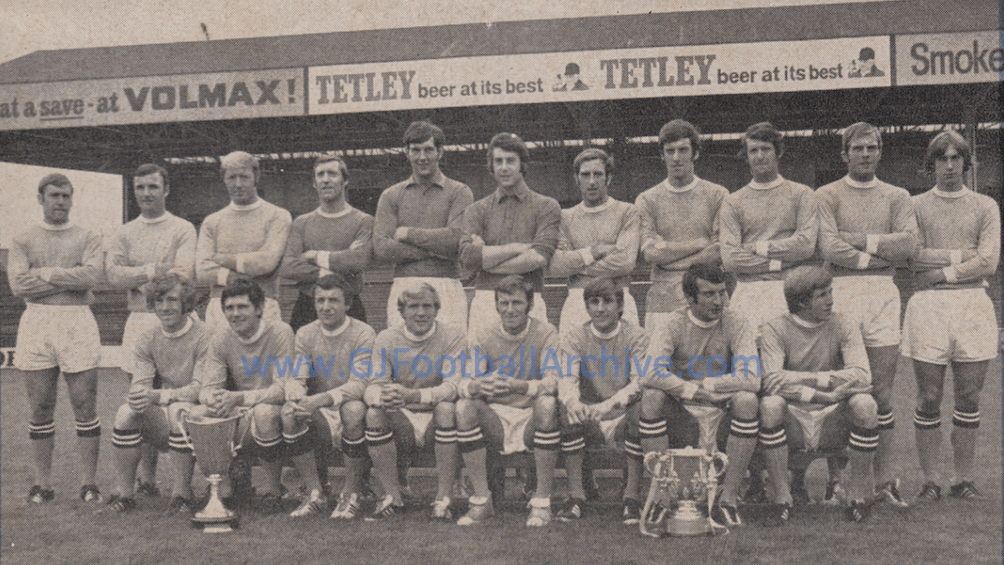
With a European final coming for City later this month it seems appropriate to include an image of a major European trophy at Maine Road for day 15 of my posts counting down to the centenary of Maine Road’s opening game. This team photo is from 1970 and shows the Manchester City team in front of the Platt Lane Stand with both the League Cup and the European Cup Winners’ Cup (at the time UEFA’s 2nd most significant competition).
I know we’re often told that City have no European history but they did actually win a major UEFA trophy before many teams that are today regarded as major European clubs, such as Liverpool, Juventus and even Barcelona. Barcelona had won the Fairs Cup but this was not a UEFA tournament and its entry rules were not always about where you finished in the League, for example the initial idea was to invite cities to play in the competition and the cities of Barcelona and London (a composite team) competed.
In 1970 City’s Mike Doyle joked that wining the League Cup (which brought a Fairs Cup place) was City’s way to ‘keep United out of Europe’ as the competition had a rule that a city could only be represented by one club if two were in qualifying positions…. it was often confusing!
For those unfamiliar with Maine Road this photo may help locate where the photo was taken from. It was taken on the pitch in front of the Maine Stand (number 1) at an angle looking towards the Platt lane Stand end (number 5).
Maine Road aerial 1971 from Farewell To Maine Road
If you’d like to read more on the history of Maine Road, take a look at Farewell To Maine Road, which can be downloaded from this page:
If you enjoy all the free material on my website and would like to support my research and keep this website going (but don’t want to subscribe) then why not make a one-time donation (or buy me a coffee). All support for my research is valued and welcome. It allows me to keep some free material available for all. Thanks.
Today (15 April) in 1970 German side Schalke 04 were defeated 5-1 in the ECWC semi-final second leg at Maine Road by Manchester City. You can read the story of that game (and watch video highlights) below.
Subscribe to get access – Annual
Read more of this content and everything else on the site when you subscribe today. It costs £20 a year and for that you get access to everything posted since December 2020 – all the interviews, video talks, articles and also PDFs of Manchester A Football History and From Maine Men To Banana Citizens. There’s also a monthly option (see below) if you want to try for a month.
It costs £3 per month (cancel anytime) and for that you get access to everything posted since 1 October 2022. Why not try it for a month and see what you think?
In September 2021 I was in Copenhagen and, as always when I’m in a city with a football ground, I popped over to the Parken Stadium. Most fans will remember that City drew 2-2 there with FC København in February 2009. Nedum Onuoha and Stephen Ireland scored in the UEFA Cup round of 32 first leg and in the return Craig Bellamy scored twice to give the Blues a 2-1 win on the night (4-3 on aggregate). That year we progressed to the quarter finals.
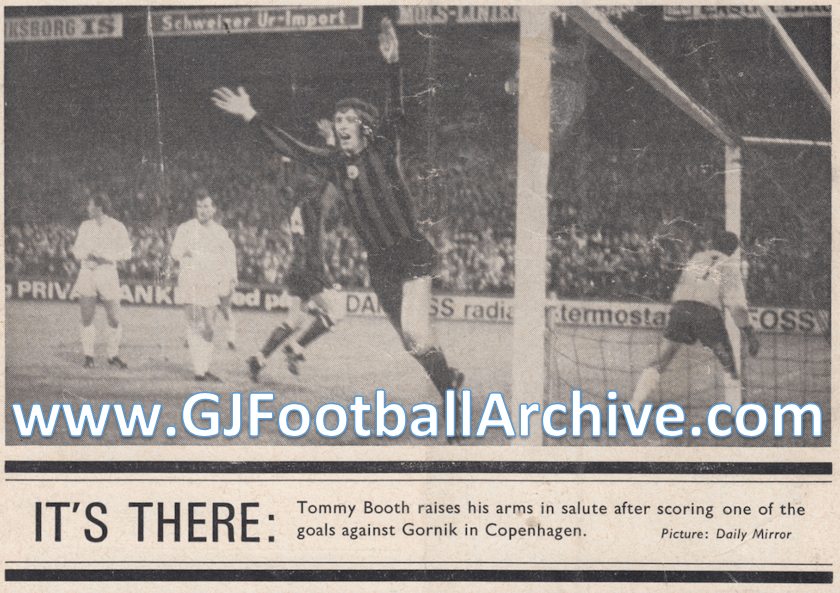
However, Copenhagen’s stadium played a much earlier role in City’s European story and, as today (31 March) is the anniversary of that game, I’m publishing this article looking back at the day when the Blues played a European Cup Winners’ Cup quarter-final replay there.
This 1500 word article is available for subscribers…
Subscribe to get access – Annual
Read more of this content when you subscribe today. It costs £3 per month (cancel any time, see below) or £20 a year. Annual subscribers get full access to ALL the content on here throughout their membership. Do a few searches and see what’s on here.
It costs £3 per month (cancel any time) or £20 a year (see above). Monthly subscribers get access to everything posted since 1 October 2022 and everything posted throughout their membership. Why not sign up for a month and see what you think?
Broadcast live on this day (25 March) in 1970 was the This is Your Life TV episode with Joe Mercer as the subject. Here are the details plus a special recording which supporters of all the clubs Joe was involved with could be interested in.
This Is Your Life was viewed at the time as significant recognition for a lifetime’s achievement. Only major stars and personalities were featured in those days, and the main idea would be that the subject of the programme would be surprised by the sudden appearance of presenter Eamonn Andrews and his ‘Big Red Book’. The subject would then be whisked away to a studio or other location where a variety of figures from the person’s life would be brought out to tell anecdotes and the like. The main part of the show would be broadcast live.
This is Your Life Joe Mercer 1970
Back in 1970 young Manchester City supporter John Stapleton was working on the series and he suggested they feature Joe Mercer as the topic of one show. John, who has gone on to be a prominent broadcaster with a well-regarded TV career was interviewed by me a few years back and we discussed the programme and John’s part in the idea of featuring Joe: ‘I did it purely for the benefit of me and my dad. Eamon Andrews, the presenter, had of course a great interest in sport and I put the idea to him and the rest of the production team. Together with Norah, Joe’s wife who in recent years I often sat with at games sharing her boiled sweets, we concocted a situation where Joe and Malcolm were in a London hotel before a trip to watch a European game in 1970. Malcolm disappeared – deliberately as part of the show though Joe didn’t know this – and Joe was called to reception urgently. Eamon leaped out to do the big “This Is Your Life” reveal and Joe had no idea whatsoever. It was a great day for us all and Joe was thoroughly deserving of it as well.’
Joe was staying at a Hilton Hotel in London. As John described, He had been due to fly with Malcolm Allison to the continent to watch ECWC semi-final opponents Schalke but he had received a message to say the game was off. It was all a ruse of course. That night television viewers watched as Eamonn Andrews surprised Joe at the hotel reception desk: ‘Joe Mercer, former England playing star, now manager of Cup winning Manchester City, tonight. This Is Your Life!’
Eamon Andrews This is Your Life Joe Mercer 1970
At the start of the show the City team appeared. This had been an extremely busy time for the Blues. Over a 18 day period City had played two League games, the League Cup final, the second leg of the ECWC quarter-final with Coimbra and found time to work with television to honour their manager. This live show occurred on Wednesday 25 March and City were to face Derby in the League on 27th and Manchester United on 28th, plus they had to play the first leg of the ECWC semi-final with Schalke on 1st. It was incredible that a team would be involved in this at such a busy time but that’s the way it was.
This is Your Life Joe Mercer 1970 MCFC squad
As Joe explains in the show Malcolm Allison was nowhere to be seen. He had been staying with Joe at the hotel and the City manager commented: ‘I’m a great sleeper you see, and subconsciously I heard Malcolm getting up and I thought, oh, he’s going to the bathroom. I thought, well, he hasn’t come back, so he must be having a bath, and then I went back to sleep. I woke about ten and Malcolm had gone, but occasionally this happens – Malcolm disappears!’
Andrews explained that Allison had left early to watch the match which was still on. Joe was flabbergasted: ‘He’s left all his clothes! I’ve had to pack his bag as well!’
During the course of the show, Andrews informed Joe that Alf Ramsey had named the squad he was to take to the 1970 World Cup: ‘I know you haven’t had a chance to hear the news, but I’m going to tell it to you now, that two of your boys have been named by Alf for the World Cup – Francis Lee and Colin Bell. And two more in the twelve reserves – Mike Summerbee and Alan Oakes. Congratulations lads, and to the whole of the Manchester City.’
Joe was overjoyed.
Subscribers to this website are now in for a special treat as an audio of the entire episode has been preserved and can now be listened to here:
Subscribe to get access – Monthly
You can listen to this special recording of Joe Mercer, Eamon Andrews, Dixie Dean, Malcolm Allison, Stan Cullis, Stanley Matthews etc. by subscribing. It costs £3 per month (cancel anytime) to access everything posted since 1 Oct 2022 or there’s an annual option (below).
You can listen to this special recording of Joe Mercer, Eamon Andrews, Dixie Dean, Malcolm Allison, Stan Cullis, Stanley Matthews etc. by subscribing. It costs £20 per year (cancel anytime) to access everything posted since the site began in December 2020, that includes history talks, videos, a couple of my books, hundreds of articles etc.
Joe appeared on several other This Is Your Life shows including in November 1988 when Tom Finney was the subject and in 1980 when Emlyn Hughes was. He also appeared on two for Matt Busby, one in 1958 and one in 1971 (which opened at Maine Road).
The Programme details for the Joe Mercer episode are:
Edition No: 274
Subject No: 276
Broadcast live: Wed 25 Mar 1970
Broadcast time: 7.00-7.30pm
Venue: Euston Road Studios
Series: 10
Edition: 18
Director: Margery Baker
Producer: Robert Tyrrell
City supporter and broadcaster John Stapleton worked on the show
The guests were:
Norah – wife
members of Manchester City FC team
Francis Lee
Colin Bell
Mike Summerbee
Alan Oakes
Alan Percival
David – son
David & Joan Mercer, This is Your Life Joe Mercer 1970
Joan – daughter-in-law
Arthur – brother
Stan Cullis
Stan Cullis, This is Your Life Joe Mercer 1970
Billy Dixie Dean
Billy ‘Dixie’ Dean, This is Your Life Joe Mercer 1970
Jim Morris
Charles Palmer
Matt Busby
Frank Soo
Walley Barnes
Maurice Edelston
Bernard Joy
Roy White
George Hardwick
Raich Carter
Neil Franklin
Stanley Matthews
Stanley Matthews, This is Your Life Joe Mercer 1970
Filmed tributes:
Malcolm Allison
Susan – granddaughter
Albert Dyson – father-in-law
If you have enjoyed this article then why not subscribe (see above for details) for other material like this? If you don’t want to subscribe but would like to support the research into Manchester football by Gary James then it’s possible to donate below. All support is used to help perform further research that will be posted here for future generations. Thanks for the support.
If you enjoy all the free material on my website and would like to support my research and keep this website going (but don’t want to subscribe) then why not make a one-time donation (or buy me a coffee). All support for my research is valued and welcome. It allows me to keep some free material available for all. Thanks.
On this day (10 March) in 1971 a crowd reported as 100,000 witnessed a 2-0 Manchester City defeat by Gornik in the ECWC quarter final first leg. The story of that game and the rest of the tie is available below (with video clips) for subscribers to this site.
Subscribe to access all the site – Annual
If you would like to read this and all the in-depth articles on this site (including the entire Manchester A Football History book, talks, articles, interviews etc.) then please subscribe. It works out about £1.67 a month if you take out an annual subscription (£20 per year) or £3 a month if you’d like to sign up for a month at a time (see below). Annual subscribers gets full access to everything posted so far and the hundreds scheduled to be posted in the coming year.
If you would like to read this and more then please subscribe. It costs £3 a month if you’d like to sign up for a month at a time. Monthly subscribers get full access to everything posted since 1 October 2022 and everything to be posted throughout their subscription. Cancel any time.