Today (8 March) marks the 102nd anniversary of a record Manchester City set – the record is the highest attendance on a club ground! The record set in 1924 saw 76,166 attend City v Cardiff. Keep reading all those who think ‘don’t you mean 84,569 in 1934?’ – City already held the record… City had moved to their new Maine Road stadium in August 1923. The capacity of the venue was estimated at around 90,000 but was actually approximately 83,000 when the stadium opened (it was enlarged in 1931 and 1935).
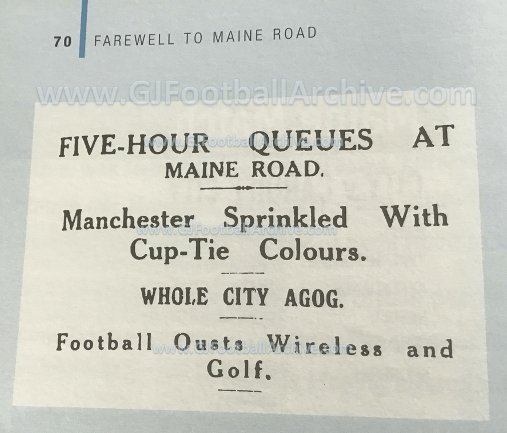
In its first season the capacity was tested and, on this day (8 March) in 1924 the largest attendance for any footballing fixture (including three FA Cup Finals) in Manchester gathered to watch the Blues. This was also, at the time, the record crowd for any game played on an English club ground. It was beaten ten years later when 84,569 watched City v Stoke – so It’s 102 years of this record for the Blues!
You can read about the remarkable day in 1924 below:
Subscribe to get access
Read more of this content when you subscribe today. It costs £20 a year (access to everything) or £3 per month (see below).
Read more of this content when you subscribe today. It costs £20 a year (see above) or £3 per month (cancel anytime; access to everything posted since 1 October 2022).
For today’s feature I’ve decided to look back to a remarkable day in 1924 when Manchester City and Brighton met in their first competitive game. This ‘first’ also became significant as a ‘last’ moment for one of City’s greatest ever players. That day the legendary Billy Meredith scored his last competitive goal. Remarkably, he was 49 and his return to City’s first team brought significant media coverage.
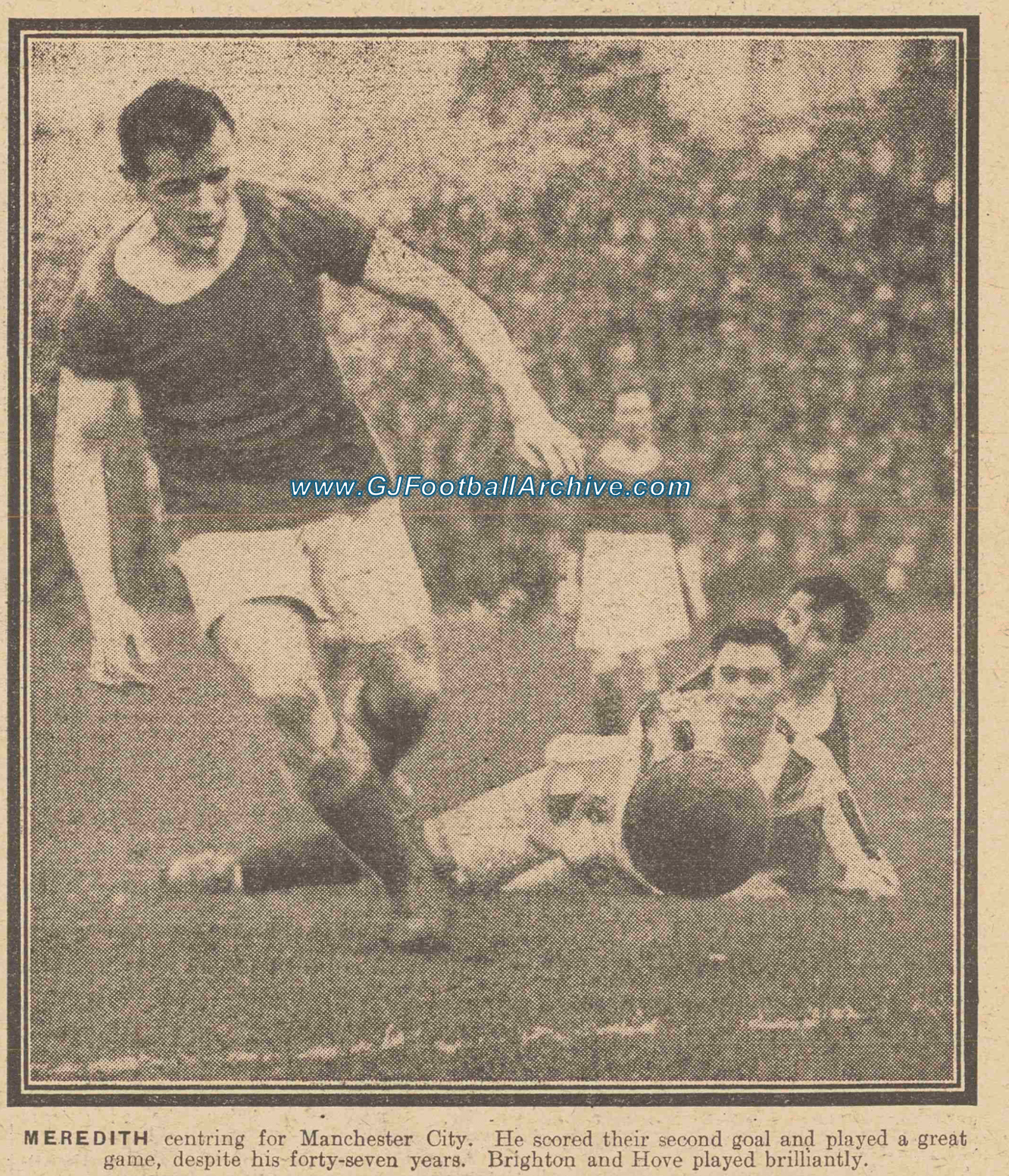
The first ever meeting between City and Brighton was on this day (23 February) in 1924 and this photo is of Meredith during that game. It was a FA Cup tie at Brighton and newspapers were full of Meredith stories. His return was big news. The Manchester Evening News explained: ‘To all intents and purposes, Meredith ceased to be an active member of the first team two seasons ago. Two things have combined to bring him within range of the rather sensational choice now made – sentiment and his own indomitable will to fret his hold on the football stage a little longer… The chief argument in his favour is that from one of his classic centres any match might be won, just as it was when he scored the goal that served to bring the English Cup to Hyde Road twenty years ago next month.’
Meredith had not played in a League game all season – in fact he’d only played one game the previous season! – and he was aged 49. However, he remained the biggest name in football and had captained City to FA Cup success in 1904, scoring the winning goal in the final.
A record crowd of 24,734 packed into Brighton’s Goldstone Ground and Meredith’s inclusion inspired the rest of the team. City defeated Brighton 5-1 and there was even a sentimental moment when a minute into the second half Meredith scored. The Daily Mail described the goal: ‘[Meredith’s] old inimitable ball magic along the touch line remains… Those bow legs still mesmerise the ball, and that great right foot still placed the ball perfectly in the mouth of goal. In this way Meredith got his goal. Hayes grasped the ball, but it spun out of his hands into the net.’
This was to be Meredith’s last-ever first team goal.
This season City reached the FA Cup semi-final, establishing attendance records along the way. Meredith’s inclusion was a masterstroke. The chance of Meredith reaching the FA Cup final had been the nation’s footballing dream, but it could not be fulfilled. In the semi-final City were defeated by Newcastle and the Welshman’s career came to an end. You can read about that game here:
Billy Meredith stopped playing more than 100 years ago but his name remains one all Blues should know. He was our first truly great player and was the game’s biggest star. He joined City in 1894 and, despite a spell at Manchester United, remained a City fan all his life, attending every FA Cup final the Blues played in until his death in 1958.
In 2004 I chatted with his then 98-year-old daughter Winifred, and she said that his heart was always with City: ‘He felt at home at City. I know he had great success at United, but I don’t think they ever really appreciated him in the way City did. I think United were not paying him properly after the war and, because of his age, they probably didn’t value him. But City did, and it’s clear they still love him today. City was always his team and meant more to him than United ever could.’
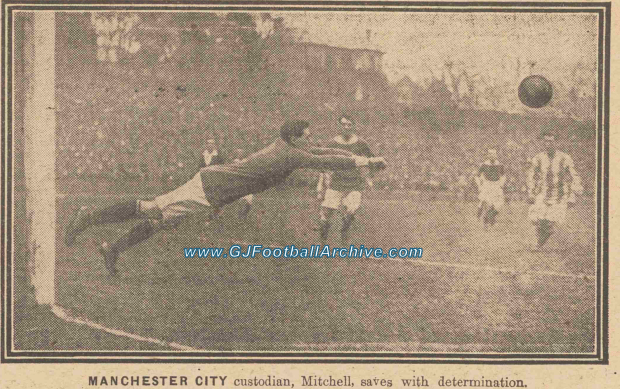
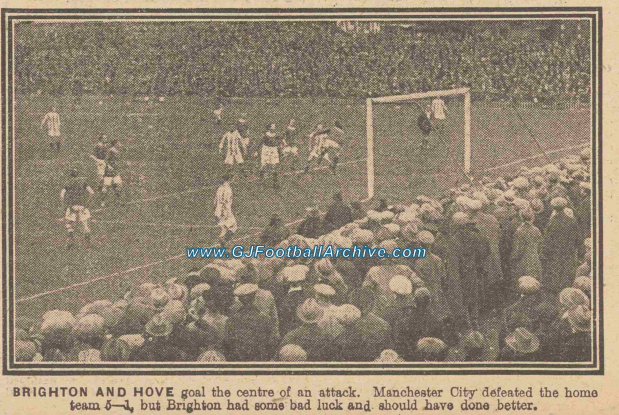
Other images from the game:
One-Time
Monthly
Yearly
If you enjoy all the free material on my website and would like to support my research and keep this website going (but don’t want to subscribe) then why not make a one-time donation (or buy me a coffee). All support for my research is valued and welcome. It allows me to keep some free material available for all. Thanks.
Tonight (7 January 2026) Manchester City and Brighton meet in the Premier League. The first game between the two clubs came over 100 years ago in 1924. This game was a newsworthy FA Cup tie due to the return of a legend to the City team. In fact it was so newsworthy that a movie company sent their camera (you’ll see from the footage it never moved!) to Brighton’s Goldstone Ground to capture the return of a true Blue hero.
Here’s film of that game, though sadly we don’t see Meredith or the goal. City are the dark shirted team (actually the club’s ‘Lucky Scarlet’!):
Subscribers can also read an article about that day here:
Subscribe to get access
If you would like to view this article then please subscribe below. It works out about £1.67 a month if you take out an annual subscription (£20 per year) or £3 a month if you’d like to sign up for a month at a time. Each subscriber gets full access to the 150+ articles posted so far and the hundreds scheduled to be posted in the coming weeks.
Now that Erling Haaland has joined an exclusive group of Manchester City players who have scored 100 League goals for the club I thought I’d post a table of all those players. I’ve also listed them in a goals per game format (I’d love to do goals per minutes but we simply don’t have that information for all players). Here goes…
The goals per game ratios for all Manchester City players who have scored 100 league goals or more…
Goals
First Name
Surname
Goals Per Game
Total League Appearances
100
Erling
Haaland
0.9009
111
184
Sergio
Aguero
0.6691
275
126
Billy
Gillespie
0.5780
218
120
Horace
Barnes
0.5530
217
122
Tommy
Browell
0.5495
222
116
Frank
Roberts
0.5370
216
158
Tommy
Johnson
0.4817
328
112
Francis
Lee
0.4498
249
110
Fred
Tilson
0.4472
246
142
Joe
Hayes
0.4290
331
107
Alec
Herd
0.4163
257
146
Billy
Meredith
0.3989
366
158
Eric
Brook
0.3511
450
117
Colin
Bell
0.2970
394
If you enjoy all the free material on my website and would like to support my research and keep this website going (but don’t want to subscribe) then why not make a one-time donation (or buy me a coffee). All support for my research is valued and welcome. It allows me to keep some free material available for all. Thanks.
The new series on Manchester City in the 1920s continues today with a subscriber article on the 1924-25 season. If you subscribe (see below) I hope you enjoy it. If you are not currently a subscriber then why not try it for a month (£3 per month or sign up for a year at a discounted £20 per year)?
Here’s the article:
Subscribe to get access
Read more of this content when you subscribe today. It costs £3 a month (cancel anytime) or sign up for a year at £20 per year. Subscribers have access to the 1000s of articles, features, interviews etc. posted so far and all those posted during your subscription.
The new series on Manchester City in the 1920s continues today with a 3,000 word subscriber article on the 1923-24 season. If you subscribe (see below) I hope you enjoy it. If you are not currently a subscriber then why not try it for a month (£3 per month or sign up for a year at a discounted £20 per year)?
Here’s the article:
Subscribe to get access
Read more of this content when you subscribe today. It costs £3 a month (cancel anytime) or sign up for a year at £20 per year. Subscribers have access to the 1000s of articles, features, interviews etc. posted so far and all those posted during your subscription.
The new series on Manchester City in the 1920s continues today with a 1,500 word subscriber article on the 1922-23 season. If you subscribe (see below) I hope you enjoy it. If you are not currently a subscriber then why not try it for a month (£3 per month or sign up for a year at a discounted £20 per year)?
Here’s the article:
Subscribe to get access
Read more of this content when you subscribe today. It costs £3 a month (cancel anytime) or sign up for a year at £20 per year. Subscribers have access to the 1000s of articles, features, interviews etc. posted so far and all those posted during your subscription.
A new series on Manchester City in the 1920s begins today with a 1,000 word subscriber article on the 1921-22 season. If you subscribe (see below) I hope you enjoy it. If you are not currently a subscriber then why not try it for a month (£3 per month or sign up for a year at a discounted £20 per year)?
Here’s the article:
Subscribe to get access
Read more of this content when you subscribe today. It costs £3 a month (cancel anytime) or sign up for a year at £20 per year. Subscribers have access to the 1000s of articles, features, interviews etc. posted so far and all those posted during your subscription.
On 3 June 2023 Ilkay Gundogan City secured his place in national football history with the quickest goal in a FA Cup final. It was a stunning volley after only 12 seconds. That day Gundogan scored two and helped City to 2-1 FA Cup final victory over Manchester United.
As well as the speed of the first goal, Gundogan’s goals gave him another MCFC record. Dave Masey, who has been collecting stats and historical information on Manchester City for years contacted me to tell me about one of his spreadsheets which holds details of City scorers in trophy winning games.
His records capture those who have scored in major cup finals, but besides Cup Finals he also records other trophy-winning games. These include the deciding League games from 1937 onwards against Sheffield Wednesday (1937), Newcastle, QPR, West Ham, Brighton and Villa (2022), but nothing from three recent title successes where the Blues clinched the title when they were not playing. Got that? Good, now….
Dave tells me that the FA Cup success saw Gundogan move to the top of the list with 5 goals, overtaking Neil Young and Sergio Aguero. So he has scored more goals in trophy-winning games than any other Blue.
The list of scorers in trophy winning games reads:
1904
Meredith
1934/7
Tilson (3), Brook (2), Doherty
1956
Hayes, Dyson, Johnstone
1968/70
Young (4), Lee (2), Summerbee, Doyle, Pardoe
1976
P Barnes, Tueart
2011-(former)
Aguero (4), Y Toure (2), Nasri (2), Kompany (2), D Silva (2),Jesus (2), Sterling (2), Dzeko, Zabaleta, Navas, Fernandinho
2016-(current)
Gundogan (5), Laporte (2), Rodri (2), Mahrez, De Bruyne
Dave also tells me that in the three seasons where somebody else’s defeat clinched the title for City, the scorers in the club’s last game before the title confirmation were:
Gundogan (3), Sterling (2), Jesus, Haaland.
As Dave says, Ilkay gets a remarkable number of important goals, particularly for somebody who is ‘just’ a 1 goal in 5/6 games player (63 in 357 for City by June 2025).
I’m always keen to find links between today’s Manchester City and the key players of the past and so a while back I set myself the task of trying to find connections from the club’s first competitive game in 1890 through to the Premier League successes of today. The idea was to see how few players I could find to form a chain through the decades.
I did this in 2021 and today (December 2024) the same number of players still link that first year of competitive football 134 years ago with today. For those wondering how many players I’ve used to link the beginning to today: the answer is 16. But who are they and can you do better?
Subscribers can read the players and the result of my efforts below:
Subscribe to get access
Read more of this content and all the other 370+ articles posted so far when you subscribe today.





 Gary James' Football Archive