My series on Manchester City in the 1930s continues today with a subscriber article on the 1931-32 season. If you subscribe (see below) I hope you enjoy it. If you don’t subscribe then why not try it for a month (£3 per month or sign up for a year at a discounted £20 per year)?
Here’s the article:
Subscribe to get access
Read more of this content when you subscribe today. It costs £3 a month (cancel anytime) or sign up for a year at £20 per year. Subscribers have access to the 1000s of articles, features, interviews etc. posted so far and all those posted during your subscription.
On this day (17 June) in 2020 football returned to the Etihad after the pause in the 2019-20 season caused by the Covid pandemic. The first game there saw Manchester City defeat Arsenal 3-0 with goals from Sterling, De Bruyne and Foden. You can watch highlights here:
On this day (31 March) in 1951 Manchester City won 4-2 away at West Ham with goals from George Smith (2 goals; photographed here in a game at Maine Road v Manchester United), Johnny Hart and Dennis Westcott. The attendance was 21,533.
If you’d like to read more on this season, then her’es a 1,500 word article on the 1950-51 season. Enjoy!
This is a subscriber article and you can read it by subscribing below.
Subscribe to get access
Read more of this content when you subscribe today. It costs £3 per month or you can subscriber for the discounted annual rate of £20 per year. Each subscriber gets access to everything posted so far, including PDFs of a couple of my books.
On this day (24 March) in 1951 Manchester City defeated Leeds United 4-1 with goals from Johnny Hart (image is of Johnny, but not from that game), Jimmy Meadows, George Smith and Dennis Westcott. The attendance was 35,149.
If you’d like to read more on this season, then her’es a 1,500 word article on the 1950-51 season. Enjoy!
This is a subscriber article and you can read it by subscribing below.
Subscribe to get access
Read more of this content when you subscribe today. It costs £3 per month or you can subscriber for the discounted annual rate of £20 per year. Each subscriber gets access to everything posted so far, including PDFs of a couple of my books.
The new series on the 1950s continues today with this 1,500 word article on the 1950-51 season. Enjoy!
This is a subscriber article and you can read it by subscribing below.
Subscribe to get access
Read more of this content when you subscribe today. It costs £3 per month or you can subscriber for the discounted annual rate of £20 per year. Each subscriber gets access to everything posted so far, including PDFs of a couple of my books.
On this day (23 February) in 1935 Manchester City established a new Football League record crowd of 79,491. Here’s the story of that day and cuttings. Enjoy!
Subscribe to get access
If you would like to view this article then please subscribe. It works out about £1.67 a month if you take out an annual subscription (£20 per year) or £3 a month (See below) if you’d like to sign up for a month at a time. Annual subscribers get full access to everything posted so far and the hundreds scheduled to be posted during the next year.
If you would like to view this article then please subscribe. It costs £3 a month (cancel anytime) if you’d like to sign up for a month at a time. Monthly subscribers get full access to everything posted since 1s October 2022 and everything scheduled to be posted during the next year.
I was interviewed on this day (17 February) in 2021 about the great Joe Mercer for the ‘esk podcast’ – an Everton podcast. I talk about meeting Joe; about writing his biography; about Joe’s time at Everton, Arsenal, Manchester City and so on. I also tell the story of Norah Mercer insisting that Bobby Charlton phones me to apologize (it was somewhat of a shock at the time)! We also discussed Everton and City in preparation for their game that night (17th February 2021). No matter who you support it’s well worth listening to.
If you enjoy all the free material on my website and would like to support my research and keep this website going (but don’t want to subscribe) then why not make a one-time donation (or buy me a coffee). All support for my research is valued and welcome. It allows me to keep some free material available for all. Thanks.
it’s one of the oldest fixtures either club has with a rich history stretching back to the 1890s. Both sides have found major success with City’s first major trophy coming in 1904 and Arsenal’s arriving 26 years later. As you’d expect with such a long history there are plenty of articles on my website about both clubs. Here’s a link to all those tagged Arsenal:
Today’s article on the 1960s is free for anyone to read and tells the story of Manchester City signing Denis Law back on 15 March 1960. There’s also film here of his debut and a great colour film of City and Law that season (see below). City manager Les McDowall had been after signing Denis Law for many, many months before he finally signed the Scottish striker for a British record fee of £55,000 the day before the transfer deadline on 15 March 1960. It had been a tense negotiation. Law himself had expected to join Arsenal to link up with his Scottish colleague Tommy Docherty, however, Huddersfield were adamant that they could not sell Law for anything less than £55,000.
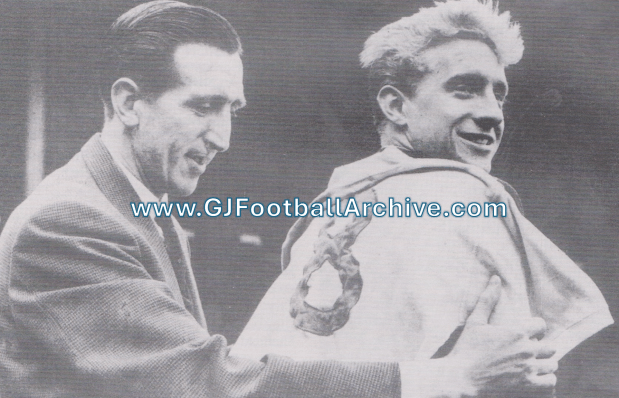
Ken Barnes welcomes Denis Law to Maine Road, 1960
It all came to a head at Leeds Road where Arsenal had sent coach Ron Greenwood to negotiate a good deal. At the same time City, represented by Les McDowall and Chairman Alan Douglas, were keen to sign the 20 year old Scotsman. The Gunners had only given Greenwood power to offer £25,000 plus David Herd, making a total of £50,000, whereas McDowall and Douglas were able to discuss the pros and cons of offering more. The discussions and negotiations went on while Law himself was playing Table Tennis in the games room. When the young player was summoned he quickly realised that his move to Arsenal was off and, after less than ten minutes, he agreed to join the Blues at a cost that was said to be three times his weight in gold.
Denis Law’s Manchester City debut 1960
Law made his debut a memorable one by scoring in the 4-3 defeat at Leeds on 19th March 1960. You can view Law’s first goal for City here:
I think the commentary was added some time after and that the commentary was done in a studio over the top. The commentator (is it Stuart Hall?) mentions City’s kit as being old gold and black but colour film of kit from that season shows City wearing yellow and maroon – as can be seen in this wonderful film from that same year which includes Tottenham v City from about 5 minutes in:
Eleven days after Law’s debut he scored again as City defeated West Ham 3-1. He made one other appearance, away at Chelsea, before the player became the subject of his first controversy at the Club. Law was selected to play for Scotland at Hampden Park on 9th April – the date of the vital home game with West Bromwich Albion – and the City management took the view that playing for your country was more important than playing for your club. This angered many supporters, who realised that a Law-less City would struggle and that relegation was still a strong possibility. The Blues were only two points above the relegation zone.
The controversy heightened when other clubs took a different view and refused to release players. The City Board then felt justified in asking the League for a postponement, but the League refused. In the programme for the game, the Board outlined their views and explained how the circumstance had occurred. The article ended by stressing that the situation of club V Country cannot be allowed to continue.
As expected, without Law the Blues were defeated 1-0.
You can find out more on Manchester City in the 1959-60 season by reading the following article on the season. This is available to subscribers.
Subscribe to get access
Read more of this content when you subscribe today. It costs £3 per month (cancel anytime) or sign up for a year at the discounted price of £20 per year (works out £1.67 per month). Subscribers access the 1000+ articles posted so far and the others scheduled during the life of your subscription.
If you enjoy all the free material on my website and would like to support my research and keep this website going (but don’t want to subscribe) then why not make a one-time donation (or buy me a coffee). All support for my research is valued and welcome. It allows me to keep some free material available for all. Thanks.
Continuing the series of features on the 1960s… On this day (20 January) in 1962 Manchester City defeated Arsenal 3-2 with two goals from Neil Young (and an own goal) at Maine Road. Were you there?
The photo above is of course Neil Young the following decade at Maine Road.
If you’d like to know more on this season, here’s a subscriber article on Manchester City during the 1961-62 season. If you’d like to read this 1600 word article, plus all other articles on the site, then please subscribe (see below). As with most of the other features in this series it includes words from interviews I have performed with those who were there.
Subscribe to get access
Read more of this content when you subscribe today. It costs £3 per month (cancel anytime) or sign up for a year at the discounted price of £20 per year (works out £1.67 per month). Subscribers access the 1000+ articles posted so far and the others scheduled during the life of your subscription.




 Gary James' Football Archive