On this day (23 March) in 1968 came a game between two title challenging teams – Leeds Utd and Manchester City. The view was that this game could knock City out of the title race if it went Leeds’ way. So what happened? Here’s film of the game:
You can find out more aboutthe potential impact of this game by reading this subscriber article on Manchester City during the 1967-68 season. If you’d like to read this 7,600 word article (yes, 7,600 words on one season!), plus all other articles on the site, then please subscribe (see below). As with most of the other features in this series it includes words from interviews I have performed with those who were there.
Subscribe to get access
Read more of this content when you subscribe today. It costs £3 per month (cancel anytime) or sign up for a year at the discounted price of £20 per year (works out £1.67 per month). Subscribers access the 1000+ articles posted so far and the others scheduled during the life of your subscription.
On this day (24 February) in 1940 Denis Law was born. Law who passed away in January, achieved major success in a glittering career for Huddersfield, Manchester City and Manchester United. He would have been 85 years old today.
There are plenty of articles mentioning Law on this site, here are those tagged with his name:
On this day (31 January) in 1968 Manchester City defeated Reading 7-0 in a FA Cup replay. As the players left the field the Elm Park tannoy announcer claimed: ‘Ladies and Gentlemen, you have just seen one of the greatest teams England has produced in a long time.’
Goalscorers were Mike Summerbee (3), Colin Bell, Tony Coleman, George Heslop and Neil Young. This photo is of the Bell, Lee & Summerbee statue at the Etihad today.
Dozens of letters arrived at Maine Road commenting on City’s performance. Many Reading fans wrote in saying they could have watched the Blues all night. Other letters arrived commenting on how well behaved the City supporters were, while fans themselves commented on the cheerfulness of the Reading police.
These points may seem trivial today, but in 1968 football had already begun to enter its hooligan period. Football supporters had started to be seen as trouble causers and incidents of violence, or of vandalism, soon found their way into national newspapers. Although City supporters were never totally blameless, during the late 1960s Blues fans continued to gain commendations rather than condemnation.
You can read more on this remarkable, trophy winning season below. If you’d like to read this 7,600 word article (yes, 7,600 words on one season!), plus all other articles on the site, then please subscribe (see below). As with most of the other features in this series it includes words from interviews I have performed with those who were there.
Subscribe to get access
Read more of this content when you subscribe today. It costs £3 per month (cancel anytime) or sign up for a year at the discounted price of £20 per year (works out £1.67 per month). Subscribers access the 1000+ articles posted so far and the others scheduled during the life of your subscription.
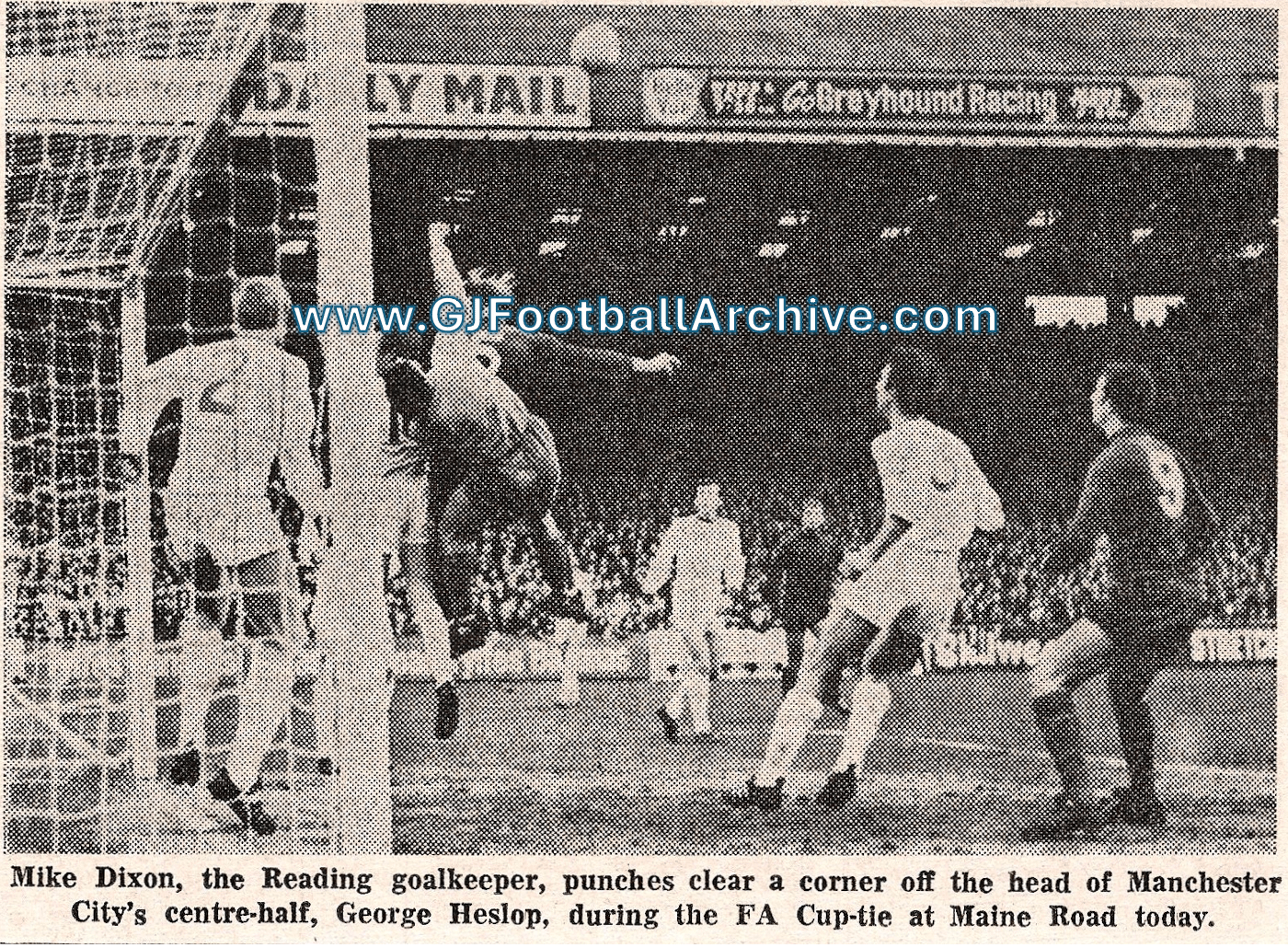
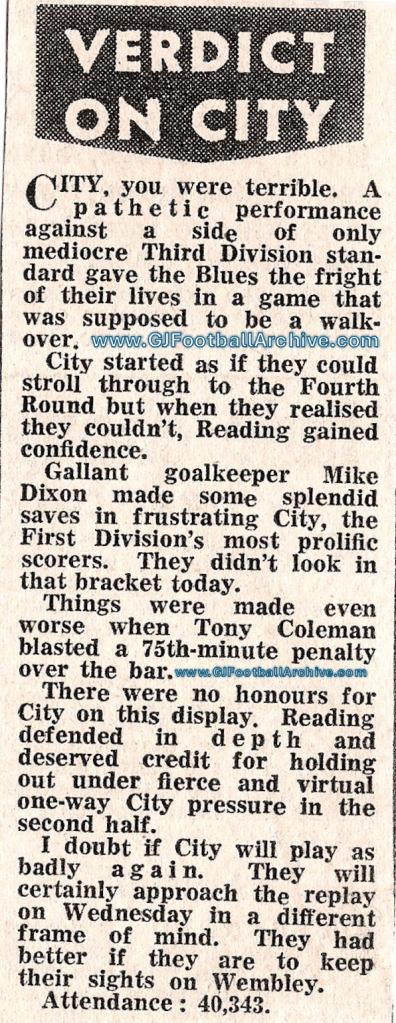
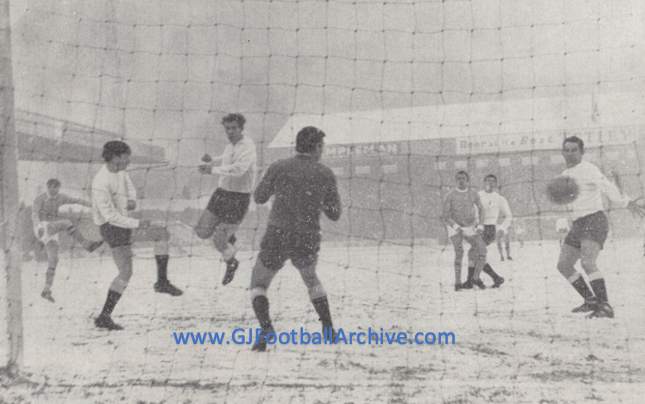
On this day (27 January) in 1968 40,343 watched as Manchester City and Reading played out a goalless draw in the FA Cup at Maine Road. City had missed a penalty too! The Manchester Evening News reporter Peter Gardner was not impressed with City (see below report). A nice reminder that even the greatest of teams can have off days!
Peter Gardner’s summary of MCFC V Reading, FAC January 1968
The tie went to a replay and you can find out what happened next in the following 7,600 word article (yes, 7,600 words on one season!) on the 1967-68 season. This is available to subscribers, who also have access to all other articles on the site. As with most of the other features in my series on the 1960s it includes words from interviews I have performed with those who were there.
Subscribe to get access
Read more of this content when you subscribe today. It costs £3 per month (cancel anytime) or sign up for a year at the discounted price of £20 per year (works out £1.67 per month). Subscribers access the 1000+ articles posted so far and the others scheduled during the life of your subscription.
I’ve just heard the sad news that yet another legendary footballer has passed away. Denis Law, who achieved major success in a glittering career for Huddersfield, Manchester City and Manchester United, has died aged 84.
I’ll post more on him over the coming days but, once again, following Bobby Kennedy and Tony Book this is yet another sad day for Manchester football.
There are plenty of articles mentioning Law on this site, here are those tagged with his name:
Continuing the series of features on the 1960s, here’s a subscriber article on Manchester City during the 1967-68 season. A trophy winning season. If you’d like to read this 7,600 word article (yes, 7,600 words on one season!), plus all other articles on the site, then please subscribe (see below). As with most of the other features in this series it includes words from interviews I have performed with those who were there.
Subscribe to get access
Read more of this content when you subscribe today. It costs £3 per month (cancel anytime) or sign up for a year at the discounted price of £20 per year (works out £1.67 per month). Subscribers access the 1000+ articles posted so far and the others scheduled during the life of your subscription.
The postponement of any game is rare. Obviously, the 2019-20 Covid hit season was different and in the days before undersoil heating icy conditions would often lead to postponements. However, Manchester City have suffered many postponements over the years. So for today’s feature I’m talking a look at some of them.
This is available to subscribers. Why not subscribe for a month and see what you think?
Subscribe to get access
Read more of this content when you subscribe today. It costs £3 per month or join up for a year at the discounted rate of £20. See link below for details.
Each year, following the end of the UEFA football season I update the UEFA European Span of Success table. What is this? It’s a list of those clubs who have won two or more major UEFA tournaments showing the span between their first UEFA success and their most recent. The list may surprise some who think that football is all about those perceived as European giants with ‘history’.
The table hasn’t really changed much from last year as Real Madrid were Champions League winners. Atalanta, who won the Europa League, and Olympiacos (Conference winners) have only won one major European trophy and so they do not yet make it on to the list of multiple winners:
European Span of success 2024
The ‘history’ ‘no history’ thing really irritates me. All clubs have history and even when that’s recognised some still go on about history as if it started in 1992, 1999 or 2008 etc. depending on whether your club was successful or your rivals were failing. The two highest placed English teams are West Ham and Manchester City, who both found major European success before some of those clubs recognised today as Europe’s elite.
Obviously, this table does not show the number of major trophies won, but it does give an indication of trophy winning longevity for those who obsess on ‘my cup’s bigger than yours’ and similar debates. Personally, I think we should all be proud of our club’s achievements and not worry about what a rival has won.
West Ham have the second longest span of all Europe’s clubs and City have the fourth equal. Nice work Hammers and Blues!
The above table includes the four major UEFA tournaments: European Cup/Champions League; European Cup Winner’s Cup; UEFA Cup/Europa League & the Europa Conference League. It does not include non-UEFA tournaments such as the Mitropa Cup and Fairs Cup. Nor does it include the Intertoto Cup or similar.
I’m sure some will say but why aren’t the Mitropa or Fairs Cups in there? It’s a good point but these were not UEFA tournaments, though I recognise that the Mitropa Cup had some significant clubs competing in it. It was predominantly an East European competition and participants were not spread over the entire continent.
With the Fairs Cup… It is true that this was later transformed into the UEFA Cup and I have included all UEFA Cup finals in my analysis. But the Fairs Cup had an odd series of entry rules at times. Cities, rather than clubs, often entered with Barcelona beating London in one final for example. It was set up as a friendly type of competition with cities that had staged trade fairs playing each other. As time wore on entry came via the League Cup or League position in England, which added significance to it. But two teams from the same city were not allowed to participate, which meant that teams finishing way down the table could be (and were) included if those above them were multiple clubs from the same city.
In 1970 Manchester City’s Mike Doyle joked that by winning the League Cup he was satisfying his aim of ‘keeping United out of Europe’ (he joked about creating car stickers with that slogan!) because it appeared at that time that United’s only chance of Europe had gone with City’s qualification for the Fairs Cup.
1970 ECWC
City went on to win the ECWC that season, meaning that Fairs Cup place was opened up to League position, but United had finished lower down the table anyway and qualified for the Watney Cup instead. Actually, the Watney Cup is one worth talking about, but I’ll save that for another day. In 1970 Fourth placed Derby County qualified for the Watney Cup, while 5th to 7th (Liverpool, Coventry and Newcastle) all got a Fairs Cup place, alongside 12th placed Arsenal (Fairs Cup winners). I’ve not investigated this fully but it does seem odd that the Watney Cup took precedence over the Fairs Cup.
Arsenal’s 1970 Fairs Cup success was their first European trophy but is not included in the span, neither are those Fairs Cup wins of Barcelona. However, as quite a few Arsenal fans seemed to get a bit upset when the table was posted last year I’ve decided to include the Fairs Cup in the following version of the table. So this table is the winners of the main UEFA competitions I mentioned earlier plus the Fairs Cup with its odd rules:
European Span of success 2024 including Fairs Cup
Hopefully, those Arsenal fans who were somewhat upset last year will now be happy. Note that West Ham have now been overtaken by Roma and that Barcelona are now above Manchester City, Bayern & Atletico Madrid. Both ‘Rome’ and ‘Barcelona’ won the Fairs Cup when it was city based and not club based.
Arsenal are now 18th in this combined table, behind their fellow English clubs West Ham, City, Chelsea, United and Liverpool.
As an example of the odd qualification rules in place for the Fairs Cup at times it’s worth looking at the 1969 qualification via the English League system.
In 1969 champions Leeds entered the European Cup. The ECWC place went to FA Cup winners Manchester City and the Fairs Cup places went to: Arsenal (4th), Southampton (7th) and Newcastle (9th). Swindon had won the League Cup, beating Arsenal in the final, but the Fairs Cup organisers wouldn’t allow them to participate as they were not a top flight club! This adds to the reason the competition is usually excluded. It is certainly not a UEFA competition in any case.
Similarly, Everton (3rd), Chelsea (5th), Spurs (6th) and West Ham (8th) who all finished above Newcastle were denied because of the rule that only one club from each city be allowed. So Liverpool and Arsenal’s inclusion meant their rivals stood less chance of winning the trophy than Newcastle simply because there were multiple clubs in their cities.
That rule does make me wonder what would have happened if both Manchester clubs had qualified for the competition as City are within the city of Manchester boundaries and United are not. Would the two clubs have challenged any decision not to include one of them based on the age old argument of Manchester’s boundaries?
Maybe I’ll post more on the odd rules of football competitions and tell the story of some of those long forgotten competitions.
If you’re interested in the wider span of success for English clubs (listing those who have the longest span between their first trophy and most recent, not simply European trophies) then take a look at this (Manchester City are second):
If you enjoy all the free material on my website and would like to support my research and keep this website going (but don’t want to subscribe) then why not make a one-time donation (or buy me a coffee). All support for my research is valued and welcome. It allows me to keep some free material available for all. Thanks.
There have been many wonderful tributes and there are definitely people who can talk better than I can about the great Bobby Charlton. However, I do want to mark this sad time with a brief story about him which I think shows the character of the man. It’s a personal story from 30 years ago.
Back in November 1993 we were preparing for the book launch of my biography of Joe Mercer, which was to take place at the start of December. As well as those that had been interviewed for the book, such as Colin Bell, Tom Finney, Francis Lee etc. Norah Mercer asked me if she could invite a few others. Obviously she could but I didn’t know who she was inviting. I just left it to her.
About a week before the launch I received a phone call at home. I answered it and the voice on the other end said: ‘Hello Gary. It’s Bobby Charlton here. I’ve just spoken with Norah Mercer and told her I can’t make it to your book launch because I’ll be in Kuala Lumpur. She said I should let you know. Sorry I can’t make it. Is that okay? I really am sorry and would be there if I could.’
I was absolutely stunned. Bobby really didn’t need to phone either of us but he certainly didn’t need to call me. He was so polite and apologetic too. It was appreciated and added to the high esteem that I already held him in.
Often it’s the simplest of things that make the biggest impression. There were several people who had been invited who didn’t come to the launch and hadn’t let us know – I don’t expect everyone to be interested or to call – so when Bobby took the time and trouble to phone us both it really was something I treasured (and still do).
I did meet him a few times in the years that followed but it’s the 1993 phone call that remains my strongest non-footballing memory of Bobby.
Without doubt Bobby was a wonderful England international and a major global footballing figure. He was also a wonderful ambassador for Manchester (the reason he was going to Kuala Lumpur too) but most significantly he was a humble, nice man.
It’s Day 95 of my Maine Road 100 countdown (not long to go now!) to the centenary of Maine Road’s first game. Earlier I asked the question: Of all the brilliant players who graced Maine Road over the decades who do you think was the one who scored most goals at the old stadium? Answer later today. Watch this space about 9pm UK time!
Well, the answer is Colin Bell. Colin scored 107 first team goals at Maine Road with Eric Brook next on 106 first team goals. The main image is Colin scoring v Spurs in December 1967.
I bet there are a few fans out there who saw every one of Colin’s 107 first team Maine Road goals. Feel free to leave comments on the great City star below. Also, why not check out the other articles that mention Colin such as this on his debut for Bury:




 Gary James' Football Archive