Three days after making his Manchester City debut in a League Cup tie with Leicester (22 September 1965, 3-1 City win) Stan Horne made his League debut for Joe Mercer’s Blues. The game, played on this day (25th) in 1965 ended in a 1-0 City win over Derby County at Maine Road. The scorer was Jimmy Murray.
Horne had previously played for Mercer’s Aston Villa too.
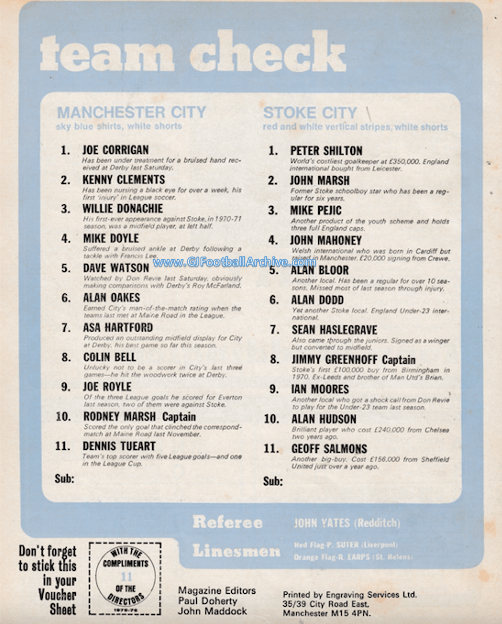
On this day in 1975 Manchester City faced Stoke at Maine Road.
Here for subscribers is a flashback piece detailing what features were in the MCFC match programme that day and game information:
Subscribe to get access
Read more of this content when you subscribe today. It costs £3 per month or sign up for a year at the discount price of £20 per year. Why not subscribe for a month and see what you think?
If you read tomorrow night’s match programme you’ll see (if all goes to plan) my One Moment In Time feature which is an image of Bobby McDonald playing against Watford. So, for this feature I thought I’d republish an article I wrote in 2011 on McDonald. This was first published in the build up to the 2011 FA Cup final. I took a look at the eleven players who made the starting line-up for City’s FA Cup final in 1981. Subscribers can read my feature on left-back Bobby McDonald below.
Subscribe to get access
Read more of this content when you subscribe today.
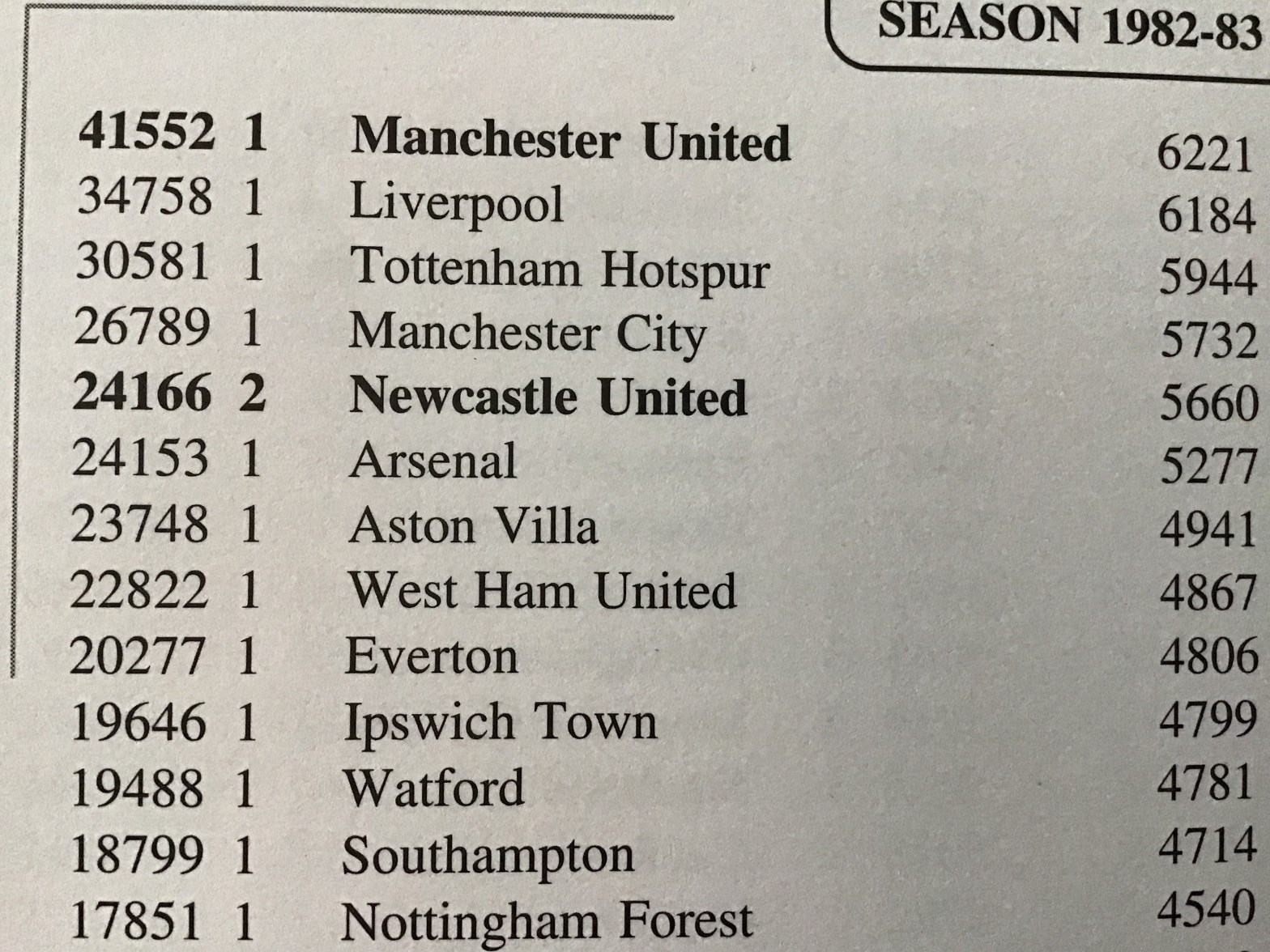
Fairly early on in the game between Manchester City and Arsenal the fans of the London club started to sing the old ‘Where were you when you were…’ chant. You’d think they’d know because often City were attracting better crowds than Arsenal. Let’s look at 1982-83 when I experienced my first relegation as a City fan. Back then City were the 4th best supported club (26,789) and Arsenal were 6th (24,153) – see the average attendance table above. City finished in a relegation position and Arsenal were 10th.
The following season Arsenal did attract a better average than City but they were the 5th best supported club in the entire 4 divisions and City were the 6th. In terms of League position Arsenal were 6th and City were 4th in Division Two.
We could talk about the late 1990s but neither club had a ground that could satisfy the demand to see them, so a sell out Maine Road in 1998-99 for third tier City has to compare with a sell out Highbury for title challenging Arsenal.
Since then stadium size has dictated average support but if we go back to earlier decades and assume that Arsenal’s ‘Where were you when you were sh*t’ refers to City heading towards relegation or being out of the top flight then City’s record is impressive overall. In 1965-66 (the last 2nd division season before the 1980s) City averaged 27,739 (10th best in entire League) while First Division Arsenal were the 9th best supported club on 29,036.
We can jump back even further. In the 1920s Arsenal were perceived as a popular club and in 1925-26 they averaged 31,471 – the 3rd best in the League. Where were City? Oh, City who were relegated that season were the 2nd best supported team with an average of almost 32,000. Not much more than Arsenal but the Gunners were 2nd in the League and City were relegated!
The year after Second Division City were the 3rd best supported club and top flight Arsenal were 4th!
1926-27 Average attendances. Manchester City in Second Division
The year after that (1927-28) Second Division City were the best supported club in the entire League with 37,468. Where were top flight Arsenal? 7th best supported with 27,434.
1927-28 Average attendances. Manchester City were the best supported club despite being in Second Division
It’s all a nonsense but if Arsenal fans, or any other team, want to sing songs like this then it would help if they knew their own history of support.
In 1932 Manchester City and Arsenal faced each other in the FA Cup semi-final. It was the Blues’ third semi appearance in eight years and they would go on to better this stage in each of the following two seasons. This semi was controversial and it had major repercussions for City. You can read the full story (and watch highlights) below:
Subscribe to get access
Read this article and the entire website when you subscribe today. Annual subscribers (£20 per year) get full access to everything posted on the site (including interviews, articles, talks and books) so far plus new material for the length of their subscription. There’s also a monthly option (see below).
Read this article and the entire website when you subscribe today. Monthly subscribers (£3 per month, cancel anytime) get full access to everything posted on the site since 1 October 2022 plus new material for the length of their subscription. Why not sign up for a month and see what you think?
The first live televised match played between Manchester City and Wimbledon was the Wimbledon victory on Monday 20 September 1993 shown on Sky TV (not City’s first live TV game on Sky though, that was QPR in 1992). Robbie Earle netted the only goal in the 55th minute of the Premiership encounter.
If you enjoy all the free material on my website and would like to support my research and keep this website going (but don’t want to subscribe) then why not make a one-time donation (or buy me a coffee). All support for my research is valued and welcome. It allows me to keep some free material available for all. Thanks.
On this day in 1947 Manchester City faced Manchester United at Maine Road. This was a home game for City against their tenants United.
Here for subscribers is a flashback piece detailing what features were in the MCFC match programme that day:
Subscribe to get access
Read more of this content when you subscribe today. It costs £3 per month or sign up for a year at the discount price of £20 per year. Why not subscribe for a month and see what you think?
A year ago today (19 September 2023) the reigning European champions Manchester City started their defence of the Champions League at home with a 3-1 victory over Red Star Belgrade. It was one of those games that felt as if City would never score at times, despite immense pressure from Pep Guardiola’s team.
Summerbee brings in the Champions League trophy
In fact City went a goal behind with a goal those of us in the stadium were convinced was offside (so did the referee’s assistant, positioned in front of the East Stand) but VAR allowed it to stand. The goalscorer was Belgrade’s Osman Bukari, who fired home just before half-time.
When the second half commenced we were convinced the Blues would overcome the deficit and sure enough Julian Alvarez met an Erling Haaland throughball, rounded the keeper and prodded home the equaliser a mere 73 seconds into the second half. Many Blues missed the goal as they were still returning from the toilets and the bars!
Alvarez opening goal celebration, 19 September 2023 Champions League MCFC v Red Star Belgrade
Alvarez netted a second on the hour mark when his free-kick from the left evaded everyone and flew past ‘keeper Omri Glazer. Rodri did what Rodri does best when he sent a curling strike into the net after 73 minutes. It was another classic, just like the final in Istanbul.
If you enjoy all the free material on my website and would like to support my research and keep this website going (but don’t want to subscribe) then why not make a one-time donation (or buy me a coffee). All support for my research is valued and welcome. It allows me to keep some free material available for all. Thanks.
For those who haven’t seen Manchester City’s match programme yet this season I’d just like to take a few moments to talk about my article this season. This year I’m doing a two page feature called ‘One Moment in Time’ where I select an image from a game, usually connecting the two clubs playing that day, and provide some information or tell a story.
For Ipswich I selected a classic 1981 FA Cup semi final image of fans on the Holte End while for Brentford I dug out an old glass plate image of City at Brentford in 1937 when the two teams challenged for the title.
I’ve already selected the photos and written my articles for tonight’s game with Inter, as well as the Arsenal and Watford games. You’ll have to buy the programmes to see what they are but I’m sure most City fans could guess that the Inter Milan feature will come from a certain major game between the two clubs in recent seasons.
I’m looking for ideas for future games of course, so if there’s a memorable image that you are aware of from a game between City and their opponents throughout this season then get in touch and remind me. It may be an image I’ve forgotten about. I’m trying to ensure these are not always the standard images people have seen. Where possible I want to select photos that are either capturing a moment that typifies City’s long history and great players or is a rare incident that was caught on camera.
Read the City programme throughout the season to see if your favourite City images are there.
There’s a lot of furore this week about Manchester City’s decision to wear their new Oasis inspired kit instead of their home kit for their Champions League game with Inter Milan. Lots are talking about tradition, heritage and the like, so I thought I’d add a few words here that might have been overlooked or forgotten. So here goes…
Firstly, my position is clear that I’ve always been keen to see City wear home colours/blue for every fixture possible (whether home, away or at a neutral venue) but I’m a pragmatist and know that’s no longer likely. History and tradition does mean something but of course, when it comes to football, traditions change frequently. People may think City have only ever worn a particular colour at home or that the traditional away colours are red & black but these things are not true. Times change.
When it comes to wearing alternative kits at home it has been done more often than perhaps people realise. In fact the only decade when it hasn’t happened appears to be the 2010s – I say appeared because I haven’t got evidence of every home game in the 1890s and 1900s!
These last few days have caused some to recall the Middlesbrough game when David James went up front and the two Tottenham games at Maine Road in 80s/90s when the referee felt the kits were too close and City ended up changing. But there have been many other occasions. In fact it’s well over 100 years since City first chose to wear away colours/alternative strips at home when they didn’t need to!
The image above of Neil Young comes from the 1971 ECWC semi-final v Chelsea. Notice that Young is wearing City’s away colours.
Often when there was a clash of colours in a cup game City would wear their away strip. Games in the 1920s right through to 1970s saw the Blues don maroon, red/black and even scarlet at times at Maine Road.
Here’s another image from that Chelsea semi final:
1971 ECWC v Chelsea. Francis Lee. Photo by Alan Jubb
To the right you can see the North Stand under construction, as you can in the Young image.
Other games in living memory (not necessarily mine, but living memory for many older blues) include:
January 1971 – City v Wigan in FA Cup (red & black)
September 1970 – City v Bologna in Anglo-Italian Cup (red & black)
January 1968 – City v Reading in FA Cup (all maroon)
March 1966 – City v Everton in FA Cup (all maroon)
March 1966 – City v Leicester in FA Cup (all maroon)
March 1956 – City v Everton in FA Cup (maroon shirts, white shorts)
In earlier decades City often chose to wear an away shirt for cup ties where there was a clash. Prior to 1921 the FA rule was that home teams would have to change if there was a clash.
In March 1924 City chose to wear a kit they described as ‘Lucky scarlet’ for a FA Cup tie with Cardiff at Maine Road. So for well over 100 years City have often chosen to wear alternative kits at home instead of traditional blue when they didn’t need to.
Personally, I’d still prefer City to always wear blue no matter where they play, but that’s never going to happen anyway.
Incidentally, if you’d like to read more on the history of Maine Road, take a look at Farewell To Maine Road, which can be downloaded from this page:
If you enjoy all the free material on my website and would like to support my research and keep this website going (but don’t want to subscribe) then why not make a one-time donation (or buy me a coffee). All support for my research is valued and welcome. It allows me to keep some free material available for all. Thanks.




 Gary James' Football Archive