As part if my Maine Rd 100 countdown in 2023 I posted this image of Manchester City fans demonstrating against chairman Peter Swales and his supporting board of directors. It’s always worth remembering those days as a reminder of how things change.
Of course fans still demonstrate and make their feelings known over various issues (as is their right) but these days it tends to be over specific issues. Back then it was about the direction of the full club. This image was from 1983 but protests against Swales and the board began in 1979 and continued until 1993-94. Here’s a photo of John Bond stood in front of the Main Entrance in 1983. The ‘cage’ protecting the entrance would often get locked to prevent fans forcing their way in during demonstrations.
John Bond, 1983
Here’s a 1995 image of Maine Road showing the forecourt in front of the Main Stand where most demonstrations occurred:
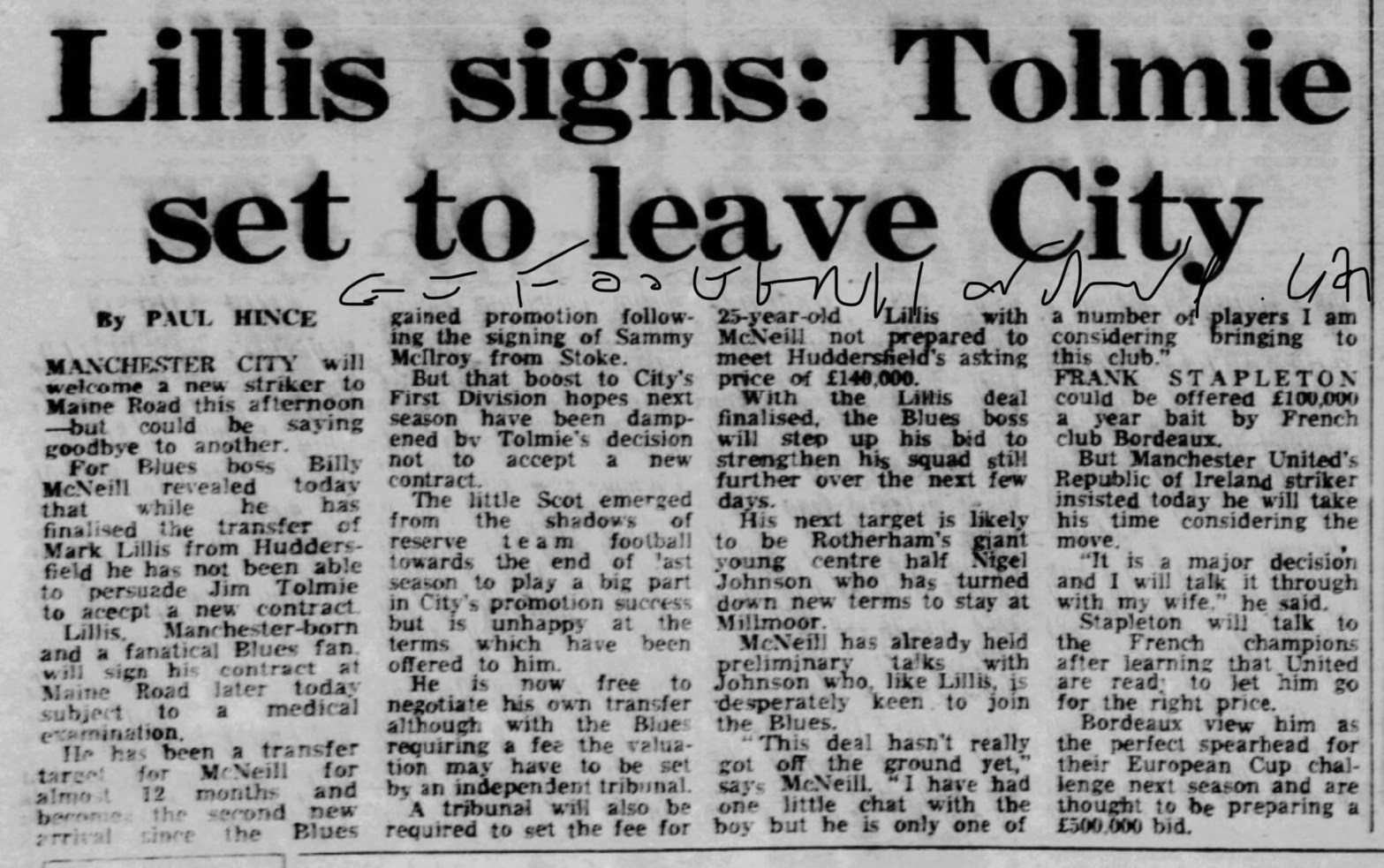
On this day (7 June) in 1985 it was reported that Manchester City had signed City fan Mark Lillis (see the image for the story). Lillis soon became a cult hero to Kippax fans.
The 1980s was a truly important decade in the history of Manchester City Football Club and you can find out more on this season by reading the following 2,500 word feature on 1985-86 (available to subscribers). Enjoy!
Subscribe to get access
Read more of this content when you subscribe today. It costs £3 per month (cancel anytime) to access everything posted since 1 October 2022 or £20 a year to access everything posted since the site was created in December 2020. This special rate works out about £1.67 a week and gives access to everything posted, including PDFs of 3 of my books.
Here’s a newspaper cutting from this day (5 June) in 1975 about England International Dave Watson who was rumoured to be leaving Sunderland. Manchester City seemed favourites to sign him and, of course, he was ultimately to join the Blues (becoming my hero too!). There are lots of articles that mention Dave on my site and here’s a link to all those tagged ‘Dave Watson’:
On 3 June 2023 Ilkay Gundogan City secured his place in national football history with the quickest goal in a FA Cup final. It was a stunning volley after only 12 seconds. That day Gundogan scored two and helped City to 2-1 FA Cup final victory over Manchester United.
As well as the speed of the first goal, Gundogan’s goals gave him another MCFC record. Dave Masey, who has been collecting stats and historical information on Manchester City for years contacted me to tell me about one of his spreadsheets which holds details of City scorers in trophy winning games.
His records capture those who have scored in major cup finals, but besides Cup Finals he also records other trophy-winning games. These include the deciding League games from 1937 onwards against Sheffield Wednesday (1937), Newcastle, QPR, West Ham, Brighton and Villa (2022), but nothing from three recent title successes where the Blues clinched the title when they were not playing. Got that? Good, now….
Dave tells me that the FA Cup success saw Gundogan move to the top of the list with 5 goals, overtaking Neil Young and Sergio Aguero. So he has scored more goals in trophy-winning games than any other Blue.
The list of scorers in trophy winning games reads:
1904
Meredith
1934/7
Tilson (3), Brook (2), Doherty
1956
Hayes, Dyson, Johnstone
1968/70
Young (4), Lee (2), Summerbee, Doyle, Pardoe
1976
P Barnes, Tueart
2011-(former)
Aguero (4), Y Toure (2), Nasri (2), Kompany (2), D Silva (2),Jesus (2), Sterling (2), Dzeko, Zabaleta, Navas, Fernandinho
2016-(current)
Gundogan (5), Laporte (2), Rodri (2), Mahrez, De Bruyne
Dave also tells me that in the three seasons where somebody else’s defeat clinched the title for City, the scorers in the club’s last game before the title confirmation were:
Gundogan (3), Sterling (2), Jesus, Haaland.
As Dave says, Ilkay gets a remarkable number of important goals, particularly for somebody who is ‘just’ a 1 goal in 5/6 games player (63 in 357 for City by June 2025).
These days pre-season tours are an expected part of a football club’s activities but that’s not always been the case. Pre-1939 it was highly unusual for English teams to travel for friendlies before a season, but some clubs did enjoy post-season tours. The idea was that a trip to mainland Europe was a reward for first team players after an arduous season. Here for subscribers to my site is a brief overview of some of Manchester City’s European tour firsts.
Subscribe to get access
If you would like to read this and all the in-depth articles on this site (including the entire Manchester A Football History book, my first book on MCFC and audio interviews with John Bond, Malcolm Allison etc. then please subscribe. It works out about £1.67 a month if you take out an annual subscription (£20 per year) or £3 a month if you’d like to sign up for a month at a time.
Four years ago (Saturday May 29 2021) I attended the Champions League final in Porto. This was Manchester City’s first CL final. In the days that followed I wrote this article on that final and the experiences. I’m republishing it here as I wrote it then. Enjoy!
Despite the result (a 1-0 victory by Chelsea) it was a wonderful experience and so I’ve decided to post here my story of the weekend. I know every one of us who attended had a different experience but I hope this gives those who were unfortunately not able to be there a taste of what the trip was like.
Porto 2021 was always going to be a historical moment in the history of Manchester City but, because of Covid and the worldwide situation, it was one of the most challenging finals to stage, participate in and attend. All of us who travelled to Porto had to have numerous covid tests (and I have seen on the Bluemoon forum that some fans on various official and unofficial flights have received news that they need to isolate– I feel for anyone on there in this situation).
Fans travelling on the official day trip were told that if they took a Covid PCR test after 1pm on Thursday that should see them through for the journey out, stadium entry and return journey as a test had to be performed for each of these within 72 hours. I was flying out on Friday and returning on Sunday so initially I arranged for my PCR test to occur after 1pm with a company called Dam. At the time of booking they guaranteed that the result would be with me before midnight on the day of the test so that seemed fine but then, on the Bluemoon forum, fans were talking about a change in Dam’s level of service which meant results were no longer guaranteed that same day. Instead 24 hours was being stated by Dam, though when I discussed this with their helpline even the 24 hours could not be guaranteed. Panic followed!
I eventually moved my test to Wednesday afternoon and booked another via the Official Supporters Club offer with Blindspot which I intended dropping off at Bar Pop on Friday morning on my way to Manchester airport.
The Dam test came back on Thursday, meaning I could fly out, and I dropped off the second test at Bar Pop on my way to the airport. There were a few issues at Dam with the booking but eventually everything was sorted. The Supporters Club/Blindspot test and drop off went really well (though the Day 2 return test result has still not arrived – we’re on Day 5 at the moment) and I am grateful to those involved for sorting this all out. You did an excellent job at short notice and in a pressured environment. Thanks.
After leaving Bar Pop I travelled to the airport, making a detour to take a look at Maine Road and surrounding areas. Somehow it seemed appropriate that this journey to the most significant European final the club has ever been involved with should include a brief look at the site of so many wonderful moments over the decades. I saw my first European match at Maine Road (which also staged the first European Cup game ever played in England as well!) in the early 70s.
At the airport everything went smoothly and I was delighted when I realised that I would be flying out on the Etihad Manchester City plane. I had received an invitation from the club (for which I will be eternally grateful and I know how lucky I am) and to experience that flight, while seeking to chronicle this landmark historical moment, added enormously to the occasion. Thanks to those involved (you know who you are. Thanks).
The Manchester City Etihad plane
The flight included several former players, officials and key figures in the club’s development. Knowing City’s history, personalities, and key moments I recognise that it was no mean feat to have some of these on the same flight. It was remarkable that City remembered and acknowledged the contribution made by these people, which included Chris Bird, Garry Cook, Paul Dickov, Brian Horton, Francis Lee, Andy Morrison, Ian Niven, Dennis Tueart and Alex Williams. Others, including Pablo Zabaleta joined the group in Porto and stayed at the same hotel.
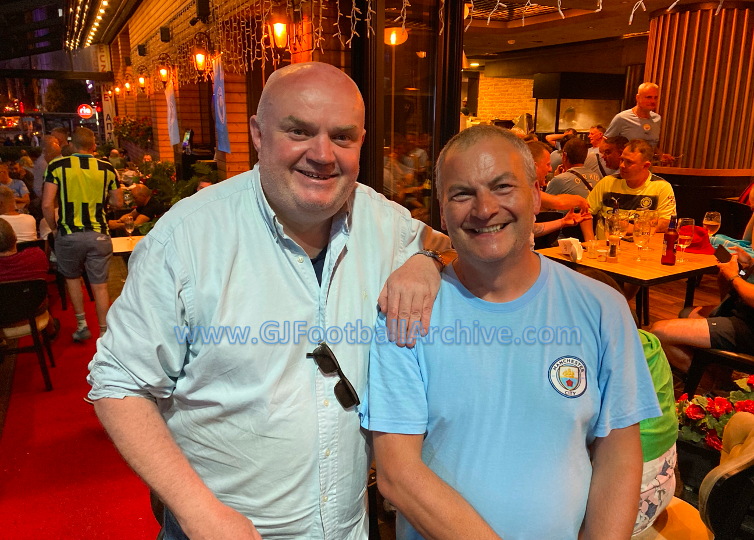
Once in Porto it was great to see so many City fans in and around the city, especially the historic area near the river. Over the weekend I bumped into several friends and faces from my City-supporting life including Jon Bell (Colin’s son), Howard Burr (and other Reddish Blues), Geoff Homer, Will Perry, John Stapleton, Kate Themen (one of the original Manchester City Women/Ladies players who played with my wife back in the late 80s and she was a drummer with The Fall), Dave Wallace, Steve Welch and of course lots of City staff.
On Friday night I was invited to a club event which saw most of the official party board boats at the riverside for a cruise. We had to walk through many crowds of Blues to board the boats and it was great to see and hear fans bursting into song whenever they saw Morrison, Dickov, Zabaleta and other members of the group.
The boats then dropped us off at a venue where City chairman Khaldoon Al Mubarak made a brilliant, heartfelt speech about his journey with Manchester City, recalling the moment he was asked by HH Sheikh Mansour to become chairman and his first day in Manchester when he was taken to Carrington, Platt Lane and the stadium. He talked with real passion for the club, its people and the fans. He recognised the history of the club and the journey that we’ve been on paying particular attention to some of the people who had helped along the way, including many of the officials and former officials in the room, as well as fans of course.
There was also a speech by CEO Ferran Soriano about the development of the City Football Group and a video was played about the Champions League journey over the last decade.
DJ Yoda put together an excellent mix of City related music, videos etc. including the recent footage of Pep and his cigar (if you don’t know what I mean do a few internet searches, it will soon appear). It was a definite highlight and something that added a bit of humour to the event too.
Saturday was of course match day. I spent some time in the City Fanzone, where I chatted to a few longstanding Blues I know, but also time around the city. Close to the bars at the historic centre there was a small group of local musicians going around playing City chants/songs such as ‘Singing the Blues’ and Blue Moon. Fans were joining in and it seemed quite bizarre hearing these musicians belt out most of the words to ‘Singing the Blues’, hoping to engage a few fans. A little later, as I wandered further down the river I spotted the same musicians doing similar with Chelsea chants/songs – you’ve got to admire their entrepreneurial skills! I can imagine them on the night the final was moved to Porto rushing to the internet to seek out MCFC & CFC songs. They must have made a few Euros from us all.
The entire atmosphere, as far as I could see and experienced, was positive with City and Chelsea fans enjoying being there. Personally, this was my first trip outside of England and Wales since November 2019 (when I talked at a film festival in St Gallen about the Bert Trautmann film I was a consultant on and then met up with a few Blues in Zurich). It was great to be outside of the UK and wonderful to finally get to see other human beings and to share an experience with fellow City fans.
I loved the way former players like Paul Dickov, Andy Morrison, Pablo Zabaleta and Shay Given were spotted by fans who, without fail, would burst into a chant or song about them. Some were mobbed too of course. At one point, I saw a group of fans opposite our hotel do an impromptu Poznan which I know was loved by the former players and staff who saw it.
Porto seemed like a fairly normal environment. Obviously, like all those attending I tried to ensure I kept to the usual social distancing rules and wore my face mask etc. but this was not always possible, especially when queuing to get into the stadium. I know others were on crowded buses too.
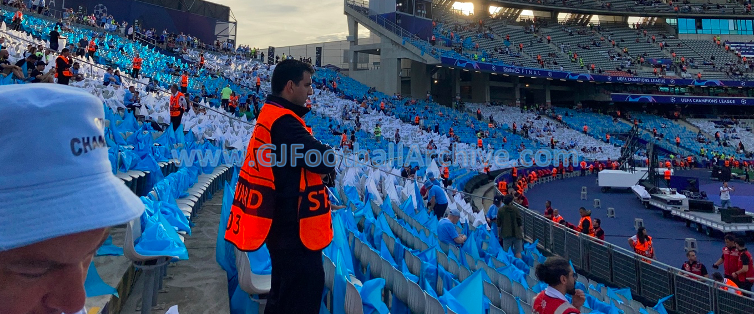
In comparison with the League Cup final at Wembley, it did feel as if UEFA had picked the wrong stadium. Looking around the venue it also made me realise how fantastic the Etihad Stadium is. We take it for granted but our facilities are considerably better than the majority of venues.
If we consider all the extra requirements placed on fans then UEFA definitely picked the wrong stadium and it seems so obvious, particularly with some of the stories coming from Chelsea and City fans about being told to isolate on their return, that the final should have been held in the UK.
The decision to stage the game at Porto was made exceptionally late and, because of this, both clubs were unable to prepare in the way they would have liked. I am aware from City personnel of the short notice they received about tickets, travel and so many other logistical areas. I can only admire the work they have done and the efforts they made to ensure they could get fans to the final and back again. Inevitably, there will be some who had issues (I’m aware of the delays to flight 12 which, from what I hear, has created a sort of Dunkirk spirit amongst those involved) but I do think the ordinary staff and management at City deserve praise for all they did.
As I arrived at the stadium on the coach, which had been delayed due to a traffic accident, we saw Jeremy Clarkson rushing down towards the turnstiles.
Security seemed tight and men and women were separated into different queues with somewhat zealous security types objecting to many, many items. Inflatable bananas, lipsticks, perfumes and many other items were cast aside before intrusive searches were performed (it reminded me of Leeds away back in 1983!). After security we got into the ground with about fifteen minutes to spare.
The Marshmello video was shown; the UEFA anthem was played (City fans started booing it and the volume seemed to be turned up to drown out the booing!); fireworks went off and then we were ready.
The game itself… Ah, I think we all know how we feel about that. I was on a coach going to the ground, close to a couple of former players when the team news came through. I read it out to those around me and one of the former players immediately asked about Fernandinho. He described how things would go and predicted the result immediately. Sad to say, he called it spot on. He wasn’t the only one of course.
The segregation in some areas of the ground seemed somewhat questionable. I was in level one on the side opposite the tunnel, close to the corner. On both sides at that level there seemed to be alternate Chelsea then City blocks. The block I was in was close to the main Chelsea end (to our right as we looked at the pitch) and there was another Chelseablock to our left. The same seemed to occur in the opposite stand. Why UEFA did this I don’t know but common sensewould say that these blocks should’ve had all Chelsea closest to Chelsea fans and all City closest to City fans with genuine neutral blocks in the middle (like Wembley does for major finals).
There were no major issues where I sat but we did feel somewhat drowned out by celebrating Chelsea fans from the moment the goal was scored.
At the end of the game Fernandinho came over to the section I was in; climbed over the barriers and hugged his son. Understandably, they were both emotional and the sight of a player searching for his son so that he could comfort him really got to me. As a parent seeing your child upset is one of the hardest things to experience and I loved how in this moment Fernandinho was not a footballer, he was a dad. Other players, including Ederson and Kyle Walker also came over to console family members.
I think we all saw how emotional our team was, especially Sergio. Like all fans I wish his City journey had ended with Champions League success.
As soon as it seemed right I left the stadium, went to my coach and waited to travel back to the city centre. I was invited back to a post-game event where the mood was understandably and appropriately muted. Wingman (Nigel Clucas), who had worked hard in the fanzone earlier in the day, got the mood spot on by playing The Smiths ‘Heaven knows I’m Miserable Now’; The Cure ‘Boys Don’t Cry’ and similar songs. Wingman did an excellent job that day and must have been exhausted.
The next morning we boarded our coaches and headed back to the airport. Both check in and security were somewhat time-consuming but, to be fair, many staff at the airport had probably been overworked for much of the night.
Compared to Porto, security at Manchester airport seemed a doddle (so long as the correct documentation had been completed beforehand) and within minutes of arriving at security I was on my way home.
Since then I have performed my Day 2 covid test, as required, and sent that off. Now, on day 5, I am still waiting for the results. From many Blues I’ve heard from it does seem like this part of the process is failing and may be something the Government needs to address if they expect UK residents to do these tests when they return from holiday overseas over the coming months.
There’s been the news that Portugal has now been removed from the UK Government’s green list. The cynic would say that the decision to stage the final in Porto influenced the decision to make Portugal a green list country in the first place. For me I don’t know what political decisions have been made and how they’ve been influenced but it does seem somewhat odd. Of course, we all know that logically a final between two English clubs which would see in excess of 12,000 travelling from the UK in the middle of a pandemic should have been staged in the UK. UEFA can say all it wants about fans being at the heart of the game but the bottom line was that the final was staged outside of the UK for the benefit of UEFA officials, sponsors and their friends. If they really wanted to help fans it would have been staged in the UK.
Ah well… Politics, hey?
So Chelsea won the trophy and while the result was a painful one for City fans it must be stressed that Chelsea are one of Europe’s elite and have now won more European trophies than Manchester United. In fact they are the second most successful British club in Europe after Liverpool and, like City, they won a major European trophy BEFORE Liverpool, Juventus and many other clubs. Chelsea’s fans, like City, have seen some dark days (most notably in the 80s) and we should all remember that their development, since the investment, is a few years ahead of City’s. If their achievements in Europe are an indicator of progress then clearly City are not too far behind.
Finally, I know this has been a lengthy piece but I just wanted to throw a few thoughts, memories and comments down. If you’re one of the people who managed to get to Porto I hope you managed to enjoy it despite the result. I was extremely fortunate this year (this is the first time I have ever been a guest of any football club for an away fixture and I know how lucky I was – I will never forget it).
Here’s to the next major final featuring Manchester City who, let’s face it, have won more trophies in 2020-21 than any other English club and have been incredible champions. It could be argued that the ONLY club that stopped them from winning all four major trophies was Chelsea (though Leicester may have in the FA Cup final of course) and they are the European champions.
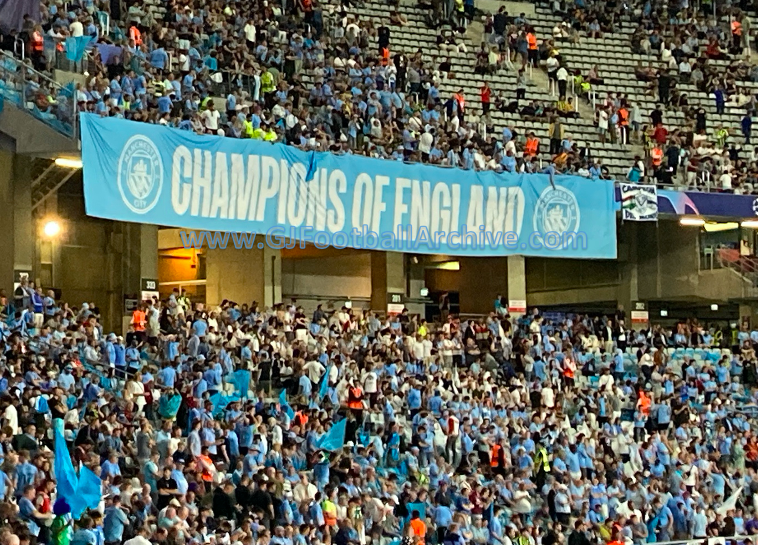
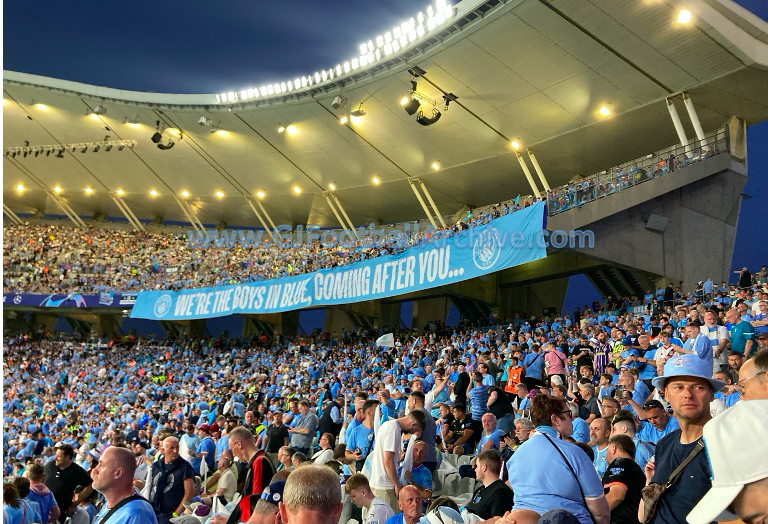
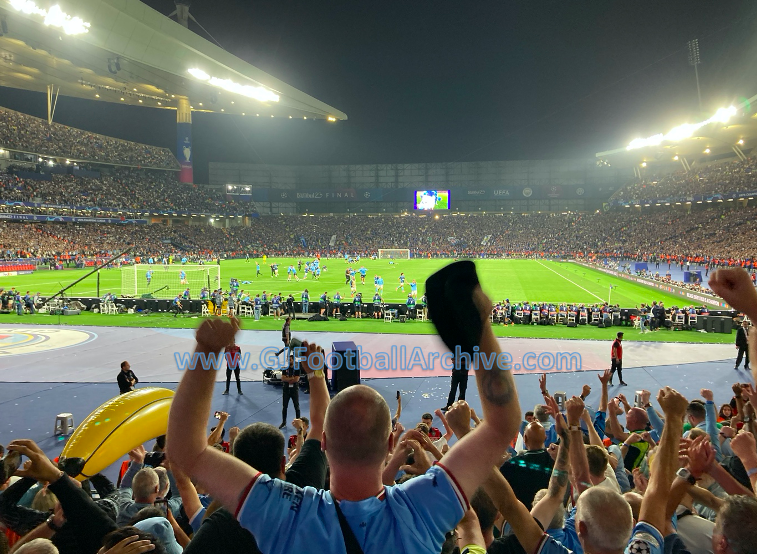
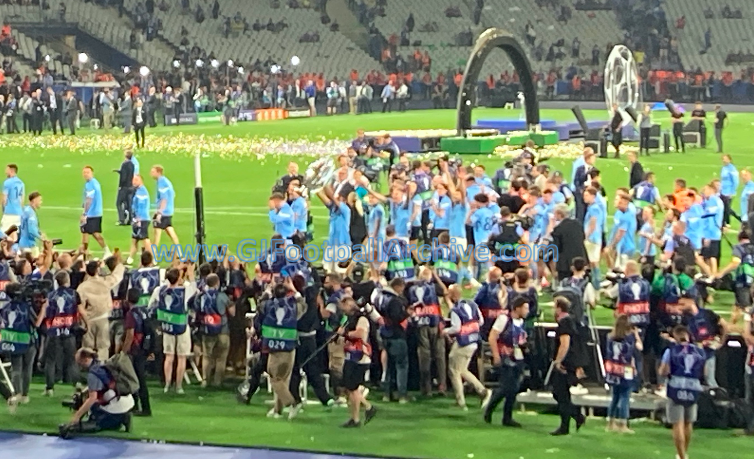
Good luck to Inter Milan tonight. Their fans were excellent in Istanbul two years ago when I was there to watch Manchester City win the Champions League for the first time. I hope Inter do it tonight.
The 1999 Play Off Final was played on Sunday 30 May in 1999 with Manchester City clearly the favourites. According to the media Gillingham were going to be swept aside by Royle’s men. For many Blues the day began with a long journey down to the capital. Some stayed overnight close by – the Wembley Hilton seemed to have City banners and flags hanging from every window.
When the players were brought out on to the pitch for the commencement of play they were greeted by smoke, fireworks, and inflatable Nationwide Building Society men. It all seemed a little surreal, but this was nothing compared to the match itself.
When the action started City were not the great force the media expected, instead they slipped their way across a wet surface and relied on the 20 year old Nicky Weaver to keep Gillingham at bay, particularly in the 9th minute when he palmed away an effort from Galloway. As the game wore on confidence grew and in the 26th minute a downward header from Horlock was superbly saved by Gillingham’s Bartram.
Mixed play followed, although it’s fair to say that City several chances and should have taken the lead, especially in the 75th minute when Goater sidefooted a shot against the post. As the game progressed City fans became nervous, then with only 9 minutes remaining the Blues were dealt a major blow when Asaba toe-poked a shot into the roof of City’s net. Worse was to follow for City as Robert Taylor made it 2-0 in the 86th minute. Two thirds of the stadium fell silent, then many, many Blues decided enough was enough and left for home. Those that remained were in for a treat.
Radio Five commentator Alan Green told his listeners about the plight of the thousands of City fans silent at Wembley adding: “That many fans go to every home game. Why do they do it?” It wasn’t long before he found the answer.
With a mere 17 seconds of normal time remaining Horlock sidefooted a goal, prompting those in the stands to start to believe that an equaliser could be possible. Four and a half minutes into injury time Dickov fired an equaliser into the top corner. For a few seconds the stadium fell silent as City supporters struggled to comprehend the importance of the goal, and then wild celebrations erupted. Outside Wembley those that had left early heard the news and rushed back.
An extremely tense period of extra time followed, and then came penalties. The City players huddled together as a team, showing the unity that previous sides had clearly not enjoyed. This unity helped City win the penalty shoot out 3-1, but this score says nothing about the drama and the excitement of it all. The penalty sequence started with Kevin Horlock scoring the first at the City-filled Players Tunnel end of the stadium. Then Weaver’s legs blocked Gillingham’s first effort by midfielder Paul Smith.
A confident looking Paul Dickov marched forward to take City’s second, but he watched in agony as his attempt bounced off both posts to leave the score at 1-0. Adrian Pennock then shot wide for Gillingham, before Terry Cooke calmly slotted his effort into the bottom corner to make it 2-0.
Gillingham’s third penalty was sent clinically into the roof of the net by John Hodge to make the score 2-1, then Richard Edghill sent his spot kick in off the bar. The pressure was at long last on Gillingham. Guy Butters looked a little on edge as he prepared for the eighth penalty, while in the nets Weaver seemed relatively composed. The young City goalkeeper dived the right way and blocked Butters’ effort to give City victory. He immediately went on a rather manic run across Wembley, until he was dragged back to reality by Morrison and the other players.
Wild celebrations followed, with the players bowing to the supporters to show their appreciation of sticking by the club through an extremely difficult period.
Manager Joe Royle was delighted, although it’s fair to say he looked absolutely worn out when he made it into the dressing room after City’s extravagant celebrations. In a rather down to earth manner he told the media: “We’re not getting too excited about this. A club this size should not be too euphoric about getting out of the old Division Three. And even though we won today, I still think the play offs are a joke. After 46 League games it comes down to a lottery.” This was a comment many at Gillingham would have agreed with.
Royle added: “I think we have gone a long way to curing Man City-itis. We can handle the big games now, even though we weren’t at our best today.”
Stats: Division Two Play Off Final. 30th May 1999.
Gillingham 2-2 Manchester City
City won 3-1 on penalties
Scorers – City: Horlock, Dickov
Gillingham: Asaba, R. Taylor
CITY: Weaver, Crooks (Taylor), Edghill, Wiekens, Morrison (Vaughan), Horlock, Brown (Bishop), Jeff Whitley, Dickov, Goater, Cooke
GUEST OF HONOUR: Mike Lazenby, Divisional Director of Marketing, Nationwide Building Society
While you’re here why not subscribe and read an indepth article on the 1998-99 season. It saw the Blues reach their all-time low before an incredible fight back. It’s City’s one and only season at that level. The article is almost 8,000 words long. It’s available to subscribers, so why not subscribe and relive this extraordinary season? It contains material from interviews I’ve performed with key figures from that time.
Subscribe to get access – Monthly
Read more of this content when you subscribe today. It costs £3 per month (cancel anytime) to access everything posted since 1 October 2022 or there’s a special annual rate below which gives greater access and works out much cheaper.
Read more of this content when you subscribe today. It costs £3 per month (above) or £20 a year (here) to access everything posted since the site was created in December 2020. This special rate works out about £1.67 a week and gives access to everything posted, including PDFs of 3 of my books.
If you enjoy all the free material on my website and would like to support my research and keep this website going (but don’t want to subscribe) then why not make a one-time donation (or buy me a coffee). All support for my research is valued and welcome. It allows me to keep some free material available for all. Thanks.
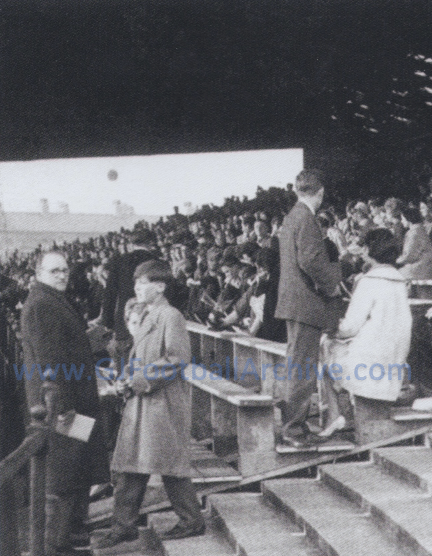
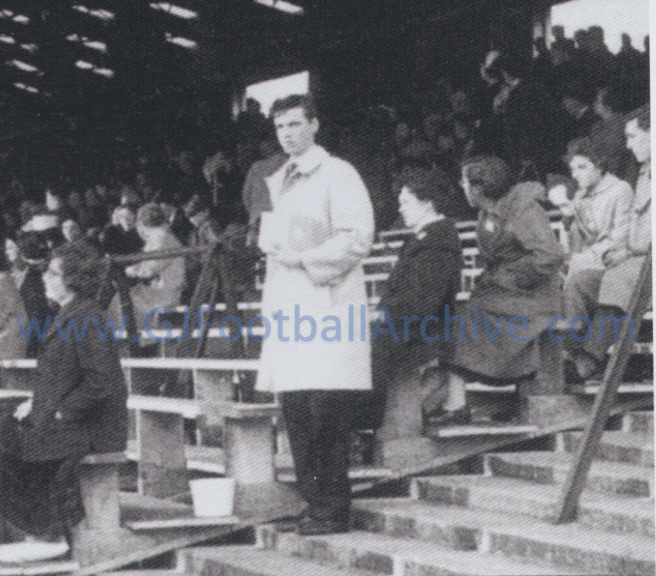
On this day (29 May) in 1961 thousands were able to sit on benches installed on the Kippax for the first ever time. But wait a minute, the Kippax wasn’t seated until 1994-95 or was it? So read on to find out what happened in 1961…
Maine Road staged one of the religious events where American evangelist Billy Graham came to preach to thousands in 1961. I cover the story in detail in Farewell To Maine Road but these images show that temporary seating was installed on the Kippax for the event, which took place between 29 May and 17 June 1961.
At this time there were no gates in the Kippax’ perimeter wall leading to the pitch and so special scaffolding steps were erected to allow attendees to climb over the wall and on to the pitch for blessings etc.
Were you at one of these religious events? If so leave your comments about the day below.
For those unfamiliar with Maine Road’s layout at the time, the above photo was taken from about a third of the way up the Kippax between number 6 and 8 on this photo.
Maine Road aerial 1971 from Farewell To Maine Road
If you’d like to read more on the history of Maine Road, take a look at Farewell To Maine Road, which can be downloaded from this page:
If you enjoy all the free material on my website and would like to support my research and keep this website going (but don’t want to subscribe) then why not make a one-time donation (or buy me a coffee). All support for my research is valued and welcome. It allows me to keep some free material available for all. Thanks.
Anyone remember seeing the CITY F.C. flag that used to proudly fly above the Popular Side/Kippax. It was there for decades. There had been a CITY F.C. flag at Hyde Road and it may well be that this was the same flag. It was often referred to in the media during its life at Maine Road, such as in this 1925 cartoon:
The first derby at Maine RoadThe City flag flying at Maine Road’s first Manchester derby
The flag flew proudly over the Popular Side until the stand was roofed in 1957. Then the flag was moved to the Scoreboard End, eventually disappearing in the 1960s when rumour has it that it was taken down by Liverpool fans. I’m not certain if that’s true and I’ve never found any evidence but if you do know more please let me know.
I do know that in the 1930s a disgruntled City fan lowered it during a difficult game and it caused outrage. It was mentioned in the local press and the culprit had to make a formal apology to the club and his fellow City fans.
This 1971 image shows the roofed Kippax Stand. The flag was originally on a flag pole roughly where the number 7 is in the days before the stand had a roof. When the Kippax was roofed it was moved to the back of the Scoreboard End. The North Stand (10) replaced the Scoreboard End in the early 1970s.
Maine Road aerial 1971 from Farewell To Maine Road
If you’d like to read more on the history of Maine Road, take a look at Farewell To Maine Road, which can be downloaded from this page:
If you enjoy all the free material on my website and would like to support my research and keep this website going (but don’t want to subscribe) then why not make a one-time donation (or buy me a coffee). All support for my research is valued and welcome. It allows me to keep some free material available for all. Thanks.