Albert Alexander (Junior): MCFC Chairman

Back in the late 1960s there was a popular Manchester City chairman whose family had been involved with the club since the very beginning of the club. That was Albert Alexander. Here’s a profile I wrote in 2012 on him. It’s about 900 words long and is free to read. Enjoy!

Albert Alexander was the second generation of the Alexander family to play a prominent role in the development and history of Manchester City.  His father, also Albert, had been involved with the Club from the 1890s and had held various positions including vice-chairman, and even manager for a spell in 1925-26.

Like his father, the younger Albert dedicated his life to the Blues.  Inevitably, he spent most of his boyhood watching the Club develop and, as he grew, he became more involved with behind the scenes work at the Club’s first home Hyde Road.  He was a member of the Ground Committee which performed crucial activities such as stewarding and ground maintenance.

Alexander also managed the Club’s A team and provided support in whatever way necessary to ensure the Blues succeeded.  He was more than happy to work through the ranks and take on any duty necessary.  His son Eric, who was Chairman in the early 1970s, remembers that his father had suffered during the First World War but that didn’t stop him from putting his energies into the Blues:  “He was a very good footballer and cricketer but he was gassed in the Great War and had to give it up.  It affected him throughout his life, although it’s fair to say he recovered enough to fulfil a happy normal life apart from playing of course. 

“He took up golf, but his love for football was such that he started the ‘A’ team at City.  He started it in 1921 and ran it through until 1963.  He enjoyed working with the youngsters and developing them.  He gained an awful lot of satisfaction from that, particularly when players like Matt Busby developed their skills and style as part of the ‘A’ team.”

Ultimately, after many years of loyal service Alexander became a City director.  This came after the Blues became aware that Manchester United were hoping he would join their board.  It is highly likely Alexander would have turned the Reds down, and it was appropriate that he became a director at Maine Road.  It was an honour he deserved for years of dedication to the City cause.

While director he felt the passion all fans feel for the Blues and he also felt the pain and worries during the Club’s struggles in the early Sixties.  He wanted better and, in 1965 as fans demonstrated following City’s lowest attended League game, he came out to face them and talk with them about his hopes and ambitions for the Club.  He apologised for City’s appalling decline.  It says much about his courage and the respect fans had for him that they dispersed.  It is doubtful whether any other director would have been respected in this manner at such a low point.

Understandably, Alexander who was City’s Chairman by this point wanted to see his side successful and later that summer he appointed Joe Mercer as manager.  It was a brave decision as Mercer had been out of work for a year and had suffered a stroke at Aston Villa.  Other names, such as former City hero Peter Doherty and Liverpool manager Bill Shankly, had been expected to be appointed by the media, so this move could easily have been seen negatively.

Alexander guided City through the successful years of the Mercer-Allison period and was probably the first Chairman to be hugely popular with fans.  Everyone seemed to love ‘Little Albert’ as Mercer dubbed him.

Many of City’s achievements during these years were dedicated to Alexander by Mercer, while journalist Bill Fryer commented in 1970:  “He is highly revered in the game and by the public, and I have no doubt good deals have been done for City out of Albert’s friendships because in reality the whole of football is a ‘club’.”

Sadly, despite the Chairman’s popularity, his final years saw him suffer at the hands of the 1970 takeover battle.  Alexander found out about the takeover when he received a knock on his door at breakfast one day.  It was a complete shock to him.

The takeover destroyed much that was good about City at this point, including the Mercer-Allison partnership.  However, it is rarely mentioned how the takeover affected Alexander, the man who had guided City with distinction through some dark days when no one else wanted to know.  He had taken the Club from the lowest point it had experienced since joining the League, to a position of strength with trophies galore.  Those bidding for control wanted the glory, Alexander’s motives were somewhat different – like all true fans he wanted City no matter what. 

Alexander stood down as Chairman and was made Life President – an honour first given to Lawrence Furniss seven decades earlier, proving the significance of this recognition.  Unfortunately, Alexander’s health was deteriorating by this point and he passed away soon after.

Manchester City owes a great deal to the dedication of Albert Alexander and the other members of his family.  The Alexanders helped guide the Blues from the 1890s through to the reign of Peter Swales, and in some ways on via the continuing involvement of Eric Alexander (still a regular attendee until his death in 2019).  Their contribution should never be forgotten.

If you enjoy all the free material on my website and would like to support my research and keep this website going (but don’t want to subscribe) then why not make a one-time donation (or buy me a coffee). All support for my research is valued and welcome. It allows me to keep some free material available for all. Thanks.

Choose an amount

£2.50
£5.00
£7.50

Or enter a custom amount

£

Your contribution is appreciated.

Donate

Subscribe to get access – Annual

Read more of this content when you subscribe today. It costs £20 a year to subscribe (it works out £1.67 a month) or £3 if you’d like to sign up a month at a time. Annual subscribers get full access for as long as you subscribe (you can always try it for a month). It’s worth bearing in mind that the 2010 Manchester A Football History cost £24.95 and all subscribers will be able to access all of that for as long as they are a subscriber (plus all the other stuff of course).

Subscribe to get access – Monthly

It costs £3 a month to subscribe a month at a time. Why not give it a try! Monthly subscribers get access to everything posted since 1 October 2022 for as long as you subscribe.

The 1940s: George Smith 5

On 14 June in 1947 Manchester City’s George Smith (on right of photo the following season playing against Manchester United) scored five as the Blues defeated Newport 5-1 in the Second Division. At the time this was City’s latest finish to a season (eclipsed by the Covid affected 2019-20 season of course!). You can read more on the 1946-47 season below. This was the first league season after the war and ended with City winning the Second Division title. There were some truly significant – and well attended – games that season and future Liverpool manager Joe Fagan made his debut this season too. This subscriber article includes comments from an interview I did with George Smith back in 2003.

This is a subscriber article and you can read it by subscribing below.

Subscribe to get access

Read more of this content when you subscribe today. It costs £3 per month or you can subscriber for the discounted annual rate of £20 per year. Each subscriber gets access to everything posted so far, including PDFs of a couple of my books.

The 1940s: A Huge Attendance in Second Tier

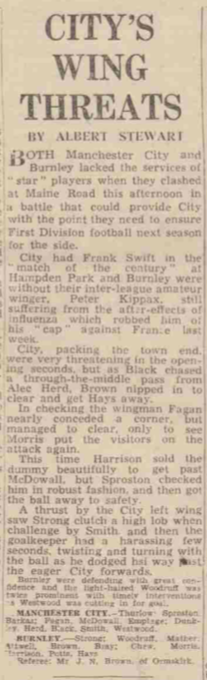
On this day (10 May) in 1947 a solitary goal from Alec Herd (image) against Burnley was enough to give Manchester City promotion.  The attendance for this Second Division game was recorded by the media at the time as 67,672 but official records reviewed almost sixty years later showed that City actually recorded the attendance as 69,463 at the time.

Typically, the attendance figures City used to give the media for League games through to the 1960s tended to exclude season tickets. So the Blues’ management would give the figure of tickets or pay on the gate admission for the game but exclude season ticket holders. Back in 1946-47 City had around 1,800 season ticket holders and almost every League attendance back then is understated by that amount. 

FA Cup games were the actual attendances as these were always sold game by game.

As this practice of excluding all season ticket holders continued for many, many decades at Maine Road attendance figures for League games are usually understated (they were often understated in the 1970s & 1980s as well but for different reasons and back then Peter Swales, Bernard Halford and the others involved in calculating attendances would deny any discrepancy despite many fans, fanzines and others challenging them often).

For comparison purposes it’s worth looking at the attendances of the Division One champions in 1947 to see how the Blues compared. This attendance against Burnley was almost 17,000 higher than Division One champions Liverpool’s highest crowd that season (52,512 v Wolves in December) and the Merseyside Reds nearest home game to City’s Burnley match was watched by 48,800 and that was Liverpool v Manchester United (May 3). Liverpool did average 45,732 that season, whereas City averaged 39,283 but they were a Second Division club.

The City-Burnley crowd was the Second Division’s record at the time and it was higher than every First Division crowd since the 1937-38 season (The Second Division record is now held by Tottenham v Southampton which had 70,302 in 1949-50).

Film of City v Burnley does exist but it’s in a most unlikely place. It was actually filmed as part of a Mancunian Films drama called Cup Tie Honeymoon. The company was run by a Manchester City fan who made this film, which starred Sandy Powell and Pat Phoenix (under her original name of Pilkington). A football game is crucial to the plot and scenes were filmed at Maine Road and interspersed with real action from the City-Burnley game to add credibility.

Myself and Will McTaggart have shown these scenes in our Boys In Blue film shows which have been staged at the Dancehouse and Cornerhouse in Manchester over the last decade. Maybe I’ll explain more about the film and those talks another day.

You can read more on the 1946-47 season below. This was the first league season after the war and ended with City winning the Second Division title. There were some truly significant – and well attended – games that season and future Liverpool manager Joe Fagan (photograph) made his debut this season too. This subscriber article includes comments from an interview I did with George Smith back in 2003.

This is a subscriber article and you can read it by subscribing below.

Subscribe to get access

Read more of this content when you subscribe today. It costs £3 per month or you can subscriber for the discounted annual rate of £20 per year. Each subscriber gets access to everything posted so far, including PDFs of a couple of my books.

The 1940s: George Smith

Continuing the series on Manchester City in the 1940s here’s an article I wrote back in 2013 about George Smith, a City star of the 1940s, who passed away that year. This is free to read and well worth taking the time to read it too. George’s story was a remarkable one.

In July 2013 City lost one of the club’s stars from the 1940s, the popular goalscorer George Smith.  Smith, who was 92, had a remarkable life and career.  He joined the Blues in 1938 from Salford Adelphi and quickly proved his value in City’s A team as an inside-forward. He seemed to be getting close to a first team call up but then war broke out and naturally the world changed considerably for all, especially young, fit, agile men.

Inevitably he joined the armed forces but before he left Manchester he did manage to make two first team appearances in the war league.  Both games were score draws with Stockport (the first ended 6-6 on 2nd December 1939!).  Then active service took over and Smith went on to serve in Africa.  There was nothing unusual about young men serving overseas, however Smith’s life changed significantly when he was under attack from the air.  A bullet entered his right arm above his elbow, travelled down his arm, past his elbow and came out again after travelling a good six or so inches through his arm.  Smith was in a great deal of pain, but the most shocking aspect in many ways was that the plane that fired at him was actually from the South African Air Force, Britain’s allies.  This meant that Smith was on the receiving end of what years later would be described as ‘friendly fire’.  

Smith was lucky the bullet had only entered his arm, but he was desperately unlucky to have been fired at by servicemen fighting on the same side.  He spent some time recovering in Africa before being able to return to England. 

Why the South African Air Force chose to shoot at him remained a mystery and was not investigated.  In fact the whole incident was hushed up and George was encouraged not to talk about the specific events.  When he eventually returned to Manchester few knew the truth of what happened and, as with so many injured men, it wasn’t a subject openly discussed.  Even when the war was over the City football guide for 1945 simply stated:  “Smith was one of the first casualties when he suffered a permanent injury to his hand sustained in manoeuvres somewhere in South Africa.”

The permanent injury affected George for the rest of his life.  Ever since that terrible incident seventy years ago, George’s hand and fingers were permanently rigid in a clasping fashion, while his arm had two large indentations where the bullet entered and exited his flesh.  In addition, the path of the bullet down his arm was still clear throughout his remaining years.

Despite the injury, George determined to return to football, but even then he experienced difficulties with the City management and football authorities.  Initially, it was felt his injury may have prevented him from playing.  Clearly, his arm would present some difficulties, but as a forward it was his feet and head that provided the main aspect of his play, not his arm, but the City management insisted on George performing a number of trials.  He passed them all and on 26th August 1944 he celebrated his return to the first team with a hat-trick against Tranmere in the opening match of the new wartime season.  This was his first appearance in since 25thApril 1942.

By the end of the war George was a key member of City’s side, although he continued to remain self-conscious about his arm.  Usually he would cover it up with the sleeve of his shirt, a sock, a glove, or he would bandage it up.  For team photos and the like the arm was usually hidden either behind his back or carefully positioned behind another player.

Some supporters and reporters thought his arm had been amputated, while others wanted to ask him but wouldn’t.  Understandably, George wanted his football to do all the talking and when City faced United on 6th April 1946 he netted all four goals as the Blues trounced the Reds 4-1.  The match, attended by over 62,000, does not form part of competitive football statistics due to the fact that wartime games are not viewed as of the same stature as regular League matches, however for every one attending or playing that day this was a full blooded Manchester derby of the highest order. It should always be remembered and, for George, scoring four goals – three in seven minutes – made him the undisputed star. When I interviewed him in 2003 he remembered: “I wasn’t much of a drinker…  I never went wild or anything… but beating United in that manner and by scoring four goals was a wonderful moment.  I enjoyed the day and enjoyed most of the games against them during this period.  It was nice for the landlords to put one over the tenants.”

The following season saw the return of League football and George was a key factor behind City’s promotion:  “The season ended in June and on the last day Roy Clarke made his debut and I scored all five goals when we beat Newport County.  It was another great day and I was given the match ball.  I’ve still got it because something like that is special, but it didn’t matter so much that I scored five.  It was good that we won.  I ended the season as top scorer but promotion was the main aim.”

George continued to perform exceptionally well for the Blues over the following seasons.  At one point he was on the verge of an England cap, and it is known that he had been mentioned by officials at the FA, however it seems his arm injury may have proved a factor.  In the end, to the amazement of most Mancunians, George was not selected for his national side.

In October 1951 he moved on to Chesterfield (scoring 97 in 250 League appearances), and later was player-manager at Mossley and Hyde United.  He also managed Prestwich Heys.

George continued to live in the Prestwich area and watch City in his later life, though ill health did affect his final years.  He loved his time at the club and for fans who remember seeing George play do so with great affection. Now he has passed away it is important supporters remember the difficulties he had to overcome before making his name as a star in City’s immediate post-war period.

You can read more on the 1945-46 season, when George was a City star below.

This is a subscriber article and you can read it by subscribing below.

Subscribe to get access

Read more of this content when you subscribe today. It costs £3 per month or you can subscriber for the discounted annual rate of £20 per year. Each subscriber gets access to everything posted so far, including PDFs of a couple of my books.

The 1940s: The 1946-47 Season

The new series on Manchester City in the 1940s continues with this feature on the 1946-47 season. This was the first league season after the war and ended with City winning the Second Division title. There were some truly significant – and well attended – games that season and future Liverpool manager Joe Fagan (photograph) made his debut this season too. This subscriber article includes comments from an interview I did with George Smith back in 2003.

This is a subscriber article and you can read it by subscribing below.

Subscribe to get access

Read more of this content when you subscribe today. It costs £3 per month or you can subscriber for the discounted annual rate of £20 per year. Each subscriber gets access to everything posted so far, including PDFs of a couple of my books.

A New Series Starts Tomorrow

It is a decade that is often overlooked from a footballing perspective and so I’m hoping to rectify that to some extent with a new series of features on the 1940s! I’m going to focus on Manchester City in the 1940s with daily articles over the next few weeks, but there will be other teams featured at points. You can read each of these by subscribing – see below for details.

Alec Thurlow

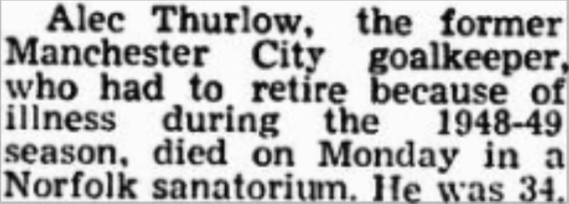
On this day (26 September) in 1946 goalkeeper Alec Thurlow signed for Manchester City with the hope that the young ‘keeper would be a permanent replacement for Frank Swift.  Sadly, Alec was forced to retire from the game in 1950 through tuberculosis. He went on to have major surgery with seven ribs removed.  He also had a collapsed lung.  Alec died in a sanatorium at the age of 34 in 1956. You can read more on Thurlow here:

Subscribe to get access

Read more of this content when you subscribe today. It costs £3 per month (cancel anytime) or you can sign up for a year at the discounted price of £20 (about £1.67 a month) per year. You get full access to all the interviews, books and other material already posted to the site.

If you enjoy all the free material on my website and would like to support my research and keep this website going (but don’t want to subscribe) then why not make a one-time donation (or buy me a coffee). All support for my research is valued and welcome. It allows me to keep some free material available for all. Thanks.

Choose an amount

£2.50
£5.00
£7.50

Or enter a custom amount

£

Your contribution is appreciated.

Donate

POSTPONED GAMES

The postponement of any game is rare. Obviously, the 2019-20 Covid hit season was different and in the days before undersoil heating icy conditions would often lead to postponements. However, Manchester City have suffered many postponements over the years. So for today’s feature I’m talking a look at some of them.

This is available to subscribers. Why not subscribe for a month and see what you think?

Subscribe to get access

Read more of this content when you subscribe today. It costs £3 per month or join up for a year at the discounted rate of £20. See link below for details.

More on the City-United 2009-10 postponed game here:

England at Maine Road

As we’re in a period of International football, I thought it would be worth remembering that there were four full internationals played at Maine Road. 

Each of these took place during a six year spell in the 1940s. 

FULL INTERNATIONALS AT MAINE ROAD

DateType of gameAgainstScoreScorersCrowdTeam
16 October 1943War
Interna-tional
ScotlandW 8-0Lawton (4), Hagan (2), Carter, Matthews60,000Swift, Scott, Hardwick, Britton, Cullis, Mercer, Matthews, Carter, Lawton, Hagan, Compton
24/4/46Burnden Park Disaster Fund MatchScotlandD 2-2Welsh (2)70,000Swift, Walton, Hardwick, Wright, Leuty, Mitchell, Matthews, Welsh, Lewis, Fielding, Mannion
13/11/46Home InternationalWalesW 3-0Mannion (2), Lawton59,121Swift, Scott, Hardwick, Wright, Franklin, Johnston, Finney, Carter, Lawton, Mannion, Langton
16/11/49Home International/ World Cup qualifiersN. IrelandW 9-2Rowley (4), Froggatt, Pearson (2), Mortensen (2)69,762Streten, Mozley, Aston, Watson, Franklin, Wright, Finney, Mortensen, Rowley, Pearson, Froggatt

In addition to these matches various other representative matches have been played at Maine Road.  These include the following inter-league games, under-21 fixtures and B Team games.

You can read more on the 8-0 victory over Scotland in 1943 here:

Manchester City 5-1 Newport County

On 16 June 1947 the Western Mail carried this match report of Manchester City’s 5-0 victory over Newport County, which was played on 14 June. The game was remarkable for a number of reasons:

  • Prior to the 2019-20 Covid affected season this was the club’s latest finish to a season. 2019-20 ended in August (Champions League) with the League campaign ending on July 26 2020. The 1946-47 season had been affected by snow and frozen pitches, causing many games to be postponed.
  • City played with only ten men for much of the second half due to an injury to Billy Walsh
  • The Blues won 5-1 with George Smith scoring all five goals. No player has ever scored more goals for the Blues in a League game (Sergio Aguero and Erling Haaland have scored 5 in the League of course – you can read about those elsewhere on this site). Denis Law did score 6 goals in a FA Cup tie v Luton but this was abandoned and wiped from the records.
  • Roy Clarke made his City debut and, as City were promoted, he became the first man to play 3 successive league games in 3 different divisions when he appeared in his next City game. He’d joined from Cardiff (Division 3); made his City debut in Division 2 then played in Division 1. Subscribers can read more about Roy Clarke here:
  • City had achieved promotion over a month earlier (May 10) when they defeated Burnley 1-0 in front of a Maine Road crowd of 69,463.
  • City were promoted as champions.