The entertainer Norman Wisdom was born on this day (4 feb) in 1915 so a good excuse to remember the day when he larked around on the Maine Rd pitch (and some claimed they thought it was Peter Reid). It’s always worth reminding ourselves of the days when he’d come out on to the pitch, fall over while taking a penalty and similar antics. Often supported by musician Rick Wakeman too! On one of the days in the 90many of us stood on the Kippax saw the elderly entertainer take to the field but didn’t recognise him at first. In fact many of us thought it was Peter Reid wearing a flat cap!
There were lots of odd prematch activities over the decades and you can read about them in this 2000 word article on the history of pre-match entertainment at Manchester City. There are mentions of the St Joseph’s Industrial School and Beswick Prize Bands, various DJs, athletic challenges, Norman Wisdom, Frank Sidebottom & more. Enjoy:
Subscribe to get access – Annual
Read more of this content when you subscribe today. It costs £20 a year (less than 6p a day) to access everything posted since the site went live in December 2020 (books, interviews, videos, history talks etc.) and throughout your period of subscription. Or you can subscribe a month at a time for £3 (cancel anytime; see below)
Monthly subscribers have access to everything posted since 1 October 2022 (books, interviews, videos, history talks etc.) and throughout your period of subscription. It costs £3 per month (cancel anytime)
Continuing the series on Manchester City in the 1920s today’s free article is about the City England international (in fact City’s first England international!) who became the manager of Milan in 1926. Here goes…
The first Manchester City player to appear for England was Herbert Burgess, who was reportedly born in Openshaw on 25 February 1883. Burgess was a left back but, according to articles at the time, was only 5ft 4.75 inches tall (weighing 11st 7lbs).
He made his first England appearance against Wales, and City teammate Billy Meredith, in February 1904 and did well in a game that ended 2-2 at Wrexham.
Prior to City Burgess had joined Football League side Glossop in March 1900 and, after three good years there, he moved to City on 30 July 1903. The fee City paid was £250. This was a period when Manchester’s Blues seemed to be cherry-picking the best Glossop had to offer and one report even suggested the nearby club was becoming a nursery club for City.
Burgess made three international appearances in 1904 with the Welsh game followed by a 3-1 victory over Ireland at Solitude, Belfast in March and a 1-0 win over Scotland at Parkhead, Glasgow on 9 April 1904. Only two weeks later Burgess helped City to FA Cup success (they became the first Manchester team to win a major trophy) and the Blues were also League runners up. These were great days for Burgess.
He made one further appearance for England – a 2-1 defeat at Hampden Park on 7 April 1906, played in front of 102,741 – and was furious that one of the Scotland goals was allowed to stand.
This period was a tough one for Burgess as the illegal payments scandal at City completely rocked his world. He was one of 17 players suspended by the FA (I can talk about this for days – it was so unfair and northern newspapers believed it was some sort of conspiracy by the southern based FA!).
Burgess was forced to leave City and, along with other star men, including Billy Meredith, he joined the then underdogs Manchester United and helped them achieve their first major success. He then moved to Denmark and played for Kristiania before joining Hungarian club MTK Budapest.
When his playing days came to an end he became Budapest’s manager and then managed Padova (1922-1926). He left Padova to become Milan’s manager in 1926 and after two years there he returned to Padova.
From 1930 to 1932 Burgess managed another Italian club, Roma. This photo is of Burgess (with cap on) as manager of AS Roma.
Burgess immediately etched his own name into the history of Roma, winning the first ever Rome derby in only his second game in charge. Roma won 1-0 win at Lazio’s Stadio della Rondinella. Burgess also guided Roma to success in the second derby, winning 3-1, the following May, this time at their all-wooden ground Campo Testaccio.
Burgess never lost a Rome derby during his time there as they drew their subsequent two derbies under him. His Roma team also pushed eventual champions Juventus all the way in the 1930-31 campaign, finishing just four points behind Juventus as runners-up.
Sadly, it’s been reported that Italy’s development under the dictatorship of Mussolino meant that English coaches were under pressure to leave and Burgess returned to Manchester, taking a job as a labourer on a housing estate on the outskirts of Manchester. He also became trainer to Ashton National.
He died in 1954.
In total at City he made 94 first team appearances and scored two goals. Had the illegal payments scandal not occurred he may well have been an England regular for several years. As it is his career is pretty impressive for a lad born in Openshaw in the 1880s – FA Cup & League winner; England international; manager of prominent clubs in Hungary and Italy.
People tend to think that it’s only in the modern era that Manchester City have achieved anything or that footballers have gone abroad to coach major clubs like Milan, Budapest and Roma, but the truth is that men like Burgess achieved so much over a century ago. We must take steps to remember them. Oh, and while I’m here it’s worth pointing out that City did have international players for years before Burgess but they didn’t play for England.
The earliest played to make an international appearance while on City’s books made an appearance for Wales in 1890 when the club was still Ardwick. Maybe I’ll write about him one day too?
Subscribe to get access
If you have enjoyed this piece and would like to support my writing while also accessing further great content, then why not subscribe? Those who subscribe on an annual basis get access to everything posted on this site since December 2020 (including PDFs of 2 out of print books, and audio interviews with John Bond, Malcolm Allison etc.). Those subscribing on a monthly basis get access to everything posted since 1 October 2022. It’s £20 a year (subscribe here) or £3 per month (subscribe below). Why not try it for a month?
If you have enjoyed this piece and would like to support my writing while also accessing further great content, then why not subscribe? Those who subscribe on an annual basis get access to everything posted on this site since December 2020. Those subscribing on a monthly basis get access to everything posted since 1 October 2022. It’s £20 a year (subscribe above) or £3 per month (subscribe here). Why not try it for a month?
I’ve posted this image of entertainer Norman Wisdom doing some prematch stuff at Maine Rd in the 90s before but it’s always worth reminding ourselves of the days when he’d come out on to the pitch, fall over while taking a penalty and similar antics. Often supported by musician Rick Wakeman too! On one of the days many of us stood on the Kippax saw the elderly entertainer take to the field but didn’t recognise him at first. In fact many of us thought it was Peter Reid wearing a flat cap!
There were lots of odd prematch activities over the decades and you can read about them in this 2000 word article on the history of pre-match entertainment at Manchester City. There are mentions of the St Joseph’s Industrial School and Beswick Prize Bands, various DJs, athletic challenges, Norman Wisdom, Frank Sidebottom & more. Enjoy:
Subscribe to get access – Annual
Read more of this content when you subscribe today. It costs £20 a year (less than 6p a day) to access everything posted since the site went live in December 2020 (books, interviews, videos, history talks etc.) and throughout your period of subscription. Or you can subscribe a month at a time for £3 (cancel anytime; see below)
Monthly subscribers have access to everything posted since 1 October 2022 (books, interviews, videos, history talks etc.) and throughout your period of subscription. It costs £3 per month (cancel anytime)
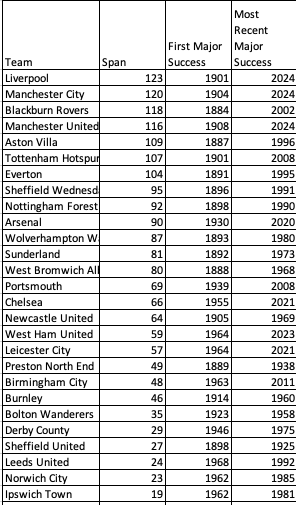
Congratulations Newcastle on defeating Liverpool in today’s League Cup final. The victory also means that 120 years separate their first major trophy success with their most recent. This span equals Manchester City. Every year, usually when the domestic season ends I update the table showing the span of success – i.e. the number of years between a club’s first major success (FA Cup, League, League Cup, major European trophy) and their most recent – for each major men’s trophy winning English club. I last did this after the 2023-24 season ended (see below). There wasn’t much difference between the 2023 final table and the 2024. Both Liverpool and Manchester City increased their span, as did United. Newcastle have leaped from 16th place (just behind Chelsea) to joint second with City. Here’s the table as it stood before today’s game:
As I always say, the span of success does not show how many trophies each club has won or how frequently that club has experienced great eras of success, but it does demonstrate how wrong those people are who believe certain clubs were unsuccessful until recent years, or those who think certain clubs have always been giants. The column on first major success helps to show when some clubs first became trophy-winning significant (often after transformational investment too!).
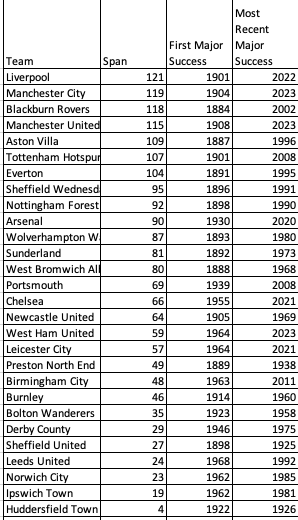
There’s not much difference between 2023 and 2024 – numbers have changed but not positions. In 2023 West Ham, like potentially Newcastle this year, proved that if you’re a club that hasn’t won a major trophy for a while putting your focus on achieving trophy success ahead of the odd Premier League position can bring significant reward. In future decades no one will remember who finished seventh, tenth or fifteenth but they will remember the trophies. Here’s the previous year’s table for comparison purposes:
I know clubs focus on their financials but winning a trophy has longevity, gaining the odd Premier League place provides a bit of extra cash now but no long term kudos. Winning a trophy attracts new fans and brings money-spinning opportunities too.
If I was a supporter of any of the major clubs who have not found significant success in recent decades then I would absolutely want my team to go for whichever cup competition seems the most likely to win. That’s what I always wanted from City before they were able to compete for the League again. Winning the FA Cup in 2011 helped everything that followed happen – it gave confidence and a trophy winning mentality.
While you’re here why not take a look at the wide range of articles available on this site? Such as the 100 day series of features on Maine Road:
If you enjoy all the free material on my website and would like to support my research and keep this website going (but don’t want to subscribe) then why not make a one-time donation (or buy me a coffee). All support for my research is valued and welcome. It allows me to keep some free material available for all. Thanks.
Every year, once the domestic season ends I update the table showing the English clubs’ span of success – i.e. the number of years between a club’s first major success (FA Cup, League, League Cup, major European trophy) and their most recent. I last did this after the 2023-24 season ended (see below). There wasn’t much difference between the 2023 final table and the 2024. Both Liverpool and Manchester City increased their span, as did United. Next month there’s a chance Newcastle can leap from 16th place (just behind Chelsea) to joint second with City. Here’s the table as it stands at present:
As I always say, the span of success does not show how many trophies each club has won or how frequently that club has experienced great eras of success, but it does demonstrate how wrong those people are who believe certain clubs were unsuccessful until recent years, or those who think certain clubs have always been giants. The column on first major success helps to show when some clubs first became trophy-winning significant (often after transformational investment too!).
There’s not much difference between 2023 and 2024 – numbers have changed but not positions. In 2023 West Ham, like potentially Newcastle this year, proved that if you’re a club that hasn’t won a major trophy for a while putting your focus on achieving trophy success ahead of the odd Premier League position can bring significant reward. In future decades no one will remember who finished seventh, tenth or fifteenth but they will remember the trophies. Here’s the previous year’s table for comparison purposes:
I know clubs focus on their financials but winning a trophy has longevity, gaining the odd Premier League place provides a bit of extra cash now but no long term kudos. Winning a trophy attracts new fans and brings money-spinning opportunities too.
If I was a supporter of any of the major clubs who have not found significant success in recent decades then I would absolutely want my team to go for whichever cup competition seems the most likely to win. That’s what I always wanted from City before they were able to compete for the League again. Winning the FA Cup in 2011 helped everything that followed happen – it gave confidence and a trophy winning mentality.
While you’re here why not take a look at the wide range of articles available on this site? Such as the 100 day series of features on Maine Road:
If you enjoy all the free material on my website and would like to support my research and keep this website going (but don’t want to subscribe) then why not make a one-time donation (or buy me a coffee). All support for my research is valued and welcome. It allows me to keep some free material available for all. Thanks.
150 years ago today on 30 July 1874 Billy Meredith was born. Billy was the captain when Manchester City brought Manchester their first major trophy, the FA Cup in 1904. He was also the goal scorer and a major hero to City fans. He later helped United achieve their first successes but returned to City for a final flourish.
His last game for City was 100 years ago this year! You can read about that and many other Meredith related stories across this website. Here’s a link to sone of them:
Continuing the series of features on Manchester City in the early 1900s! Today it’s a 9400 (yes that’s right!) word article telling the story of 1903-04 when Manchester won its first major trophy. If you’re a subscriber you’ll need to get a brew before reading this celebration of that season. If you’re not a subscriber then why not?
Ever wondered how Manchester found its first major trophy success or what the scandal that rocked City was all about? Then subscribe and read this series of articles.
Subscribe to get access
Read more of this content when you subscribe today. It costs £3 per month (cancel anytime) or sign up a year at a time for the discounted annual fee of £20. This gives access to everything on the site, including PDFs of 3 of my books and various other articles, interviews and audio material. Each subscriber has access to all content posted during their subscription period too. Why not sign up for a month and see what you think?
A new series of features starts tomorrow. This series provides a season by season account of Manchester City FC in the early 1900s. Some are 2000+ word articles, others are a bit less, but each adds to the story of how the club evolved. So, if you’ve ever wondered how Manchester found its first major success or wondered about the scandal that rocked the club, here’s your chance to find out. This series covers 1900-1910.
Watch this space tomorrow for details.
Match programme for 29 September 1900. Manchester City v Stoke
So far I’ve told you about Bert Trautmann, Tony Book, Glyn Pardoe, Vincent Kompany and İlkay Gündoğan in my all-time best Manchester City FA Cup final winning team and today it’s the time for another couple of names.
I was asked to select an all-time City eleven and had two rules – they had to actually play in a winning final (so, unused substitutes were not allowed) and they could not be a member of the current playing squad. I also tried to focus on the fact that this eleven would also be facing an all time Manchester United eleven. Therefore victories over United in key games were always in the back of my mind.
The next two players selected are:
David Silva (2010-2020)
This World Cup winner joined City in 2010 and immediately impressed. ‘El Mago’ (the magician) was a member of both the 2011 and 2019 FA Cup successes, but was also the star man time and time again as the Blues won eleven major trophies in his decade.
Billy Meredith (1894-1906 & 1921-1924)
A Welsh international and Manchester’s first superstar who was idolised by both Blues and Reds. Captain and goalscorer in City’s first FA Cup success in 1904. This talented right-winger narrowly pipped 60s & 70s legend Mike Summerbee to this spot. Imagine either man playing in a side managed by Pep!
Meredith is the earliest name in my list and you can read more about 1904 here:
More on the all-time Manchester City FA Cup winning eleven tomorrow. It was a tough selection and over the next few days I’ll post the rest of the starting eleven.
You can read about the significance of 2011 in this feature here:
As usual, once the domestic season ends I update the table showing the English clubs’ span of success – i.e. the number of years between a club’s first major success (FA Cup, League, League Cup, European trophy) and their most recent. There’s actually not much difference between last year’s final table and this:
Okay, the span of success does not show how many trophies each club has won or how frequently that club has experienced great eras of success, but it does demonstrate how wrong those people are who believe certain clubs were unsuccessful until recent years, or those who think certain clubs have always been giants. The column on first major success helps to show when some clubs first became trophy-winning significant (often after transformational investment too!).
There’s not much difference between 2023 and 2024 – numbers have changed but not positions. In 2023 West Ham proved that if you’re a club that hasn’t won a major trophy for a while putting your focus on achieving trophy success ahead of the odd Premier League position can bring significant reward. In future decades no one will remember who finished seventh, tenth or fifteenth but they will remember the trophies. Here’s last year’s table for comparison purposes:
I know clubs focus on their financials but winning a trophy has longevity, gaining the odd Premier League place provides a bit of extra cash now but no long term kudos. Winning a trophy attracts new fans and brings money-spinning opportunities too.
If I was a supporter of any of the major clubs who have not found significant success in recent decades then I would absolutely want my team to go for whichever cup competition seems the most likely to win. That’s what I always wanted from City before they were able to compete for the League again. Winning the FA Cup in 2011 helped everything that followed happen – it gave confidence and a trophy winning mentality.
While you’re here why not take a look at the wide range of articles available on this site? Such as last summer’s 100 day series of features on Maine Road:





 Gary James' Football Archive