Here’s the Official Programme cover and Manchester City comments (below), published on 27 October 1900 for City’s game with Derby at Hyde Road. Back then the programme was a shared one with Second Division Newton Heath (later United) and a couple of rugby clubs. the comments below on City’s performances and preview of the Derby game are interesting. The 3-0 game it opens with was City’s 3-0 Division One defeat at Sunderland. The Monday game it mentions was a 2-0 victory over Newton Heath in the Lancashire Cup.
The ‘Doctor’ mentioned lower down was City half back William ‘Doc’ Holmes. The preview suggested this would be a tough game for City, though the return of Jimmy Ross was welcomed. Ross, a former Preston Invincible, was a key member of the side and he’d been sidelined for the previous six League games.
The match with Derby ended in a 2-0 victory with both goals scored by Fred Williams. If you’d like to find out more on this season for Manchester City then why not read the following 1200+ word article telling the story of 1900-01? Why not subscribe and read this and all the other content on here? You can even try it for a month at a time if that works best?
Subscribe to get access
Read more of this content when you subscribe today. It costs £3 per month (cancel anytime) or sign up a year at a time for the discounted annual fee of £20. This gives access to everything on the site, including PDFs of 3 of my books and various other articles, interviews and audio material. Each subscriber has access to all content posted during their subscription period too. Why not sign up for a month and see what you think?
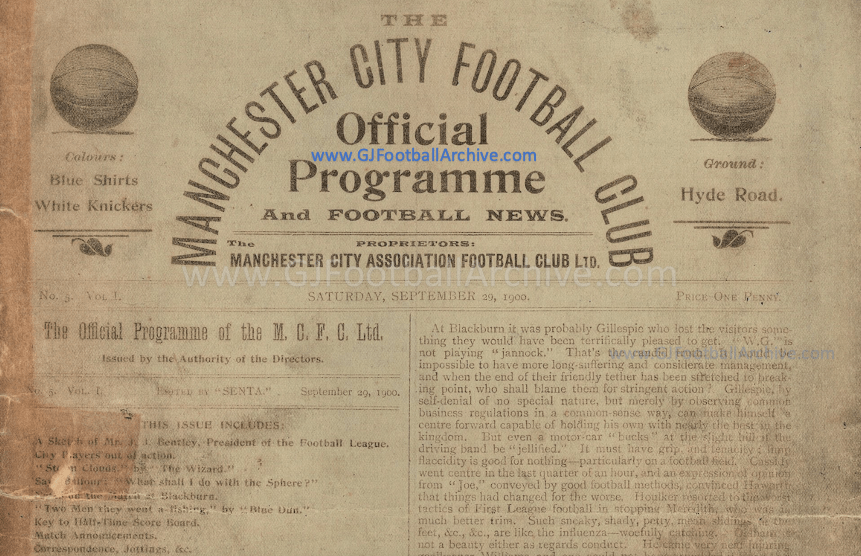
Always a controversial question but back in the early 1900s there was only ever one answer and that was Manchester City who were often referred to as simply ‘Manchester’ in official publications for both City and their Manchester rivals. Here’s an image of the title section of the official programme which directly references ‘Manchester’ (meaning City) and Newton Heath.
Obviously, as there was no Manchester United then I guess it was inevitable that City would be known as Manchester to some. It just surprises me that an official publication for both clubs would use ‘Manchester’ so regularly. Presumably both clubs were happy with this. So if anyone asks ‘which club is Manchester? then the one both were happy to call Manchester must be in with a big shout!
On another topic… notice the opportunity to have your flask filled up at City’s headquarters, the Hyde Road Hotel, before the match? Imagine if that option was brought back at the Etihad!
The series of features on the 1900s continues today with a simple look at the average attendances of league clubs. I’m publishing the statistics here for season 1900-1901 when Manchester City finished 11th in the First Division (top tier). There were 18 clubs in the division that season. Despite this relatively low position, City were the second best supported club – the highest position either Manchester team had enjoyed up to that point. League champions Liverpool were the 5th best supported club. Newton Heath (MUFC) were still a Second Division club and were 22nd best supported team.
All these figures are estimated based on newspaper reports of the period but are widely accepted as a good indication of support enjoyed at each club.
Match programme for 29 September 1900. Manchester City v Stoke
In the following table every team is in Division One unless (2) appears after their name. This indicates they were a Second Division club that season. Where two teams have the same average then these have been listed in alphabetic order.
1900-1901 Average Attendances
Average
Team
18700
Aston Villa
18300
Manchester City
16225
Everton
15800
Newcastle
15000
Liverpool
13600
Sheff Utd
11525
Sunderland
10575
WBA
10175
Bolton
9950
Sheff Wed
9450
Notts County
9350
Nottm Forest
8375
Middlesbrough (2)
8050
Derby
6950
Bury
6850
Stoke
6575
Blackburn
6325
Preston
5900
Small Heath (2)
5900
Woolwich Arsenal (2)
5850
Wolves
5475
Newton Heath (2)
4975
Leicester Fosse (2)
4625
Grimsby (2)
3725
Stockport (2)
3575
Lincoln (2)
3125
Walsall (2)
3100
Burnley (2)
2850
Barnsley (2)
2825
Chesterfield (2)
2800
Glossop (2)
2675
New Brighton Tower (2)
2375
Burton Swifts (2)
2075
Burslem Port Vale (2)
2050
Gainsborough Trinity (2)
1850
Blackpool (2)
This series of features covers the final years of Ardwick, the birth of Manchester City and the Club’s first national success. Why not subscribe and read every feature?
Continuing the series of features on Manchester City in the early 1900s! Today it’s a 1200+ word article telling the story of 1900-01.
Ever wondered how Manchester found its first major trophy success or what the scandal that rocked City was all about?
Subscribe to get access
Read more of this content when you subscribe today. It costs £3 per month (cancel anytime) or sign up a year at a time for the discounted annual fee of £20. This gives access to everything on the site, including PDFs of 3 of my books and various other articles, interviews and audio material. Each subscriber has access to all content posted during their subscription period too. Why not sign up for a month and see what you think?
A new series of features starts tomorrow. This series provides a season by season account of Manchester City FC in the early 1900s. Some are 2000+ word articles, others are a bit less, but each adds to the story of how the club evolved. So, if you’ve ever wondered how Manchester found its first major success or wondered about the scandal that rocked the club, here’s your chance to find out. This series covers 1900-1910.
Watch this space tomorrow for details.
Match programme for 29 September 1900. Manchester City v Stoke
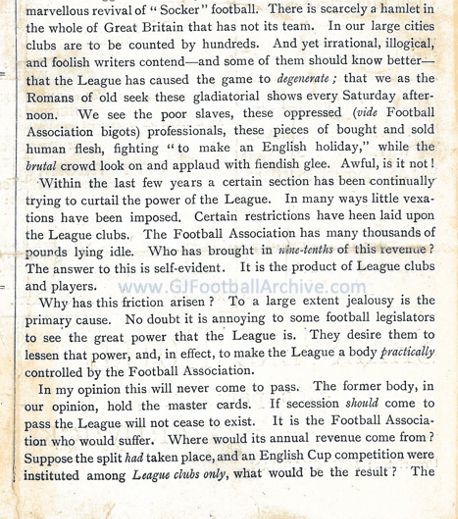
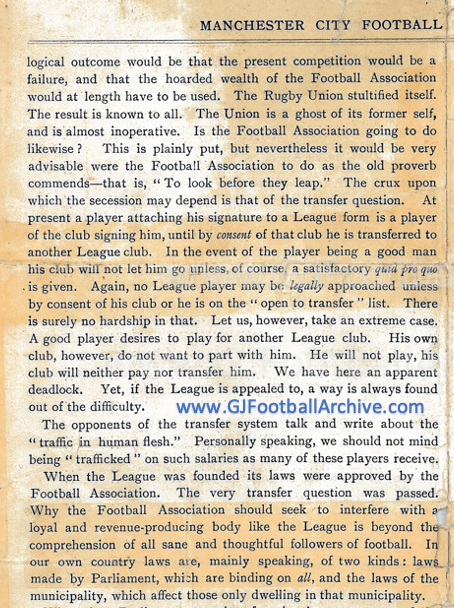
This is an interesting article. It’s an article written by a Manchester City official challenging the authority/interference of the FA and basically saying that the FA is antiquated and governs football poorly. This is well worth reading in its entirety. It was written in 1900 and I can’t help thinking that this may have added to the negativity in which City was viewed by FA officials at the time. In the years that followed, of course, the FA took every opportunity possible to challenge and investigate City even when other, FA favoured, clubs were guilty themselves.
I guess there are parallels with today. I won’t go into detail but have a read of it all and see what you think. This criticism was published in the MCFC match programme and therefore was the official word of the club at the time. No wonder the FA wanted to curb City’s development!
Here’s a team photo of Manchester City, taken at Hyde Road, in 1900. It’s a typical squad pose in front of the old Hyde Road main stand which was destroyed by fire twenty years later. Notice the way the wooden wall of the stand was painted in City blue and white. People often talk about Hyde Road as if it was this dull, dismal ground but the stand here had only been erected a few years earlier and Joshua Parlby, Lawrence Furniss and the others behind the club made sure it was frequently painted blue and white (plus green) wherever possible.
Over the following twenty years City continued to invest in the ground but the site restricted the club’s growth and 40,000 crowds could not be accommodated particularly well. Often gates would be closed some way off capacity under the orders of the local police who tried to keep crowds back. Bennett Street and even Hyde Road itself were often overcrowded with fans hoping to get in.
There’s lots more on here about Hyde Road and City’s other grounds. Do a few searches and see what you find. Some is only for subscribers but much is available freely. It takes a lot of time, effort and money to research Manchester’s football history so if you want to support this work and get something back then please subscribe. Thanks.
If you enjoy all the free material on my website and would like to support my research and keep this website going (but don’t want to subscribe) then why not make a one-time donation (or buy me a coffee). All support for my research is valued and welcome. It allows me to keep some free material available for all. Thanks.
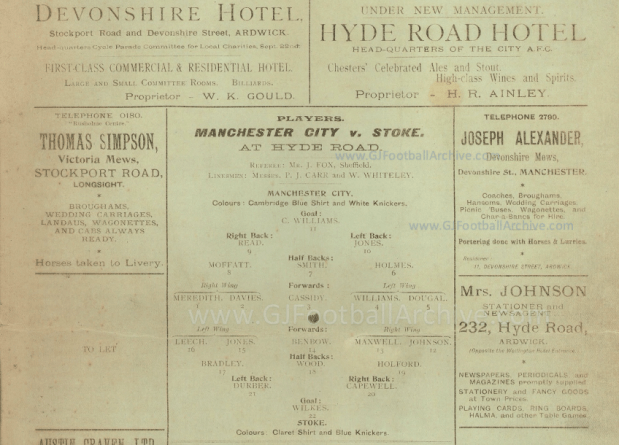
Recently I’ve been contacted by someone who had in their possession a couple of Manchester City match programmes from 123 years ago. These were from the first season the club did its own official match programme (there was an earlier joint effort between 2 rugby and 2 football clubs that was described as official from the 1890s – see below – but 1900-01 was the first for MCFC on their own). He sent me scans of them and one programme was produced for a match played on this day (29 September) in 1900. Here are some images and details from it.
This was a special game for City, though the programme was not produced because it was a special game. This was the fifth issue of the season and contained eight pages, like the others. The significance of the game however was that Arthur Balfour MP was a visitor that day. Balfour would become Prime Minister in 1902 and was still in that role when City won the FA Cup for the first time in 1904 (he wore a City rosette at the final!).
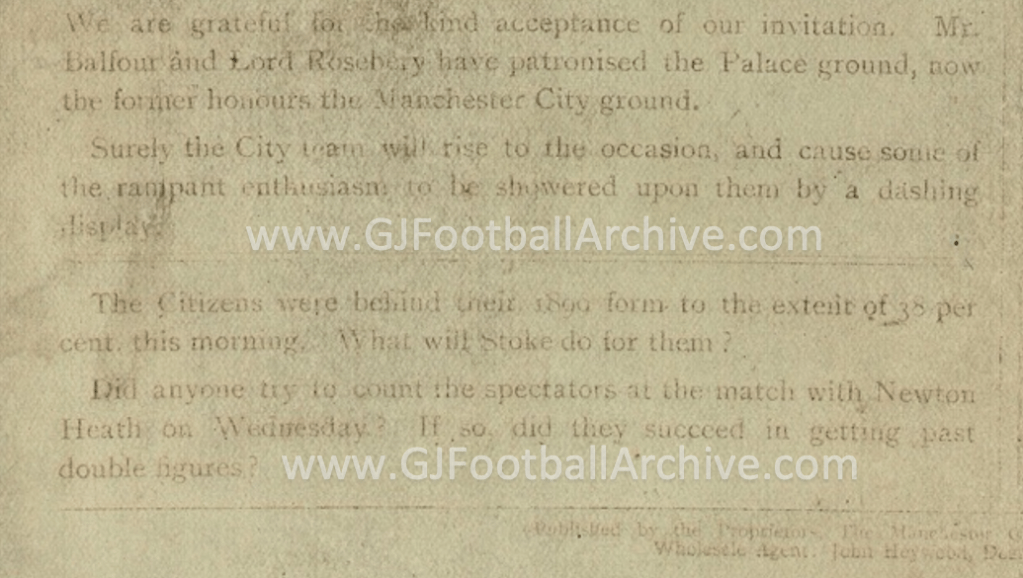
The back page talks about Balfour’s visit. Both the front and the back pages are quite difficult to read as they’ve faded. It is interesting that the club felt able to make light of Balfour’s lack of enthusiasm for ‘socker’ (yes, socker or soccer as we grew to call it, was an English word for association football before the Americans became recognised for their use of it). Balfour preferred golf (after the 1904 FA Cup final he called himself a football ‘ignoramous’. Bob Hulmes, who sent the programme scans to me, managed to transcribe the wording regarding Balfour:
Says Balfour: “What shall I do with the sphere?”
We have specially desired fine weather today as the Right Hon. Arthur James Balfour is due to make his first appearance on the Hyde Road Football enclosure this afternoon. Some little decoration will be made, for the most pleasing sight to the hon. gentleman will be a mighty crowd of enthusiastic well wishers. It is not often that we have a leader of the nation at such functions, and the occasion is historic as far as Manchester is concerned. No doubt our honoured guest wishes he had the opportunity to open a game of golf instead of socker but we are ready to excuse a “miskick” on this occasion. We are grateful for kind acceptance of our invitation. Mr Balfour and Lord Rosebery have patronised the Palace ground, now the former honours the Manchester City ground.
Surely the City Team will rise to the occasion and cause some of the rampant enthusiasm to be showered upon them by a dashing display.
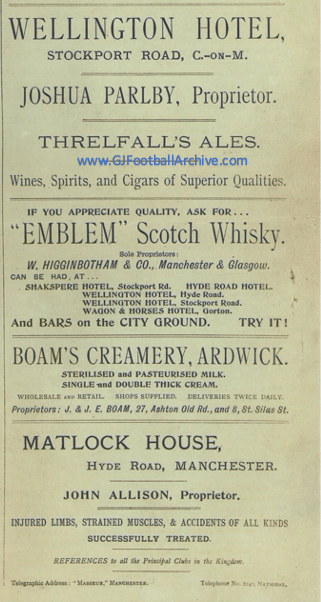
It’s worth noting some of the advertisements. There’s one for Joseph Alexander’s coaches and carriages (the Alexander family business. Note: The Alexanders remained key members of City’s management/directorship/shareholding for most of the 120 years that followed!). There’s also the Wellington Hotel, Stockport Road, which was run by the ever popular City official Joshua Parlby, and the Matlock House Hydro – one of City director John Allison’s business.
The game was against Stoke and they are wearing their then home colours of ‘claret shirts and blue knickers’.
Bob also nudged me towards page 8 which included a wry comment about the previous Wednesday’s friendly at Newton Heath (United):
Did anyone try to count the spectators at the match with Newton Heath on Wednesday? If so, did they succeed in getting past double figures?
The official attendance was estimated by Newton Heath as 600 (I wonder if they had a mickey-take name along the lines of Emptyhad for United’s games at Bank Street?
Before the 1900-01 season there was an official match programme produced for both Newton Heath and Manchester City, alongside a couple of rugby clubs. It was first ‘mocked up’ in May 1898 but went into production for the 1898-1899 season. It continued into the 1900-01 season by which time City were producing their own official programme. Both programmes were in competition throughout that 1900-01 season.
From 9 May 1898 the first Manchester football programme was a mock up based on Everton Liverpool programme
Thanks to Bob Hulmes for allowing me to us images of his match programme. The programme belonged to Bob’s grandfather. He lived in Ardwick, near Hyde Road, and he followed City until his death in 1964. Bob found two programmes from 1900 lining a drawer when his grandfather died in 1964, which shows exactly how rare these images are. It’s a pure fluke in many ways that they survived and fortunately the family looked after them over the decades.
Continuing the weekly series of ‘True Blue’ figures associated with the early years of Manchester City, here’s an article on the City chairman John Chapman who died in office. You can find out why this man was such an important figure in Manchester City history below:
Subscribe to get access – Annual
Read more of this content when you subscribe today. Annual subscribers can access all the articles, talks, books and interviews posted since December 2020 for an annual subscription of £20 (works out about £1.67 per month). There’s also a monthly subscription (see below).
Monthly subscribers can access all the articles, talks, books and interviews posted since 1 October 2022 for a monthly subscription of £3 (cancel any time).
Continuing the weekly series of ‘True Blue’ figures associated with the early years of Manchester City, here’s an article on Billy Meredith who was the captain and goalscorer for Manchester’s first major trophy success. You can find out why this man was such an important figure in Manchester City history below:
Subscribe to get access – Annual
Read more of this content when you subscribe today. Annual subscribers can access all the articles, talks, books and interviews posted since December 2020 for an annual subscription of £20 (works out about £1.67 per month). There’s also a monthly subscription (see below).
Monthly subscribers can access all the articles, talks, books and interviews posted since 1 October 2022 for a monthly subscription of £3 (cancel any time).





 Gary James' Football Archive