On this day (11 March) in 1980 Kevin Reeves became the fourth player to be transferred for a million pounds or more (Manchester City had been responsible for 50% of those) when he signed for City. I have interviewed many of the people involved in that deal and you can read quotes from some of those involved (Reeves, Allison & Steve Daley) in my article.
Subscribe to get access – Annual
Read more of this content when you subscribe today. It costs £20 a year or £3 per month (see below). Annual subscribers get full access to everything on the site.
Read more of this content when you subscribe today. It costs £20 a year (above) or £3 per month. Monthly subscribers get full access to everything posted on the site since 1 October 2022.
On this day (10 March) in 1971 a crowd reported as 100,000 witnessed a 2-0 Manchester City defeat by Gornik in the ECWC quarter final first leg. The story of that game and the rest of the tie is available below (with video clips) for subscribers to this site.
Subscribe to access all the site – Annual
If you would like to read this and all the in-depth articles on this site (including the entire Manchester A Football History book, talks, articles, interviews etc.) then please subscribe. It works out about £1.67 a month if you take out an annual subscription (£20 per year) or £3 a month if you’d like to sign up for a month at a time (see below). Annual subscribers gets full access to everything posted so far and the hundreds scheduled to be posted in the coming year.
If you would like to read this and more then please subscribe. It costs £3 a month if you’d like to sign up for a month at a time. Monthly subscribers get full access to everything posted since 1 October 2022 and everything to be posted throughout their subscription. Cancel any time.
On this day (9 March) in 1904 Manchester City took a major step forward in their quest for their first major trophy when they won 3-1 at Middlesbrough in the FAC quarter-final replay. The goalscorers were Billy Gillespie, George Livingstone and Sandy Turnbull.
Subscribers can read all about Tom Maley, City’s manager at the time, here:
As promised, here for subscribers is my presentation on Joshua Parlby and the launch of Manchester City FC. It lasts about 58 minutes and was recorded on 1 March 2023. There are lots of myths out there, but I focused on the facts and my latest research.
The presentation is all about the visionary who promoted a new club to represent Manchester, Manchester City and about the steps taken in 1894. This talk is now only available to subscribers (see below for details of how to subscribe).
Subscribers can also see the previous history talk on St Mark’s and City’s development in the Gorton area during the 1870s and 1880s below.
Subscribe to get access – Annual
Annual subscribers get access to everything posted since December 2020 (interviews, history talks, articles, PDFs of books etc.) and everything to be posted during your subscription. It costs £20 a year (about 5p a day).
Monthly subscribers get access to everything posted since 1 October 2022 and everything to be posted during your subscription. It costs £3 a month (cancel any time).
If you enjoy all the free material on my website and would like to support my research and keep this website going (but don’t want to subscribe) then why not make a one-time donation (or buy me a coffee). All support for my research is valued and welcome. It allows me to keep some free material available for all. Thanks.
Earlier this week the former Manchester City and England international Mike Summerbee was presented with an OBE by Prince William. This is excellent and well deserved news. Mike’s a great ambassador for football, City and Manchester (OBE & Windsor photos from Manchester City).
Mike Summerbee receiving his OBE from Prince William March 2023
It seems appropriate to include here an interview I did with Mike several years ago. I’ve interviewed him often over the years and this one was a general piece, performed in April 2005. It was for the Manchester City match programme and we started by talking about one of his favourite topics ‘Escape to Victory’. Here is that interview as written up at the time. Enjoy!
Mike Summerbee was the second player, after Ralph Brand to join Joe Mercer’s City in 1965. Over the following decade he became a major star and played a significant role throughout the Mercer-Allison glory years. Always the entertainer, Mike featured in the classic footballing wartime adventure film “Escape To Victory” and today assists the Club’s commercial activities. In April 2005 Gary James caught up with him at the Manchester City Experience.
Let’s start with “Escape To Victory”. How did you get involved in the filming of that movie?
It was Bobby Moore who got me involved. We’d known each other since I was 16, and we both had a similar outlook. The makers of the film had got several Ipswich Town players involved, plus Pele and of course Bobby. They needed another familiar British player and Bobby suggested me. He called me and said: “How do you fancy being in a movie with Michael Caine?” And that was it. Within three weeks I was on my way to Budapest for filming. I had no idea at the time that this would become one of those films still being shown and talked about twenty odd years later, but it has become a cult movie with websites dedicated to it. It’s the sort of film that many other people would have wanted to be in. I know for a fact that Rod Stewart wanted to be in it.
Why do you think the film is remembered so affectionately?
I don’t want to give too much away – everyone should come to our special showing and see the movie and hear my reasons then – but the film is like a Boys’ Own adventure. It’s got drama, excitement, and is a traditional film. It doesn’t rely on bad language, sex, or extreme violence, and it really does appeal to everyone. Don’t forget it also contains some great actors – everyone remembers Stallone and Caine but look at the other cast members as well – and then there are some very well known footballers including Pele.
I loved making the film and one of the great aspects for me was that when we came to the football scenes we were told to go out and play the game. John Huston – a great director – wanted it to look as realistic as possible and so we played a real game. Inevitably we had spells concentrating on tackling or shooting but much of the game came from real play. Pele’s wonderful overhead kick goal was natural and was done only once. We didn’t take ages setting up, re-shooting etc. It was done for real and only in one take. John Huston had cameras everywhere and tried to make sure everything that took place on the pitch was filmed from every angle. That makes it so much more real.
You have a speaking part in the film, did you know about that before you accepted?
We were told to let the actors act and they were told to let the footballers play. That way we all did what we were good at. Then when it came to the dressing room scenes Michael Caine said to Huston that it didn’t feel right for only the actors to talk and he said that a couple of us should speak. When it came to half time, I congratulated a couple of players on their play – that was natural not planned – and that stayed in, and then other lines were given to us. It felt strange, but when you watch the film it makes much more sense to have us speaking. I loved making the film and there are so many different aspects to talk about, but we’ll save that for the 5th May event.
Moving back to your playing career, we all know that you came from a footballing family, but did that mean it was something you had to do?
My dad played professionally and so from an early age it seemed natural to play. All boys loved playing back then anyway, so there was nothing strange about that, but I suppose when you are young whatever your father does has a greater importance. My brother was a better player than I, although he stopped playing when my Dad died, and we used to play whenever and wherever we could. I’d get to school as early as possible – not for the lessons, I was a dunce! – but for the kickabout. We’d have a tennis ball and play until we had to go in. I also played cricket, athletics and other sports, but football was my best.
Your progression into professional football seems rapid – you were a key feature of the Swindon team in your teens – were there any setbacks?
I’d had a spell at Bristol City when I was 15, but I was so homesick I had to give up on it. My mother worried about me and suggested I kept out of the game. She knew about the problems and difficulties a footballer could have because of my father’s career, and then the opportunity came with Swindon and everything started going right for me. I joined them at a time when they were ready to give youth a chance and I made my debut at 17.
Was life relatively easy for you then?
The life of a footballer was not as glamorous or financially rewarding as it is today. I loved playing and I loved the camaraderie of it all, but we all had to have other jobs to keep us going outside of the season. I used to end up working for the Corporation cutting grass, painting, oddjobs, and digging graves! It kept you in touch with the fans – both the living and the dead! – and I actually loved all of that time. We didn’t have flash cars or anything then. In fact Ernie Hunt and I had a tandem, and we used to cycle together on our tandem to the ground. It was a great, fun time, and I have very fond memories of it all.
One of the significant angles is that Joe Mercer was interested in signing you from fairly early in your career, were you aware of his interest?
To some extent yes. Joe had played with my father at Aldershot, and then Swindon played Joe’s Aston Villa in a testimonial game. We won and I scored a couple, and Joe even played wing-half for Villa. After that I was told he wanted to sign me for Villa and that he’d made a bid but nothing further happened. I don’t know if it was problems at Villa or what but some time after that Joe moved on, and then in 1965 he got the City job. I was in Torquay and I gave him a call – I thought it was time to make the move and chance my arm a little. Joe said he’d be in touch. Then serious interest came from City and I was off.
Did City mean much to you as a boy?
Because of where I lived I’d travel to Birmingham to watch games and whenever City played Villa I used to enjoy seeing Bobby Johnstone, Ken Barnes, Bert Trautmann and the rest. They were such a great and in many ways glamorous side to watch, and the pale blue shirt – a colour I still don’t believe we’ve managed to recreate properly – was so memorable. No other side could match that colour and City were unique. All of those great memories were in my head and I was desperate to play for City when Joe came here. Although they were in Division Two when I arrived they were a major, major side with a great stadium. I loved Swindon, but City were something else.
Everyone talks about the atmosphere around the place, how did you find it?
Joe lifted the spirits of everybody, that was clear, and Malcolm Allison was so ahead of his time and knew all about psychology. He knew what players needed, and he always knew the best way of getting more out of me was by winding me up. I think I was a consistent player, and at half time in one game we’d had a bit of a bad spell. I’d played well, but one or two players had struggled and we all knew it, but in the dressing room Mal went up to the two players and told them they were doing well and that they just had to keep plugging away. He was boosting their confidence I guess and they certainly were more confident in the second half. When he came to me he said I was playing the worst game ever and that I was letting everybody down! It wound me up so much I had a go back at him, and then when we got on the pitch I pushed and fought for everything to prove how wrong he was and I gave 120% – his trick had worked!
During your first year at City (1965-66) England manager Alf Ramsey came to watch you play, and eventually you became the first City man since Don Revie in 1956 to play for England. Were you aware of the attention?
When Ramsey came to watch me the attention was good and, considering Alf concentrated on his ‘wingless wonders’, it was great for me a winger to be considered. I’d been included in the squad from almost immediately after the World Cup win, then I made my England debut against Scotland at Hampden (February 1968) in front of about 150,000, alongside the likes of Moore & Charlton. I was very nervous but they helped to calm me and at half time both Bobbys told me I was doing well, so that helped. In the end every one of my England appearances came at centre-forward, so I guess the style of play limited my opportunities, but I loved playing for England.
What was Alf Ramsey like as a manager?
He was definitely a ‘player’s manager’. He handled us well, and I believe that he was, in the end, treated appallingly be the FA. He treated us exceptionally well and he was a great man to play for – I don’t believe that England have ever managed to find a permanent manager who can match him. He had the same sort of authority as Joe Mercer, but they were different characters. Joe was wonderful with the media and the public, while Alf was primarily a players’ man. There was one time, we’d lost 2-0 at Katowice (1973) and I’d been on the bench. We were pretty down. Alf knew how low we were but because we were playing in Moscow a couple of days later he told everybody to get to bed early, no drinking or anything.
We all sneaked into Bobby Moore’s room and had a few gins. Sir Alf caught us and we thought he was going to have a go. He said: “I thought I’d told you not to drink! But in the circumstances I’ll have a large gin and tonic please.”
Throughout the Sixties and Seventies, City never seemed to fear any opposition, is that something that came from the players?
Obviously, Joe and Malcolm bred a certain atmosphere which boosted confidence. Whenever we played United we’d get to Trafford at 12.30 simply to soak up the atmosphere and to be ready. Mal would swagger to the Stretford End before the game to tell them how many we’d win by, and we’d go out there and match his score, although we used to encourage him to keep the expectation down a little! For us it didn’t matter whether we played Shankly’s Liverpool, Busby’s United, or any other team because we knew we were more than a match for any of them. Some of these teams possessed better individual players but, particularly at Old Trafford, we were always the better side. We had a great team spirit. People always talk about Lee, Bell and Summerbee like Charlton, Law and Best, but our side wasn’t about three players, it was about the whole team. Oakes, Pardoe, Young…. You know all the players. Unfortunately the 3 player line is a good one for the media to focus on, but for the players it was always about the team. I always think it’s wrong to talk about Lee, Bell, & Summerbee. We were part of a great, strong side and, although the 3 of us were well known, we needed that entire side to bring City success.
Finally, you’ve always been known as an entertainer, and always had a great rapport with fans and the media, presumably this is a very important aspect to your life?
As a player I used to meet the fans as often as possible – we all would. We’d have lunch in the old Social Club all mixed together, we’d attend supporters & Junior Blues meetings; take part in the pantomime every year; and generally be out and about. We also used to get on well with the media. The journalists were always good honest judges back then – people like Frank McGhee and Richard Bott always talked truthfully about your performance. If they said I’d had a bad game, I knew I had. They weren’t out to knock you, or to build you up. They spoke honestly and so I enjoyed talking with them.
For me football is entertainment and the game itself is sometimes less important than everything that surrounds it. I don’t miss playing, but I do miss the camaraderie we had. I miss the team spirit we had with City, England, and even during the filming of Escape To Victory. It’s the same camaraderie fans feel on the terraces. That’s why I enjoy my involvement with the Club today because it’s all about the fans, the City spirit, and the wonderful life that surrounds the game.
If you enjoy all the free material on my website and would like to support my research and keep this website going (but don’t want to subscribe) then why not make a one-time donation (or buy me a coffee). All support for my research is valued and welcome. It allows me to keep some free material available for all. Thanks.
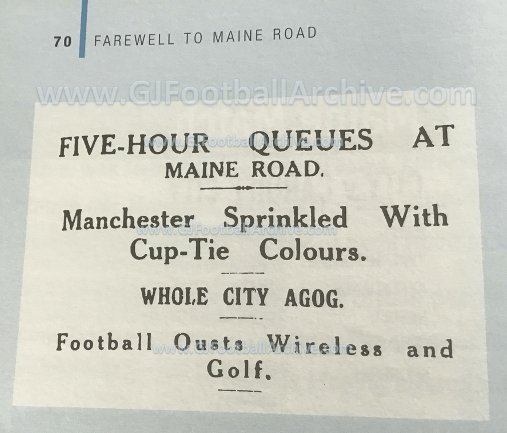
A record Manchester City have held for 99 years was set on this day (8 March) in 1924 – the record is the highest attendance on a club ground! Happy anniversary! The record set in 1924 saw 76,166 attend City v Cardiff. City had moved to their new Maine Road stadium in August 1923. The capacity of the venue was estimated at around 90,000 but was actually approximately 83,000 when the stadium opened (it was enlarged in 1931 and 1935).
In its first season the capacity was tested and, on this day (8 March) in 1924 the largest attendance for any footballing fixture (including three FA Cup Finals) in Manchester gathered to watch the Blues. This was also, at the time, the record crowd for any game played on an English club ground. It was beaten ten years later when 84,569 watched City v Stoke. You can read about the remarkable day in 1924 below:
Subscribe to get access
Read more of this content when you subscribe today. It costs £20 a year (access to everything) or £3 per month (see below).
Read more of this content when you subscribe today. It costs £20 a year (see above) or £3 per month (cancel anytime; access to everything posted since 1 October 2022).
This has been a sample of the material on http://www.GJFootballArchive.com If you would like to read all the in-depth articles (including the entire Manchester A Football History book and the audio interview with John Bond) then please subscribe. It works out about £1.67 a month if you take out an annual subscription (£20 per year) or £3 a month if you’d like to sign up for a month at a time. Each subscriber gets full access to the 260+ articles posted so far and the hundreds scheduled to be posted in the coming weeks.
This week Manchester United play Real Betis in the Europa League. This immediately brings to mind the stories of the former England international winger Peter Barnes. Barnes, or El Rubio as he was known in Spain (it means the blond one).
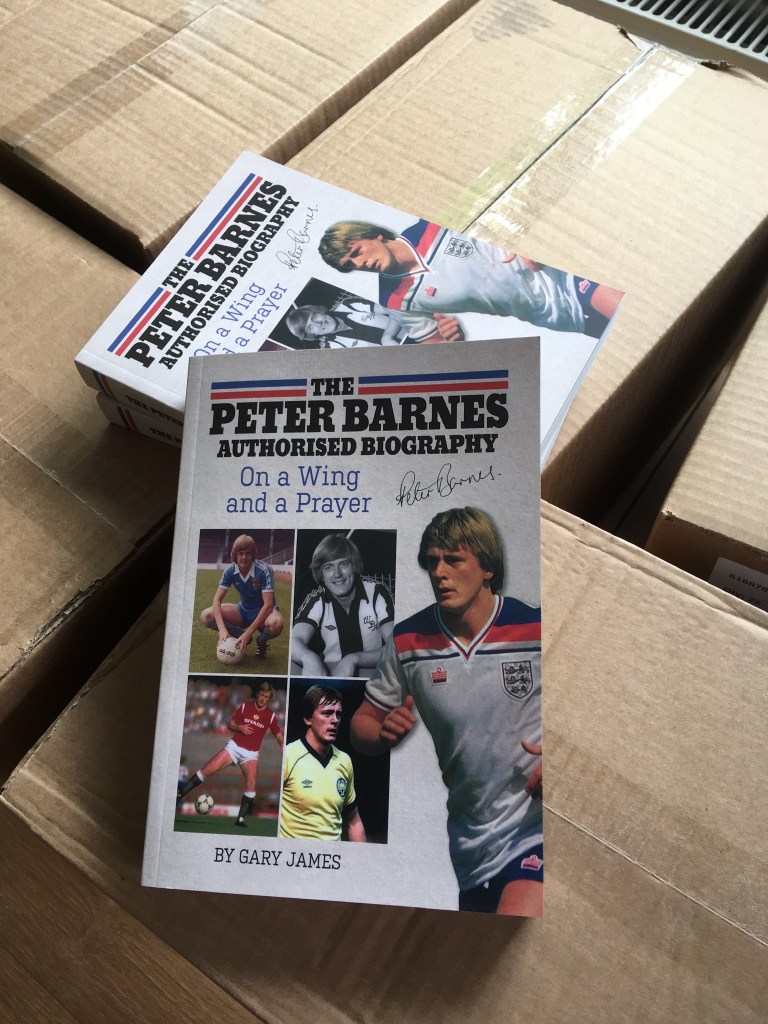
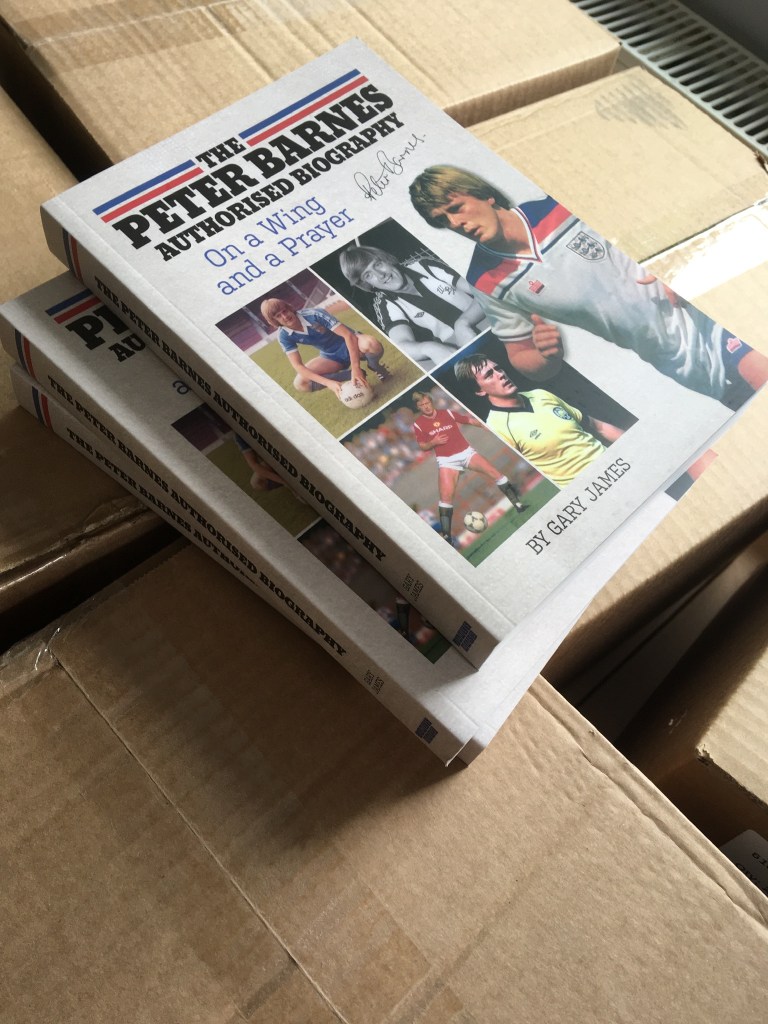
Peter’s time at both clubs is covered in my authorised biography of him. There are some touching moments and some great stories too. The book was started before the Covid pandemic and then was delayed because of Covid. Despite the delays it was great to write this biography and Peter’s a wonderful person who has an interesting story. I’m sure fans of every club Peter was involved with and neutrals will enjoy reading the book.
You can buy the book below.
This 372 page, colour paperback book is £16.95 (including UK postage).
United Kingdom
The Peter Barnes Authorised Biography – UNITED KINGDOM
Order today for £16.95 (incl UK Postage and Packaging).
£16.95
To order please use the button above (UK postage included; outside UK contact me for additional postage costs). You do not need to have a PayPal account to order – use the ‘Pay with PayPal’ button above and it will give you the option to pay by credit/debit card without creating a PayPal account.
Here are the contents pages:
This long awaited authorised biography, written by Gary James with the memories and stories of Peter’s career throughout, tells the story of Peter’s life from his childhood in Manchester and Wrexham through to the modern day. With particular focus on his footballing career with Manchester City, West Bromwich Albion, Leeds United, Real Betis, Coventry City, Manchester United, Tampa Bay Rowdies and, of course, England.
If you run a book shop and would like to know more about the book please email: accounts@manchesterfootball.org
The ISBN is 978-1-9168852-0-2.
You can listen to Peter in conversation with myself about the book here:
Today (7 March) in 1979 Manchester City faced top German side Borussia Mönchengladbach in the first leg of the UEFA Cup quarter-final at Maine Road.
There was a 39,005 crowd present and the City team was: Corrigan; Donachie, Power, Reid, Watson, Booth, Channon, Viljoen, Kidd, Hartford & Barnes.
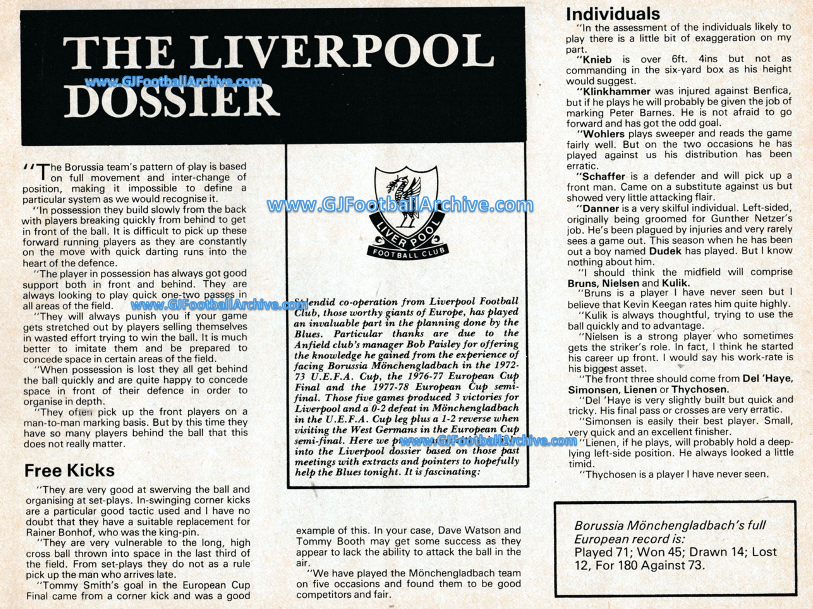
Believe it or not (this may surprise a modern audience but leading clubs often did what I’m about to say) Liverpool, in particular Bob Paisley, had spent considerable time helping the Blues prepare for this match by providing vital information on the West German side.
Liverpool had faced Mönchengladbach on five occasions, the most famous was the 1977 European Cup final and the most recent being in the 1978 European Cup semi-final. Paisley told City that the game would be tough, and outlined the players to watch. He also suggested that Dave Watson and Tommy Booth might be the key men in City’s side as the Germans seemed to lack ability to attack the ball in the air.
While City had Liverpool doing all they could to help there was someone who was becoming a bit of a thorn in the side of Malcolm Allison. That was hypnotist Romark. Romark had previously ‘cursed’ Allison while the City man had been manager of Crystal Palace (a really interesting story which I covered in my biography of Peter Barnes, published in 2021).
The hypnotist had offered to help Allison but Big Mal was having none of it. The following year Romark helped Halifax Town defeat City in the FA Cup! If only Allison had not angered the hypnotist all those years ago. Maybe life would’ve been so different for City!
The first leg saw Malcolm Allison, who had returned to the Blues in January as the self-styled ‘coaching overlord’, perform one of his many shock moves when Nicky Reid was thrust in to the spotlight at the age of 18 for his debut. Allison selected him to mark Allan Simonsen. It was an amazing selection at the time, but Reid did enough to justify Allison’s bold move.
Nicky Reid
Mike Channon, who was rumoured to be unhappy at the Club, managed to give the Blues a 1-0 lead. Unfortunately, the highly disciplined Mönchengladbach kept the pressure on and managed to snatch an equaliser and the often vital away goal.
The second leg of the tie took place 13 days later, on 20 March 1979 watched by around 30,000. The City team was: Corrigan; Donachie, Power, Viljoen, Watson, Booth, Channon, Reid (Deyna), Henry, Hartford & Barnes
Nicky Reid retained his place for the second leg (but still didn’t make his League debut until eleven days later when he scored against Ipswich). He was clearly a talented player but his arrival in the heat of European competition without even making an appearance in the League did raise many questions about the way Malcolm Allison was influencing things. Reid went on to captain the Blues to the FA Youth Cup final the following May, and was voted City’s young player of the year.
Malcolm Allison made yet another surprise selection as Tony Henry – another reserve who up to that point had only featured in two League game (once being substituted by Kenny Clements, once coming on for Asa Hartford) – was included while experienced European campaigners Deyna, Bell, and Kidd were left on the bench with Paul Futcher.
It was not a good night at all for City and having so much experience on the bench seemed baffling to fans, the media and also most of the players. City were very much the underdogs throughout and were losing 3-0 when, late on, Reid was substituted by Deyna. The experienced Pole provided City’s only goal of the match, but it was too late and City were out of Europe.
Kenny Clements explained to me when I interviewed him years later: “I broke my leg a few weeks after Milan so that made life a bit difficult for me, but the big problem was the return of Malcolm Allison. I know he was a great coach first time at City, but second time he really did ruin everything. All the older players told me it’d be great having him back, and then when he was back they all admitted they were wrong. I think he’d become too hung up on new ideas that he forgot about the basics. I remember he used to give us homework. He’d tell us to go home and write “I must win” or “I will win” a thousand times, then the next day he’d ask us if we’d done it.
“I always used to say ‘yeah’, but some of the younger, more impressionable lads would produce their lists and some would even write out twice as many lines! He insisted we drank coffee before a game to keep us alert, and brought in lots of motivational people. It didn’t motivate me I’m afraid!
“By the time of the next UEFA match (Mönchengladbach) I was fit but didn’t start, and then for the second leg both Brian Kidd and I had to sit it out while Nicky Reid made his debut marking one of the greatest players of all time. When we were two goals down Kiddo threw his shirt at Allison in anger.”
For many connected with City Mönchengladbach became the game that would be quoted when they discussed how things had changed following Allison’s return. Tony Book had developed a good team with a nice blend of young up-and-coming talent, like Peter Barnes (who was still only 21 but an exciting England winger), with the older experienced internationals like Dave Watson, Brian Kidd, Asa Hartford. Book’s team had been runners up to Liverpool in 1977 and had impressed with many great individual victories since then, especially that Milan victory of course, but the return of Malcolm Allison changed the dynamics at the club.
Ah well! Without that I guess City wouldn’t have what they have today, but for those of us who lived through the 70s to the present, it was the return of Allison that started the process of transforming City from regular challenging giant into a club that had lost its way. The 1978-79 Mönchengladbach games are a reminder of what we were, what we lost, but also of what we have now. Let’s ensure we enjoy the present because, as Allison once said to me: “Celebrate every success as if it’s your first, because it could be your last!”
When City walked out to face Mönchengladbach in the quarter final none of us, especially Allison, expected it would be our last European tie for 25 years! To read about the significance and facts of City’s European heritage (there are a few points that may surprise fans of certain other clubs) then take a look at another post:
Manchester City suffered a 1-0 home defeat by Bolton Wanderers on this day (7 March) in 2005 and this game ultimately led to a significant change to the then 12th placed Blues. Years later, in an interview I did with him the City chairman John Wardle told me that Kevin Keegan, the City manager, took him to one side: “There were nine games left and Kevin said ‘John, I can’t do any more for you’. I didn’t believe him. I thought it was a joke at first but with Kevin you knew when he was being serious. He said ‘I know when I’m done and it’s only right that you put somebody else in’. I sat there shell-shocked. He said that if I wanted him to recommend someone he would. He then recommended Stuart Pearce.
“Stuart had already left Carrington and we had to call him back. I spoke with him, then Kevin talked with him. It was like a handover. Kevin packed his bags and left. We never saw him again at the training ground. That’s Kevin. Once he makes a decision to move on, he moves on. Obviously, it stunned me on the day but I have to stress that I cannot speak highly enough about Kevin Keegan. He’s a real football person and he also cares about people.”
Keegan was hugely popular with fans and they recognised that he had been responsible for the second stage in City’s redevelopment following the disastrous mid-nineties. They also felt that the departure of Nicolas Anelka in January was a sign that financial issues were having a severe impact on the Club. The player was sold for a reported £7m to Fenerbahce. At the time this was City’s record sale.
It is fair to say that Keegan’s time brought a great deal of pride back to the Club. Director Dennis Tueart felt that bringing Keegan in during 2002 was absolutely the right move for the Club. He told me: “I knew he wouldn’t stay for years and years because I knew him. He said to me in 1975 that he would never stay anywhere longer than about five years. People told us he wouldn’t stay but I said if he can have control for a couple of years and get us out of this division then that’s fine. That’s what we needed. Let’s manage first things first and get out of this division. If we can’t do that then what hope? So it was no surprise to me when he eventually left us.”
Former City and England captain Stuart Pearce guided the Blues through the final nine games of 2004-05, taking over on this day (11th March) in 2005. Apart from a 2-1 defeat in his first game, the Blues were unbeaten until the end of the season. This run included victories over Liverpool (1-0), Birmingham (3-0), Portsmouth (2-0) and Villa (2-1). As a result Stuart Pearce was named the Barclays Premiership Manager of the Month for April. The Club announced he was the first City manager to win the award since the birth of the Premier League. That was not true – Alan Ball had, of course, previously won the award in 1995-96.
Subscribe to get access to the entire site
This is a sample of the in-depth material available on this site. If you would like to read all the in-depth articles (including the entire Manchester A Football History book and listen to a frank interview from John Bond) then please subscribe. It works out about £1.67 a month if you take out an annual subscription (£20 per year) or £3 a month if you’d like to sign up for a month at a time. Each subscriber gets full access to all the articles posted so far and the hundreds scheduled to be posted in the coming months..










 Gary James' Football Archive