Defender Bobby Kennedy proved to be a popular player after joining the Blues in 1961. He went on to make 251 (plus 3 as sub) appearances for City over a seven year period and was a key member of City’s mid sixties side. In April 2005 Gary James caught up with him at the stadium.
Subscribe to get access
Read more of this content when you subscribe today.
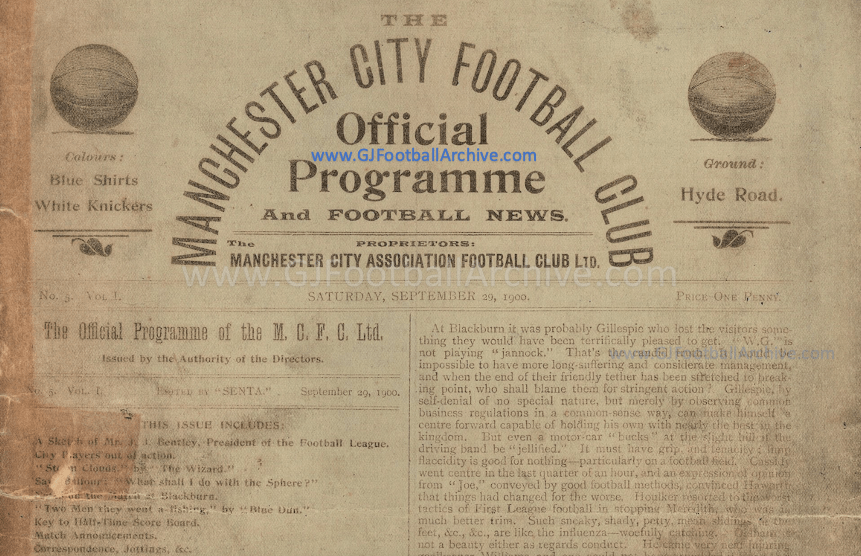
Recently I’ve been contacted by someone who had in their possession a couple of Manchester City match programmes from 123 years ago. These were from the first season the club did its own official match programme (there was an earlier joint effort between 2 rugby and 2 football clubs that was described as official from the 1890s – see below – but 1900-01 was the first for MCFC on their own). He sent me scans of them and one programme was produced for a match played on this day (29 September) in 1900. Here are some images and details from it.
This was a special game for City, though the programme was not produced because it was a special game. This was the fifth issue of the season and contained eight pages, like the others. The significance of the game however was that Arthur Balfour MP was a visitor that day. Balfour would become Prime Minister in 1902 and was still in that role when City won the FA Cup for the first time in 1904 (he wore a City rosette at the final!).
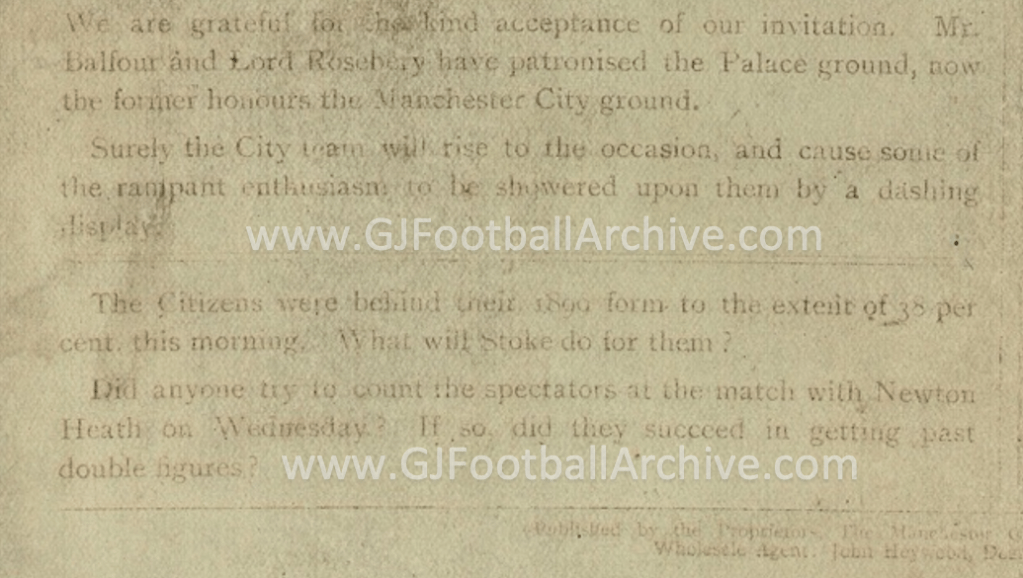
The back page talks about Balfour’s visit. Both the front and the back pages are quite difficult to read as they’ve faded. It is interesting that the club felt able to make light of Balfour’s lack of enthusiasm for ‘socker’ (yes, socker or soccer as we grew to call it, was an English word for association football before the Americans became recognised for their use of it). Balfour preferred golf (after the 1904 FA Cup final he called himself a football ‘ignoramous’. Bob Hulmes, who sent the programme scans to me, managed to transcribe the wording regarding Balfour:
Says Balfour: “What shall I do with the sphere?”
We have specially desired fine weather today as the Right Hon. Arthur James Balfour is due to make his first appearance on the Hyde Road Football enclosure this afternoon. Some little decoration will be made, for the most pleasing sight to the hon. gentleman will be a mighty crowd of enthusiastic well wishers. It is not often that we have a leader of the nation at such functions, and the occasion is historic as far as Manchester is concerned. No doubt our honoured guest wishes he had the opportunity to open a game of golf instead of socker but we are ready to excuse a “miskick” on this occasion. We are grateful for kind acceptance of our invitation. Mr Balfour and Lord Rosebery have patronised the Palace ground, now the former honours the Manchester City ground.
Surely the City Team will rise to the occasion and cause some of the rampant enthusiasm to be showered upon them by a dashing display.
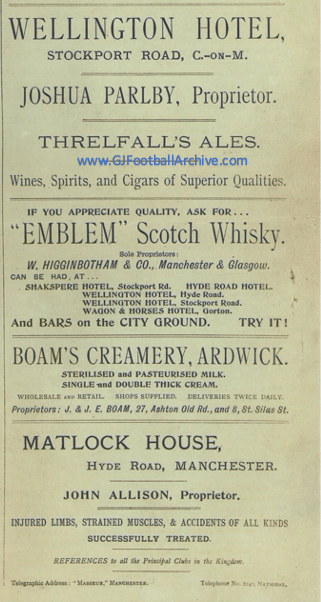
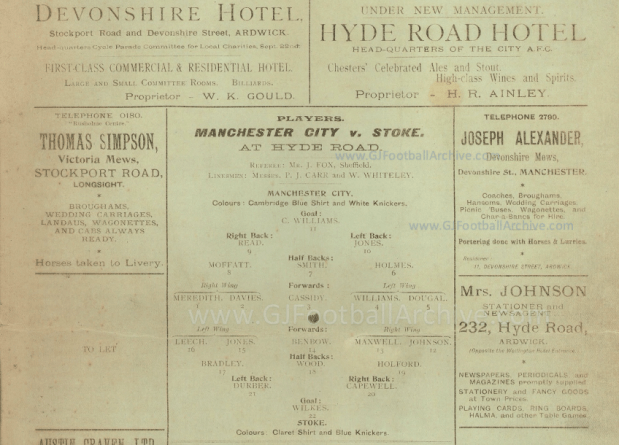
It’s worth noting some of the advertisements. There’s one for Joseph Alexander’s coaches and carriages (the Alexander family business. Note: The Alexanders remained key members of City’s management/directorship/shareholding for most of the 120 years that followed!). There’s also the Wellington Hotel, Stockport Road, which was run by the ever popular City official Joshua Parlby, and the Matlock House Hydro – one of City director John Allison’s business.
The game was against Stoke and they are wearing their then home colours of ‘claret shirts and blue knickers’.
Bob also nudged me towards page 8 which included a wry comment about the previous Wednesday’s friendly at Newton Heath (United):
Did anyone try to count the spectators at the match with Newton Heath on Wednesday? If so, did they succeed in getting past double figures?
The official attendance was estimated by Newton Heath as 600 (I wonder if they had a mickey-take name along the lines of Emptyhad for United’s games at Bank Street?
Before the 1900-01 season there was an official match programme produced for both Newton Heath and Manchester City, alongside a couple of rugby clubs. It was first ‘mocked up’ in May 1898 but went into production for the 1898-1899 season. It continued into the 1900-01 season by which time City were producing their own official programme. Both programmes were in competition throughout that 1900-01 season.
From 9 May 1898 the first Manchester football programme was a mock up based on Everton Liverpool programme
Thanks to Bob Hulmes for allowing me to us images of his match programme. The programme belonged to Bob’s grandfather. He lived in Ardwick, near Hyde Road, and he followed City until his death in 1964. Bob found two programmes from 1900 lining a drawer when his grandfather died in 1964, which shows exactly how rare these images are. It’s a pure fluke in many ways that they survived and fortunately the family looked after them over the decades.
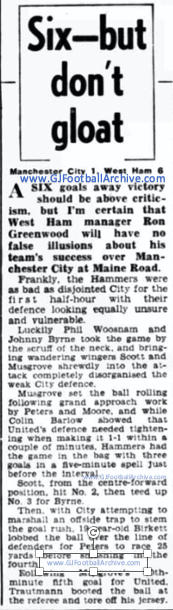
It was a miserable day all round as Manchester City’s Bert Trautmann was sent off for booting the ball at the referee on this day (8 September 1962). City lost the game with West Ham 6-1 with Trautmann’s dismissal coming after the fifth goal.
After he had booted the ball at the ref, the official took out his notebook and ordered Trautmann off. The German goalkeeper immediately took his shirt off and headed down the tunnel and straight out of the ground and into his car.
Here are Trautmann’s views, as told to a journalist the following day:
The view from West Ham was that their team was not particularly worth the 6-1 victory. This London report makes interesting reading:
Demonstrations followed the game expressing anger towards the manager Les McDowall but Trautmann managed to escape fan criticism.
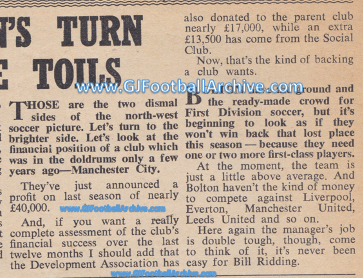
This month (September) in 1967 this article was published highlighting the profitability of Manchester City. I know this is a long time ago but for those who believe City’s profitability is a recent thing it’s worth stating that the Blues were a hugely profitable club until chairman Peter Swales took power. No time to go into all that now (look across this website and you’ll see my posts on it though). Back in 1967 the club was under the stewardship of the Alexander family of course.
For post 86 of my Maine Rd 100 a photo of Tony Book, Peter Swales and Kaz Deyna. They were photographed at Deyna’s signing in the Maine Rd boardroom. Swales was the City chairman for what became a quarter of Maine Road’s existence, but who were the other chairmen? For the benefit of subscribers to my website I decided to compile for the first time ever a full list of Manchester City’s chairmen since the club’s earliest known game in 1880 through to today. Here goes:
Subscribe to get access
If you would like to read this and all the in-depth articles on this site (including the entire Manchester A Football History book and the audio interview with John Bond) then please subscribe. It works out about £1.67 a month if you take out an annual subscription (£20 per year) or £3 a month if you’d like to sign up for a month at a time. Annual subscribers get full access to the 1000+ articles posted so far and the hundreds scheduled to be posted in the coming weeks.
If you would like to read this and all the in-depth articles on this site (including the entire Manchester A Football History book) then please subscribe. Monthly subscription costs £3 a month if you’d like to sign up for a month at a time. Monthly subscribers get full access to everything posted since 1 October 2022 and the hundreds scheduled to be posted in the coming weeks.
It’s day 23 of my posts counting down to the centenary of Maine Road’s opening game and today’s feature is on the building of the North Stand. As Manchester City are about to appear in the 2023 Champions League final I thought I’d post images from a much earlier European game. This image of Neil Young comes from the 1971 ECWC semi-final v Chelsea. Notice Young is wearing City’s away colours. People often assume that City rarely wore away colours at Maine Road, but the truth is somewhat different.
Often when there was a clash of colours in a cup game City would wear their away strip. Games in the 1920s right through to 1970s saw the Blues don maroon, red/black and even scarlet at times at Maine Road.
The main image shows that North Stand being constructed in the background. You can see that the roof is not yet complete but that the terracing is in use for this ECWC semi final. The terracing was new concrete and the stand housed bars underneath. It was a terraced stand until summer 1972 when the decision was taken to make it a seated stand.
City chairman Eric Alexander was the main man responsible for the stand’s development and he was a passionate believer in giving fans the best facilities possible. He also had ambitious plans to redevelop the Kippax, however Peter Swales became the chairman soon after and he put Ian Niven in charge of ground developments. From then on, until 1993, the only major development was the erection of a new Main Stand roof in 1982. In the 1990s the club was forced to build – or condemn – the Platt Lane Stand.
Maine Road was a major ground for most of its existence and, even with little investment during from 1973 onwards, it was still selected as a cup semi-final venue. BUT I often wonder how spectacular the stadium would have been had Eric Alexander been left in charge of stadium developments. Instead of penny-pinching and devaluing the ground maybe it would have eclipsed Old Trafford as it had for the first 40 years of its existence?
People always focus on Swales as the cause of all the problems and it is true that he was the chairman and the man ultimately responsible, but he was not the major shareholder. In fact he often talked of how he only had a small number of shares until 1983 (when he made a major purchase following City’s relegation he often said). He was supported by directors who often held many more shares than he did. They could’ve ousted him, but instead supported him. Each director had responsibilities for different elements of the club – Swales often talked of this and the match programme frequently told us who was responsible and what they did – yet once Swales did stand down and Franny Lee took over some of those who had worked with Swales swapped sides and retained their positions. I know, from my own interviews with Swales, Alexander and others, that Swales felt let down and betrayed. Every issue was suddenly made to be ‘his’ fault. He accepted this, saying that he was the main man, but others needed to hold their hands up for the lack of investment in Maine Road etc.
1971 ECWC v Chelsea. Francis Lee. Photo by Alan Jubb
The above image shows Francis Lee at this same game and to the right you can see more of the North Stand under construction.
For those unfamiliar with Maine Road this photo may help. The North Stand can be seen with a completed roof on this image (number 10). This was later in 1971 and the stand is still a terraced one.
Maine Road aerial 1971 from Farewell To Maine Road
If you’d like to read more on the history of Maine Road, take a look at Farewell To Maine Road, which can be downloaded from this page:
If you enjoy all the free material on my website and would like to support my research and keep this website going (but don’t want to subscribe) then why not make a one-time donation (or buy me a coffee). All support for my research is valued and welcome. It allows me to keep some free material available for all. Thanks.
As part of their All-Manchester FA Cup features the Athletic have asked their writers about the most important FA Cup final. Well, as it’s a City-Utd final then it makes sense to highlight the first ever FA Cup final featuring one of the teams. In 1904 Manchester found its first major trophy success and that led to Manchester being established as a footballing city. It’s part of the reason Manchester City retained a special place in the hearts and minds of Mancunians, even when the success faded.
The captain and goalscorer was the great Billy Meredith. The other year, following the purchase of the oldest surviving FA Cup by Sheikh Mansour (to loan to the National Football Museum) I helped Manchester City with the story of the cup and its significance to Manchester. They’ve produced a video telling the story and it can be viewed here:
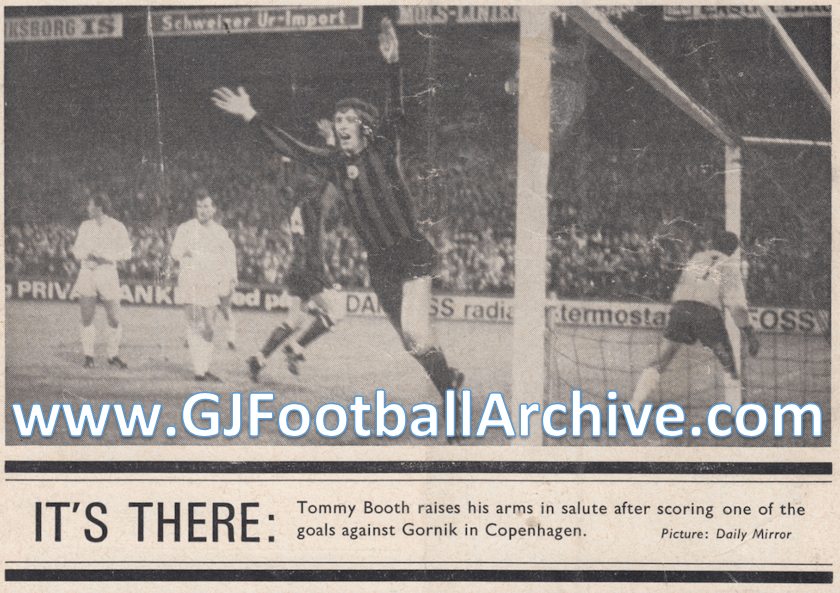
In September 2021 I was in Copenhagen and, as always when I’m in a city with a football ground, I popped over to the Parken Stadium. Most fans will remember that City drew 2-2 there with FC København in February 2009. Nedum Onuoha and Stephen Ireland scored in the UEFA Cup round of 32 first leg and in the return Craig Bellamy scored twice to give the Blues a 2-1 win on the night (4-3 on aggregate). That year we progressed to the quarter finals.
However, Copenhagen’s stadium played a much earlier role in City’s European story and, as today (31 March) is the anniversary of that game, I’m publishing this article looking back at the day when the Blues played a European Cup Winners’ Cup quarter-final replay there.
This 1500 word article is available for subscribers…
Subscribe to get access – Annual
Read more of this content when you subscribe today. It costs £3 per month (cancel any time, see below) or £20 a year. Annual subscribers get full access to ALL the content on here throughout their membership. Do a few searches and see what’s on here.
It costs £3 per month (cancel any time) or £20 a year (see above). Monthly subscribers get access to everything posted since 1 October 2022 and everything posted throughout their membership. Why not sign up for a month and see what you think?
On this day (22 March) 1969 Manchester City and Everton met in the FA Cup semi-final at Villa Park. Here for subscribers is the story of that day, including material from interviews I have performed with some of the key people (such as Tommy Booth). Enjoy!
Subscribe to get access – Annual
To read this and all the other in-depth articles please subscribe. It works out about £1.67 a month if you take out an annual subscription (£20 per year) or £3 a month if you’d like to sign up for a month at a time (see below). Annual subscribers get full access to everything posted since December 2020 and the hundreds scheduled to be posted during their subscription.
To read this and all the other in-depth articles please subscribe. It’s £3 a month (cancel anytime). Monthly subscribers get full access to everything posted since 1 October 2022 and everything scheduled to be posted during their subscription.
I’d like to thank you for taking the time and trouble to visit my website. I have been researching and writing about Manchester football since the 1980s. I am not employed by anyone and I do not have sponsorship either and so I’ve set up this website to help share my 32 years plus writing and research.
The intention is to develop the archive and to provide access to as much of my material as possible over the coming weeks, months & years. Subscribers can already access hundreds of articles/posts including PDFs of a couple of books and exclusive audio interviews, talks etc.
It costs £20 a year (it works out £1.67 a month) or £3 if you’d like to sign up a month at a time to get full access for as long as you subscribe. If you’d like to check whether it’s value for money, have a search through content before subscribing – or even subscribe for a month, access what you want and then cancel!
It’s the return of the FA Cup tonight with Manchester United facing Everton. It’s always worth reminding ourselves of the significance of the FA Cup to Manchester and the story of Manchester’s first major trophy success. The captain and goalscorer of the first triumph by Manchester in 1904 was the great Billy Meredith. In 2021 following the purchase of the oldest surviving FA Cup by Sheikh Mansour (to loan to the National Football Museum) I helped Manchester City with the story of the cup and its significance to Manchester. They’ve produced a video telling the story and it can be viewed here:




 Gary James' Football Archive