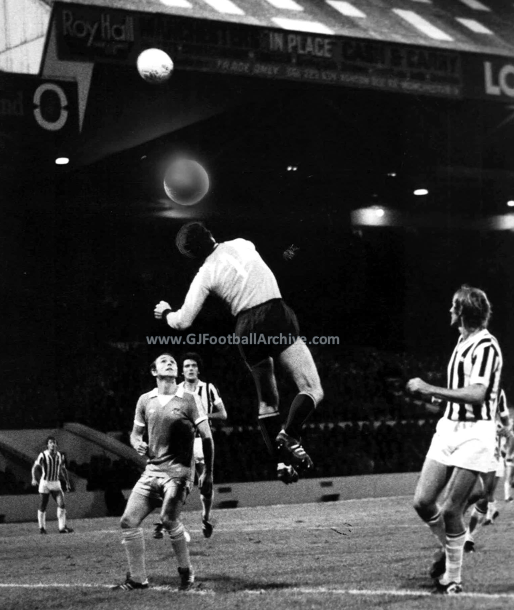
It’s day 24 of my posts counting down to the centenary of Maine Road’s opening game. With many Manchester City fans currently in Istanbul getting ready for tonight’s final I thought I’d post another Maine Road image with a European theme. Today’s feature is on this image of City facing Juventus in 1976.
That night Brian Kidd scored the only goal in City’s 1-0 UEFA Cup victory, played on 15 September. But, look at the photo closely and you’ll see there are two balls! Why? Well, often in the days of black and white press photos newspapers wouldn’t quite get the shot they wanted. They’d sometime tippex on, or even cut and stick a ball on an action photo to create either a more dramatic image, or simply to ensure they could fit the image on the space available.
Modern technology has made it easier to ‘move’ the ball to a more convenient place, but it has also allowed photos to be taken quickly and in bursts. Also, once colour photography was used in national newspapers any cutting and pasting or tippexing seemed too obvious. Although this added ball definitely looks fake so I’m not certain any reader would have been fooled.
I’ve seen plenty of images like this over the years and I find them both fascinating and frustrating. I’d like the true image to be shown, but I also am intrigued as to how they felt they made the image better. For those wondering the City player is Dennis Tueart and the stand in the background is the Main Stand.
For those unfamiliar with Maine Road this photo may help. The roof shown is to the left of number 1 below – you can see the bit where it drops down to the next level. The tunnel is the one on the far left of the Main Stand below where the roof line changes. City were attacking the Platt Lane (stand is numbered 4 & 5) in the image.
Maine Road aerial 1971 from Farewell To Maine Road
If you’d like to read more on the history of Maine Road, take a look at Farewell To Maine Road, which can be downloaded from this page:
If you enjoy all the free material on my website and would like to support my research and keep this website going (but don’t want to subscribe) then why not make a one-time donation (or buy me a coffee). All support for my research is valued and welcome. It allows me to keep some free material available for all. Thanks.
It’s day 23 of my posts counting down to the centenary of Maine Road’s opening game and today’s feature is on the building of the North Stand. As Manchester City are about to appear in the 2023 Champions League final I thought I’d post images from a much earlier European game. This image of Neil Young comes from the 1971 ECWC semi-final v Chelsea. Notice Young is wearing City’s away colours. People often assume that City rarely wore away colours at Maine Road, but the truth is somewhat different.
Often when there was a clash of colours in a cup game City would wear their away strip. Games in the 1920s right through to 1970s saw the Blues don maroon, red/black and even scarlet at times at Maine Road.
The main image shows that North Stand being constructed in the background. You can see that the roof is not yet complete but that the terracing is in use for this ECWC semi final. The terracing was new concrete and the stand housed bars underneath. It was a terraced stand until summer 1972 when the decision was taken to make it a seated stand.
City chairman Eric Alexander was the main man responsible for the stand’s development and he was a passionate believer in giving fans the best facilities possible. He also had ambitious plans to redevelop the Kippax, however Peter Swales became the chairman soon after and he put Ian Niven in charge of ground developments. From then on, until 1993, the only major development was the erection of a new Main Stand roof in 1982. In the 1990s the club was forced to build – or condemn – the Platt Lane Stand.
Maine Road was a major ground for most of its existence and, even with little investment during from 1973 onwards, it was still selected as a cup semi-final venue. BUT I often wonder how spectacular the stadium would have been had Eric Alexander been left in charge of stadium developments. Instead of penny-pinching and devaluing the ground maybe it would have eclipsed Old Trafford as it had for the first 40 years of its existence?
People always focus on Swales as the cause of all the problems and it is true that he was the chairman and the man ultimately responsible, but he was not the major shareholder. In fact he often talked of how he only had a small number of shares until 1983 (when he made a major purchase following City’s relegation he often said). He was supported by directors who often held many more shares than he did. They could’ve ousted him, but instead supported him. Each director had responsibilities for different elements of the club – Swales often talked of this and the match programme frequently told us who was responsible and what they did – yet once Swales did stand down and Franny Lee took over some of those who had worked with Swales swapped sides and retained their positions. I know, from my own interviews with Swales, Alexander and others, that Swales felt let down and betrayed. Every issue was suddenly made to be ‘his’ fault. He accepted this, saying that he was the main man, but others needed to hold their hands up for the lack of investment in Maine Road etc.
1971 ECWC v Chelsea. Francis Lee. Photo by Alan Jubb
The above image shows Francis Lee at this same game and to the right you can see more of the North Stand under construction.
For those unfamiliar with Maine Road this photo may help. The North Stand can be seen with a completed roof on this image (number 10). This was later in 1971 and the stand is still a terraced one.
Maine Road aerial 1971 from Farewell To Maine Road
If you’d like to read more on the history of Maine Road, take a look at Farewell To Maine Road, which can be downloaded from this page:
If you enjoy all the free material on my website and would like to support my research and keep this website going (but don’t want to subscribe) then why not make a one-time donation (or buy me a coffee). All support for my research is valued and welcome. It allows me to keep some free material available for all. Thanks.
I’ve been asked whether Gundogan’s goal in the FA Cup final was the fastest Manchester City goal of all time. Sadly, it’s impossible to prove as we do not have accurate times for the majority of goals scored throughout football history. Often in the past reports would say things like: ‘From the kick-off City rushed forward and scored.’ No time and even when this is said in reports highlights that have been found often show that this was not the case, so it’s impossible to say conclusively.
We know it’s the fastest FA Cup final goal of all time and, at 12 seconds, it’s also the fastest goal in a Manchester derby. Back in 1975 Dennis Tueart netted what was claimed to be the fastest derby goal at 35 seconds. I interviewed him about it a few years ago:
GJ: ‘You played in lots of significant derbies over the years, but there is one, above all others, that we should mention – the November 1975 League Cup tie at Maine Road.‘
DT: ‘I scored the first goal after about 35 seconds and that is the fastest goal in a Manchester derby. It was a midweek game at Maine Road and I loved night matches, under the floodlights, packed stadium. Incredible. The lights meant that the stadium shone out amongst the dark streets – it was the whole focus.
Dennis Tueart scores after 35 seconds v United, 1975
‘We were 1-0 up and played great football. 3-0 up after 36 minutes when I got my second goal after Asa Hartford had got City’s second. Colin Bell was injured and stretchered off which was by far the worst moment of the evening and would impact us for the next few years.
‘After the game we went to Cellar Vie in the city centre, and I walked in and I got a standing ovation from everyone in there. Again it hit home how important the derby was to the city of Manchester.’
Now Gundogan holds the record but we should also mention Shaun Goater who in 2003 netted after only 9 seconds of coming on as substitute. You can read about that here:
Gundogan’s goal is the fastest in a derby, while Goater’s goal was the fastest ever netted in a derby from a player’s arrival on the pitch, regardless of stage of the game.
If you’d like to read the indepth material on this website, or download the entire Manchester A Football History, Farewell to Maine Road or my first book then why not subscribe? Details here:
If you enjoy all the free material on my website and would like to support my research and keep this website going (but don’t want to subscribe) then why not make a one-time donation (or buy me a coffee). All support for my research is valued and welcome. It allows me to keep some free material available for all. Thanks.
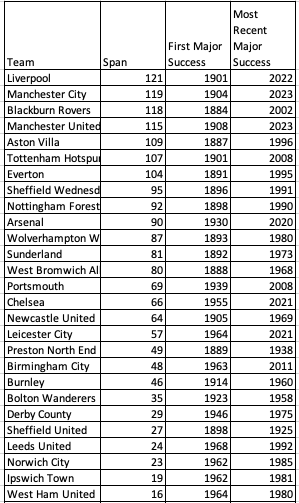
Congratulations to West Ham on your success in last night’s Europa Conference League. Great news for your club and for those clubs who wonder whether competitions like this are a drain or something to aim for. I’ve now updated the table showing the span of success – i.e. the number of years between a club’s first major success (FA Cup, League, League Cup, European trophy) and their most recent. West Ham have jumped some way up that list.
Okay, the span of success does not show how many trophies each club has won or how frequently that club has experienced great eras of success, but it does demonstrate how wrong those people are who believe certain clubs were unsuccessful until recent years, or those who think certain clubs have always been giants. The column on first major success helps to show when some clubs first became trophy-winning significant (often after transformational investment).
West Ham have proved that if you’re a club that hasn’t won a major trophy for a while putting your focus on achieving trophy success ahead of the odd Premier League position can bring significant reward. In future decades no one will remember who finished seventh, tenth or fifteenth but they will remember the trophies.
I know clubs focus on their financials but winning a trophy has longevity, gaining the odd Premier League place provides a bit of extra cash now but no long term kudos. Winning a trophy attracts new fans and brings money-spinning opportunities too.
If I was a supporter of Everton, Aston Villa or any of the other major clubs who have not found significant success in recent decades then I would absolutely want my team to go for whichever cup competition seems most likely to win. That’s what I always wanted from City before they were able to compete for the League again. Winning the FA Cup in 2011 helped everything that followed happen.
While you’re here… why not take a look at the free to read daily Maine Road features counting down to the old stadium’s 100th anniversary of its first game? Here are a sample couple of features (follow the Maine Road tag or search for more):
For many, many years Dave Masey has been collecting stats and historical information on Manchester City. Like me he was a member of the Association of Football Statisticians and he has helped me often over the years. Following Saturday’s FA Cup final he got in touch with me to tell me about one of his spreadsheets which holds details of City scorers in trophy winning games.
His records capture those who have scored in major cup finals, but besides Cup Finals he also records other trophy-winning games. These include the deciding League games from 1937 onwards against Sheffield Wednesday (1937), Newcastle, QPR, West Ham, Brighton and Villa (2022), but nothing from three recent title successes where the Blues clinched the title when they were not playing. Got that? Good, now….
Dave tells me that Gundogan is now at the top of the list with 5 goals, overtaking Neil Young and Sergio Aguero. So he has scored more goals in trophy-winning games than any other Blue.
The list of scorers in trophy winning games reads:
1904
Meredith
1934/7
Tilson (3), Brook (2), Doherty
1956
Hayes, Dyson, Johnstone
1968/70
Young (4), Lee (2), Summerbee, Doyle, Pardoe
1976
P Barnes, Tueart
2011-(former)
Aguero (4), Y Toure (2), Nasri (2), Kompany (2), D Silva (2),Jesus (2), Sterling (2), Dzeko, Zabaleta, Navas, Fernandinho
2016-(current)
Gundogan (5), Laporte (2), Rodri (2), Mahrez, De Bruyne
Dave also tells me that in the three seasons where somebody else’s defeat clinched the title for City, the scorers in the club’s last game before the title confirmation were:
Gundogan (3), Sterling (2), Jesus, Haaland.
As Dave says, Ilkay gets a remarkable number of important goals, particularly for somebody who is ‘just’ a 1 goal in 5 games player (60 in 303 for City). Certainly this season he has played a true leader’s role and, looking at his place in this table, he is clearly a man for all trophy-winning seasons.
Driving back from Wembley last Saturday both Talksport and BBC Radio 5 Live had phone-in shows where the question kept being brought up about comparing Manchester United’s treble in 1999 with the possibility of City managing the same achievement this year. Obviously, a football game can go any direction and no success is guaranteed ever, so I am absolutely not going to talk as if something has been achieved when it hasn’t. If City do manage this incredible feat then the comparisons are likely to be made again BUT how sensible is this?
I am against making these comparisons because I think they’re futile. A bit like when I asked former City player Johnny Williamson, who had played with both Frank Swift and Bert Trautmann, which was best. He said: ‘It doesn’t matter. You pick one and I’ll pick the other because the two of them were head and shoulders above the rest!’
United’s treble in 1999 was absolutely incredible and a major achievement. If City manage the same this weekend then that will also be incredible and a major achievement. Which is best doesn’t matter and even if it did can we really do an accurate comparison? 24 years is a long time in football and the game changes so much in that time.
Much has been made about where City were in 1999 (winning promotion from ‘new’ Division Two) when United won their treble. People have said: ‘How can a team go from promotion challengers to potential treble winners in 24 years?’ Well, guess where United were 24 years before their treble…. they were promotion challengers in ‘old’ Division Two!
Martin Buchan and Alex Stepney celebrating United’s promotion in 1975 at Old Trafford
In the years that followed United’s promotion in 1975 they had a few peaks and troughs as City have. It wasn’t until 1993 (18 years after promotion) that they won the League for the first time since the 1960s but they had won the FA Cup 2 years after promotion. It took City only 13 years after their 1999 promotion to win the League but the FA Cup came in 2011 (12 years after the 1999 promotion). Both clubs spent a lot of money to find those first successes with City receiving Abu Dhabi investment and United borrowing heavily (the increasing level of debt was frequently raised by shareholders back then who questioned whether the club could sustain making purchases like they had to create the most expensive British team ever up to that point) to fund Ferguson’s first successful team.
Comparisons would need to look into every aspect of both clubs – for example Pep’s team are the only team to win a domestic treble as well, so does that elevate their current achievements? Similarly, Ferguson led United to a period of sustained success and dominance that no one else has matched so far. Comparisons are really fairly pointless.
To United fans their treble will always be the best and to City fans, if the club is lucky enough to achieve the same, that will be the best. For most neutrals it will be ‘so what?’, although they’ll downplay any success by a rival. I remember in 1999 someone phoning in a BBC radio show after United had won the Champions League for the second time. The caller was a Nottingham Forest fan who had got fed up with all the praise being heaped on United and, like many United fans today about City, he felt his club was more worthy. He said something like: ‘You keep going on about this United team but what have they done? They’ve just matched what Forest and Brian Clough achieved years ago. We’ve had two European Cups for years and our team was better and cheaper than this lot!’
It’s all a game to fill programmes and articles. It’s not needed. If you think about it 24 years is an extremely long time. If both Manchester clubs can go from promotion chasing teams to European finals in those years then that’s some journey. You have to be well into your 30s to stand a chance of being able to compare 1999 and 2023 and for anyone under that age it’s ancient history and another ‘so what?’.
When United won the treble in 1999 I was an adult with two kids and was just in my 30s. I’d written four major books on Manchester football (including the Pride of Manchester on Manchester derby matches) by this time and had researched the history of both clubs in-depth, so I did get interviewed a lot by TV and radio. I was perceived as an expert, but if you’d have asked me to compare United’s 1975 promotion team with City’s 1999 promotion team I would’ve had to admit I was too young to appreciate what United’s 1975 achievement was like. I’d be able to quote journalists and interviewees but I couldn’t give an honest view which group of players was better. It’s the same now, yet we’ve a whole range of people offering views who are either invested in one club or who are too young to be able to talk with knowledge about it. In any case football in 2023 is somewhat different to football in 1999 – just as that was so different from 1975 and that so different from 1951.
Paul Dickov at Wembley 1999
Maybe we should have filled phone-ins after City had won the double on Saturday with questions like: ‘How does City’s League and Cup double compare with past doubles? Was this City team better than Preston in 1889?’ It’s ludicrous to even try.
It’s day 21 of my posts counting down to the centenary of Maine Road’s opening game and today’s image is a reminder of a European night that was hugely significant. It was the most important European game played by Manchester City at Maine Road.
The game, played on 15 April 1970, saw German side Schalke 04 defeated 5-1 in the ECWC semi-final second leg at Maine Road by City. Subscribers can read the story of that game (and watch video highlights) here:
The image shows Francis Lee in action during that game with the Main Stand and Platt Lane corner in the background. This game led to City playing in their first European final and it seems appropriate to remember that night this week. Joe Mercer’s team went on to win the ECWC (at the time the 2nd most important UEFA club competition).
As well as that image here’s another from the night. This was the celebratory post match pitch invasion. I’d love to hear from any Blues who were there that night. Please use the contact page or leave a comment below. Thanks.
For those unfamiliar with Maine Road this photo may help locate the scene. Number 1 is the Main Stand. Number 4 is the Platt Lane Corner. The pitch invasion image shows one of the corner tunnels but I can’t make out whether it’s the one that used to be position near number 9 or the one shown below at number 6.
Maine Road aerial 1971 from Farewell To Maine Road
If you’d like to read more on the history of Maine Road, take a look at Farewell To Maine Road, which can be downloaded from this page:
If you enjoy all the free material on my website and would like to support my research and keep this website going (but don’t want to subscribe) then why not make a one-time donation (or buy me a coffee). All support for my research is valued and welcome. It allows me to keep some free material available for all. Thanks.
Last night I did a talk at a branch of the Women’s Institute on the incredible story of the women’s team, the Manchester Corinthians, and our quest to have a plaque erected to them. There were lots of great questions and it was a really nice event. Thanks to all those involved.
Some of the trophies won by the Manchester Corinthians
The story of the Corinthians is an inspiring one and I was delighted to explain the history of the club and why I am so determined to have tributes to them erected. I also explained about the work the Friends of Fog Lane Park are doing too to recognise the women.
There are stories on this website about the Corinthians (follow the links below) but I am delighted to say that last year we received funding from a major source to erect a plaque and, thanks to the donations of many others (including the Dick, Kerr Ladies Foundation), there will be other tributes. The Friends of Fog Lane Park are playing a key role in identifying other ways of recognising the Corinthians.
I’ve been wanting to explain about the support for some time but I am still unable to publicly say who the major funder is – that will come soon – but if all goes as planned we should be able to have an event late this summer to recognise the women and unveil the plaque. Watch this space for details!
If you or a relative played for the Manchester Corinthians or Manchester Nomads (sister club) then please get in touch with me. I’m keen to track down as many women involved as possible so that they can all share in the celebration. In addition, in 2024 I will be publishing the Authorised History of the Corinthians. It would be great to include as many women in that as possible. More on the book here:
It is still possible to donate to the Just Giving page (follow Manchester Corinthians Plaque link below) and all funds raised will be used to develop further tributes to the Corinthians at Fog Lane Park.
Also, if you are interested in a talk on the history of this pioneering club and the women involved then please get in touch. I’d be happy to speak at other Women’s Institute groups, Probus, Rotary, Rotaract, history groups and others. It’s always a good night (and last night there was some nice tea and cake too!).
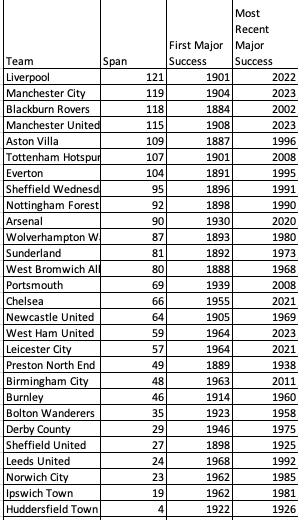
Ahead of West Ham’s European final tomorrow night (7 June) I thought I’d post the latest update to the table showing the span of success – i.e. the number of years between a club’s first major success (FA Cup, League, League Cup, European trophy) and their most recent. If West Ham win tomorrow they will leap ahead of Leicester City.
This season has seen City overtake Blackburn Rovers and they are now second to Liverpool.
Okay, the span of success does not show how many trophies each club has won or how frequently that club has experienced great eras of success, but it does demonstrate how wrong those people are who believe certain clubs were unsuccessful until recent years, or those who think certain clubs have always been giants. The column on first major success helps to show when some clubs first became trophy-winning significant (often after transformational investment).
While you’re here… why not take a look at the free to read daily Maine Road features counting down to the old stadium’s 100th anniversary of its first game? Here are a sample couple of features (follow the Maine Road tag or search for more):
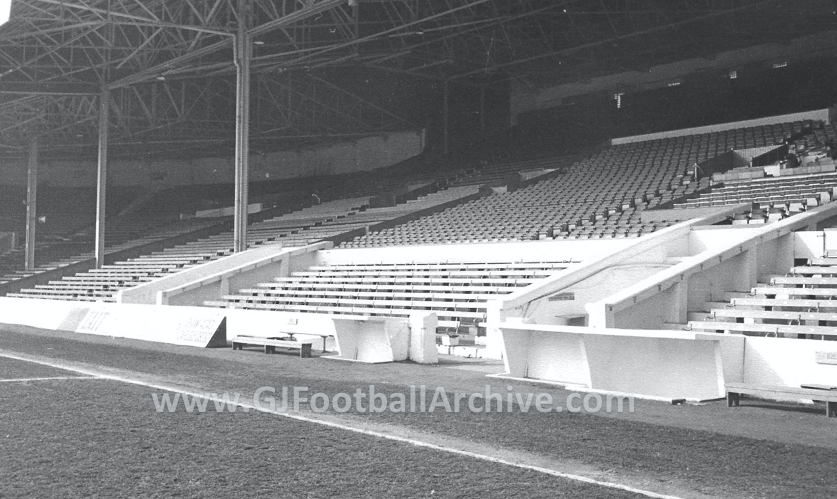
It’s day 20 of my posts counting down to the centenary of Maine Road’s opening game and today’s feature is on the original Maine Road dug outs. Nowadays the playing staff areas take up considerable space wither side of the tunnel at most stadia but for most of Maine Road’s existence there were two concrete bunkers dug out for the manager, physio and maybe one other to sit on. When substitutes were allowed in the 1960s then the sub would also sit there. Inevitably they were cramped and gave an extremely poor view of the game. Basically, the manager would be looking out at leg level.
The main image shows that the City dug out (on the right) had been extended by the time this image was taken in the 1970s. The away dug out (left of the tunnel) is the original size.
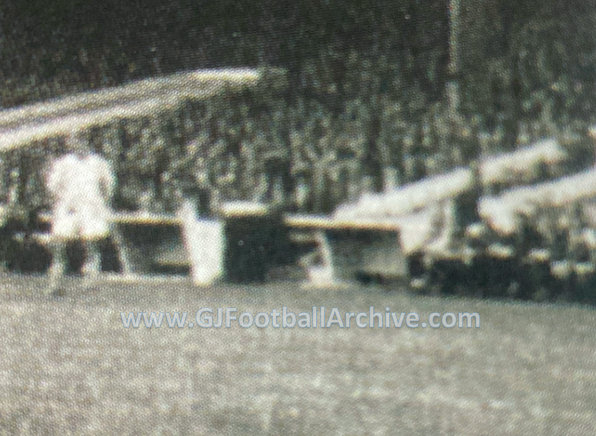
City’s dugouts – which actually were dug out – were built at some point after the main construction of the stadium but I’m not exactly certain when. This image from 1926 shows that small benches were originally positioned/built either side of the tunnel.
1926 City v Fulham, Maine Road. Jimmy McMullan with the ball.
The concrete dugout lasted into the 1970s when more modern bus shelter style ‘dugouts’ (but not ‘dug out’) were erected. This image shows the home bus shelter style dugout in 1983 with manager John Benson. The man with the perm hidden mostly by John Benson is comedian Eddie Large. Physio Roy Bailey is the man closest to the camera.
Mirrorpix photo
Even then the originals remained for some time before being demolished when parts of the white wall were rebuilt. I think they’d been fairly redundant for years though. I have photos of them being used at times during the 1960s and 1970s but this image from the 1950s shows they were empty on many matchdays.
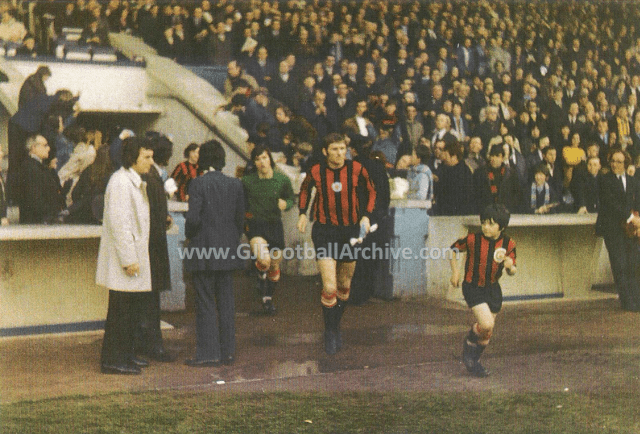
1971 ECWC v Chelsea. Tony Book and mascot Paul Todd. Photo by Alan Jubb
The above image is of the same dugouts in 1971. I tend to think that by this time they were only used if it was a wet day as they provided a little bit of shelter. Notice the bar scarfs in the crowd – blue & white; red & black and one that’s blue & white with a thinner maroon bar too.
For decades, the manager’s dugouts weren’t the only ‘dugouts’ at the ground as there were also similar arrangements for the police and/or St John Ambulance personnel in Maine Road’s corners. These seemed to be in use into the 1960s as this image shows. Look carefully to the right of the player on the right and you can see two police or St John’s Ambulance staff in a corner dug out near the Kippax. This image is from the early 1960s.
These also disappeared when parts of the white wall were rebuilt and gates added in the corners.
For those unfamiliar with Maine Road this photo may help locate the player dugouts. You can’t really see them but one was positioned in the white wall in front of number 1 and one to the left as we look of the central tunnel next to 1.
Maine Road aerial 1971 from Farewell To Maine Road
If you’d like to read more on the history of Maine Road, take a look at Farewell To Maine Road, which can be downloaded from this page:
If you enjoy all the free material on my website and would like to support my research and keep this website going (but don’t want to subscribe) then why not make a one-time donation (or buy me a coffee). All support for my research is valued and welcome. It allows me to keep some free material available for all. Thanks.






 Gary James' Football Archive