On this day (29 May) in 1961 thousands were able to sit on benches installed on the Kippax for the first ever time. But wait a minute, the Kippax wasn’t seated until 1994-95 or was it? So read on to find out what happened in 1961…
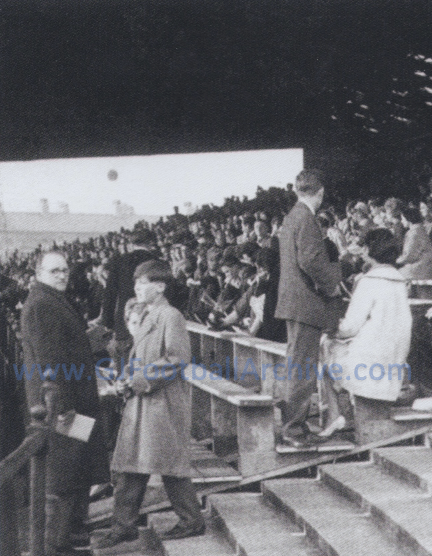
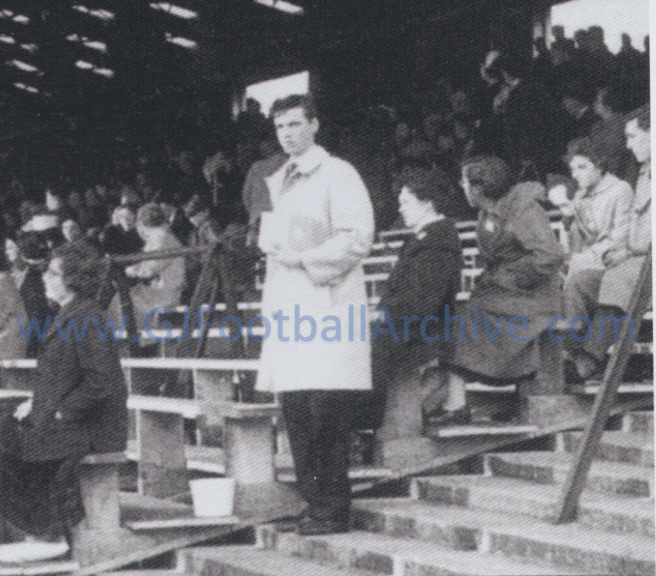
Maine Road staged one of the religious events where American evangelist Billy Graham came to preach to thousands in 1961. I cover the story in detail in Farewell To Maine Road but these images show that temporary seating was installed on the Kippax for the event, which took place between 29 May and 17 June 1961.
At this time there were no gates in the Kippax’ perimeter wall leading to the pitch and so special scaffolding steps were erected to allow attendees to climb over the wall and on to the pitch for blessings etc.
Were you at one of these religious events? If so leave your comments about the day below.
For those unfamiliar with Maine Road’s layout at the time, the above photo was taken from about a third of the way up the Kippax between number 6 and 8 on this photo.
Maine Road aerial 1971 from Farewell To Maine Road
If you’d like to read more on the history of Maine Road, take a look at Farewell To Maine Road, which can be downloaded from this page:
If you enjoy all the free material on my website and would like to support my research and keep this website going (but don’t want to subscribe) then why not make a one-time donation (or buy me a coffee). All support for my research is valued and welcome. It allows me to keep some free material available for all. Thanks.
Anyone remember seeing the CITY F.C. flag that used to proudly fly above the Popular Side/Kippax. It was there for decades. There had been a CITY F.C. flag at Hyde Road and it may well be that this was the same flag. It was often referred to in the media during its life at Maine Road, such as in this 1925 cartoon:
The first derby at Maine RoadThe City flag flying at Maine Road’s first Manchester derby
The flag flew proudly over the Popular Side until the stand was roofed in 1957. Then the flag was moved to the Scoreboard End, eventually disappearing in the 1960s when rumour has it that it was taken down by Liverpool fans. I’m not certain if that’s true and I’ve never found any evidence but if you do know more please let me know.
I do know that in the 1930s a disgruntled City fan lowered it during a difficult game and it caused outrage. It was mentioned in the local press and the culprit had to make a formal apology to the club and his fellow City fans.
This 1971 image shows the roofed Kippax Stand. The flag was originally on a flag pole roughly where the number 7 is in the days before the stand had a roof. When the Kippax was roofed it was moved to the back of the Scoreboard End. The North Stand (10) replaced the Scoreboard End in the early 1970s.
Maine Road aerial 1971 from Farewell To Maine Road
If you’d like to read more on the history of Maine Road, take a look at Farewell To Maine Road, which can be downloaded from this page:
If you enjoy all the free material on my website and would like to support my research and keep this website going (but don’t want to subscribe) then why not make a one-time donation (or buy me a coffee). All support for my research is valued and welcome. It allows me to keep some free material available for all. Thanks.
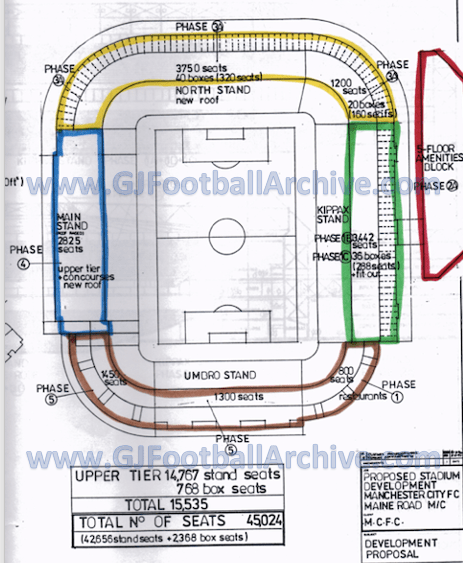
Here’s a 1994 plan of what might have been in terms of Maine Road’s development. This image is of how the entire stadium was supposed to look. To explain the colour image looks towards the stadium from above the Kippax car park. The North Stand is on the right and the Platt Lane on the left. The black and white image is from the other side of the ground, looking towards the Kippax from the Main Stand.
1990s Maine Rd redevelopment plans as seen in Farewell To Maine Road
You can see from the black and white image that the plan was to replicate the general look of the new Kippax (being planned at this stage – this was January 1994 and the old Kippax was still standing) around the ground. The North Stand was to have a second tier added and hospitality boxes between the levels, like the new Kippax. The Platt Lane was to have a second tier added above the two lines of existing hospitality boxes.
The Main Stand would have part of the seating chopped away and a new second tier added.
To facilitate all of this some houses were to be bought and demolished on the streets immediately behind the North Stand and the Kippax/Platt Lane corner.
The new Kippax was the first phase of the development but Manchester’s bids for the Olympics changed thinking. Couple that with relegation in 1996 and the wholesale redevelopment of Maine Road was postponed after the Kippax opened and then dropped completely.
As mentioned previously, Francis Lee’s plans would have seen the new Kippax followed by a phased development of each of the other three stands. These images might give an indication of how it would have progressed.
The following 1971 aerial image shows the proximity of the housing on Thornton Road (bottom left, near number 6) and behind the North Stand (number 10). They were planned to be demolished in Lee’s 1994 plan.
Maine Road aerial 1971 from Farewell To Maine Road
If you’d like to read more on the history of Maine Road, take a look at Farewell To Maine Road, which can be downloaded from this page:
If you enjoy all the free material on my website and would like to support my research and keep this website going (but don’t want to subscribe) then why not make a one-time donation (or buy me a coffee). All support for my research is valued and welcome. It allows me to keep some free material available for all. Thanks.
Ten years ago this month I was awarded my PhD. It’s been a remarkable decade since. there were two areas I wanted to make significant progress in during the time that followed. One was the establishment of an annual conference where those researching the history of football (of all codes) could meet and share ideas in a positive and supportive environment. the other was to perform detailed research into the history of women’s football in Manchester.
Both aims have been met with the establishment of the International Football History Conference and the setting up of a self funded project into women’s football. The next football conference is in Belfast next month and the women’s football history project has seen two books, a booklet, a chapter and lots of articles published.
I’ll be posting features on both soon. Thanks to all who have helped with these initiatives.
On this day (24 May) in 2021 Pep Guardiola won the League Managers Association Manager of the Year Award. Here’s the origins. press release from Manchester City issued that day…
Pep Guardiola wins LMA Manager of the Year award • Pep Guardiola has been named LMA Manager of the Year for the second time in four seasons • Guardiola’s team has already completed a League and Cup double and now have their sights set on Saturday’s Champions League final • The Catalan manager acknowledged the importance of sharing his award with the players and staff who have guided City to success this season Pep Guardiola has been named Manager of the Year by the League Manager’s Association.
Adapting to the challenges posed by the Covid-19 pandemic, Guardiola guided Manchester City to a third Premier League title in four seasons and a fourth consecutive League Cup.
On Saturday, Guardiola and his players will compete in a first Champions League final in the Club’s history.
Voted for by fellow managers, it is the second time the City boss has been awarded the prize, having previously done so in recognition of the 2017/18 Centurions season.
Pep Guardiola: “I am delighted to win this award for the second time, but an award like this is only possible if a manager is surrounded by top professionals.
“My players have been fantastic – their dedication and professionalism never waver, even in a season that has been the most challenging we have ever faced.
“And my staff are also deserving of the highest praise. I am so lucky to have a team of people who give everything they have every single day to make sure Manchester City are the best we can be.
“This award is dedicated to and shared with them.”
Director of Football Txiki Begiristain added: “Pep deserves this award, absolutely. To win the Premier League and Carabao Cup, as well as reach the final Champions League final, in the most trying season we’ve ever seen, says everything about his quality as a manager.
“He has shown an outstanding ability to constantly innovate. With the challenges presented by COVID-19, he’s had to adapt to a new way of working. He’s done it brilliantly and our results say everything you need to know.
On this day (22 May) in 2022 Manchester City beat Aston Villa 3-2 to win the Premier League in dramatic style. In 2012 whenCity won the League with that last day drama I thought ’ah, well we’ll never experience anything like that again. Next time it’ll feel different’ but then they did it again! As time goes by we tend to think of those incredible days as a great way to win the title but at the time it doesn’t feel like that! Here’s some of my film from that day:
The 2021-22 season was an incredible season and we should always look back and remember that success (and all the others we’ve enjoyed). To win the Premier League you have to be the best, most consistent team that season. Winning the League – especially one that we are often told is the greatest in the League – is the mark of a truly great team.
Let’s not forget this success made it 4 titles in 5 seasons too! I know City ended up doing 4 in a row, but that is truly exceptional (and unique in England).
Years ago the great City coach Malcolm Allison told me that ‘it’s important to celebrate each success as if it’s your first because it could be your last.’ Never take anything for granted.
It’s the Women’s FA Cup final today (Chelsea v Manchester United). If you’re interested in reading content about women’s football then there are plenty of articles on my website that may be of interest. Listed below are links to all those tagged ‘women’s football’ including a piece on the original Man Utd women’s team.
Looking forward to this weekend’s men’s FA Cup final. Back in 2011 Manchester City won their first FA Cup since 1969. The success became the first major trophy win of the current City ownership. To reach the final in 2011 City defeated Manchester United in that season’s FA Cup semi final. A few years back I produced Restored 2011: The All-Manchester FA Cup Semi Final and as we build up to this year’s FA Cup final it’s well worth reminding ourselves of this time when fans hoped for success. It’s a nice reminder of how significant the FA Cup has been to City’s modern success.
This special 1 hour audio recording looks at the years between City’s 1976 League Cup success and the FA Cup glory of 2011. 2011 was a crucial step in City’s journey since the 2008 takeover and I felt it was vital to do a special marking this.
So what’s in this special recording? Well, I’ve included exclusive material from interviews and recordings I’ve done over the years with Garry Cook, Brian Marwood, Roberto Mancini, Peter Barnes and Peter Swales. Why Swales? Well, have a listen and you’ll hear why. Basically though I’m trying to set the tone for why the 2011 FA Cup semi final victory and overcoming Manchester United was so significant.
On Mancini… I include a few words from him recorded in 2011 and at one point he talks about the view that was then being expressed that City were ‘trying’ to buy success (now they say City ‘have’ bought success!). His words are a reminder that City have been having that particular criticism thrown at them for over a decade! Oh well, I wonder how long those criticisms were laid at other clubs who had seen major investment which propelled them forward?
Anyway, get yourself a brew and be prepared to be transported back in time. Here’s the recording:
If you enjoy the recording then please let me know, comment or subscribe to the site. If it’s of interest then, over the coming months and years, I’ll produce others like this highlighting key points in Manchester City – and Manchester’s – footballing history. It costs £20 a year to subscribe (it works out £1.67 a month) or £3 if you’d like to sign up a month at a time to get full access for as long as you subscribe (you can always try it for a month). It’s worth bearing in mind that the 2010 Manchester A Football History cost £24.95 and all subscribers will be able to access all of that for as long as they are a subscriber (plus all the other stuff of course). You can subscribe below.
On this day (15 May) in 2022 City fought back from 2-0 down to draw 2-2 to keep the Premier League title in their own hands. Jack Grealish made it 2-1 four minutes into the second half when his volley deflected off Craig Dawson and over Lukasz Fabianski. City’s second was an own goal by Vladimir Coufal, who headed Riyad Mahrez’s free-kick into his own net.
You can see the action from City’s 2-2 with West Ham United here:
Today (14 May) in 2023 goals from Ilkay Gundogan (2) and Erling Haaland gave City a 3-0 win at Goodison Park and left Manchester’s Blues within one win of sealing a third consecutive Premier League title. This was Gundogan’s 300th appearance for City. It was also City’s 11th straight Premier League win. Highlights here:




 Gary James' Football Archive