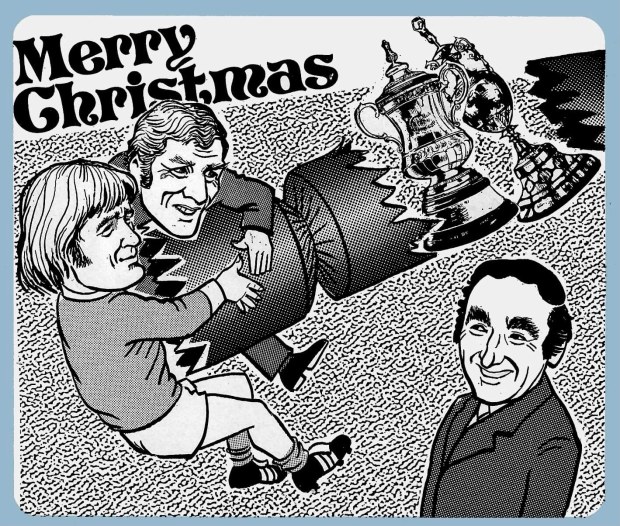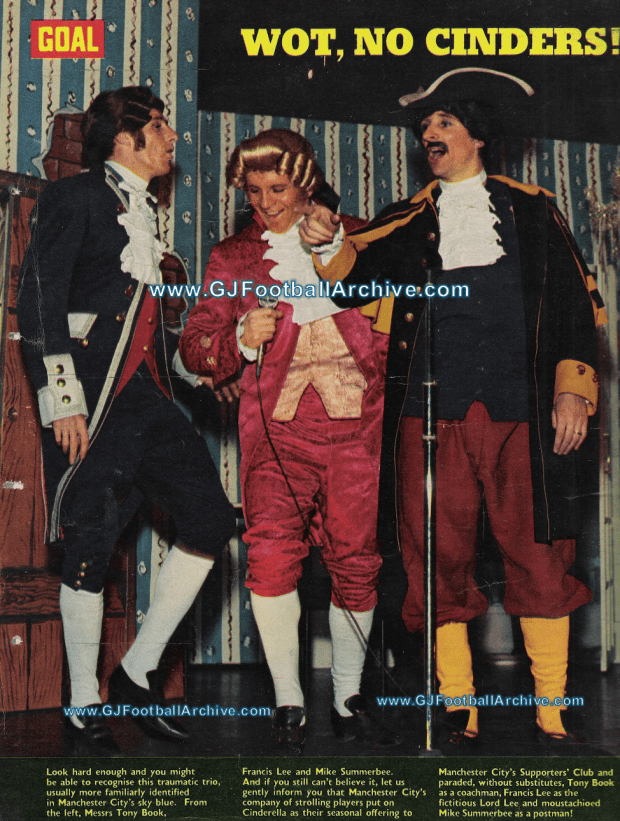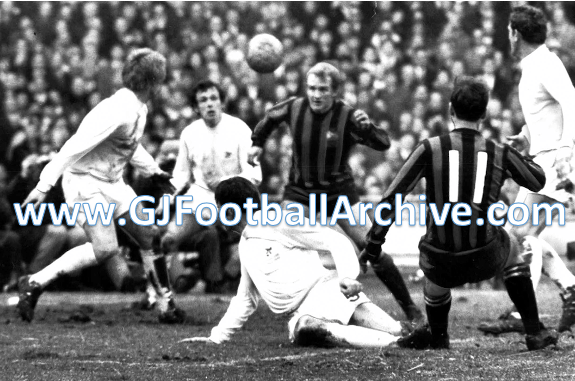
On this day (March 7) in 1970 Manchester City defeated West Bromwich Albion 2-1 in the League Cup final. City’s goalscorers were both grandfathers of modern day player Tommy Doyle (currently on loan to Birmingham from Wolves). They were Glyn Pardoe and Mike Doyle. Sadly both men have since passed away. As you can see below I interviewed Glyn a few times over the years, including one of my first ever interviews back in the early 1990s (it was for my biography of Joe Mercer and Glyn was a wonderful, welcoming man).
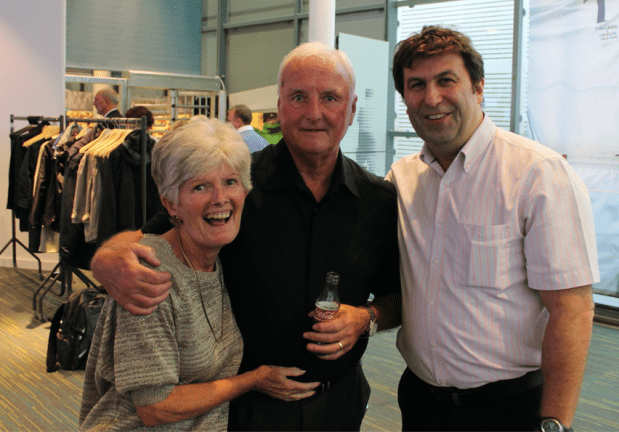
This photo is of Glyn with Janice Monk and Steve Mackenzie at one of my book launches. Back in January 2004 I interview Glyn for my then regular Manchester City match programme series In Search of the Blues. Here is that interview as it was written up for the programme:
Glyn Pardoe holds the record for the youngest player to make his debut with the Blues. At the age of 15 years and 314 days he played in City’s 11th April 1962 meeting with Birmingham City. He went on to play throughout City’s glorious late sixties period and made a total of 374 (plus 2 as substitute) appearances.
Gary James, author of Farewell To Maine Road, caught up with Glyn to discuss his playing career and his present day activities.
Let’s start with your role today, I’m sure many of our readers will have heard you on local radio this season. Can you explain your role?
I work with Ian Cheeseman, Jimmy Wagg and the others at GMR to provide my views on what’s happening on the pitch. Part of that is actually sat next to Ian summarising, and part of it is after the match when I am one of the guys talking to callers and generally talking about City. It’s a great role and I love chatting to fans. Ian and Jimmy are nice lads as well, and the great thing for me is that I enjoy it. I love listening to supporters giving their views and I like to stress that the game is still all about opinions. It doesn’t matter what else changes, football is a great game to talk about.
How did it all come about?
You have to go back to the eighties when I was still working for the Club. Back then Ian Cheeseman was doing the Club videos of each game, while I was working with the Reserves and the Youth teams. I was asked to give my opinions of each first team game for the Club videos, and so I’d work with the Reserves in the morning, then head off up to the old commentary gantry at Maine Road for the first team.
Eventually that stopped of course, but then a few months ago I got a call from Ian. Totally out of the blue really… I didn’t ever consider I could do the same thing on radio. Ian asked if I could help for one game, so I did, then afterwards they kept asking me back.
Did you find it difficult?
At first it was hard, although I don’t think any of that came across. Unlike the old days of working on the video, I was not too familiar with every one of the first team squad, so it took some time to work out the characteristics of each player. I also have a day job of course – it’s security reception work – so that had to be taken in to consideration. Nevertheless, it has been a great experience and I do enjoy doing it.
Going back to your early career, making your debut at such an early age must have been a shock?
Well you’d think so, and I’m sure it was, but I did actually get to find out a few days before, so that helped. If I’d have found out on the morning I don’t know how I’d have coped. I don’t think I ever thought about my age. I’m sure others did, but to me it was just a great opportunity.
Your debut came against Birmingham in 1962. Do you remember much about the game?
Not really, except we lost 4-1 at home and I was up against a tough centre-half called Trevor Smith. I wore the number nine shirt for that game – I later played in almost every position! I don’t think I did a great deal, but I know I kept my place for the next 3 games.
These were not particularly good days as far as fans were concerned, but how did it feel to be a player during those first few years of your career?
The great side of the 1950s had disintegrated really. We still had a few of the players in the side like Trautmann and Hayes, but the rest of the side was mainly youngsters finding their feet. It was difficult because there was a general air of despondency. We’d go to places like Blackburn and expect to win. We’d take the lead, but end up losing 4-1 (1st May 1963) and I think that said it all. We didn’t know how to win matches. At the time I knew nothing else really, but when you do start to find success you suddenly realise how bleak the atmosphere inside the Club had been just a couple of seasons earlier.
Because you made your debut at such an early age did you think ‘this is it, I’ve made it’?
Not a chance! They’d never have allowed me to think like that anyway. I remember playing on the Saturday, and then walking up to the ground on the Monday and having to knock to be allowed in. As far as everybody was concerned I was a Reserve – or even a youth player I suppose – not a first teamer. You never actually ‘made it’ until you were a first team regular and even then you could never be complacent. Even when we were winning all the trophies there was a very real fear that your contract would not be renewed. I remember worrying each summer, thinking that I’d be forced to move on.
In those days the Club had total control and as a player you were simply glad to be there. We’ve gone to the other extreme now, but for me I don’t think I ever felt I’d made it. Even when we were the most successful side in the Country.
How do you feel the mid-sixties transformation of the Club’s fortunes came about?
Joe Mercer and Malcolm Allison came in. That’s it really. I remember when the Club was at its lowest and we had no hope, ambition, or direction and as a player you really worried about where we were heading and who the new guy might be. I was still only about 18 and had no idea how it would all pan out of course. Then Joe arrived, followed by Malcolm, and everything started to improve. Training improved considerably and so you started to realise how football could be improved and enjoyed.
What were your first impressions of Mercer & Allison?
Joe was a very respectable figure. We knew what he’d achieved as a player and he had a great approach. He was quiet but very supportive. A real calming influence. Lovely.
My first impression of Malcolm – remember I was still only a lad – was that he was very loud. He liked to shout a lot! Naturally, I got used to that, but at first it was a bit of a shock. Malcolm was a terrific coach and we all learnt so much from him. He was fantastic once you got to know him, and together they both turned us into a great side.
In the 1965-6 promotion season I only missed the opening game, so it was their arrival which made me a regular first teamer. I’d had good runs before that of course, but once they arrived I hardly missed a match, and enjoyed the successes.
The 1970 League Cup Final saw you score the winning goal 12 minutes into extra-time – presumably a great moment?
Fantastic! It’s always a great feeling when you score, but when you score in a cup final it’s tremendous. A truly great memory.
Not too long after that you suffered with a serious leg injury sustained in the Manchester derby. Did you realise how bad it was at the time?
I knew very little at the time. It was the December 1970 game at Old Trafford and there was a collision between me and George Best. Apparently I broke my leg and an artery was trapped, but I have no memory of what followed. I’ve been told that I was within twenty minutes of losing my leg. They had decided that removing my leg would save my life, but fortunately the operation they eventually did meant that my leg was saved as well. I was in a daze for at least four or five hours and really have no idea of the worry my family and friends went through.
You were only 24 when the injury occurred, and it was a long struggle back to fitness after that wasn’t it?
I missed the rest of that season, all the next, and didn’t play again in the first team until November 1972. Even then my appearances were limited. I managed 32 League appearances during 1973-4 and played in the League Cup Final with Wolves, but my career was really over.
Even now I still haven’t got full movement back, but I do feel fortunate that I am still alive and I still have my leg.
Personally, considering your age at the time I feel the blow you suffered was equal if not greater than the tragedy suffered by Paul Lake and by Colin Bell. Presumably you regard it as your worst moment?
I don’t like thinking about worst moments. Football was all about enjoyment to me. I feel very lucky to have been in such a successful side, and to play during a great period. Not many people are given the opportunity in the first place, so it all has to be great.
Which players were you closest with during your career?
Alan Oakes is my cousin of course, so I’d been playing with him since I was very young. The two of us, plus Mike Doyle and Colin Bell were known as the Big Four because we were always together. We played golf a lot and so were always seen together, but the whole of the playing staff was close in those days. We had a great team spirit.
After your playing days finished you continued to work with the Club. Did you enjoy that period?
I worked with the youth sides, and winning the Youth Cup against United in 1986 was a great moment. The lads had so much enthusiasm – Paul Moulden, Paul Lake, Steve Redmond, Andy Hinchcliffe, Ian Brightwell and the others. That gave me great satisfaction but people forget that we came close to winning it again three years later. Watford beat us in the final, but that side contained players like Neil Lennon, Ged Taggart and Ashley Ward. To think that so many of the players from those two sides went on to play international football or make a name for themselves at other clubs makes you appreciate the quality we had at the time. Those kids had ability, and it brought me and the others a lot of satisfaction.
Finally, how did the fans treat you during your time at the Club?
Always great. They were very supportive – even when we were struggling at the start of my career. They gave me fantastic treatment throughout my career, and I still enjoy meeting and talking with them today.
Here’s film of that 1970 final:
A reminder that you can still watch my 1 hour plus talk on Manchester City crowds, support, chants and Maine Road here. It’s free to watch:
I’m keen to hear thoughts on the idea of doing other talks like this for subscribers to my site. If you’re interested then please get in touch and let me know what you’d like me to talk on. I have quite a few ideas I’m keen to do and am also open to suggestions. Thanks.
If you enjoy the talk then please subscribe to my site. I am a self employed historian and spend all my working week writing, researching and publishing my work. I am not an employee of any organisation (I know some think I’m employed by a football club but I’m not an employee of any club). I am independent of any organisation and care passionately about the quality and accuracy of my work.
A limited amount of content will always be free for anyone to read but those subscribing will have access to everything on this site for as long as they subscribe. For subscribers I guarantee to post a minimum of 4 articles alongside adding material from my archives each month (in practice it’s been much more than this!). To subscribe costs £3 a month or £20 a year (a reminder that the 2010 edition of Manchester A Football History cost £24.95 when published and is now out of print but available to subscribers as a downloadable pdf as part of their subscription.).
If you’re uncertain whether to subscribe or not then why not subscribe for a month at £3 and see if you’re getting value for money. The £20 annual subscription works out about £1.67 a month for a guaranteed 4 new articles per month and access to everything else posted in the archive.
You can subscribe here:
Subscribe to get access
Read everything on this website when you subscribe today.