Continuing the series on Manchester City in the 1920s here’s a brief post on 1920s City manager Peter Hodge. Enjoy!
Peter Hodge
City Manager between: 26 April 1926 – 12 March 1932
Previously: Former Leicester City manager.
Took Over From: Committee led by vice-chairman Albert Alexander snr.
Inherited: Sam Cowan, Tommy Johnson & Frank Roberts.
Players Brought In: Eric Brook & Fred Tilson.
Youngster Gave Debut To: Matt Busby
Players He Let Go/Sold: Tommy Johnson in 1930, leading to widespread demonstrations and a boycott (crowds dropped by around 8,000 following the move).
First Game: City 2 Leeds Utd 0 (City scorers Austin & Johnson), 27 April 1926, Division One, attendance 43,475
Lows: Relegation five days and 2 games after taking over in 1926.
Last Game: Arsenal 1 City 0, 12 March 1932, FA Cup semi final at Villa Park, attendance 50,337.
Unusual Start: It was agreed Hodge would become City manager in 1926 but would only take up the post after his current club Leicester ended their own season. Their last game was on 24th April 1926 and he became City’s manager with 2 League games left the following Monday. The Blues looked safe from relegation, but defeat at Newcastle saw City demoted (a point would have kept them up).
Similar End: Hodge’s City career ended with defeat by a solitary goal in the dying seconds of the FA Cup semi-final with Arsenal in 1932. The manager had already agreed to return to his previous club Leicester once City’s FA Cup campaign ended.
Season By Season Record:
League
1925-26 P 2 W 1 D 0 L 1 GF 4 GA 4 Pts 2
1926-27 P 42 W 22 D 10 L 10 GF 108 GA 61 Pts 54
1927-28 P 42 W 25 D 9 L 8 GF 100 GA 59 Pts 59
1928-29 P 42 W 18 D 9 L 15 GF 95 GA 86 Pts 45
1929-30 P 42 W 19 D 9 L 14 GF 91 GA 81 Pts 47
1930-31 P 42 W 18 D 10 L 14 GF 75 GA 70 Pts 46
1931-32 P 32 W 11 D 10 L 11 GF 70 GA 59 Pts 32
2 points for a win
FA Cup
1925-26 City competed in the FA Cup Final 2 days before he took over.
1926-27 P 1 W 0 D 0 L 1 GF 1 GA 4 Reached 3rd round
1927-28 P 3 W 2 D 0 L 1 GF 3 GA 2 Reached 5th round
1928-29 P 1 W 0 D 0 L 1 GF 1 GA 3 Reached 3rd round
1929-30 P 5 W 2 D 2 L 1 GF 18 GA 7 Reached 5th round
1930-31 P 1 W 0 D 0 L 1 GF 0 GA 3 Reached 3rd round
1931-32 P 5 W 4 D 0 L 1 GF 16 GA 7 Reached semi-final
TOTAL (League & cup fixtures)
P260 W122 D59 L79 GF 582 GA 446
Trophies Won: Second Division title 1927-28, the season after missing out on promotion by the tightest margin in the history of the game.
Followed By: City secretary Wilf Wild who went on to become a truly successful manager.
If you enjoy all the free material on my website and would like to support my research and keep this website going (but don’t want to subscribe) then why not make a one-time donation (or buy me a coffee). All support for my research is valued and welcome. It allows me to keep some free material available for all. Thanks.
Read more of this content when you subscribe today. It costs £20 a year to subscribe (it works out £1.67 a month) or £3 if you’d like to sign up a month at a time. Annual subscribers get full access for as long as you subscribe (you can always try it for a month). It’s worth bearing in mind that the 2010 Manchester A Football History cost £24.95 and all subscribers will be able to access all of that for as long as they are a subscriber (plus all the other stuff of course).
It costs £3 a month to subscribe a month at a time. Why not give it a try! Monthly subscribers get access to everything posted since 1 October 2022 for as long as you subscribe.
Continuing the series on Manchester City in the 1920s here’s a free to read 1300 word article on 1920s City (and 1900s United) manager Ernest Mangnall. Enjoy!
Although JAMES ERNEST MANGNALL is usually remembered as the first man to bring Manchester United trophy success – with a side containing the key members of City’s 1904 FA Cup triumph – he actually spent more years managing the Blues and saw City as the bigger club with more potential.
People tend to focus on his successes at United but his commitment to the Blue cause and determination to move City to the best stadium in English football, are perhaps the most interesting aspects of his life. His United successes are clearly significant moments in Manchester football, however City fans prefer to remember his Blue achievements.
He joined City in 1912 but the most interesting aspect of his arrival is the way it was carried out. Mangnall had been United’s leader since 1903 and had achieved so much that no one could ever have expected him to move. As well as the trophy successes (promotion, two League titles and the FA Cup) he was also credited with being instrumental in United’s move from Clayton (where the Velodrome’s BMX track is today, close to the Etihad Stadium) to Old Trafford.
City were still regarded as the region’s number one club despite the problems they had faced in the period 1905-1912, and they stunned the football world when they lured Mangnall away from the Reds. Never before had a manager left a major club for its biggest rivals after so much success, but what made the story more of a sensation was the fact Mangnall had agreed to become City manager while still in office at Old Trafford, and that he had watched the Blues’ opening game at Notts County when he was supposed to be with United at Arsenal. He actually remained in charge of United for the Manchester derby of 7th September 1912 at Old Trafford.
Occasionally United historians dispute that Mangnall was officially their manager on the day of the derby but leading newspapers of the period, most notably the Umpire and the Daily Dispatch, are perfectly clear that he was officially in charge. City won the Old Trafford match 1-0 despite being down to ten men for most of the game. Mangnall, according to one report, was delighted with the City win despite, officially at least, still being a Red. “United speeded their manager rejoicing with two points to his new club” read one article.
The following Monday Mangnall moved into his Hyde Road office, and within a few weeks his side were looking like Championship contenders: “Manchester City stand out boldly as the only first class team in the two divisions of the League, the Southern and the Scottish Leagues, with the highest possible points to their credit. The Citizens of Manchester have earned every point in September. Other clubs have remained undefeated, but they have not annexed the maximum marks. Nine years have passed since Manchester City commenced a campaign in this stimulating style.”
The title didn’t arrive, however Mangnall did develop a decent-looking side by the time of the First World War – they missed the 1914-15 title by three points. City were also proving a highly popular side to watch, so much so that the ground could hardly cope. A notorious cup match with Sunderland in February 1913 had to be abandoned due to overcrowding. Incredibly – and this is difficult to appreciate today – the team manager was also responsible for the management of the ground at this time, and so Mangnall was held responsible for all matters concerning safety and crowd control as well as picking the team and buying the players. A reporter named Veteran accused Mangnall of spending too much time with the team and said: “I am rather surprised at Mr. Mangnall being caught napping, but it may be that he has been away with the team and had had little to do with the home management.”
During the hostilities Mangnall kept the Club alive and brought some trophy success in the wartime tournaments that replaced the League.
After the war, Mangnall’s side became very popular and he had to focus on ground issues as well as team matters. With the Blues filling the 40,000 capacity on a regular basis, Mangnall regular had to face the press, the FA, the Football League, Manchester City Council, and the police to explain why chaotic scenes were being experienced game after game in the streets around the ground.
In 1920 fire destroyed the Main Stand and exacerbated the problems Mangnall faced. He approached his former club United about using Old Trafford, the ground he had been primarily responsible for, but they met his request with exorbitant terms that were ridiculed in the press. Perhaps they still felt a little aggrieved about his departure almost a decade earlier?
Mangnall’s view was that City had to move from Hyde Road. Its forty thousand capacity was far too small, and the manager worked with club officials, most notably another former City manager Lawrence Furniss, to plan the development of a new ground. One with potential.
At the same time as the ground debates, Mangnall guided the Blues to second place in the League and their popularity increased further.
By the start of 1921-22 far too many people were missing out on watching Manchester’s favourite team. That season he created plans for an “English Hampden” on the Moss Side/Rusholme border.
In 1923 City moved to the 85,000 capacity Maine Road, and in Mangnall’s final season (1923-24) he almost managed to guide the Blues to the FA Cup Final. With the 49 year old Billy Meredith back in Mangnall’s side, City were defeated by Newcastle. That run was important as it perhaps demonstrated the reason why Mangnall had been determined to join the Blues back in 1912 for his City side attracted a few magnificent attendances including over 76,000 for a cup tie with Cardiff. At the time this was the largest crowd for any footballing fixture played in Manchester including three FA Cup finals (1893, 1911 replay & 1915). Mangnall knew all about City’s popularity and he must have felt a great deal of satisfaction at seeing such a large crowd in the stadium he had pushed for.
The following May his contract was not renewed, although It seems likely he chose to step down feeling that there was little more he could achieve at Maine Road. After leaving the Blues he became a director of his home town team, Bolton, and was a significant figure within the PFA. He died of a cerebral embolism in 1932 at St. Annes.
In addition to his roles at Burnley – his first club as secretary, United, City, and Bolton, he was also recorded as the man responsible for founding the Central League and the Football Managers’ Association.
Modern day football rarely remembers men like Mangnall, however his place in the history of Manchester must always remain a significant one. He restored pride and passion to the Blues and was the key figure in City’s move to Maine Road. That move enabled City to rediscover their ambition, drive, and natural position as one of England’s elite.
Football historians tend to focus on Mangnall’s United career but that does the man a great disservice. He may have won trophies at Old Trafford but his entire career was packed with achievements.
Mangnall should always be remembered as the catalyst for City’s regeneration during a difficult period. The fact that he walked out on United to take on the City challenge adds an angle that Blues love. Mangnall was a great Blue.
If you enjoy all the free material on my website and would like to support my research and keep this website going (but don’t want to subscribe) then why not make a one-time donation (or buy me a coffee). All support for my research is valued and welcome. It allows me to keep some free material available for all. Thanks.
Read more of this content when you subscribe today. It costs £20 a year to subscribe (it works out £1.67 a month) or £3 if you’d like to sign up a month at a time. Annual subscribers get full access for as long as you subscribe (you can always try it for a month). It’s worth bearing in mind that the 2010 Manchester A Football History cost £24.95 and all subscribers will be able to access all of that for as long as they are a subscriber (plus all the other stuff of course).
It costs £3 a month to subscribe a month at a time. Why not give it a try! Monthly subscribers get access to everything posted since 1 October 2022 for as long as you subscribe.
Continuing the series on Manchester City in the 1920s here’s a free to read 1100 word article on 1920s City (and 1930s Everton) star Tommy Johnson. Enjoy!
Tommy Johnson was a huge favourite with City supporters throughout his eleven year career with the Blues. Their love affair with the Dalton-in-Furness born goalscorer was borne out of a tremendous appreciation of his contribution to the Blue cause. They also recognised that despite the fame and adulation Johnson was from the same background as they were. For much of his City life he lived in the Gorton area and was often seen in the pubs and clubs talking and mixing with supporters.
In an interview I did with him two decades ago, Johnson’s son Alan remembered his father being a familiar presence in Gorton: “My father was proud of being an ordinary bloke. The players didn’t get paid large wages and life at times was tough, and I think most of his neighbours and friends understood that he really wasn’t any different from them. After he’d left City and joined Everton he would sometimes bring Dixie Dean to Gorton and the two of them would sit in the Plough or one of the other pubs chatting away. In fact Dixie became as well known in the pubs of Gorton as my Dad was!”
Around 1918 City full back Eli Fletcher spotted the promise of Dalton-In-Furness born Johnson when he saw him play. He contacted the Blues and urged them to sign the exciting 17 year old. Johnson joined the Blues in February 1919, and he immediately made an impression during that final season of wartime football.
Once the full League programme resumed in August 1919 Johnson had to wait for his opportunity to impress in the First Division. His chance did not come until the following February, but when it did he scored both goals in City’s 2-0 defeat of Middlesbrough. It wasn’t however until the 1922-3 season that the striker could be regarded as a regular. That season he played 35 of City’s 42 League games and scored on 14 occasions.
In 1926 Johnson appeared in the FA Cup final and a few weeks later he made his England debut at inside left against Belgium in Antwerp. He scored as England won 5-3. A journalist of the period described him as: “an inside forward with a left foot shot few players have equalled and a penchant for the telling cross-field pass.”
During 1926-7 Johnson broke the twenty goals a season barrier when he scored 25 in 38 League appearances, including a hat-trick in the 8-0 victory over Bradford on the final day of the season. The following season he became recognised across the country as a major striker as he managed to score a Club record 38 goals in 39 League appearances. Five of those goals came in one incredible match with Everton at Goodison when City defeated the home side 6-2.
Tommy Johnson’s record breaking 38th League goal of the season as drawn for the Liverpool Echo.
The following season was to be his last at Maine Road despite his role as the fans’ favourite. There were plenty of magical moments from Johnson. The Manchester derby of October 1929 saw one of Johnson’s most memorable performances. According to the renowned Manchester journalist Ivan Sharpe writing in the Athletic News: “Johnson should have been a fairly happy man. He has the credit of making the match come to life. It was going to pieces early in the second half when Moore thoughtlessly pulled up while appealing for off-side and Johnson – with his right foot – scored and set the game alight.”
The game with United ended in a 3-1 City victory but it also saw one of the more controversial moments of the season when the referee blew for full-time a good two minutes before time was actually up. This was particularly galling for Johnson as he netted the ball after an amazing run just at the moment the whistle went. Ivan Sharpe gave his entertaining thoughts on the incident in his match report: “When Thomas CF Johnson was a boy he dreamed of playing for a First Division team, and like every youngster, of playing at centre-forward.
“On his night of nights he was playing against his own club’s deadly rivals, and over 100,000 eyes were riveted upon him as he darted through the defence – ‘Go on Johnson!’ – dodged this man and that man, drew out the goalkeeper, dribbled the ball round the other side’s last hope and with the roars of the delighted populace acclaiming his performance, rolled the ball through the untenanted goal. I have not asked him, but I know it’s true, because every schoolboy gets those midnight, alone-I-did-it goals.
“But isn’t it a hard world? The once-in-a-lifetime goal dribbled around the goalkeeper on the aforesaid deadly rivals’ very own ground all came true in this battle of Manchester, and the referee said the time had expired a moment before the ball had crossed the line! And that’s not all. Time had not expired. My watch and every watch around me – plus the carefully compiled record I invariably keep of the minutes of the passing show – definitely established that the referee was two and a half minutes too soon. And this is making no allowance whatever for lost time.
“How curious that the referee got in a muddle with his minutes on the day the clock goes back. He provided the last ‘rows’ of summer!”
The following March, Johnson was transferred to Everton for £6,000. The supporters were furious. Petitions were written. Demonstrations were made, and even a boycott of the Blues was threatened, but there was nothing the fans could do to actually stop the transfer. City’s average attendance did drop by several thousand however.
At Everton Johnson won the Second Division Championship and the FA Cup – beating City 3-0 in the final. A spell at Liverpool followed before he became player-manager of Darwen.
In the late 1940s he became licensee of a pub in Gorton and attended Maine Road regularly. He purchased his own season ticket for several years. According to his son Alan, Tommy Johnson was a dedicated City fan: “At Everton he had a lot of success – he won more trophies than he had in Manchester – but City remained his club. In fact, after he’d left City he kept coming back to Maine Road and sometimes paid to stand on the Kippax side of the ground. He was often recognised and was usually congratulated simply for being ‘Tosh’ Johnson!”
Johnson passed away in 1973 at the age of 71. Four years later Manchester City Council named part of a new Moss Side housing development ‘Tommy Johnson Walk’ in his honour close to Maine Road.
If you enjoy all the free material on my website and would like to support my research and keep this website going (but don’t want to subscribe) then why not make a one-time donation (or buy me a coffee). All support for my research is valued and welcome. It allows me to keep some free material available for all. Thanks.
Read more of this content when you subscribe today. It costs £20 a year to subscribe (it works out £1.67 a month) or £3 if you’d like to sign up a month at a time. Annual subscribers get full access for as long as you subscribe (you can always try it for a month). It’s worth bearing in mind that the 2010 Manchester A Football History cost £24.95 and all subscribers will be able to access all of that for as long as they are a subscriber (plus all the other stuff of course).
It costs £3 a month to subscribe a month at a time. Why not give it a try! Monthly subscribers get access to everything posted since 1 October 2022 for as long as you subscribe.
Continuing the series on Manchester City in the 1920s today’s free article is about the City England international (in fact City’s first England international!) who became the manager of Milan in 1926. Here goes…
The first Manchester City player to appear for England was Herbert Burgess, who was reportedly born in Openshaw on 25 February 1883. Burgess was a left back but, according to articles at the time, was only 5ft 4.75 inches tall (weighing 11st 7lbs).
He made his first England appearance against Wales, and City teammate Billy Meredith, in February 1904 and did well in a game that ended 2-2 at Wrexham.
Prior to City Burgess had joined Football League side Glossop in March 1900 and, after three good years there, he moved to City on 30 July 1903. The fee City paid was £250. This was a period when Manchester’s Blues seemed to be cherry-picking the best Glossop had to offer and one report even suggested the nearby club was becoming a nursery club for City.
Burgess made three international appearances in 1904 with the Welsh game followed by a 3-1 victory over Ireland at Solitude, Belfast in March and a 1-0 win over Scotland at Parkhead, Glasgow on 9 April 1904. Only two weeks later Burgess helped City to FA Cup success (they became the first Manchester team to win a major trophy) and the Blues were also League runners up. These were great days for Burgess.
He made one further appearance for England – a 2-1 defeat at Hampden Park on 7 April 1906, played in front of 102,741 – and was furious that one of the Scotland goals was allowed to stand.
This period was a tough one for Burgess as the illegal payments scandal at City completely rocked his world. He was one of 17 players suspended by the FA (I can talk about this for days – it was so unfair and northern newspapers believed it was some sort of conspiracy by the southern based FA!).
Burgess was forced to leave City and, along with other star men, including Billy Meredith, he joined the then underdogs Manchester United and helped them achieve their first major success. He then moved to Denmark and played for Kristiania before joining Hungarian club MTK Budapest.
When his playing days came to an end he became Budapest’s manager and then managed Padova (1922-1926). He left Padova to become Milan’s manager in 1926 and after two years there he returned to Padova.
From 1930 to 1932 Burgess managed another Italian club, Roma. This photo is of Burgess (with cap on) as manager of AS Roma.
Burgess immediately etched his own name into the history of Roma, winning the first ever Rome derby in only his second game in charge. Roma won 1-0 win at Lazio’s Stadio della Rondinella. Burgess also guided Roma to success in the second derby, winning 3-1, the following May, this time at their all-wooden ground Campo Testaccio.
Burgess never lost a Rome derby during his time there as they drew their subsequent two derbies under him. His Roma team also pushed eventual champions Juventus all the way in the 1930-31 campaign, finishing just four points behind Juventus as runners-up.
Sadly, it’s been reported that Italy’s development under the dictatorship of Mussolino meant that English coaches were under pressure to leave and Burgess returned to Manchester, taking a job as a labourer on a housing estate on the outskirts of Manchester. He also became trainer to Ashton National.
He died in 1954.
In total at City he made 94 first team appearances and scored two goals. Had the illegal payments scandal not occurred he may well have been an England regular for several years. As it is his career is pretty impressive for a lad born in Openshaw in the 1880s – FA Cup & League winner; England international; manager of prominent clubs in Hungary and Italy.
People tend to think that it’s only in the modern era that Manchester City have achieved anything or that footballers have gone abroad to coach major clubs like Milan, Budapest and Roma, but the truth is that men like Burgess achieved so much over a century ago. We must take steps to remember them. Oh, and while I’m here it’s worth pointing out that City did have international players for years before Burgess but they didn’t play for England.
The earliest played to make an international appearance while on City’s books made an appearance for Wales in 1890 when the club was still Ardwick. Maybe I’ll write about him one day too?
Subscribe to get access
If you have enjoyed this piece and would like to support my writing while also accessing further great content, then why not subscribe? Those who subscribe on an annual basis get access to everything posted on this site since December 2020 (including PDFs of 2 out of print books, and audio interviews with John Bond, Malcolm Allison etc.). Those subscribing on a monthly basis get access to everything posted since 1 October 2022. It’s £20 a year (subscribe here) or £3 per month (subscribe below). Why not try it for a month?
If you have enjoyed this piece and would like to support my writing while also accessing further great content, then why not subscribe? Those who subscribe on an annual basis get access to everything posted on this site since December 2020. Those subscribing on a monthly basis get access to everything posted since 1 October 2022. It’s £20 a year (subscribe above) or £3 per month (subscribe here). Why not try it for a month?
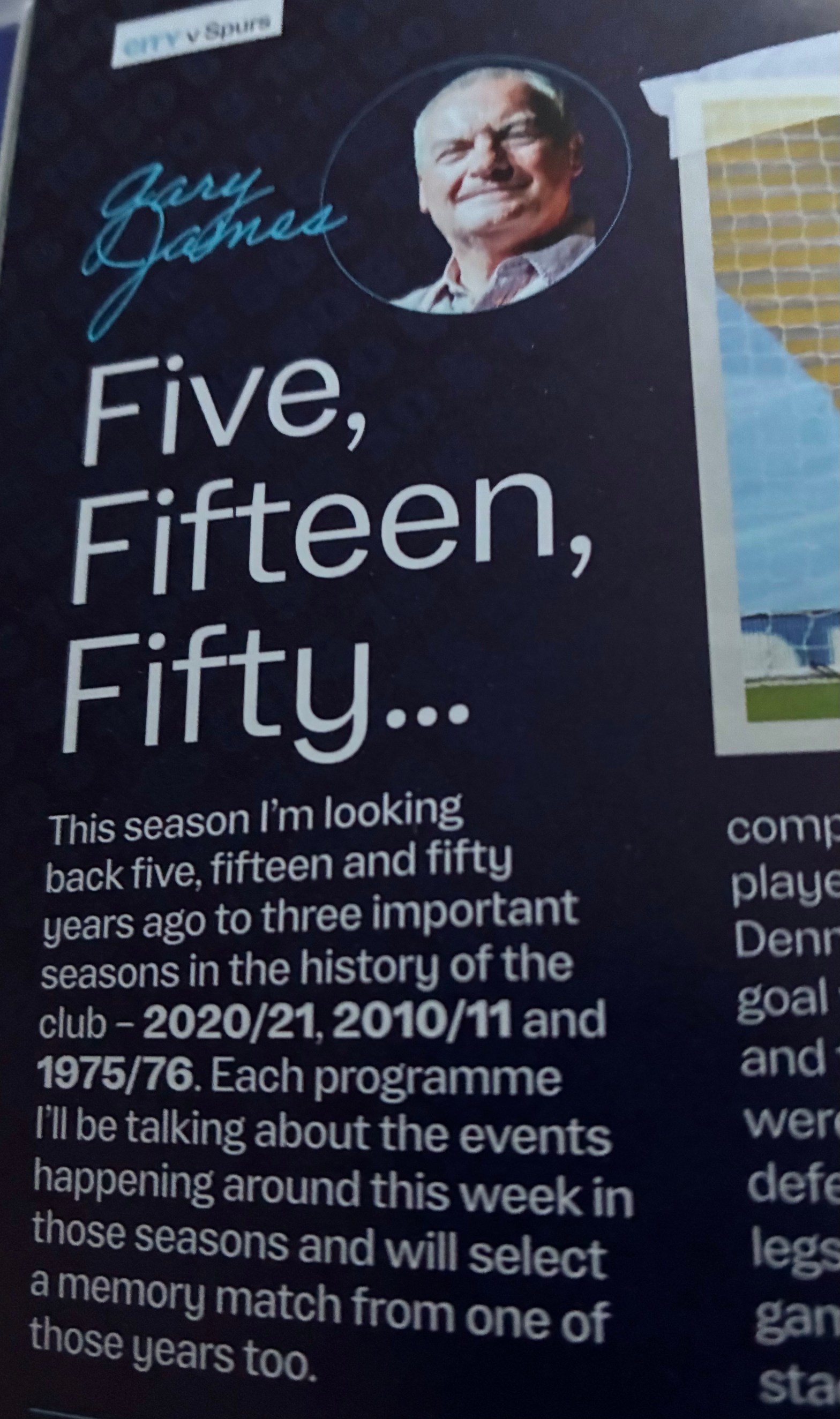
Those who saw the Manchester City v Tottenham match programme at weekend May have noticed my new series of articles. This year I’m doing a season tracker feature and have chosen the seasons 1975-76, 2010-11 and 2020-21. Each issue will cover those seasons plus I’ll write a Memory Match feature on a game from that week in one of the three seasons. The three seasons are all important ones in the history of Manchester’s Blues (every season is important of course!) and I hope I can do them justice. The reason I’ve chosen those seasons….
Typically season tracker pick seasons that are a multiple of five and usually focus on 5, 10, 25 years but I felt it was important to look at a season further back, so chose fifty years ago (1975-76 – one of my own personal favourite seasons). I also wanted to recognise the 2010-11 season as that saw Roberto Mancini’s team win their first major trophy. The 2020-21 season was of course a major trophy winning season unde Pep Guardiola.
The Memory Match I chose for the first issue was from 2010 and a day when Liverpool were defeated.
I hope everyone who gets chance to see the programme enjoys the four page feature. Thanks, as always, to those who support my writing.
The first League meeting between Manchester City and Wimbledon occurred on this day (25 August) in 1984 was an altogether new experience for City. Relegation in May 1983 had brought many changes to the club, including the arrival of manager Billy McNeill and his assistant Jimmy Frizzell. Their first season in charge had seen the Blues finish fourth behind Chelsea, Newcastle, and Sheffield Wednesday, and much was expected from their second campaign.
The opening fixture of the 1984-5 season saw City take to the field against Wimbledon for the first time. It should have been an easy victory for McNeill’s men, particularly as the Blues viewed themselves as championship contenders whereas Dave Bassett’s Wimbledon had risen from Division Four in two consecutive seasons. It seemed at the time as if everyone in football doubted that Wimbledon would be able to handle life in Division Two.
The match commenced with City hopeful, but within fifteen minutes of the start Wimbledon were 2-0 up thanks to goals from Stewart Evans and Glyn Hodges. City just didn’t know what had hit them.
By half-time, however the Blues had pulled a goal back and by full-time had equalised. Gordon Smith and Derek Parlane had provided the crucial City goals, but the game was certainly one which made City realise promotion was not going to be as straightforward as some had suggested. Apart from a victory over Grimsby a few other worrying results followed, then McNeill’s men got their act together and moved up the division. Gradually they rose up the Division – although it’s fair to say there were a few heartstopping moments along the way!. The Blues ended the season in the third automatic promotion spot, while Wimbledon ended the season in an encouraging 12th place – their best ever at the time.
If you enjoy all the free material on my website and would like to support my research and keep this website going (but don’t want to subscribe) then why not make a one-time donation (or buy me a coffee). All support for my research is valued and welcome. It allows me to keep some free material available for all. Thanks.
Starting tomorrow a new series of articles and features on Manchester City in the 1920s. Some of these will be free to read by everyone while others will only be available to those who subscribe to the site on a monthly or annual basis. The 1920s was an important decade for Manchester’s Blues with title challenges, FA Cup finals and stadium moves.
If you’d like to know more about subscribing then see:
Always a controversial question but back in the early 1900s there was only ever one answer and that was Manchester City who were often referred to as simply ‘Manchester’ in official publications for both City and their Manchester rivals. Here’s an image of the title section of the official programme which directly references ‘Manchester’ (meaning City) and Newton Heath.
Obviously, as there was no Manchester United then I guess it was inevitable that City would be known as Manchester to some. It just surprises me that an official publication for both clubs would use ‘Manchester’ so regularly. Presumably both clubs were happy with this. So if anyone asks ‘which club is Manchester? then the one both were happy to call Manchester must be in with a big shout!
On another topic… notice the opportunity to have your flask filled up at City’s headquarters, the Hyde Road Hotel, before the match? Imagine if that option was brought back at the Etihad!
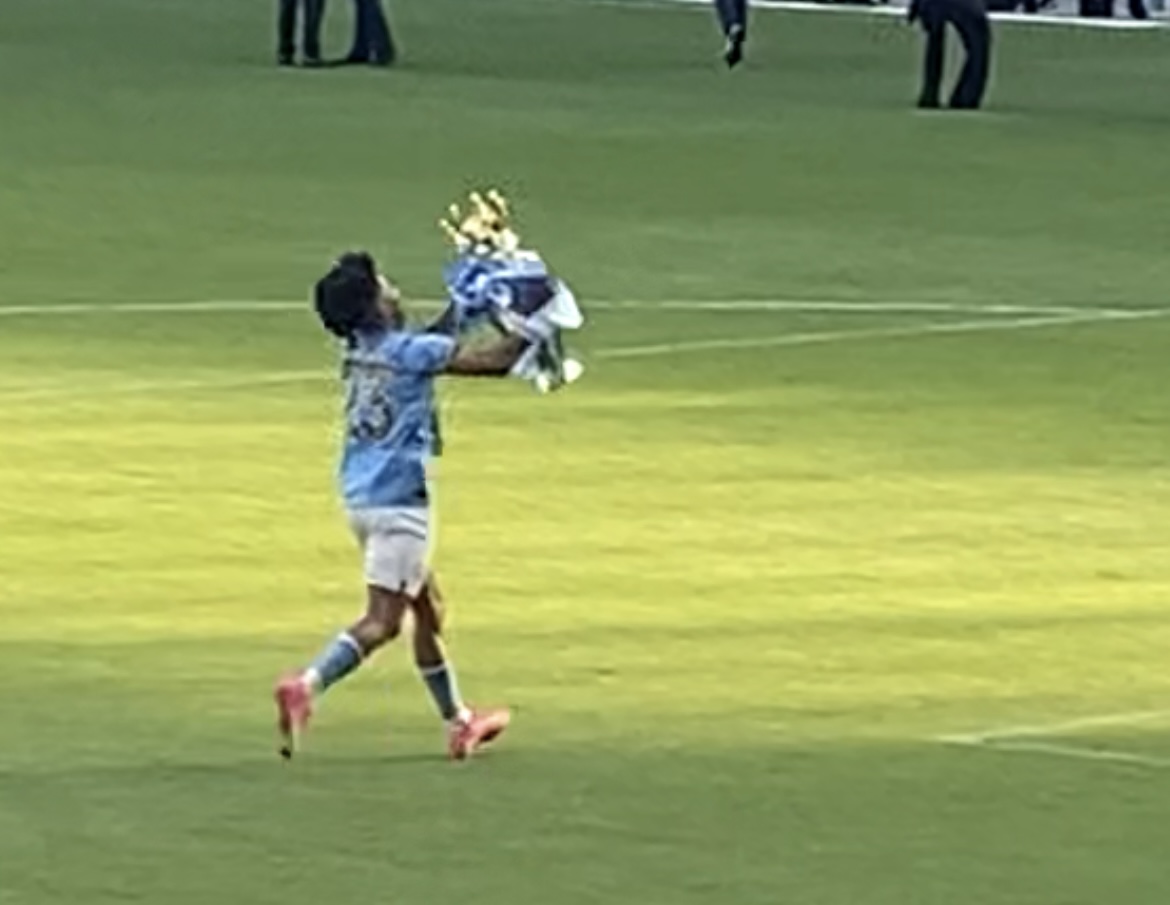
I noticed on Twitter/X that this video of mine of Rico Lewis celebrating Manchester City’s 2023 Premier League success has been retweeted hundreds of times in only a few minutes. As I’m travelling today I didn’t know why but soon investigated and found the news that he may be leaving City.
I don’t know anything more but hope he stays. Regardless of what happens it is a nice reminder of the joy Rico demonstrated on the day of City’s Premier League success.
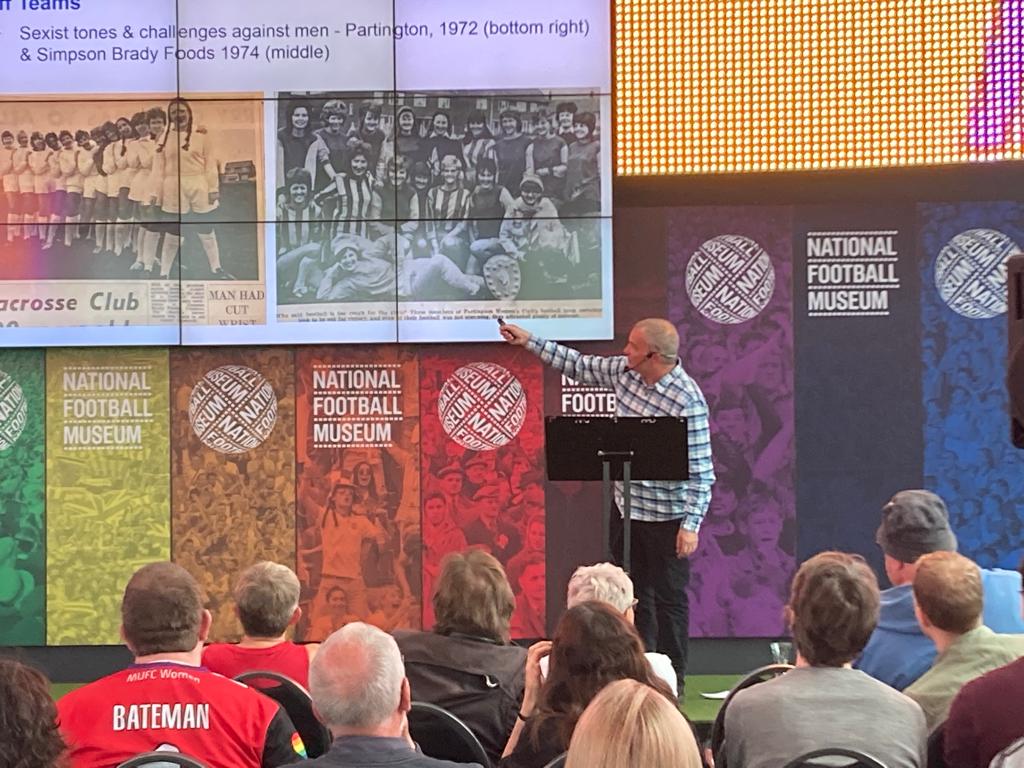
If you’re interested in women’s football or in football in Trafford or Manchester then get your self a brew, settle down and enjoy this video of my talk. It was part of my work on the #WEuro2022 Heritage Lottery funded project and my long standing project into the history of women’s football in Manchester. Here goes:
This talk on the history of women’s football was staged at the National Football Museum a few years back. The talk lasts about 47 mins. Enjoy!
The history of women’s football in Trafford is documented in the new book on women’s football I’ve co-edited. You can find out more about that here: