Guest Blog – James Ernest Mangnall, The Architect of Manchester Football by Iain McCartney

The links between the blue and the red half of Manchester are many, although there are some who will quickly deny the others mere existence. Fortunately, there are others who will embrace those historic, and often welcome links between the two bitter rivals, history being more important than the colour of a football shirt.

The links, as I said, are many, but if only three were to be listed, it is arguable that these would be, in no particular order, Sir Matt Busby, Billy Meredith and Denis Law for self-explanatory reasons. There is, however, one man who should nudge all three of those legendary figures out of the way, a man from the distant past, but one whose place in the history of both City and United is assured, but sadly, often forgotten. His name? John Ernest Mangnall.

Born in Bolton in January 1866, Mangnall also stakes a claim in the history of his local club, and that of near neighbours Burnley, a proud Lancastrian, but it is in Cottonopolis that he comes to the fore and more so during his time with Manchester United.

But for the meantime, let’s push Ernest Mangnall’s footballing credentials to the side [his given first name being lost in the mists of time] and look at the man from a much different sporting angle.

It might be said that football, a game that he played with the same enthusiasm that he carried forward into his managerial positions, was not even his first love, as he was more than a keen cyclist, being a member of various clubs, entering races and most notably cycling between John O’Groats and Lands End, at a time when bicycles were certainly not built for comfort.

Having cut his managerial teeth with Burnley, although he had helped steer Bolton along the way from the boardroom, as a director, he found is way to the dull, dreary surroundings of Clayton in 1903, with many possibly correct in thinking he was a glutton for punishment, as United were little more than a struggling side and had been rescued from what could easily have been oblivion by J.H. Davies. They had also recently changed their name from Newton Heath to Manchester United.

Appointed in place of James West, who had resigned as secretary, Mangnall embraced the role of the man not simply answered the mail and carried out other menial tasks, but took on the running of the club as a whole. Purchasing postage stamps of players made little difference.

Slowly Mangnall began to blend a team together and following a handful of near but not quite near enough finishes, he guided United out of the Second Division and into the top flight at the end of the 1905-06 season where, thanks to his now neighbours City finding themselves in a spot of bother, he ‘stole’ Burgess, Meredith, Bannister and Sandy Turnbull from his rivals and with the likes of Charlie Roberts and Dick Duckworth already at United, he had a more than capable team at his finger tips, creating a team that gave Manchester United their first domestic trophies with the League championship in 1908 and the FA Cup in 1909. The former was also won in 1911, plus success in the FA Charity Shield in 1908 and 1911.

Not only was he instrumental in building a strong United team on the field, he was more than involved in dragging the club away from its slum like home at Clayton and moving to pastures new at Old Trafford.

But all good things come to an end at some point or other and having perhaps achieved as much as he could at Old Trafford, Mangnall made the surprise move across town and joined neighbours City in August 1912. What the club and manager hoped to achieve failed to materialise, but as he had done with United, he played a major part in City’s move to Maine Road.

So, that is the career of Ernest Mangnall in a nutshell, but if you want to learn more about that man then his biography is available now from Empire Publications, 229 Ayres Road, Old Trafford, Manchester, M16 0NL UK Tel: 0161 872 3319 or 1 Newton Street, Manchester M1 1HW – telephone 0161 872 3319.

As something of a postscript.

I created ‘The Manchester United Graves Society’ a couple of years or so back, whereby I am trying to locate the burial places [or cremation details] of as many former players and officials as possible and to date have found over 500. One of the early finds was John Ernest Mangnall, who died at Lytham St Annes in January 1932, and is buried in the Lytham Park Cemetery.

Upon obtaining a photograph of his grave, I was saddened to find that the headstone was broken and the grave in general was in need of some TLC. So, enquiries were made with the cemetery as regards to any red tape that would cause problems in restoring the grave to its former glory and thankfully there were none. To be honest, they were more than delighted that someone wanted to carry out restoration work on the grave.

Funds were raised, a stone mason contacted and the work was carried out. Photos of before and after are shown here.

Should anyone want to visit the grave, it can be found at – A – 512 C/E. Go in the main gate and head up to your right.

Another Attendance Record

On this day (18 October) in 2003 Manchester City scored 6 goals at their new home, the City of Manchester Stadium (now Etihad Stadium), for the first time. It was also the 6th consecutive record attendance for the new ground. There was also a sending off for Shaun Wright-Phillips. It was an odd day in some ways but you can read more below:

Although the game was 1-1 at half-time, City defeated Bolton 6-2 at the City of Manchester stadium.  The 6th was scored by Claudio Reyna in the 84th minute.The Bolton victory was notable from a stadium perspective as it also marked the sixth consecutive highest record breaking attendance for the venue.  Due to seating reconfigurations taking place throughout the early part of the season, a new record crowd for the stadium was set for the first five League games.  

The first competitive game (TNS, UEFA Cup) saw 34,103 – capacity had been restricted to about 35,000 due to safety legislation – followed by a record in every one of the following five League games staged – 46,287 (Portsmouth), 46,436 (Arsenal), 46,687 (Villa), 46,842 (Spurs) & 47,101 (Bolton).  Each of those matches was watched by a capacity attendance.  Over the following months further changes, such as reducing the size of the Directors’ Box, increased capacity further and the record crowd was broken again when Leeds United came on 22nd December (47,126) and then Liverpool (47,201) six days later.  Ultimately, the Chelsea game on 28th February became the season’s best with an attendance of 47,304.

On This Day – Francis Lee

On this day (9 October) in 1967 Francis Lee finally signed for Manchester City from Bolton Wanderers. Heres a long profile of Lee I’ve written on him:

Subscribe to get access

Read more of this content when you subscribe today. It costs £20 a year to get full access to everything on this site throughout their subscription. have a search and see whats available.

Subscribe to get access

Read more of this content when you subscribe today. You can subscribe at either £20 per year (above) or at £3 per month here (cancel any time). For those subscribing £3 per month you will be able to access all content from October 2022 onwards for as long as you are a subscriber. Those subscribing £20 a year have access to everything posted since December 2020.

On This Day: Manchester’s First Major Trophy Success

On this day in 1904 (23 April) Manchester found its first major trophy success. The captain and goalscorer was the great Billy Meredith. Last year, following the purchase of the oldest surviving FA Cup by Sheikh Mansour (to loan to the National Football Museum) I helped Manchester City with the story of the cup and its significance to Manchester. They’ve produced a video telling the story and it can be viewed here:

https://www.mancity.com/citytv/mens/manchesters-first-trophy-1904-fa-cup-documentary-63745781

For more on the significance of this FA Cup trophy check out the category 1903-04 in the drop down list below.

New Article: ‘The game of football is quite unsuitable for females and ought not to be encouraged’

Together with Fiona Skillen, Helena Byrne and John Carrier I have co-authored an article on women’s football and the impact of the 1921 #FABan. The reason we wrote this academic article was to highlight that too often we assume that what happened in England is what happened across Great Britain and Ireland. It isn’t and in this piece you can read an overview of each nation and what occurred. The article is open access/free to read here:

https://www.tandfonline.com/doi/10.1080/17460263.2021.2025415

I hope you enjoy that. We do see this article as a means of highlighting the differences and we see this as a call for more detailed research, properly triangulated, to ensure we uncover the true development of women’s football across England, Scotland, Wales, Northern Ireland and Ireland. No book has yet been published that comes anywhere close to telling the development of women’s football across each of these nations with some making assumptions that are simply not valid across each nation. Our article cannot cover everything but I hope it gives a taster for the topic.

Special thanks to Glasgow Caledonian University for making this open access. It really is appreciated.

It is worth reading the piece (well, it’s free so you may as well have a look!) to see what happened in your part of the UK and Ireland. For those with a Greater Manchester interest you’ll see mention of Manchester United, Bolton Wanderers, Manchester Corinthians and Manchester Ladies. Some interesting stuff on crowds. Also, if you’re a fan of Stoke City, Manchester City, Manchester United, Oldham Athletic or Everton you can see what happened to their former player Jimmy Broad when he tried to train a women’s football team in the 1950s!

I have written other academic articles on women’s football but these tend to be behind a publisher’s paywall. If you have access via a library or university here’s one that may be of interest:

https://www.tandfonline.com/doi/full/10.1080/17460263.2020.1818613

While I’m talking about academic articles, one of my earlier articles on Manchester football is still free to read/download here:

https://www.tandfonline.com/doi/full/10.1080/17460263.2013.873075

Review of Barnes Biography

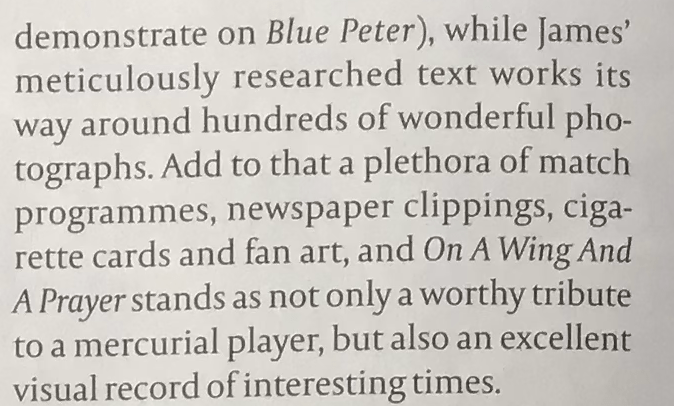
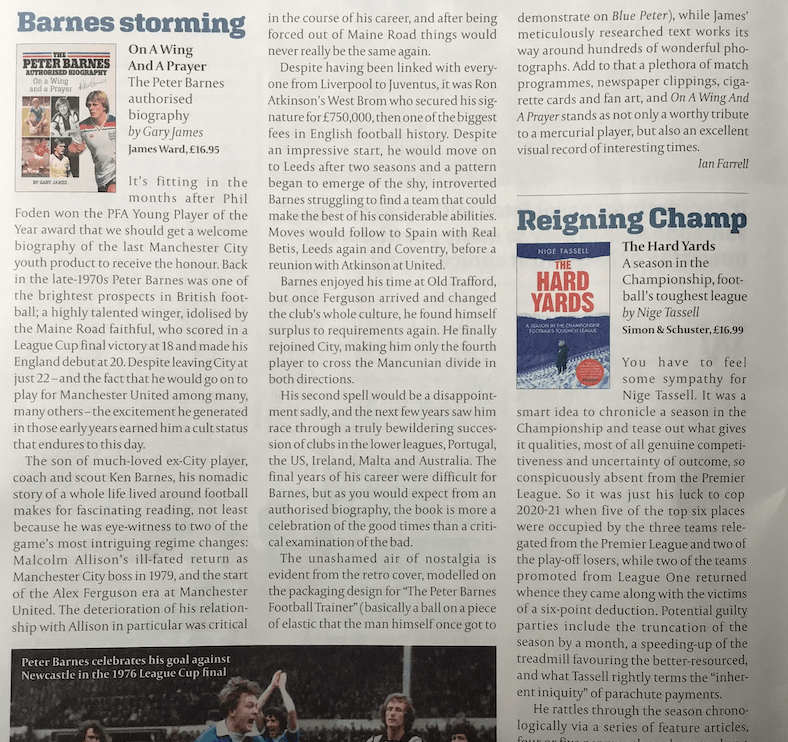
For those still wondering whether my biography of Peter Barnes is worth getting, here’s a fairly typical review that appeared last month. Enjoy! Also thanks to Ian Farrell for reviewing this in When Saturday Comes. Ta!

Dismal Days AFTER the MCFC Takeover

Here’s a flashback to a difficult period on this day in 2008…

City conceded twice in three consecutive League games during this period, dropping to 13th after a 2-1 defeat to Spurs on 9thNovember. It was a difficult time, especially as manager Mark Hughes felt aggrieved with some refereeing decisions. Most notably, Hughes was unhappy that Middlesbrough on 29th October had been awarded a highly debateable penalty by referee Lee Mason. Replays showed that there had been minimal contact between City’s Sturridge and Boro’s Wheater as the player went down outside the area. That goal switched control in the game. Hughes: “Wheater was not in full control of the ball, he was outside the box and the linesman did not give it. The shape of the game changed… All night the referee took it upon himself to make decisions that were quite frankly disappointing.”

After defeats at Bolton and at home to Spurs the media began to speculate that Mark Hughes’ position was in doubt. City, a point above the relegation zone, had suffered seven defeats in 12 League games causing journalist Daniel Taylor to comment: “Hughes is now at a club where the high expectation levels make him vulnerable…[Hughes] did not sound entirely convincing as he tried to pass some of the blame for this defeat to the referee Mike Dean for ‘not taking into account the [rainy] conditions’.”

It should be noted that City had ended the Spurs game with only nine players following the dismissals of Fernandes (26 min) & Dunne (83) and that Tottenham also had a man sent off. 

Match Stats:

2008-09

29 Oct  Middlesbrough (A)                    L 0-2                                        25,731

2 Nov   Bolton Wanderers (A)               L 0-2                                        21,095

9 Nov   Tottenham Hotspur (H)              L 1-2 Robinho                          41,893

Historic Name That Ground – Week 17 Answer

Well, did you get the latest ‘Historic Name That Ground’… On Monday I asked ‘Can you name the ground featured in the image above? This was taken in the 1950s.’ The ground is…

Bolton Wanderers’ old Burnden Park Stadium, seen in 1952. Years later they build a Co-op store on part of that end and I remember standing there (on the terracing, not in the Co-op!) for the Nat Lofthouse Testimonial in August 1989. My first book had come out that year and as I was stood waiting for the game to start I heard a bloke in front of me say to his mate: ‘Have you seen that new book that’s come out on City?’

Immediately, my ears pricked up. This was the first time I’d overheard anyone talking about one of my books and couldn’t wait to hear what he said. His mate replied: ‘no, not seen it. I’ll have a look.’

First bloke replied: ‘I wouldn’t bother. It’s sh*t!’

Since then I’ve always been somewhat grounded about my writing and books!

While you’re here why not subscribe to my site and you can then access every article, interview, audio recording etc. already posted and those that will be posted during your subscription. It costs £20 per year (about £1.67 a month) or you can sign up on a monthly basis at £3 per month (you can cancel at any time, so you could sign sign up for a month, access everything you want and then cancel). You can subscribe below:

Subscribe to get access

Read more of this content when you subscribe today.

I had planned to run ‘Historic Name That Ground’ only during the close season as in previous years, but it’s proving of interest so I’ll keep it going for a little while yet. If you have an old image of a ground that you think it’d be worth including in this weekly quiz then please get in touch. They don’t have to be from the 1900s to 1960s – even ground images from the 70s and 80s may prove a challenge to identify these days. You can email me at gary@GJFootballArchive.com Thanks.

Manchester City – FA Cup Winners Since 1904

St. George’s Day always marks the anniversary of Manchester City’s first FA Cup success. In fact the 1904 FA Cup win was the first major trophy success by any of the Manchester teams and has been recognised as the point when Manchester became a footballing city. 

I’ve written about this often (including academic papers. See: https://gjfootballarchive.com/2021/01/11/fa-cup-success-football-infrastructure-and-the-establishment-of-manchesters-footballing-identity-free-download-for-limited-period/ ) and feel that every Mancunian should recognise the significance of this moment. 

Subscribers to my site can read the following article highlighting the key people, moments and fan related material from that success:

Subscribe to get access

To read this and access the other in-depth articles please subscribe. It works out about £1.67 a month if you take out an annual subscription (£20 per year) or £3 a month if you’d like to sign up for a month at a time. Each subscriber gets full access to the 280+ articles posted so far and the hundreds scheduled to be posted in the coming weeks.

Manchester’s First Great Season

“Not a little of the success the City club has achieved is due to the indefatigable labours of the secretary, Mr T.E. Maley, who came to Manchester three years ago, when the City were in the Second Division.  He brought to his duties valuable experience gained with the famous Celtic club, and he has had the benefit of being a player, a club official, a legislator, and a selector.  His splendid services to the City are reflected in the position they at present occupy – the holders of the English Cup – the most coveted of football prizes, and one of the leading clubs in the League.”The Manchester Evening Chronicle, 12 November 1904

This season became Manchester’s first major trophy-winning season. It established the city’s trophy-winning heritage and it helped transform Manchester from a rugby playing city to a footballing one. Every Mancunian needs to know the story of this season. The following 10,000 word article tells the story of that season.

If you would like to read the full article and other pieces like this then please subscribe below. It works out about £1.67 a month if you take out an annual subscription (£20 per year) or £3 a month if you’d like to sign up for a month at a time. Each subscriber gets full access to the hundreds of articles posted so far and the hundreds scheduled to be posted in the coming months.

Subscribe to get access

Read more of this content when you subscribe today.