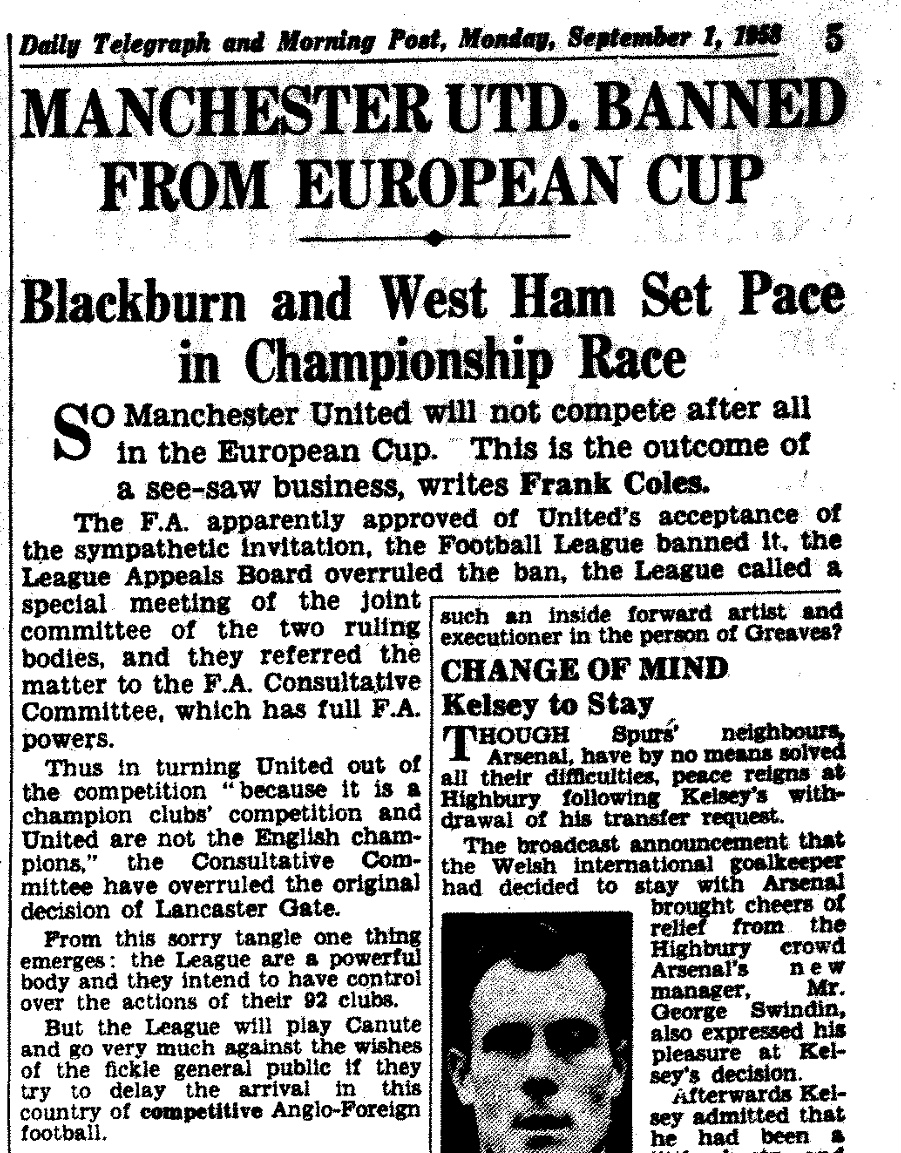
On this day (1 September) in 1958 it was revealed that Manchester United were to be prevented from taking a special place that had been awarded to them in the European Cup. UEFA had offered United the place as a mark of sympathy following the Munich Air Crash and the FA had approved the move but then discussions within the League proved problematic, leading to the Football League banning the move.
This cutting even quotes an unnamed official who basically said the European Cup is for champions and United ‘are not the English champions.’ It was all a mess and distasteful.
To understand the full story/impact of the Munich Air Disaster and how it affected all of Manchester then have a read of this:
Well, the draw has been made for the newly enlarged Champions League. The dates of fixtures will be confirmed once the Europa League draw has been made but here are the fixtures for Manchester City:
Inter Milan (H)
Paris St-Germain (A)
Club Brugge (H)
Juventus (A)
Feyenoord (H)
Sporting Lisbon (A)
Sparta Prague (H)
Slovan Bratislava (A)
The Inter Milan fixture will be a nice reminder of the 2023 Champions League final. You can read about that here:
If you enjoy all the free material on my website and would like to support my research and keep this website going (but don’t want to subscribe) then why not make a one-time donation (or buy me a coffee). All support for my research is valued and welcome. It allows me to keep some free material available for all. Thanks.
On this day (14 August) in 2003 the City of Manchester Stadium (now Etihad Stadium) staged its first competitive game as City defeated TNS 5-0 in the UEFA Cup. Relive that night (and Granada TV!) with this video of the game:
The report above talks of the UEFA Cup draw with TNS.
On this day (31 July) in 2008 Manchester City played a home game at Barnsley. This game made history as it was the first occasion the Blues had played a home European tie outside of Manchester. Previously City had played home European games at Maine Road and at the City Of Manchester Stadium, but work at Eastlands following a concert by Bon Jovi prevented the Club from staging the game at home. The decision was taken to stage the match at Barnsley. Subscribers can read about both legs of the European tie here:
On 20 June 2003 following the UEFA Cup draw, which had seen Manchester City drawn against Welsh Club TNS, discussions were being taken as to where the Welsh leg of the game could be played. Initially reports like this one suggested Wrexham but ultimately the game was moved to Cardiff. With the City leg played at the new City of Manchester Stadium (now Etihad) this meant both legs were played in the two newest major stadia in the UK.
This cutting has some interesting quotes on the European status of the two clubs at the time.
Each year, following the end of the UEFA football season I update the UEFA European Span of Success table. What is this? It’s a list of those clubs who have won two or more major UEFA tournaments showing the span between their first UEFA success and their most recent. The list may surprise some who think that football is all about those perceived as European giants with ‘history’.
The table hasn’t really changed much from last year as Real Madrid were Champions League winners. Atalanta, who won the Europa League, and Olympiacos (Conference winners) have only won one major European trophy and so they do not yet make it on to the list of multiple winners:
European Span of success 2024
The ‘history’ ‘no history’ thing really irritates me. All clubs have history and even when that’s recognised some still go on about history as if it started in 1992, 1999 or 2008 etc. depending on whether your club was successful or your rivals were failing. The two highest placed English teams are West Ham and Manchester City, who both found major European success before some of those clubs recognised today as Europe’s elite.
Obviously, this table does not show the number of major trophies won, but it does give an indication of trophy winning longevity for those who obsess on ‘my cup’s bigger than yours’ and similar debates. Personally, I think we should all be proud of our club’s achievements and not worry about what a rival has won.
West Ham have the second longest span of all Europe’s clubs and City have the fourth equal. Nice work Hammers and Blues!
The above table includes the four major UEFA tournaments: European Cup/Champions League; European Cup Winner’s Cup; UEFA Cup/Europa League & the Europa Conference League. It does not include non-UEFA tournaments such as the Mitropa Cup and Fairs Cup. Nor does it include the Intertoto Cup or similar.
I’m sure some will say but why aren’t the Mitropa or Fairs Cups in there? It’s a good point but these were not UEFA tournaments, though I recognise that the Mitropa Cup had some significant clubs competing in it. It was predominantly an East European competition and participants were not spread over the entire continent.
With the Fairs Cup… It is true that this was later transformed into the UEFA Cup and I have included all UEFA Cup finals in my analysis. But the Fairs Cup had an odd series of entry rules at times. Cities, rather than clubs, often entered with Barcelona beating London in one final for example. It was set up as a friendly type of competition with cities that had staged trade fairs playing each other. As time wore on entry came via the League Cup or League position in England, which added significance to it. But two teams from the same city were not allowed to participate, which meant that teams finishing way down the table could be (and were) included if those above them were multiple clubs from the same city.
In 1970 Manchester City’s Mike Doyle joked that by winning the League Cup he was satisfying his aim of ‘keeping United out of Europe’ (he joked about creating car stickers with that slogan!) because it appeared at that time that United’s only chance of Europe had gone with City’s qualification for the Fairs Cup.
1970 ECWC
City went on to win the ECWC that season, meaning that Fairs Cup place was opened up to League position, but United had finished lower down the table anyway and qualified for the Watney Cup instead. Actually, the Watney Cup is one worth talking about, but I’ll save that for another day. In 1970 Fourth placed Derby County qualified for the Watney Cup, while 5th to 7th (Liverpool, Coventry and Newcastle) all got a Fairs Cup place, alongside 12th placed Arsenal (Fairs Cup winners). I’ve not investigated this fully but it does seem odd that the Watney Cup took precedence over the Fairs Cup.
Arsenal’s 1970 Fairs Cup success was their first European trophy but is not included in the span, neither are those Fairs Cup wins of Barcelona. However, as quite a few Arsenal fans seemed to get a bit upset when the table was posted last year I’ve decided to include the Fairs Cup in the following version of the table. So this table is the winners of the main UEFA competitions I mentioned earlier plus the Fairs Cup with its odd rules:
European Span of success 2024 including Fairs Cup
Hopefully, those Arsenal fans who were somewhat upset last year will now be happy. Note that West Ham have now been overtaken by Roma and that Barcelona are now above Manchester City, Bayern & Atletico Madrid. Both ‘Rome’ and ‘Barcelona’ won the Fairs Cup when it was city based and not club based.
Arsenal are now 18th in this combined table, behind their fellow English clubs West Ham, City, Chelsea, United and Liverpool.
As an example of the odd qualification rules in place for the Fairs Cup at times it’s worth looking at the 1969 qualification via the English League system.
In 1969 champions Leeds entered the European Cup. The ECWC place went to FA Cup winners Manchester City and the Fairs Cup places went to: Arsenal (4th), Southampton (7th) and Newcastle (9th). Swindon had won the League Cup, beating Arsenal in the final, but the Fairs Cup organisers wouldn’t allow them to participate as they were not a top flight club! This adds to the reason the competition is usually excluded. It is certainly not a UEFA competition in any case.
Similarly, Everton (3rd), Chelsea (5th), Spurs (6th) and West Ham (8th) who all finished above Newcastle were denied because of the rule that only one club from each city be allowed. So Liverpool and Arsenal’s inclusion meant their rivals stood less chance of winning the trophy than Newcastle simply because there were multiple clubs in their cities.
That rule does make me wonder what would have happened if both Manchester clubs had qualified for the competition as City are within the city of Manchester boundaries and United are not. Would the two clubs have challenged any decision not to include one of them based on the age old argument of Manchester’s boundaries?
Maybe I’ll post more on the odd rules of football competitions and tell the story of some of those long forgotten competitions.
If you’re interested in the wider span of success for English clubs (listing those who have the longest span between their first trophy and most recent, not simply European trophies) then take a look at this (Manchester City are second):
If you enjoy all the free material on my website and would like to support my research and keep this website going (but don’t want to subscribe) then why not make a one-time donation (or buy me a coffee). All support for my research is valued and welcome. It allows me to keep some free material available for all. Thanks.
Tomorrow will see Manchester City and Manchester United face each other in the second All-Manchester FA Cup final. This promises to be another dramatic day in the history of Manchester football (we are so blessed being able to see days like these).
Obviously, the game could go either way and I don’t want to make predictions as derby days are often difficult to predict. I well remember arriving at Maine Road in September 1989 when Alex Ferguson’s United were most expensive squad ever assembled in British football at the time. That day City fans feared the worst and by full-time the Blues had defeated the Reds 5-1 with chants of Fergie Out coming from the fans left in the away section of the Platt Lane Stand. Who would have thought that night that he would keep his job and bring so much success to the Reds?
Whatever happens enjoy the day and game. Clearly, if United win then that will help their development and if City win then that will mean four major trophies have been won this season – the other three are of course the Premier League, the UEFA Super Cup and the FIFA Club World Cup. Not bad hey? Add to that the FA Youth Cup and it’s been another great season.
On this day (29 April) 1970 Manchester City won the European Cup Winners’ Cup beating Gornik Zabrze from Poland 2-1 at the Prater Stadium in Vienna. For those wondering, this meant that City had won a UEFA tournament years before many prominent ‘European’ teams including Liverpool, Barcelona, Juventus etc. Note: The Fairs Cup was not established as a UEFA competition and had some odd entry rules (one team from a city plus initially only teams from cities that had staged trade fairs could enter, hence its title. London entered it one year!).
The following table shows the span of success between each club’s first UEFA trophy and their most recent for the 20 or so clubs with the biggest span between first and most recent European success.
European span of success 2023, showing EC/CL, ECWC, UEFA/Europa & Europa Conference
Also, for subscribers, here are a few comments and feelings from supporters, players, and others affected by the Gornik final in 1970. These were gathered as part of a project I organised to commemorate the 30th anniversary of the final. As we’ve now reached the 54th anniversary they have become an even greater historical record.
Subscribe to get access
Read more of this content when you subscribe today. It costs £3 per month (cancel anytime) or subscribe for the discounted figure of £20 a year (works out about £1.67 per month). Subscribers access everything already posted and all articles posted throughout their subscription.
The series of features/articles covering Manchester City in the 1970s continues with a 1,700 word article on the entire 1972-73 season – a season of major change which saw one man who didn’t want to be manager told to take the manager’s job or you’ll be leaving yourself! Oh City! You can read this below. This series of articles and features on Manchester City in the 1970s has been running throughout January with indepth articles some days and smaller ‘on this day’ style posts on others. Every day in January will offer something to enjoy.
Subscribers will get access to everything. If you want to know more on this incredible decade for Manchester City Football Club then why not subscribe and read it all? You could even subscribe for a month and see what you think. The following 1,700 word article is on the 1972-73 season and is available to subscribers below. Enjoy!
Subscribe to get access – Monthly
Read more of this content when you subscribe today. It costs £3 per month (cancel anytime) to access everything posted since 1 October 2022 or there’s a special annual rate below which gives greater access and works out much cheaper.
Read more of this content when you subscribe today. It costs £3 per month (above) or £20 a year (here) to access everything posted since the site was created in December 2020. This special rate works out about £1.67 a week and gives access to everything posted, including PDFs of 3 of my books.
If you enjoy all the free material on my website and would like to support my research and keep this website going (but don’t want to subscribe) then why not make a one-time donation (or buy me a coffee). All support for my research is valued and welcome. It allows me to keep some free material available for all. Thanks.
It was great to be at the Etihad today for the unveiling of the statue celebrating the achievements of England internationals Colin Bell, Francis Lee and Mike Summerbee. The statue recognises the achievements of all those involved in winning the major trophies of 1968 to 1970, including City’s first European trophy of course and many of those former players were here for this wonderful day.
Members of the families of Colin Bell, Francis Lee and Mike Summerbee, together with Mike of course, were present to see the statue this morning. After they’d had their personal time with the statue a celebratory brunch occurred. It included a speech from Ferran Soriano and interviews with the sculptor, club archivist Steph Alder, photographer Kevin Cummins, journalist Chris Bailey and myself. We were asked about the significance of the players and that era.
For me one of the most important aspects is that it recognises all the players who appeared in City’s title success of 1968 and in the trophy successes that followed (FA Cup, League Cup and ECWC). That’s significant and fits with comments that all three men have said over the decades that the successes under Joe Mercer and Malcolm Allison were the work of an entire team. Bell, Lee & Summerbee always praised the others.
I love the statue as it shows the men in movement. Often football statues are standing poses or similar, with no suggestion of movement, but this is a wonderful piece of three men moving forward. It’s a great work.
The statue is located in front of the main entrance in a specially paved area which allows fans who want to take a photo to stand with the three men in motion with the Etihad in the background.
There was inevitably some emotion today as Colin and Francis are no longer with us but I do know that Colin was aware that a statue was on its way and Francis did approve the style and saw representations of it. All families seem happy with this work of art.
For those who want to know more on the statues, there will be a film which will be on City’s channel and on YouTube I’m told soon. In the meantime, go and have a look yourself.
Here’s something the club issues a few days ago on the sculptor:
This installation will be located on the west side of the perimeter and will be unveiled on Tuesday morning ahead of a UEFA Champions League meeting with RB Leipzig later that day, where fans will be invited to visit the permanent tribute to an extraordinary era in the Club’s history.
Speaking of his appointment to the project David Williams-Ellis said:
“It is a great honour to create a work of art for Manchester City Football Club celebrating the diverse, talented players, Bell, Lee and Summerbee.
“It’s been an extraordinary last two years, working on this project that celebrates these players from a great era in Manchester City’s football history.
“I hope that the work will give a sense of history and place to the legions of fans and visitors that come to the football ground from around the world and become an enduring part of Manchester’s cultural landscape.”
David Williams-Ellis – Artist Biography
David Williams-Ellis’ sculptures, worked in clay directly from life, are inspired by the romanticism of Rodin and Bourdelle and are noted for their sense of movement and vitality.
David was classically trained in Florence under drawing teacher, Nerina Simi. From there he went on to be an apprentice wood carver and then joined a community of marble carvers beneath the Carrara Mountains in Pietresanta.
David’s reputation was cemented after his time in Italy. Today, his work is in private and public collections across the globe and can be seen in flagship buildings including Scone Palace in Perthshire, Aberdeen’s Maritime Museum, the IFC Building in Shanghai and Oxford House, Swires, Hong Kong.
Amongst his most notable work includes the D-Day Memorial Sculpture, unveiled on 6th June 2019 above Gold Beach in Normandy to commemorate the 22443 service men and women who fell on D-Day and in the Normandy campaign under British command.




 Gary James' Football Archive