On 26 May 1964 Mancunian Mike Doyle signed professional forms for Manchester City. He embodied a spirit and determination as a player that brought great success and the loyal support of City fans. He was a vital member of two successful periods at Maine Road, and had managed to bridge the gap between Mercer and Allison’s great team of the late 60s and Book’s mid-70s entertainers. In fact he was also there for the miserable period that predated Mercer’s arrival!
Doyle joined the City groundstaff in May 1962 and made his debut in the 2-2 draw at Cardiff on 12 March 1965 and appeared in 6 games during the latter end of a traumatic season. That summer Mercer & Allison arrived and transformed the Blues with Doyle playing a leading role in every City triumph of the period. In fact, until recent years he shared the distinction with Tommy Booth of appearing in more finals than any other City player. He appeared in ECWC, FA Cup and 3 League Cup finals but also played his part in the League title success in 1968 and Second Division title in 1966. He even captained City to their 1976 League Cup triumph and scored in the 1970 victory.
Ever the determined player City fans loved his fighting spirit and never say die attitude. Significantly, in an era of major talent and success, Doyle was voted City’s player of the year twice (1971 & 1974). After making five appearances for England and over 550 competitive first team appearances for the Blues he moved to Stoke in 1978, where he was voted their player of the year in 1979, and later had spells at Bolton and Rochdale.
Mike Doyle was a tremendous City player who played in a determined manner. He won many admirers with his total dedication to the Blue cause. He died on 27 June 2011.
On this day (17 April) in 1888 the first meeting of the Football League was held in Manchester. The following report names the clubs accepted and the others who wanted to join the League. It has often been written in Manchester United related books that Newton Heath applied to join the League in 1888 but didn’t receive enough votes to be accepted. That is completely untrue as no one actually had to apply nor was a vote taken. Clubs were asked and some tried to push to get included but Newton Heath were neither asked nor were they pushing for acceptance either. Nor were Ardwick or Manchester Asoociation who, to be frank would’ve been the most famous Manchester club at this time.
Bolton Wanderers were the only team from present day Greater Manchester to be asked/selected for the first League season.
Manchester Courier, 18 April 1888
The plaque is positioned on the corner of Mosley Street and Market Street/Piccadilly in Manchester.
The series of features/articles covering Manchester City in the 1970s continues with a 1,700 word article on the entire 1973-74 season – a season which included a Wembley final, multiple managerial changes and a controversial Manchester Derby at Old Trafford! You can read this below. This series of articles and features on Manchester City in the 1970s has been running throughout January with indepth articles some days and smaller ‘on this day’ style posts on others. Every day in January will offer something to enjoy.
Subscribers will get access to everything. If you want to know more on this incredible decade for Manchester City Football Club then why not subscribe and read it all? You could even subscribe for a month and see what you think. The following 1,700 word article is on the 1973-74 season and is available to subscribers below. Enjoy!
Subscribe to get access – Monthly
Read more of this content when you subscribe today. It costs £3 per month (cancel anytime) to access everything posted since 1 October 2022 or there’s a special annual rate below which gives greater access and works out much cheaper.
Read more of this content when you subscribe today. It costs £3 per month (above) or £20 a year (here) to access everything posted since the site was created in December 2020. This special rate works out about £1.67 a week and gives access to everything posted, including PDFs of 3 of my books.
If you enjoy all the free material on my website and would like to support my research and keep this website going (but don’t want to subscribe) then why not make a one-time donation (or buy me a coffee). All support for my research is valued and welcome. It allows me to keep some free material available for all. Thanks.
A new daily series of articles for subscribers started earlier this month covering the 1980s. This is a seasonal journey through a truly important decade in the history of Manchester City Football Club. Today’s article is a 4,100 word feature on the 1988-89 season. Enjoy!
Subscribe to get access – Monthly
Read more of this content when you subscribe today. It costs £3 per month (cancel anytime) to access everything posted since 1 October 2022 or there’s a special annual rate below which gives greater access and works out much cheaper.
Read more of this content when you subscribe today. It costs £3 per month (above) or £20 a year (here) to access everything posted since the site was created in December 2020. This special rate works out about £1.67 a week and gives access to everything posted, including PDFs of 3 of my books.
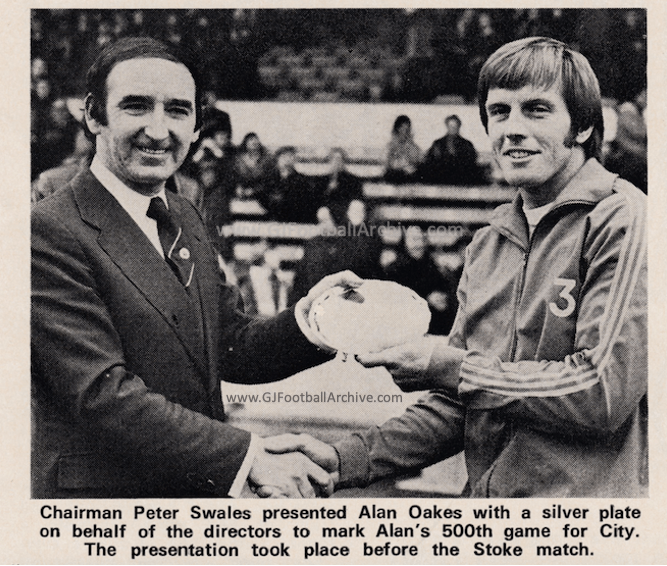
Today (9 November) in 1974 Manchester City presented longserving player Alan Oakes with a silver plate to commemorate his 500th League appearance. He’d actually made his 500th League appearance the previous week when City faced Everton at Goodison.
At Maine Road on 9 November City chairman Peter Swales presented him with the award before the game with Stoke (Oakes made his 501st League appearance that day). City won that match 1-0 with a goal from Rodney Marsh. You can see Marsh’s goal here:
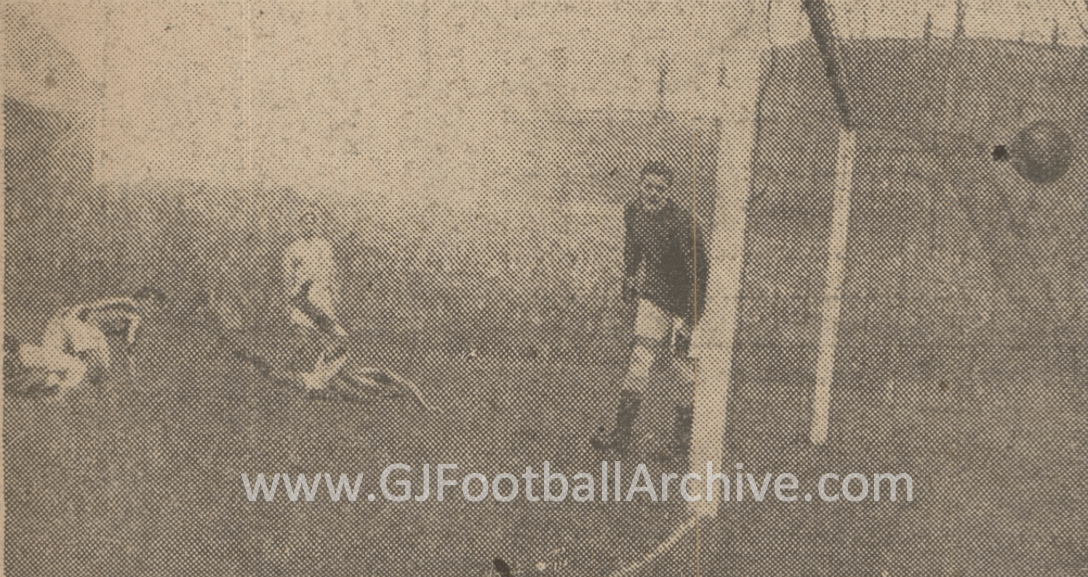
This action shot is from 101 years ago today (14 October 1922) and shows Manchester City’s Horace Barnes heading the ball out of the Stoke goalkeeper’s (Scott) hands. City won the match 2-1 (Horace Barnes & Tommy Johnson scoring for City) at Hyde Road and the stand seen in the background is City’s Popular Side.
If you like these daily snippets why not subscribe to the site and see all the other great content. For details see:
Former Manchester City player Jimmy Broad, whose dad was a popular City coach for decades, scores for Stoke against City on this day (7 October) in 1922. The game ended in a 1-1 draw. The goalkeeper is Mitchell and the City scorer was the great Tommy Johnson. The game took place at the Victoria ground before about 20,000.
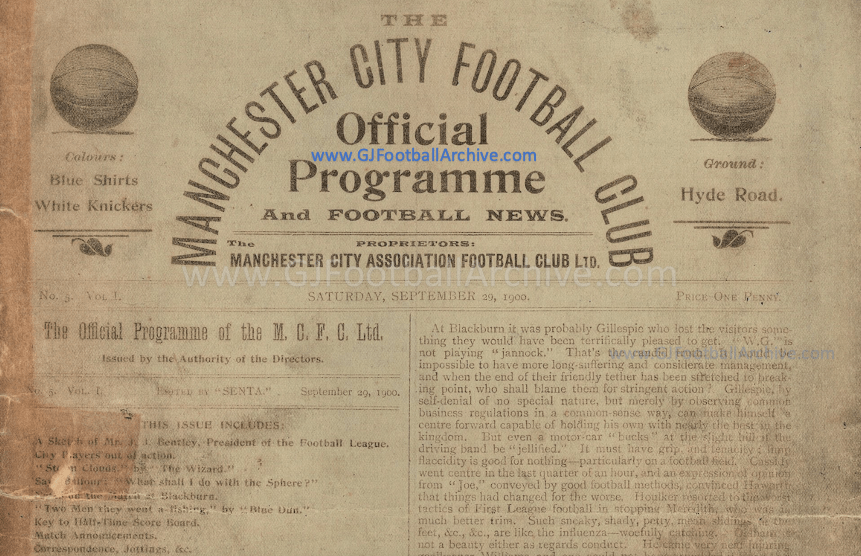
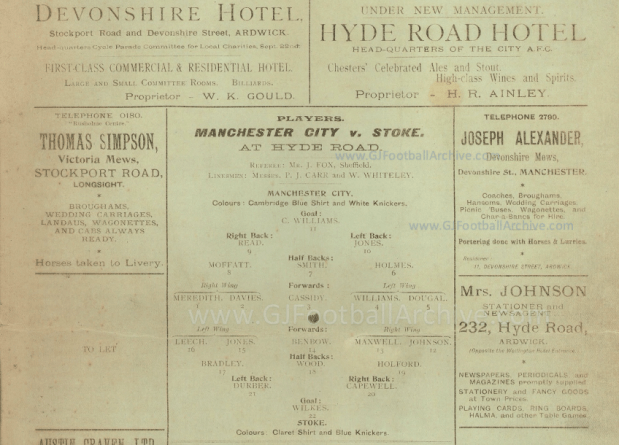
Recently I’ve been contacted by someone who had in their possession a couple of Manchester City match programmes from 123 years ago. These were from the first season the club did its own official match programme (there was an earlier joint effort between 2 rugby and 2 football clubs that was described as official from the 1890s – see below – but 1900-01 was the first for MCFC on their own). He sent me scans of them and one programme was produced for a match played on this day (29 September) in 1900. Here are some images and details from it.
This was a special game for City, though the programme was not produced because it was a special game. This was the fifth issue of the season and contained eight pages, like the others. The significance of the game however was that Arthur Balfour MP was a visitor that day. Balfour would become Prime Minister in 1902 and was still in that role when City won the FA Cup for the first time in 1904 (he wore a City rosette at the final!).
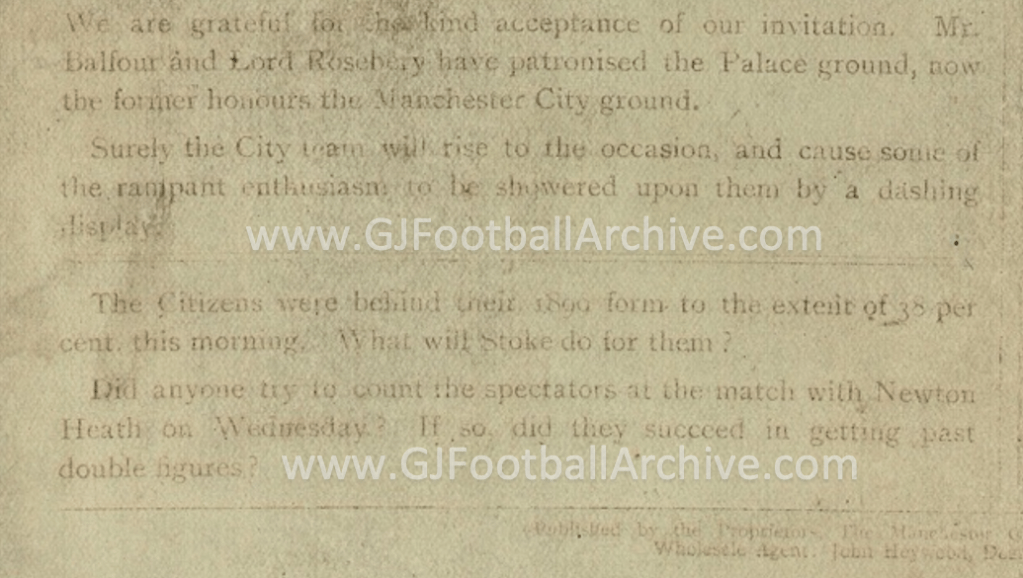
The back page talks about Balfour’s visit. Both the front and the back pages are quite difficult to read as they’ve faded. It is interesting that the club felt able to make light of Balfour’s lack of enthusiasm for ‘socker’ (yes, socker or soccer as we grew to call it, was an English word for association football before the Americans became recognised for their use of it). Balfour preferred golf (after the 1904 FA Cup final he called himself a football ‘ignoramous’. Bob Hulmes, who sent the programme scans to me, managed to transcribe the wording regarding Balfour:
Says Balfour: “What shall I do with the sphere?”
We have specially desired fine weather today as the Right Hon. Arthur James Balfour is due to make his first appearance on the Hyde Road Football enclosure this afternoon. Some little decoration will be made, for the most pleasing sight to the hon. gentleman will be a mighty crowd of enthusiastic well wishers. It is not often that we have a leader of the nation at such functions, and the occasion is historic as far as Manchester is concerned. No doubt our honoured guest wishes he had the opportunity to open a game of golf instead of socker but we are ready to excuse a “miskick” on this occasion. We are grateful for kind acceptance of our invitation. Mr Balfour and Lord Rosebery have patronised the Palace ground, now the former honours the Manchester City ground.
Surely the City Team will rise to the occasion and cause some of the rampant enthusiasm to be showered upon them by a dashing display.
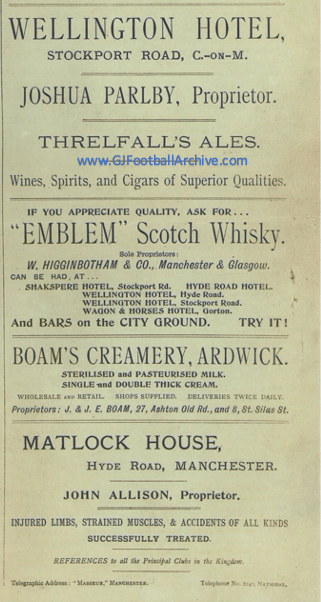
It’s worth noting some of the advertisements. There’s one for Joseph Alexander’s coaches and carriages (the Alexander family business. Note: The Alexanders remained key members of City’s management/directorship/shareholding for most of the 120 years that followed!). There’s also the Wellington Hotel, Stockport Road, which was run by the ever popular City official Joshua Parlby, and the Matlock House Hydro – one of City director John Allison’s business.
The game was against Stoke and they are wearing their then home colours of ‘claret shirts and blue knickers’.
Bob also nudged me towards page 8 which included a wry comment about the previous Wednesday’s friendly at Newton Heath (United):
Did anyone try to count the spectators at the match with Newton Heath on Wednesday? If so, did they succeed in getting past double figures?
The official attendance was estimated by Newton Heath as 600 (I wonder if they had a mickey-take name along the lines of Emptyhad for United’s games at Bank Street?
Before the 1900-01 season there was an official match programme produced for both Newton Heath and Manchester City, alongside a couple of rugby clubs. It was first ‘mocked up’ in May 1898 but went into production for the 1898-1899 season. It continued into the 1900-01 season by which time City were producing their own official programme. Both programmes were in competition throughout that 1900-01 season.
From 9 May 1898 the first Manchester football programme was a mock up based on Everton Liverpool programme
Thanks to Bob Hulmes for allowing me to us images of his match programme. The programme belonged to Bob’s grandfather. He lived in Ardwick, near Hyde Road, and he followed City until his death in 1964. Bob found two programmes from 1900 lining a drawer when his grandfather died in 1964, which shows exactly how rare these images are. It’s a pure fluke in many ways that they survived and fortunately the family looked after them over the decades.
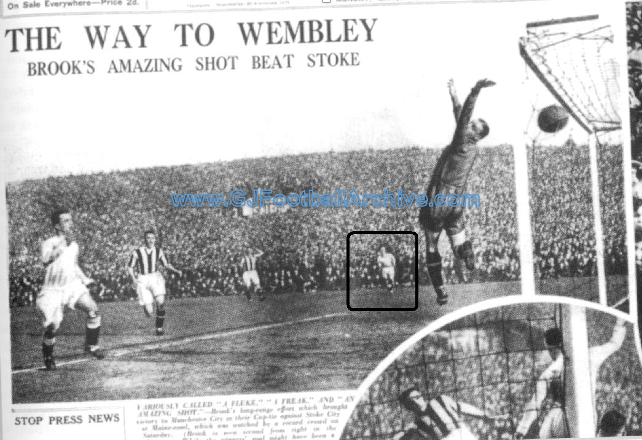
Post 69 in the 100 Maine Rd countdown is this image from a game played on 5 March 1934. It shows Eric Brook scoring what some believed was the greatest goal ever netted at Maine Road (see post 68 for a later contender). What else makes this image special is that it’s from the 84,569 game v Stoke when City attracted a record English crowd on a club ground that still stands today.
Subscribers can read more on why this day, game and image is so special here:
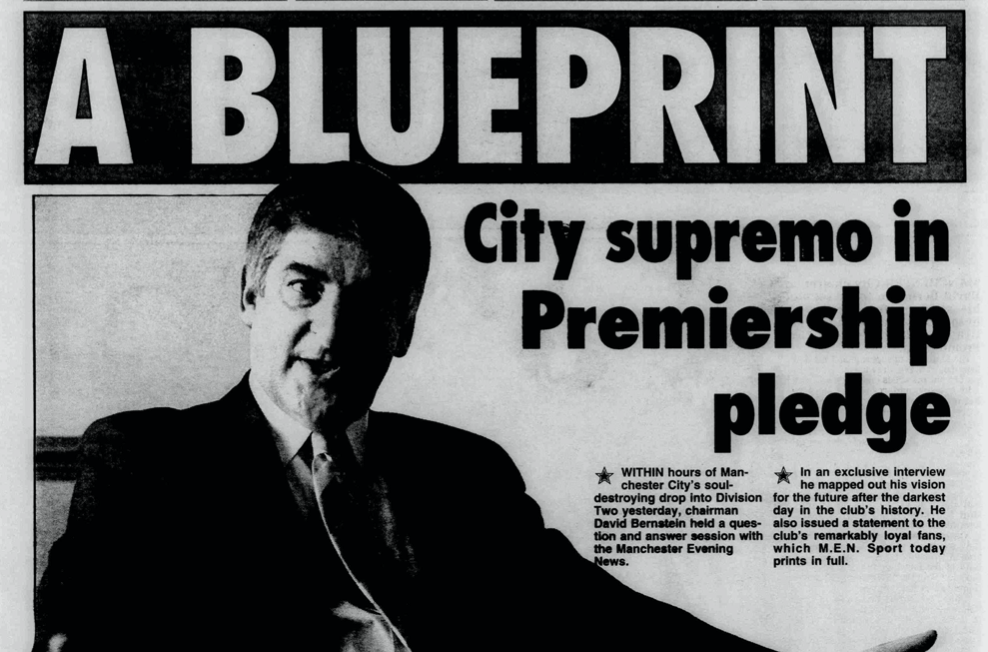
Warning! The following 600 word article is the story of Manchester City’s final game of the 1997-98 season. It was against Stoke on 3 May and, well, let’s just say it was a 5-2 easy victory but the consequences were grave for the club. If you have no idea what I’m on about then have a read – or if you want to relive a painful memory then carry on. Fortunately, I’ve made this article available to subscribers only so people won’t just catch site of our misery just by passing! If you can then enjoy looking back and remembering those days!
Subscribe to get access – Monthly
Read more of this content when you subscribe today. It costs £3 per month or £20 for an annual subscription.
Annual subscribers get access to everything (all the books, articles, videos, interviews etc.) posted since the site was created in December 2020. Monthly subscribers get access to everything since 1 October 2022. All subscribers access everything posted throughout their subscription. Why not give it a try for a month and see what you think?




 Gary James' Football Archive