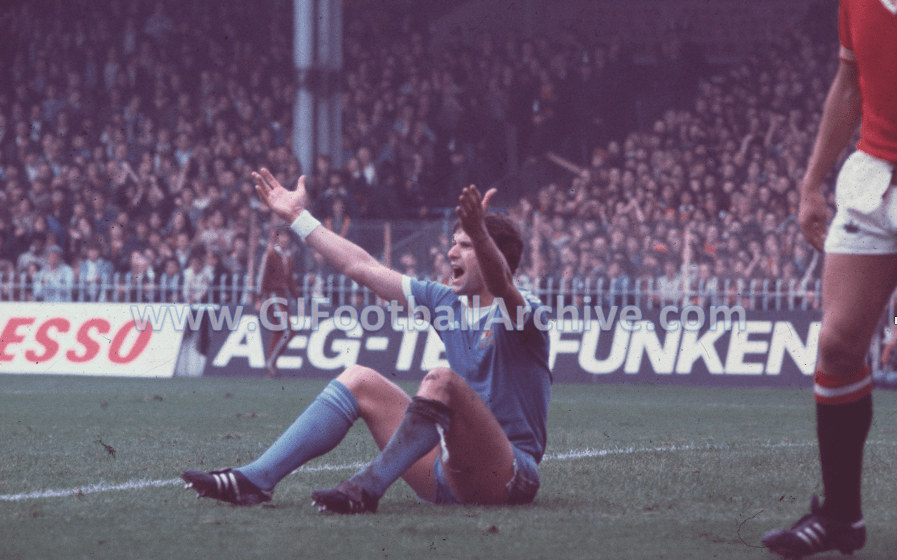
Day 6 of my posts counting down to the centenary of Maine Road’s opening game continues with another segregation image. This is a late 1970s Manchester derby image and the City player is Mike Doyle but look beyond him at the segregation and perimeter fencing. As well as the railings in front of the Kippax Stand the away section (to the right) has an additional chicken wire style temporary fence in front of the United fans.
This was a period when United fans had an extremely bad reputation for pitch invasions and crowd actions and City had been forced to install this additional netting for this derby match after consultation with the police.
The fencing didn’t last of course and so this image is extremely unusual.
If you’d like to read more on the history of Maine Road, take a look at Farewell To Maine Road, which can be downloaded from this page:
If you enjoy all the free material on my website and would like to support my research and keep this website going (but don’t want to subscribe) then why not make a one-time donation (or buy me a coffee). All support for my research is valued and welcome. It allows me to keep some free material available for all. Thanks.
Day 59 of my posts counting down to the centenary of Maine Road’s opening game is the story of the day Celtic and Rangers played a game at Maine Road as a combined Glasgow XI. That day was the great City player Billy Meredith’s testimonial.
It was played on 29 April 1925 and saw a MEREDITH XI versus RANGERS & CELTIC XI.
A series of benefit matches and events were organised for Billy Meredith following his retirement in 1924, with this match being the most significant event. Somehow Meredith had convinced Rangers and Celtic to form one side to take on a team of Lancashire based players selected by Meredith himself. The Meredith side, playing in red and white, contained City favourites Frank Roberts and Charlie Pringle, plus of course Meredith, and former City star Horace Barnes – a Preston player at the time of the match. City’s legendary trainer Jimmy Broad trained the team.
The Glasgow side, playing in blue and white, contained five Celtic players – including Jimmy McGrory – and six Rangers men. Former City full-back Johnny McMahon was one of the linesmen, while the other was an ex-United star George Wall, who incredibly smoked a pipe throughout the match.
Meredith testimonial programme, as seen in From Maine Men To Banana Citizens by Gary James
According to the Manchester Evening Chronicle report: ‘Many old friendships were renewed at Maine Road on Wednesday night, and we all laughed at Meredith trying the old backheel to the half-back business with very little success. Incidentally the main image above is of Meredith a couple of years earlier with the Hyde Road ground in the background.
A few moments from the match, including the teams posing for photographs. The footage concentrates on Meredith pre-match, and also shows the Popular Side (later Kippax) and Platt Lane end. The camera was placed in front of the Platt Lane end, close to the goal for much of the action (Platt Lane is the stand numbered 4 & 5 in the image below, although that stand was still unroofed back in 1925).
If you enjoy all the free material on my website and would like to support my research and keep this website going (but don’t want to subscribe) then why not make a one-time donation (or buy me a coffee). All support for my research is valued and welcome. It allows me to keep some free material available for all. Thanks.
Day 58 of my posts counting down to the centenary of Maine Road’s opening game is an aerial photo of the ground from about 1973. Unusually this image looks towards the ground from behind the North Stand (from the city centre direction looking south) and shows the streets that would soon disappear as part of the area’s housing developments.
I’ve highlighted what became recognised as MCFC property with blue lines – that’s the stadium site plus the Platt Lane training complex, which became City’s during the 1970s.
The two areas marked in yellow on either side of Lloyd Street South were redeveloped into Walks and Closes named after former City players. Many of these new Walks & Closes still exist, although some have been remodelled and the names of some, for example the one named after Frank Swift, have disappeared altogether.
The are marked in pink between the player streets and the stadium became the Claremont Road School playing fields which, on match day, provided extra car parking for supporters.
c.1973 Maine Road
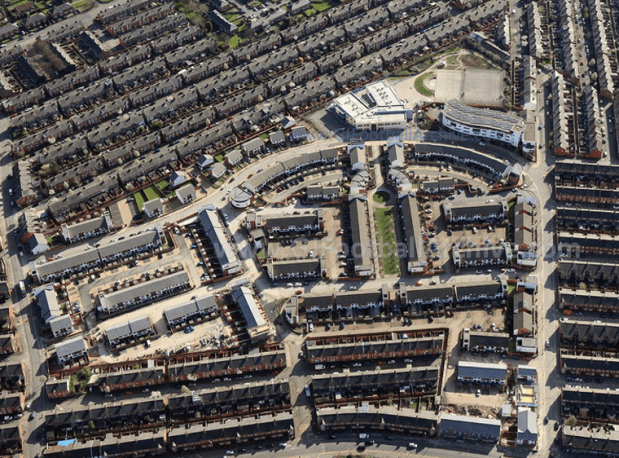
It’s worth comparing that 1970s image with this one from recent years, showing the housing and school now built on Maine Road.
And compare both to this 1940s image of the Maine Road site too:
This 1971 aerial image shows the stadium from another angle, looking west.
Maine Road aerial 1971 from Farewell To Maine Road
If you’d like to read more on the history of Maine Road, take a look at Farewell To Maine Road, which can be downloaded from this page:
If you enjoy all the free material on my website and would like to support my research and keep this website going (but don’t want to subscribe) then why not make a one-time donation (or buy me a coffee). All support for my research is valued and welcome. It allows me to keep some free material available for all. Thanks.
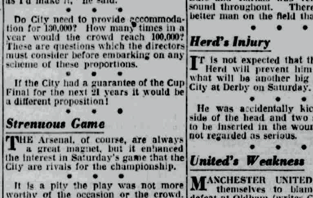
Day 57 of my posts counting down to the centenary of Maine Road’s opening game is a follow on from yesterday. It’s a cutting from the same newspaper, which was produced shortly after City and Arsenal had met at Maine Road in February 1935. It also follows on from some recent articles about stadium improvements. Here, the rumour was that City were planning to make Maine Road a 130,000 capacity venue.
February 1935 City v Arsenal Maine Road extension plans
Maine Road was only 12 years old but already it held a record individual crowd (84,569) for a game on a club ground that still stands today and it held the record League crowd (set at the game with Arsenal in February 1935). It had been expanded a little with the extension to the Platt Lane Corner (near the Main Stand and numbered 3 on the 1971 aerial photo lower down the page).
There was a development plan being developed which would see both the Platt Lane End and Scoreboard End have roofs added and be extended and then attention would turn to the Kippax where a double deck stand was suggested. By that time it was felt the stadium would hold 130,000. As it was the 1930s extensions meant it’s capacity was viewed as about 86,000.
The Platt Lane Stand (number 5 below) was built in 1935 (the old terracing was extended at the back on wooden steps and a roof was erected over the terracing) to the plan but World War Two meant the other plans were put on hold. They were eventually dropped and the next major development would be the Kippax roof and terracing extension in 1957.
Back in February 1935 the local media debated how often City would need a 100,000 capacity venue. The view was that, unless City could persuade the FA to move the FAC Final to Maine Road, then only one game a season would attract that kind of figure to the ground. With United in Division Two for much of the 1930s, and being watched by exceptionally low crowds, the game that most fans saw as the biggest meeting back then was the visit of Arsenal. How times change!
This 1971 aerial image shows the proximity of the housing on Thornton Road (bottom left, near number 6) and behind the North Stand (number 10). They were planned to be demolished in Lee’s 1994 plan.
Maine Road aerial 1971 from Farewell To Maine Road
If you’d like to read more on the history of Maine Road, take a look at Farewell To Maine Road, which can be downloaded from this page:
If you enjoy all the free material on my website and would like to support my research and keep this website going (but don’t want to subscribe) then why not make a one-time donation (or buy me a coffee). All support for my research is valued and welcome. It allows me to keep some free material available for all. Thanks.
Day 55 of my posts counting down to the centenary of Maine Road’s opening game is a follow on from one from a few days ago. I posted a 1994 plan of what might have been in terms of Maine Road’s development and here’s more on that plan.
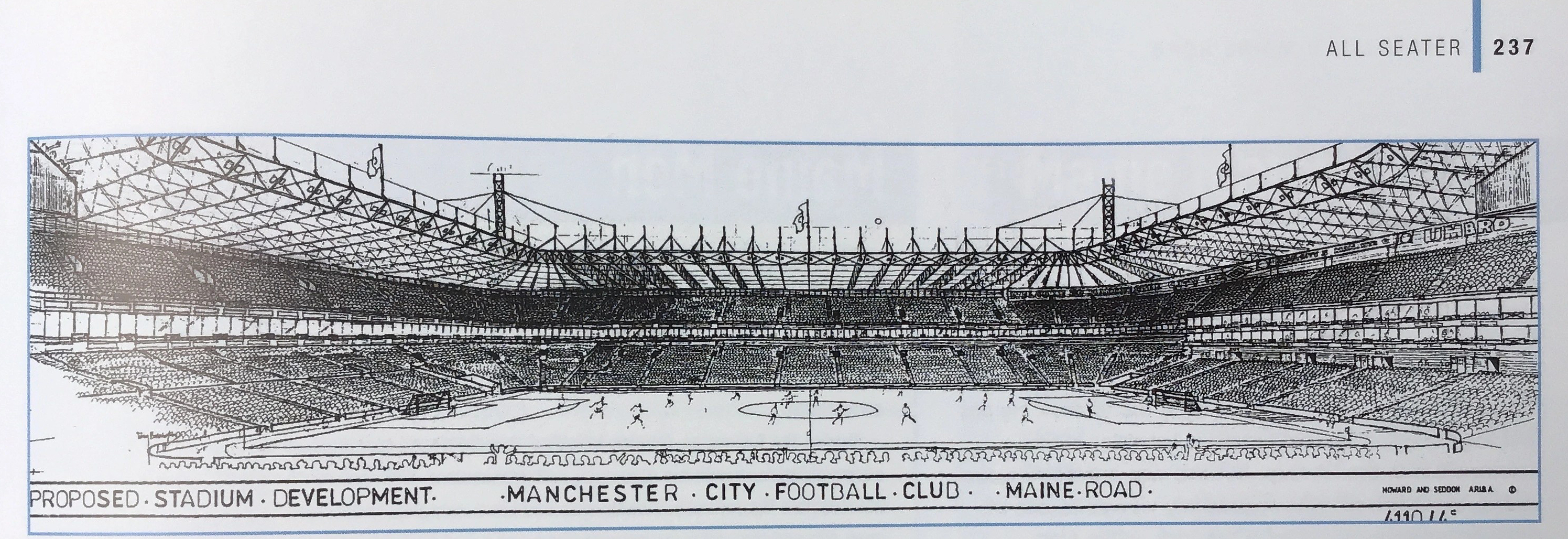
This image is of how the entire stadium was supposed to look. To explain the colour image looks towards the stadium from above the Kippax car park. The North Stand is on the right and the Platt Lane on the left. The black and white image is from the other side of the ground, looking towards the Kippax from the Main Stand.
1990s Maine Rd redevelopment plans as seen in Farewell To Maine Road
You can see from the black and white image that the plan was to replicate the general look of the new Kippax (being planned at this stage – this was January 1994 and the old Kippax was still standing) around the ground. The North Stand was to have a second tier added and hospitality boxes between the levels, like the new Kippax. The Platt Lane was to have a second tier added above the two lines of existing hospitality boxes.
The Main Stand would have part of the seating chopped away and a new second tier added.
To facilitate all of this some houses were to be bought and demolished on the streets immediately behind the North Stand and the Kippax/Platt Lane corner.
The new Kippax was the first phase of the development but Manchester’s bids for the Olympics changed thinking. Couple that with relegation in 1996 and the wholesale redevelopment of Maine Road was postponed after the Kippax opened and then dropped completely.
As mentioned previously, Lee’s plans would have seen the new Kippax followed by a phased development of each of the other three stands. These images might give an indication of how it would have progressed.
This 1971 aerial image shows the proximity of the housing on Thornton Road (bottom left, near number 6) and behind the North Stand (number 10). They were planned to be demolished in Lee’s 1994 plan.
Maine Road aerial 1971 from Farewell To Maine Road
If you’d like to read more on the history of Maine Road, take a look at Farewell To Maine Road, which can be downloaded from this page:
If you enjoy all the free material on my website and would like to support my research and keep this website going (but don’t want to subscribe) then why not make a one-time donation (or buy me a coffee). All support for my research is valued and welcome. It allows me to keep some free material available for all. Thanks.
The 52nd post in my series counting down to the centenary of Maine Road’s opening game takes a look at the CITY F.C. flag that proudly flew above the Popular Side (Kippax) for decades.
There had been a CITY F.C. flag at Hyde Road and it may well be that this was the same flag. It was often referred to in the media during its life at Maine Road, such as in this 1925 cartoon:
The first derby at Maine RoadThe City flag flying at Maine Road’s first Manchester derby
The flag flew proudly over the Popular Side until the stand was roofed in 1957. Then the flag was moved to the Scoreboard End, eventually disappearing in the 1960s when rumour has it that it was taken down by Liverpool fans. I’m not certain if that’s true and I’ve never found any evidence but if you do know more please let me know.
I do know that in the 1930s a disgruntled City fan lowered it during a difficult game and it caused outrage. It was mentioned in the local press and the culprit had to make a formal apology to the club and his fellow City fans.
This 1971 image shows the roofed Kippax Stand. The flag was originally on a flag pole roughly where the number 7 is in the days before the stand had a roof. When the Kippax was roofed it was moved to the back of the Scoreboard End. The North Stand (10) replaced the Scoreboard End in the early 1970s.
Maine Road aerial 1971 from Farewell To Maine Road
If you’d like to read more on the history of Maine Road, take a look at Farewell To Maine Road, which can be downloaded from this page:
If you enjoy all the free material on my website and would like to support my research and keep this website going (but don’t want to subscribe) then why not make a one-time donation (or buy me a coffee). All support for my research is valued and welcome. It allows me to keep some free material available for all. Thanks.
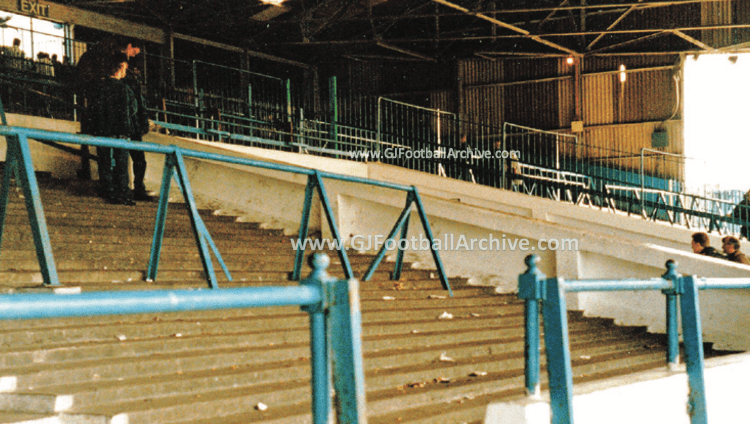
It’s 51 of my posts counting down to the centenary of Maine Road’s opening game and today I’m looking at the segregation fence in the old Kippax Stand.
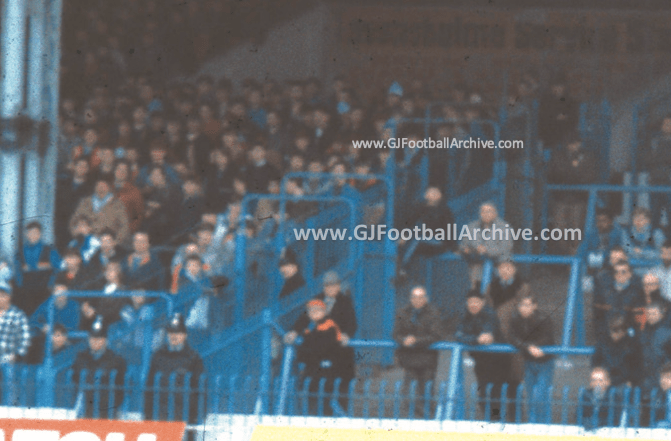
On the main photo above you can see the segregation fence as it looked in the early 1990s. The gap between away fans and home fans had increased compared with the image below from the mid 1980s. The police used to patrol up and down this narrow pathway and on the image below you can see some police within that area.
Kippax Segregation mid 1980s
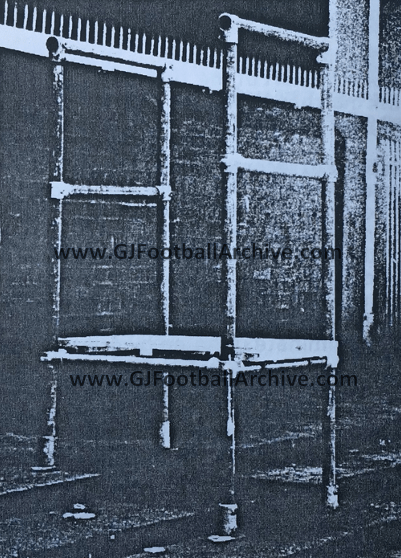
To help the police control the crowd a few simple platforms were constructed out of scaffolding. It all seems so primitive now but I guess clubs were reacting to increasing violence and needed quick solutions. The following was one of several platforms in the Kippax by the end of the 1980s.
Kippax Segregation police platform early 1990s
Before the segregation fence had an alleyway for the police to walk through there was one fence and scaffolding was erected next to it to separate the fans further (see next two images). Similarly this approach was used to widen the segregation fence at other times in later years.
Kippax Segregation early 1990s
The single fence with scaffolding to separate fans further (below).
Early Kippax Segregation
I explain a lot more about this area in Farewell To Maine Road. Formal segregation started in the mid 1970s but not for every game. By the end of the decade it was permanent and in place game after game.
This 1971 image shows the Kippax Stand and the segregation area was roughly where the number 8 is within the stand.
Maine Road aerial 1971 from Farewell To Maine Road
If you’d like to read more on the history of Maine Road, take a look at Farewell To Maine Road, which can be downloaded from this page:
If you enjoy all the free material on my website and would like to support my research and keep this website going (but don’t want to subscribe) then why not make a one-time donation (or buy me a coffee). All support for my research is valued and welcome. It allows me to keep some free material available for all. Thanks.
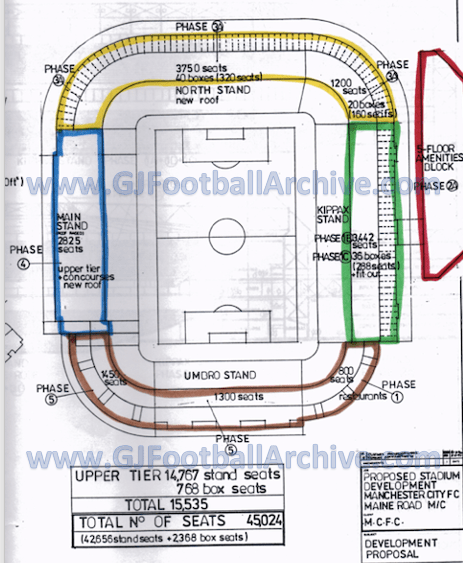
For day 49 of my posts counting down to the centenary of Maine Road’s opening game I’ve posted this plan of what might have been. These were developed in January 1994 shortly after Francis Lee became chairman.
The Kippax needed to be replaced and the plans by former chairman Peter Swales and his supporting directors had been to bolt plastic seats on to the lower part of the original Kippax terracing with a reprofiled second tier behind. Lee ripped up those plans and within days had created a plan which would see the entire ground extended, not simply the building of a new Kippax.
The new Kippax was the first phase of that development but Manchester’s bids for the Olympics changed thinking. Couple that with relegation in 1996 and the wholesale redevelopment of Maine Road was postponed and then dropped completely.
Lee’s plans would have seen the new Kippax followed by a phased development of each of the other three stands. I haven’t got chance to work through every step here but these images might give an indication of how it would have progressed.
1990s Maine Rd redevelopment plans as seen in Farewell To Maine Road
Here’s an aerial photo of the ground in 1995 with the Kippax nearing completion:
If you’d like to read more on the history of Maine Road, take a look at Farewell To Maine Road, which can be downloaded from this page:
If you enjoy all the free material on my website and would like to support my research and keep this website going (but don’t want to subscribe) then why not make a one-time donation (or buy me a coffee). All support for my research is valued and welcome. It allows me to keep some free material available for all. Thanks.
For day 43 of my posts counting down to the centenary of Maine Road’s opening game I’ve posted an unusual image of a screen on the Maine Road pitch. Can you work out what it was for?
This is a photo I took back in May 1999 of the Play Off semi-final away leg at Wigan. It was Springfield Park’s last competitive fixture and demand for tickets was high. I couldn’t get a ticket to be there but, because of the significance of the game, City decided to put a screen up at Maine Road and sell tickets for the Kippax.
Around 10,000 of us attended the game at Maine Road and we booed and cheered as you would if you were actually at the game. At one point Joe Royle appeared on the screen and we all chanted for him to ‘give us a wave’. Of course, Royle was at Springfield Park and couldn’t hear us but that didn’t stop us from booing when he seemingly ignored us! Football humour, hey?
Here’s an aerial photo of Maine Road from 1971. The Main Stand roof is different (as is the Platt Lane Stand and the Kippax Stand) but hopefully this will give an idea of where the screen was for those unfamiliar with Maine Road. It was positioned in front of the players’ tunnel (near 1 on the image) and I was sat in the new Kippax, roughly in between numbers 7 and 8 on this image.
Maine Road aerial 1971 from Farewell To Maine Road
If you’d like to read more on the history of Maine Road, take a look at Farewell To Maine Road, which can be downloaded from this page:
If you enjoy all the free material on my website and would like to support my research and keep this website going (but don’t want to subscribe) then why not make a one-time donation (or buy me a coffee). All support for my research is valued and welcome. It allows me to keep some free material available for all. Thanks.
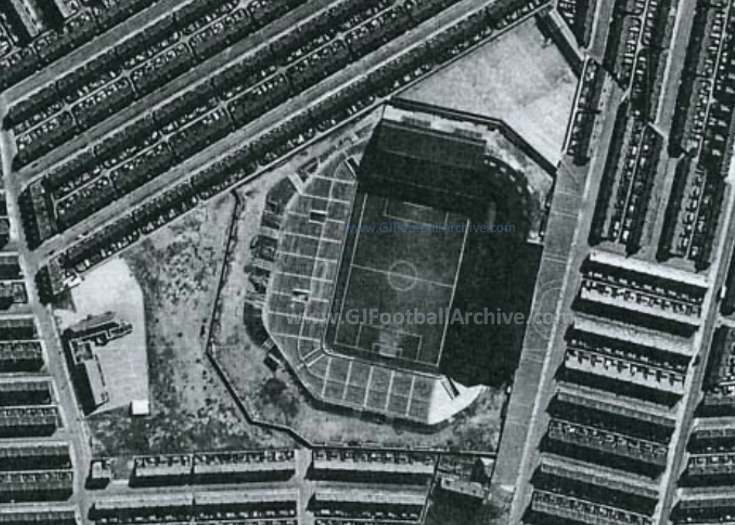
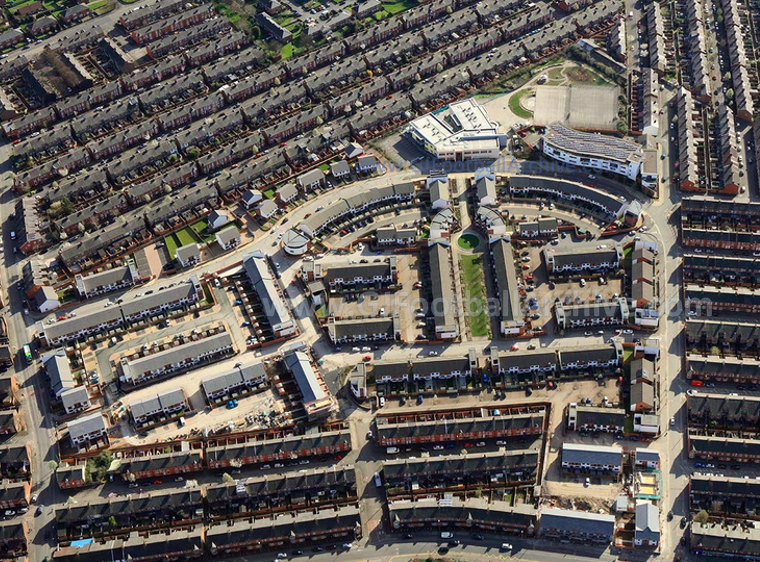
For day 42 of my posts counting down to the centenary of Maine Road’s opening game I’ve posted a then and now style feature on Maine Road from the air.
The angles are not quite the same but I hope the following gives you enough of a feel to recognise the differences between Maine Road c.1946 and Maine Road about a year or so ago.
There are a few obvious consistencies between the two photos – mostly the old terraced streets which predated the building of the stadium. Maine Road itself is on the right and Kippax Street is the street that heads towards the terracing (from the bottom/Claremont Road) in the older image. In the newer image it leads into part of the new housing estate. Note the centre spot/circle in the new image. It appears further north than in the older image but that’s mostly the angle (having said that I’m not entirely convinced it’s in exactly the right spot – I’ve not yet compared actual plans but I guess the architects and planners did).
It’s nice to see that the old directors car park (top right) is now a school playground/facility. This seems appropriate as the players often used that car park as a training area during the week. It’s nice to see some continuity. A passageway, known as ‘Pink Passage’ for many years, existed between the directors car park and the external wall of the Platt Lane Stand – you can just about see it on the old photo going from the back of Thornton Road around the Platt Lane to Maine Road.
Notice how the Kippax/Popular Side terracing in the old photo is narrower the closer it gets to Thornton Road (top)… In a previous post I’ve talked about how they had to square off this terracing when they put a roof on in 1957 and how residents objected because they lost the Granada TV signal! See:
Here’s another aerial photo of Maine Road. This is 1971. Notice the away section of the Kippax built on stilts (to left of number 8). The directors car park is the space behind the Platt Lane (numbers 4 & 5) with the Pink Passage between the two walls of the car park and the Platt Lane Stand. Kippax Street itself (the street not the stand) is just visible on the far right (to the right of number 9 on the edge of the photo).
Maine Road aerial 1971 from Farewell To Maine Road
If you’d like to read more on the history of Maine Road, take a look at Farewell To Maine Road, which can be downloaded from this page:
If you enjoy all the free material on my website and would like to support my research and keep this website going (but don’t want to subscribe) then why not make a one-time donation (or buy me a coffee). All support for my research is valued and welcome. It allows me to keep some free material available for all. Thanks.













 Gary James' Football Archive