Spotted this image from 1969 of Manchester City fans at Trafalgar Square for the FA Cup Final. I wonder if there’s anyone reading who is on this photo? Feel free to let me know if you are on it.
You can find out all about Manchester City during the 1968-69 season by reading the following subscriber article. If you’d like to read this 6,000 word article , plus all other articles on the site, then please subscribe (see below).
Subscribe to get access
Read more of this content when you subscribe today. It costs £3 per month (cancel anytime) or sign up for a year at the discounted price of £20 per year (works out £1.67 per month). Subscribers access the 1000+ articles posted so far and the others scheduled during the life of your subscription.
The new series on Manchester City in the 1920s continues today with a 1,300 word subscriber article on the 1929-30 season. If you subscribe (see below) I hope you enjoy it. If you are not currently a subscriber then why not try it for a month (£3 per month or sign up for a year at a discounted £20 per year)?
Here’s the article:
Subscribe to get access
Read more of this content when you subscribe today. It costs £3 a month (cancel anytime) or sign up for a year at £20 per year. Subscribers have access to the 1000s of articles, features, interviews etc. posted so far and all those posted during your subscription.
This is an interesting cutting from 1935 talking about the possibility of increasing Maine Road to cope with the huge crowds that wanted to watch Manchester City play. It may seem crazy today but wasn’t such an odd idea in the 1930s. You can find out more on the story here:
I’ve included this in some of my books over the years and I think it’s a great crowd shot which leads to the odd question too. Take a close look at it. This is from 1912-13 season and shows a section of the crowd in the Main Stand paddock. There are definitely men, women and children in there, but is there also one of the earliest non-white faces to be seen at a home City game too? It’s difficult to tell but look at the complexion of the man above the word ‘archive’… We’ll never know sadly.
As part if my Maine Rd 100 countdown in 2023 I posted this image of Manchester City fans demonstrating against chairman Peter Swales and his supporting board of directors. It’s always worth remembering those days as a reminder of how things change.
Of course fans still demonstrate and make their feelings known over various issues (as is their right) but these days it tends to be over specific issues. Back then it was about the direction of the full club. This image was from 1983 but protests against Swales and the board began in 1979 and continued until 1993-94. Here’s a photo of John Bond stood in front of the Main Entrance in 1983. The ‘cage’ protecting the entrance would often get locked to prevent fans forcing their way in during demonstrations.
John Bond, 1983
Here’s a 1995 image of Maine Road showing the forecourt in front of the Main Stand where most demonstrations occurred:
Anyone remember seeing the CITY F.C. flag that used to proudly fly above the Popular Side/Kippax. It was there for decades. There had been a CITY F.C. flag at Hyde Road and it may well be that this was the same flag. It was often referred to in the media during its life at Maine Road, such as in this 1925 cartoon:
The first derby at Maine RoadThe City flag flying at Maine Road’s first Manchester derby
The flag flew proudly over the Popular Side until the stand was roofed in 1957. Then the flag was moved to the Scoreboard End, eventually disappearing in the 1960s when rumour has it that it was taken down by Liverpool fans. I’m not certain if that’s true and I’ve never found any evidence but if you do know more please let me know.
I do know that in the 1930s a disgruntled City fan lowered it during a difficult game and it caused outrage. It was mentioned in the local press and the culprit had to make a formal apology to the club and his fellow City fans.
This 1971 image shows the roofed Kippax Stand. The flag was originally on a flag pole roughly where the number 7 is in the days before the stand had a roof. When the Kippax was roofed it was moved to the back of the Scoreboard End. The North Stand (10) replaced the Scoreboard End in the early 1970s.
Maine Road aerial 1971 from Farewell To Maine Road
If you’d like to read more on the history of Maine Road, take a look at Farewell To Maine Road, which can be downloaded from this page:
If you enjoy all the free material on my website and would like to support my research and keep this website going (but don’t want to subscribe) then why not make a one-time donation (or buy me a coffee). All support for my research is valued and welcome. It allows me to keep some free material available for all. Thanks.
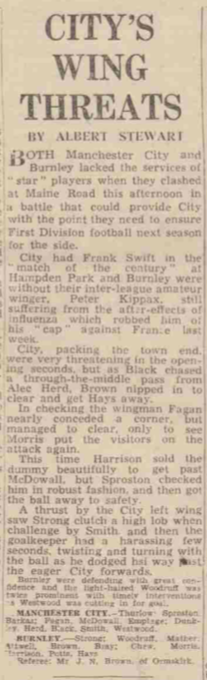
On this day (10 May) in 1947 a solitary goal from Alec Herd (image) against Burnley was enough to give Manchester City promotion. The attendance for this Second Division game was recorded by the media at the time as 67,672 but official records reviewed almost sixty years later showed that City actually recorded the attendance as 69,463 at the time.
Typically, the attendance figures City used to give the media for League games through to the 1960s tended to exclude season tickets. So the Blues’ management would give the figure of tickets or pay on the gate admission for the game but exclude season ticket holders. Back in 1946-47 City had around 1,800 season ticket holders and almost every League attendance back then is understated by that amount.
FA Cup games were the actual attendances as these were always sold game by game.
As this practice of excluding all season ticket holders continued for many, many decades at Maine Road attendance figures for League games are usually understated (they were often understated in the 1970s & 1980s as well but for different reasons and back then Peter Swales, Bernard Halford and the others involved in calculating attendances would deny any discrepancy despite many fans, fanzines and others challenging them often).
For comparison purposes it’s worth looking at the attendances of the Division One champions in 1947 to see how the Blues compared. This attendance against Burnley was almost 17,000 higher than Division One champions Liverpool’s highest crowd that season (52,512 v Wolves in December) and the Merseyside Reds nearest home game to City’s Burnley match was watched by 48,800 and that was Liverpool v Manchester United (May 3). Liverpool did average 45,732 that season, whereas City averaged 39,283 but they were a Second Division club.
The City-Burnley crowd was the Second Division’s record at the time and it was higher than every First Division crowd since the 1937-38 season (The Second Division record is now held by Tottenham v Southampton which had 70,302 in 1949-50).
Film of City v Burnley does exist but it’s in a most unlikely place. It was actually filmed as part of a Mancunian Films drama called Cup Tie Honeymoon. The company was run by a Manchester City fan who made this film, which starred Sandy Powell and Pat Phoenix (under her original name of Pilkington). A football game is crucial to the plot and scenes were filmed at Maine Road and interspersed with real action from the City-Burnley game to add credibility.
Myself and Will McTaggart have shown these scenes in our Boys In Blue film shows which have been staged at the Dancehouse and Cornerhouse in Manchester over the last decade. Maybe I’ll explain more about the film and those talks another day.
You can read more on the 1946-47 season below. This was the first league season after the war and ended with City winning the Second Division title. There were some truly significant – and well attended – games that season and future Liverpool manager Joe Fagan (photograph) made his debut this season too. This subscriber article includes comments from an interview I did with George Smith back in 2003.
This is a subscriber article and you can read it by subscribing below.
Subscribe to get access
Read more of this content when you subscribe today. It costs £3 per month or you can subscriber for the discounted annual rate of £20 per year. Each subscriber gets access to everything posted so far, including PDFs of a couple of my books.
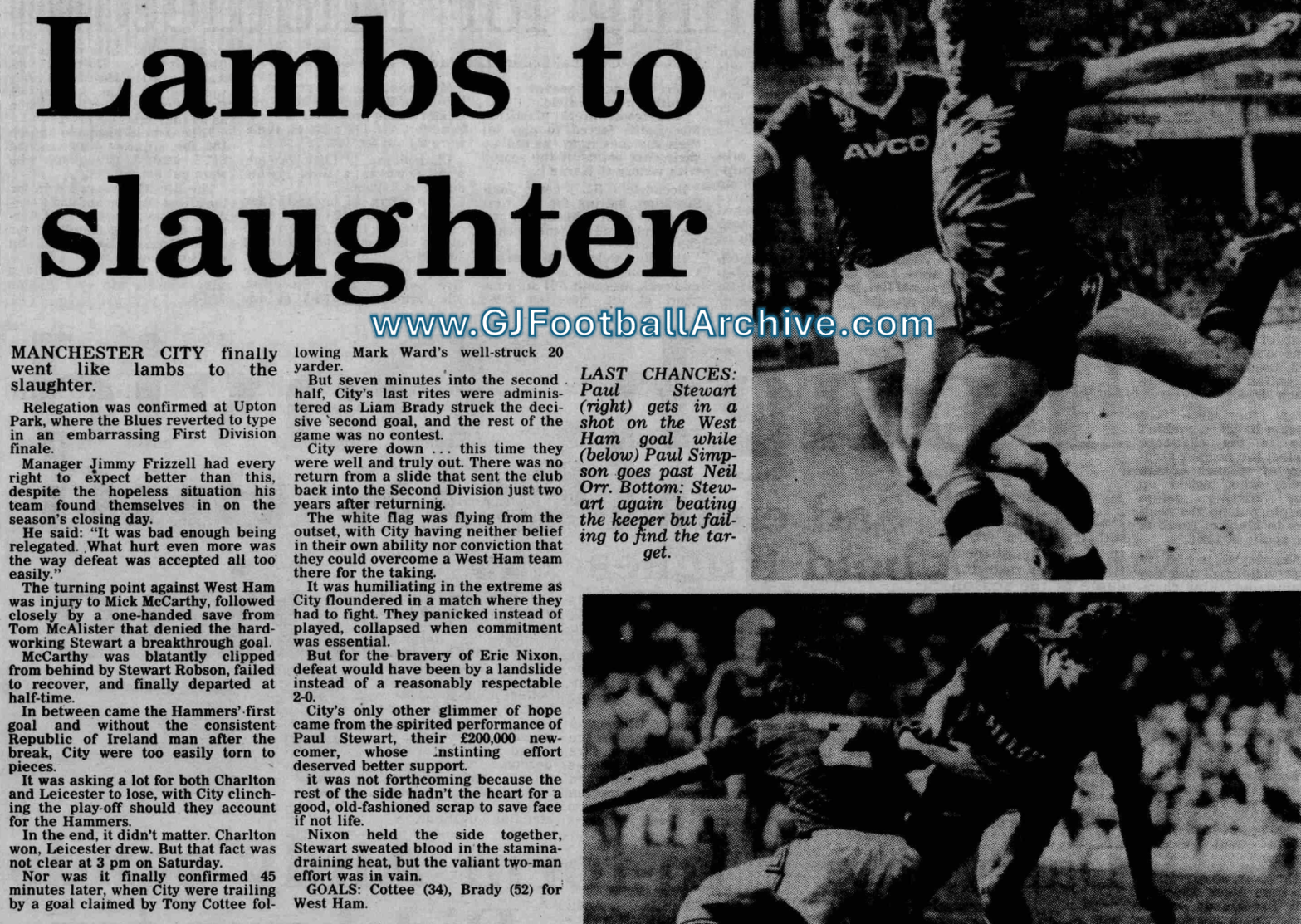
On this day (9 May) in 1987 Manchester City were relegated after a 2-0 defeat at West Ham (see match report). At the end of the game City supporters and West Ham fans climbed over the fences and onto the pitch. Some thought that the two sets of supporters were about to confront each other, but the fans knew differently. The Hammers began chanting “You’ll be back” and both groups swapped scarves and souvenirs on the pitch. It was the kind of moment that should have been widely reported in the media but at the time focus tended to be on hooliganism and confrontation rather than the positives of football support. City had been relegated, but their supporters did not seek revenge. The West Ham fans could have ridiculed, but they didn’t. If only those condemning football fans at the time could have seen the two sets of loyal supporters genuinely appreciating and understanding each other.
The relationship between the fans of the two clubs is not something that is widely discussed or promoted but it is something that has endured. City fans have never forgotten the ‘You’ll be back’ game and in recent years, as others have unfairly mocked both sets of fans, the supporters of both the Blues and the Hammers seem to understand and respect each other. Inevitably, there will always be banter during a game but outside of the match the mutual recognition and respect always seems to win through.
To many West Ham are the City of the South – a proud football club with a great history and heritage, combined with a loyal and passionate fanbase.
You can read more on the 1986-87 season below. This is a 2,500 word feature on the entire season and is available to subscribers.
Subscribe to get access
Read more of this content when you subscribe today. It costs £3 per month (cancel anytime) to access everything posted since 1 October 2022 or £20 a year to access everything posted since the site was created in December 2020. This special rate works out about £1.67 a week and gives access to everything posted, including PDFs of 3 of my books.
On this day (May 1) in 1934 Manchester City, who had won the FA Cup for the second time in their history, took part in an incredible home coming parade. Over a million people were on the streets to welcome back the club. You can see film of that below:
That commentary is a bit cringeworthy but listen out for comment about a million people on the streets; the scenes certainly suggest there was too.
Deservedly Manchester took time out to celebrate and what seemed like the whole of Manchester lined the city’s streets. The authoritative Pathe News claimed there were over a million on the streets. The film company was not known for exaggeration and if that figure is accurate – and their footage suggests it is – then this remains the largest homecoming in Mancunian football history (It was claimed in 1999 that 700,000 people had welcomed Manchester United’s treble winning team through the streets).
Various speeches were made into a microphone set up on the Town Hall steps (the BBC were broadcasting this live on radio), and the players and officials were given a civic reception. Mancunians enjoyed the success and wanted more.
In Albert Square Mancunians sang their celebratory songs including “Who Said City Couldn’t Play” – the earliest known recording of a City specific song:
Who Said City Couldn’t Play,
City Couldn’t Play, City Couldn’t Play,
Who Said City Couldn’t Play,
City Couldn’t Play football?
You can hear a recording of the song and read more about it here:
The 1933-4 League programme still had two games left for the Blues. On 2nd May – the day after the parade – City suffered a 3-2 defeat at Liverpool, and then on 5th May City demolished Wolves 4-0 at Maine Road. Before the game City staff, assisted by a couple of police officers, carried the trophy around the ground on some kind of wooden board. The fans were delighted.
During a week of FA Cup celebrations an illuminated bus journeyed around the city covered in City’s colours. On the front above the bus number, ‘City 2 1’, was the Manchester coat of arms. On the side the message ‘Welcome to the victors’ proudly illuminated next to a picture of the FA Cup and a drawing of Sam Cowan.
You can see film of this illuminated ‘Victory Bus’, preserved by the North West Film Archive at Manchester Metropolitan University, here (the bus can be seen after 5 mins 38 seconds but other scenes connected with the homecoming can be viewed after about 3 minutes):
This has been a taster of the material on this site. Subscribers have access to over 500 articles and posts, with many more scheduled over the coming weeks. Posted already for subscribers are exclusive audio interviews I have performed with Malcolm Allison, John Bond and George Graham (more to follow); the entire Manchester A Football History book (now out of print) and various other long read articles. It costs £20 a year (that’s about £1.67 a month) or £3 per month if you want to sign up a month at a time. Whichever subscription is taken out subscribers get full access to everything posted for as long as they are subscribers. You can subscriber here:
This is the cover of the wartime Manchester derby match programme for today (27 April) in 1940. The game was actually a League War Cup tie second leg and ended in a 2-0 United victory at Maine Road. The first leg had ended 1-0 to City. Wartime crowds were restricted by the Government and accurate attendance figures are often difficult to find but I do know that this Maine Road game attracted a restricted crowd of 21,596. You can read more on this wartime season below. It’s a 1,400 word article on Manchester City’s 1939-40 season. The season started as any other but then world events intervened!
This is a subscriber article and you can read it by subscribing below.
Subscribe to get access
Read more of this content when you subscribe today. It costs £3 per month or you can subscriber for the discounted annual rate of £20 per year. Each subscriber gets access to everything posted so far, including PDFs of a couple of my books.




 Gary James' Football Archive