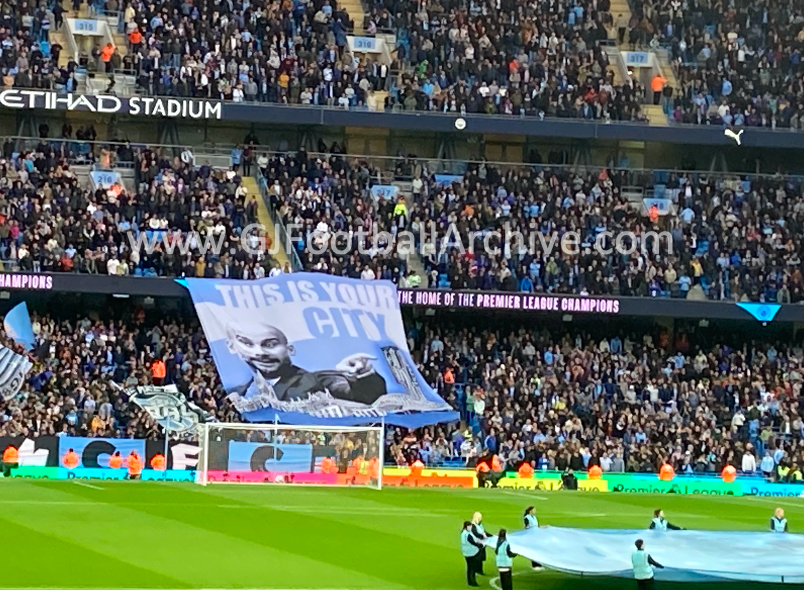
For those lucky enough to get the match programme for today’s game at the Etihad my programme feature focuses on Tony Book and Denis Law. It’s not extensive as I’m sure they’ll also be featured elsewhere, but I wanted to make sure I made mention of them in my piece too.
City v Chelsea has been an important fixture over the decades with European semi finals played between the sides over fifty years ago for example. Many of these are featured on this website, so why not have a search around. Here’s a link to all articles tagged Chelsea on here:
Continuing the series of features on the 1960s, here’s a subscriber article on Manchester City during the 1960-61 season. If you’d like to read this 1200 word article, plus all other articles on the site, then please subscribe (see below).
Subscribe to get access
Read more of this content when you subscribe today. It costs £3 per month (cancel anytime) or sign up for a year at the discounted price of £20 per year (works out £1.67 per month). Subscribers access the 1000+ articles posted so far and the others scheduled during the life of your subscription.
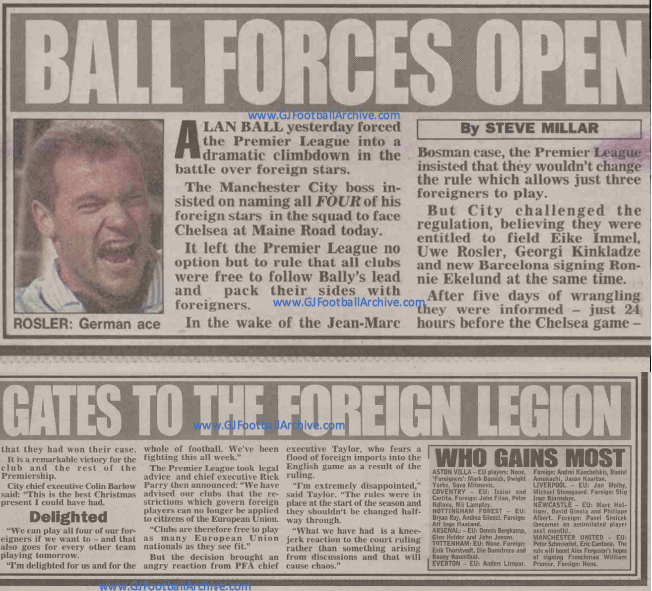
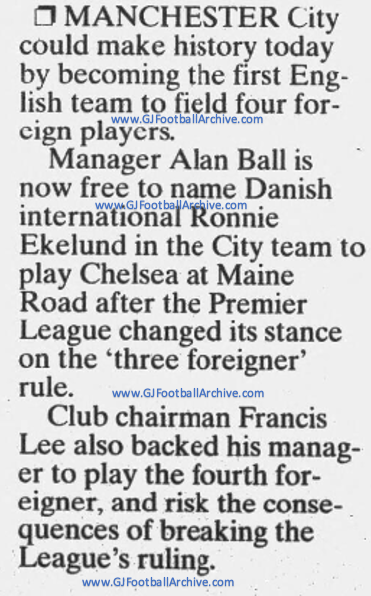
On this day (23 December) in 1995 there was a great deal of speculation that Manchester City would be the first team to field four ‘foreign players’ which wound PFA chief Gordon Taylor up considerably. There had been a rule in place limiting the number of foreign players to three but this had been challenged by English clubs, following the historic Bosman judgement in the European Court of Justice.
Basically, before Bosman challenged the restrictive trade practices UEFA insisted that a maximum of three foreign players could appear for clubs. The Bosman judgement was immediately considered by Premier League clubs who felt it meant they could play as many players from the European Union as they wanted (though the maximum of 3 from outside the EU was still a limit).
The Premier League, supported by the FA, said the ruling meant that City and other clubs could play as many EU players as they wanted. At Maine Road Alan Ball had brought Danish under-21 international Ronnie Ekelund on loan and together with Eike Immel, Uwe Rosler and Georgi Kinkladze it was suggested he would play against Chelsea on 23 December 1995.
In the end Ekelund came on as substitute for Rosler, so 4 ‘foreign players’ had appeared that day but only 3 at any one time (though there’s a whole other discussion to be had about players from other United Kingdom countries and Ireland and whether they should count as that day the Republic of Ireland’s Niall Quinn played, as did Gerry Creaney from Scotland and Welsh international Kit Symons!).
As for the game… City lost 1-0 to Chelsea!
Ekelund had a brief up and down career at City, making only 6 (plus 3 as sub) appearances and he was soon off to Barcelona, while the change to the ‘foreign player’ rule was to have a massive impact on the development of football in England, paving the way for the multitude of talented players at City today.
Subscribe to get access
If you have enjoyed this piece and would like to support my writing while also accessing further great content, then why not subscribe? Those who subscribe on an annual basis get access to everything posted on this site since December 2020 (including PDFs of 2 out of print books, and audio interviews with John Bond, Malcolm Allison etc.). Those subscribing on a monthly basis get access to everything posted since 1 October 2022. It’s £20 a year or £3 per month. Why not try it for a month?
Manchester City’s recent results have inevitably brought many headlines and, of course, if you support a team whose form is one of mainly defeats then inevitably you’re bound to worry. For me, one thing it demonstrates more than anything else though is how wrong some were to claim that football is dominated by one club in a way that it has never been before. For several years now some have been claiming that City winning trophies is all about money; all about financial power that leaves others unable to cope. When we fail in life it’s easy to blame others but maybe those who make those comments should look at themselves first?
Instead, of analysing why their clubs fail, some have suggested ‘it’s not fair!’ and that there has never been a time when money has ruled football. I’ve been saying that this is untrue and that wealthy football clubs – or clubs that have received significant investment – have always been there, and that money is no guarantee of success. Those of us old enough to remember the late 1970s and early 1980s well know that City, Leeds, Wolves, Chelsea and others found that spending money could also lead to ruin.
You don’t have to look far for articles from this last year which have talked about how unhealthy the Premier League is ‘because of City’ but, as I said at the time, those comments really were out of place. Recent results have demonstrated this further. What I said earlier this year (and in recent seasons) is that significant praise was due to City and their manager Pep Guardiola for everything they’ve achieved in a highly competitive domestic and European scene. It’s also clear that those clubs, fans and others who have tried to explain away a club’s failings by simply stating: ‘It’s unfair, we can’t compete with City’ actually need to look at their own club and recognise its failings. When we fail in life it’s easy to blame others but maybe look at your self first?
City’s current form is not great and defeats are either because the opposition are better or City have failed. It’s not because one team has more money than another; it’s because they played the game better. When City win trophies it’s not because they have more money; it’s because they’ve played better; coached better; found a way to play that’s better… So can those who claim that football is uncompetitive because of City now start to look at themselves first and see why their team fails?
We should all remember, whether at times of success or failure, that football is an entertaining game. Sometimes we win; sometimes we fail… no team has ever dominated for decades and therefore successes like City’s 4 league title in a row really are major achievements that should be celebrated and recognised by all!
Here’s a few articles from months/years ago that challenge/discuss some of the comments about dominance in the past:
On this day (12 November) in 2023 Manchester City drew 4-4 at Chelsea and this was heralded as a great game by the Sky TV pundits. As fans, these sort of games never feel like great games at the time but neutrals obviously love them. For fans of the teams involved they tend to feel like opportunities lost or maybe great comebacks depending on which side you support. Immediately after the game in 2023 I was asked when City’s previous 4-4 draw was and I spent a few minutes thinking ‘I’ve never seen one before involving City, or have I?’ So, I then started to scour the material in my collection and was somewhat surprised to find it was against Grimsby in September 1950! Certainly many, many years before I was born.
My favourite goal in last season’s match at Chelsea was the one Haaland scored with his er… um… er… shorts area. The City scorers were: Haaland (25 minutes pen, 47 minutes), Akanji (45+1 minutes), Rodri (86 minutes) and for Chelsea (including two City old boys): Thiago Silva (29 minutes), Sterling (37 minutes), Jackson (67 minutes), Palmer (90+5minutes pen).
Incredibly last season’s game wasn’t the first time City had drawn 4-4 at Chelsea and, coincidentally I’d tweeted about this before last year’s match. I never expected history to repeat itself. You can read about the earlier match via the link below. Incidentally, the game was in 1936-37 and City won the title that year – as they did in 2023-24!
If you enjoy all the free material on my website and would like to support my research and keep this website going (but don’t want to subscribe) then why not make a one-time donation (or buy me a coffee). All support for my research is valued and welcome. It allows me to keep some free material available for all. Thanks.
Here’s a brief clip I took on this day (6 November) in 2021 of City fans at the end of the Manchester Derby at Old Trafford. A dominant day for Manchester’s Blues.
After the game City manager Pep Guardiola told the BBC he wanted to give a ‘massive compliment to the players’ because ‘they are the real artists for the way we played.’
Guardiola said City’s approach was shaped by United’s ability on the counter-attack: ‘If you don’t finish the attack you will be attacked much, much quicker and that is where they are so good. That is why we needed a game with a thousand million passes. We need a game like with the ball in the fridge, keep it there. Right now Chelsea are unstoppable. We know we cannot drop much points to be close to them but against the big six we performed well.’
The win lifted City above Liverpool into second in the Premier League while fifth-placed United were nine points behind leaders Chelsea.
A flashback to a high scoring win for Manchester’s Blues on 2 November 2013…
After the 2-1 last gasp defeat at Chelsea in their previous League game, manager Manuel Pellegrini took the decision to drop goalkeeper Joe Hart for this important match with Norwich. The decision brought much scrutiny City’s way but Hart’s replacement Pantilimon had little to do as the Blues thrashed Norwich 7-0. The win lifted City to fourth in the League but more significantly demonstrated the fire power the Blues possessed and demonstrated to all that Pellegrini’s men were determined to mount a serious challenge for the title. Seven separate scorers – including an own goal – made this City’s largest top flight win since 1968. Afterwards Pellegrini was delighted that his side kept striving for more: “Normally a team 4-0 ahead finishes working.”
City had a 100% home record in the Premier League but away from home life was not so easy. At Sunderland in the next League game the Blues were unfortunate to lose 1-0. The BBC’s Sam Sheringham explained: “Referee Mike Dean’s leniency was on display once again in the build-up to the opening goal. The official opted not to penalise Bardsley when he appeared to bundle over Milner, allowing the full-back to race on to Brown’s long pass and curl a precise finish past Costel Pantilimon.”
The Blues were back down to eighth in what seemed likely to be a tight title race.
Match Stats:
2013-14
2 Nov Norwich City (H) W 7-0 Silva, Nastasic, Negredo, Toure, Aguero, Dzeko & Johnson (OG) 47,066
10 Nov Sunderland (A) L 0-1 40,137
League Cup
30 Oct Newcastle United (A) W 2-0 Negredo, Dzeko 33,846
Twenty years ago today (16 October 2004) eventual champions Chelsea were defeated 1-0 by Manchester City at the City of Manchester Stadium (now Etihad). City were the only side to beat the champions during 2004-5 and managed to draw the return fixture 0-0. You can read more on the October game below:
By the time Chelsea arrived in Manchester on 16 October the Blues were 12th on 8 points, while the visitors were second, behind Arsenal, on 20 points. Chelsea were also one of only two sides unbeaten in the League and were, without doubt, favourites to win this match. Keegan optimistically told fans pre-match: “It is still 11 against 11 on the day and we are more than capable of beating the top sides.”
The manager’s views proved correct as City defeated the eventual champions 1-0 with an 11th minute penalty from Nicolas Anelka. It was the first time Jose Mourinho had suffered a defeat at Chelsea and was only the second time his side had conceded a goal during 2004-05. It was also City’s first home victory over the London club in the Premier League. Sadly, Jihai Sun suffered cruciate ligament damage and was to miss the rest of the season.
The Jihai Sun injury was not the only one affecting Keegan’s side during the first half of the season and, as the Blues had one of the smallest squads in the Premier League, the manager found himself with few players to choose from at times.
If you enjoy all the free material on my website and would like to support my research and keep this website going (but don’t want to subscribe) then why not make a one-time donation (or buy me a coffee). All support for my research is valued and welcome. It allows me to keep some free material available for all. Thanks.
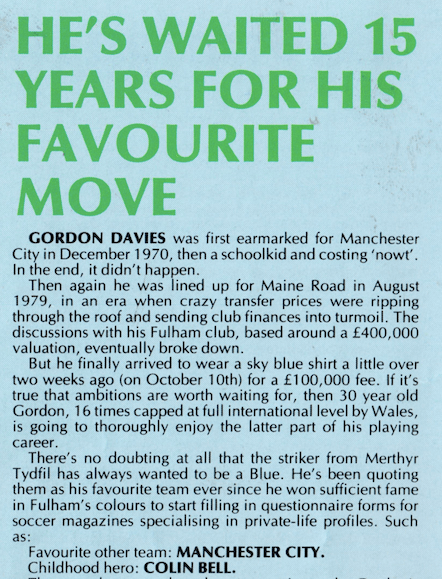
On this day (10 October) in 1985 Chelsea forward Gordon Davies joined Manchester City (the team he supported; his hero was Colin Bell). Davies made 3 Welsh international appearances while at City. There was a chant connected with him which was, err, well, typical 1980s. It was based on the ‘Woo Gary Davies, woo Gary Davies, woo Gary Davies on the ra-di-o’ jingle used by Radio One DJ Gary Davies (of course). The chant (I’m sure you can guess) went ‘Woo Gordon Davies, woo Gordon Davies, woo Gordon Davies in the ar-e-a’ (meaning penalty area of course!). Those were the days, hey?
Subscribe to get access
Enjoying this website? Fancy supporting my research into Manchester football history? Why not subscribe? Every subscription directly helps support my research and provides each annual subscriber with access to everything posted on this site, including the entire Manchester A Football History and From Maine Men To Banana Citizens books, plus interviews, articles and more. I am not employed by anyone and all my research is self funded or comes from subscriptions to this site.
If you enjoy all the free material on my website and would like to support my research and keep this website going (but don’t want to subscribe) then why not make a one-time donation (or buy me a coffee). All support for my research is valued and welcome. It allows me to keep some free material available for all. Thanks.
There’s a lot of furore this week about Manchester City’s decision to wear their new Oasis inspired kit instead of their home kit for their Champions League game with Inter Milan. Lots are talking about tradition, heritage and the like, so I thought I’d add a few words here that might have been overlooked or forgotten. So here goes…
Firstly, my position is clear that I’ve always been keen to see City wear home colours/blue for every fixture possible (whether home, away or at a neutral venue) but I’m a pragmatist and know that’s no longer likely. History and tradition does mean something but of course, when it comes to football, traditions change frequently. People may think City have only ever worn a particular colour at home or that the traditional away colours are red & black but these things are not true. Times change.
When it comes to wearing alternative kits at home it has been done more often than perhaps people realise. In fact the only decade when it hasn’t happened appears to be the 2010s – I say appeared because I haven’t got evidence of every home game in the 1890s and 1900s!
These last few days have caused some to recall the Middlesbrough game when David James went up front and the two Tottenham games at Maine Road in 80s/90s when the referee felt the kits were too close and City ended up changing. But there have been many other occasions. In fact it’s well over 100 years since City first chose to wear away colours/alternative strips at home when they didn’t need to!
The image above of Neil Young comes from the 1971 ECWC semi-final v Chelsea. Notice that Young is wearing City’s away colours.
Often when there was a clash of colours in a cup game City would wear their away strip. Games in the 1920s right through to 1970s saw the Blues don maroon, red/black and even scarlet at times at Maine Road.
Here’s another image from that Chelsea semi final:
1971 ECWC v Chelsea. Francis Lee. Photo by Alan Jubb
To the right you can see the North Stand under construction, as you can in the Young image.
Other games in living memory (not necessarily mine, but living memory for many older blues) include:
January 1971 – City v Wigan in FA Cup (red & black)
September 1970 – City v Bologna in Anglo-Italian Cup (red & black)
January 1968 – City v Reading in FA Cup (all maroon)
March 1966 – City v Everton in FA Cup (all maroon)
March 1966 – City v Leicester in FA Cup (all maroon)
March 1956 – City v Everton in FA Cup (maroon shirts, white shorts)
In earlier decades City often chose to wear an away shirt for cup ties where there was a clash. Prior to 1921 the FA rule was that home teams would have to change if there was a clash.
In March 1924 City chose to wear a kit they described as ‘Lucky scarlet’ for a FA Cup tie with Cardiff at Maine Road. So for well over 100 years City have often chosen to wear alternative kits at home instead of traditional blue when they didn’t need to.
Personally, I’d still prefer City to always wear blue no matter where they play, but that’s never going to happen anyway.
Incidentally, if you’d like to read more on the history of Maine Road, take a look at Farewell To Maine Road, which can be downloaded from this page:
If you enjoy all the free material on my website and would like to support my research and keep this website going (but don’t want to subscribe) then why not make a one-time donation (or buy me a coffee). All support for my research is valued and welcome. It allows me to keep some free material available for all. Thanks.







 Gary James' Football Archive