League Dominance – Gap Between Top and Bottom

Following on from my piece the other day about League domination where I challenged a few myths that have developed about Premier League domination. It continues to be said that the Premier League is not as competitive as in the past and that teams at the bottom have no chance. This is of course concerning and there are definitely issues between the haves and have nots in football but is this a recent phenomenon? Is this caused by one club in particular?

Each season there are often one or two clubs who have an extremely low points total and, to be frank, I’m not certain whether the champions (whoever they are and whenever they succeed) can be blamed for the results of games not involving them.

Surely, even if City, Liverpool, Arsenal, Chelsea, United etc. win the League every season by a record amount of points the results between all other 19 clubs have zero to do with that club’s dominance?  If you’re a supporter of a relegated club can you honestly say that you’d stand a chance of winning the League if City or another team did not exist?  You’d need possibly the top ten to disappear before it had a major impact on your chance of League success (I’m not saying that’s acceptable – I’m just stating that it can never be the fault of one club).

Those finishing second may blame the dominant club but surely not anyone outside of those challenging. Blame all the elite maybe. These things never happen over night and because one club wins the League.

So, how do we calculate the gap between the champions and those struggling?  Where do we start?

One method is to look at the team that wins the League and see how big a gap is between them and the relegated clubs. There are often one or two teams that gather few points and so I’ve looked at the difference between the champions and the team finishing 17th (safe from relegation). I’ve taken the lowest points accumulated by the 17th placed team and compared that to the Champions.

This makes interesting reading and shows that the lowest points gathered by the 17th placed ‘safe’ team was almost two decades ago! That’s right, it’s not the current era – it’s all those years ago!

Chelsea were the champions when the lowest points total was accrued by the 17th placed club in 2004-05 (in fact the three lowest were all in the 2000s not the last decade). The five lowest points accumulated by a team in 17th place are (note: 5 of these are 2010 or earlier):

1: 2004-05 Champions Chelsea earned 61 points more than 17th placed WBA (34)

2: 2009-10 Chelsea earned 51 points more than 17th placed West Ham (35)

2: 2008-09 United earned 55 points more than 17thplaced Hull (35)

2: 2019-20 Liverpool earned 64 points more than 17th placed Aston Villa (35)

5th: 1999-00 United earned 55 points more than 17th placed Bradford (36)

5th: 2007-08 United earned 51 points more than 17th placed Fulham (36)

5th: 2013-14 City earned 50 points more than 17th placed WBA (36)

5th: 2017-18 City earned 64 points more than 17th placed Southampton (36)

5th: 2018-19 City earned 62 points more than 17th placed Brighton (36)

5th: 2022-23 City earned 53 points more than 17th placed Everton (36)

Ignoring the first few seasons when there were more than 20 clubs in the Premier League, the highest points total ever gathered by the club in 17th place was 44 (Bolton) in 2002-03 – only two seasons before the lowest points total, showing how these things can vary.

Okay but what about teams actually relegated? Here are the five lowest points accumulated by a team finishing 20th and the difference with the champions that season. Again the lowest points gathered was in the 2000s, not 2020s (Only 2 of these are since 2015 and none are from the 2020s!):

1: 2007-08 Champions United gathered 76 points more than 20th Derby (11 points)

2: 2005-06 Chelsea gathered 76 more than Sunderland (15)

3: 2018-19 City gathered 82 more than Huddersfield (16)

4: 2015-16 Leicester gathered 64 more than Aston Villa (17)

5: 2002-03 United gathered 64 more than Sunderland (19)

5: 2009-10 Liverpool gathered 78 more than Portsmouth (19)

Okay, so what about the actual points gap between the champions and the 20th placed club? Again analysis of every Premier League season shows some interesting information.  The five biggest points differences between top and bottom are (again two of these are from the 2000s):

1st: 2018-19 City 82 points over Huddersfield

2nd: 2019-20 Liverpool 78 points over Norwich

3rd: 2005-06 Chelsea 76 points over Sunderland

3rd: 2007-08 United 76 points over Derby

5th: 2021-22 City 71 points over Norwich

For the next analysis I’ve calculated the difference between the champions and the club finishing in 18th place (usually a relegated place, but not in the first couple of years of the Premier League). The idea being that the bottom two could be way off the pace.

This shows that City’s record 100 points season was the biggest gap between them and the 18th place relegated club. That’s significant, however that was an incredible record breaking season of wins for City. Interestingly though, for a team that’s supposed to be creating barriers between the top and the bottom City only hold two of the top five biggest gaps (Chelsea also hold 2) and one of those top 5 champions is actually Chelsea in 2004-05 – 19 years ago!

If we look beyond the top five there are 3 clubs in joint 6th place including Manchester United in 1998-99 – 25 years ago! Yet it’s supposed to be only now that the gap between top and relegation is vast.

For those wondering here are the highest 10 or so gaps between top and relegated clubs (18th place):

1st: 2017-18 City (the record 100 points season) 67 points over Swansea

2nd: 2019-20 Liverpool 65 points over Bournemouth

3rd: 2018-19 City 64 points over Cardiff

4th: 2004-05 Chelsea 62 points over Crystal Palace

5th: 2016-17 Chelsea 59 points over Hull

6th: 1999-00 United 58 points over Wimbledon

6th: 2020-21 City 58 points over Fulham

6th: 2021-22 City 58 points over Burnley

9th: 2003-04 Arsenal 57 points over Leicester

9th: 2005-06 Chelsea 57 points over Birmingham

11th: 2008-09 United 56 points over Newcastle

11th: 2009-10 Chelsea 56 points over Burnley

What does all this statistical information prove? Well there doesn’t appear to be much difference between the 2000s and the last decade. Some seasons in each decade there were huge gaps.

We all know that the elite are some way ahead of those that struggle and there is an imbalance. That’s concerning for football and the introduction of Financial Fair Play and similar has, so far, strengthened the position of the elite and limited the opportunity for investment at lower clubs. 

You can read my previous post here:

If you enjoy all the free material on my website and would like to support my research and keep this website going (but don’t want to subscribe) then why not make a one-time donation (or buy me a coffee). All support for my research is valued and welcome. It allows me to keep some free material available for all. Thanks.

Choose an amount

£2.50
£5.00
£7.50

Or enter a custom amount

£

Your contribution is appreciated.

Donate
League Dominance?

Lots of tosh has been spoken recently about teams dominating English league football with some claiming that there’s ‘never’ been a time when a team has dominated as much as Manchester City do today. Ignoring the fact that the League campaign is not over yet and will go to the final day (so that’s a nonsense for a start) I decided to pull together a few facts that may be useful. They’re certainly relevant.

So, first of all, the question of whether Manchester City is the first to dominate in a way no other has before (again the season isn’t over and it could go either way yet, so ‘dominate’ is not something I believe anyway!)… City have currently won 3 League titles in a row. A feat that has been done several times before, most recently (before City) by Manchester United in 2006-09.

Ah, but City have won 5 out of 6 titles they say… Yes, but United won 7 out of the first 9 Premier Leagues and were runners up in the other 2. Liverpool achieved the same 7 out of 9 League titles in the 1970s and early 80s. We can’t predict the future of course but City have never managed seven titles in 9 seasons. In fact if City do win the League the stats will show it’s 7 in 11 seasons and at present it’s 7 titles in 12 seasons. So that means two other clubs have had longer spells as ‘dominant’ clubs using the language and phraseology that those criticising the reigning Champions usually use.

One of the other criticisms that’s thrown City’s way is about the Premier League being ‘boring’ because it’s a ‘foregone conclusion’ and ‘other teams have to be perfect’ to finish above City. Well, to be the best you have to beat the best but in terms of the League being ‘boring’ and a ‘foregone conclusion’ then the stats in terms of points gaps say otherwise.

Sure, City’s incredible 2017-18 season when they amassed 100 points was one in which the Blues ran away with the title, but it was also a rarity. City won the League by bettering second place by an astounding 19 points but, wait a minute, that amazing gap is only 1 point  more than the (18 point) gap between 2020 champions Liverpool and second placed City (at a time when City are supposed to be the dominant team!). Not only that but United had an 18 point gap between them and second placed Arsenal in 2000.

Worth noting too that in the 31 season history of the Premier League 14 runners-up teams bettered 2nd placed United’s points tally in 2017-18 when City achieved their 100 points. Surely, no title winning team can be blamed if the runners-up have worse results than in more than 45% of the competition’s seasonal history?

What about the ‘foregone conclusion’ and ‘boring’ line? Well, I suppose it can be argued it’s boring if the League is won many, many weeks before the end of the season. Using that logic it should also be ‘not boring’ if it goes down to the last game (like this season) or the last week (could be 2 or 3 games depending on fixture congestion). So I’ve had a look at how many seasons have finished with 3 points or less separating the top two teams. This shows that there have been 9 seasons when this has been the case. Guess what? 4 of those were seasons when City have won the Premier League (2 United, 1 Arsenal, Blackburn & Chelsea).

This means that 57% of all City’s Premier League title wins have been by less than 3 points! For United (13 PL titles) the figure is 15%; Arsenal (3 PL) it’s 33% and Chelsea (5 PL) is 20%.  Four of United’s PL titles have been won by 10 points or more.

Of course, title races can be exciting when teams win the League by ten points or more, but the argument many put across is that it’s boring when one team walks away with it. Surely there’s less chance of that happening when a team wins the title by less than 3 points?

There are lots of statistics that could be posted and, to be frank, they never actually tell the story of a season. How many times do we see possession stats that are in one club’s favour but the other team is actually winning? Nevertheless, when people try to suggest a season is boring because a club (any club) is running away with it then the stats can help show that something is not true. Similarly, when it comes to dominant football clubs – yes, there are eras of dominance by certain clubs and Manchester City certainly are a dominant club at the moment – we must not be fooled into thinking that a situation has NEVER happened before when it so obviously has (and other clubs may actually have been more dominant!).

Ah well! Football, hey? If only people actually looked at history more before jumping to conclusions.

If you enjoy all the free material on my website and would like to support my research and keep this website going (but don’t want to subscribe) then why not make a one-time donation (or buy me a coffee). All support for my research is valued and welcome. It allows me to keep some free material available for all. Thanks.

Choose an amount

£2.50
£5.00
£7.50

Or enter a custom amount

£

Your contribution is appreciated.

Donate

City on the Hill

On this day (7th May) in 2000 Manchester City achieved promotion by beating Blackburn 4-1 on the last day of the season. A large group of fans gathered on the hill above Ewood Park to watch as much of the game as possible (were you one of those fans – please get in touch with your story if you were).

As with most things City did back then, the journey to promotion had not been as straightforward as fans hoped it would be.

“We will not be going to Blackburn to defend or looking for just one point, that would be inviting disaster.  We will be playing to take three points.  Legends are born in games like this and particularly at a massive club like City with the fan base we have.  Someone can be a hero, not just for a day but for a long time.”  

These were the words Joe Royle used in the build up to City’s crucial match with Blackburn on the final day of the 1999-2000 season.  He wanted to send a strong message to the rest of football that City were determined to return to the Premier League, and return they did.  The game with Blackburn was extremely tense at times, and there were a number of occasions when everyone connected with the club felt that Blackburn would be added to the names of Luton and Liverpool in the City cock-up list.  However Royle’s City showed resilience and success followed.

Here is my review of that game and the 1999-2000 season. To read the rest of this piece then please subscribe below:

Subscribe to get access

To read this and access all other content please subscribe. It works out about £1.67 a month if you take out an annual subscription (£20 per year) or £3 a month if you’d like to sign up for a month at a time. Each subscriber gets full access to the 1000s of articles posted so far (including audio interviews with John Bond, Malcolm Allison, George Graham and the entire Manchester A Football History book) and the hundreds scheduled to be posted in the coming months.

City 1 Leicester 0, the FA Cup Final

On this day (April 26) in 1969 Manchester City defeated Leicester City in the FA Cup final. It is worth pausing to consider how the Blues compared to football’s other successful sides in the competition at this time in football history.  City’s four FA Cup successes placed them 7th in the all-time list of FA Cup winners – can you guess the clubs they were behind? Liverpool? No! MUFC? No! Arsenal? No! Keep going…

They were behind Aston Villa (7), Blackburn Rovers (6), Newcastle United (6), Tottenham Hotspur (5), The Wanderers (5) and West Bromwich Albion (5).  Bolton, Sheffield United and Wolves had, like City, each won four FA Cups, while Manchester United and Arsenal had only won three, Liverpool one and Chelsea had not yet won the trophy.  In fact Chelsea had only won one major trophy (the League Championship) at this point in their history.  

Here for subscribers is a long read on that final and the events surrounding it:

Subscribe to get access

Read more of this content when you subscribe today.

Manchester Home To A League First & Myth Busting

On this day (17 April) in 1888 the first meeting of the Football League was held in Manchester. The following report names the clubs accepted and the others who wanted to join the League. It has often been written in Manchester United related books that Newton Heath applied to join the League in 1888 but didn’t receive enough votes to be accepted. That is completely untrue as no one actually had to apply nor was a vote taken. Clubs were asked and some tried to push to get included but Newton Heath were neither asked nor were they pushing for acceptance either. Nor were Ardwick or Manchester Asoociation who, to be frank would’ve been the most famous Manchester club at this time.

Bolton Wanderers were the only team from present day Greater Manchester to be asked/selected for the first League season.

Manchester Courier, 18 April 1888

The plaque is positioned on the corner of Mosley Street and Market Street/Piccadilly in Manchester.

The Span of Success 2023: Updated

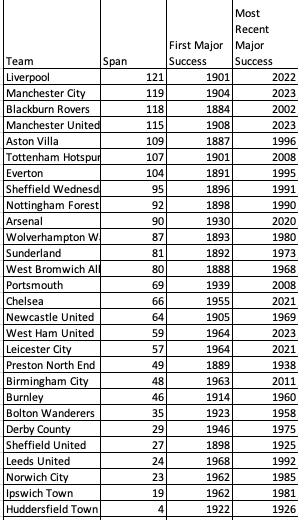
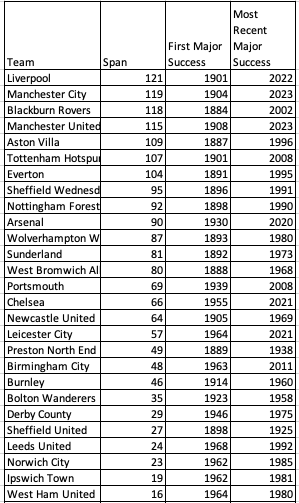
Congratulations to West Ham on your success in last night’s Europa Conference League. Great news for your club and for those clubs who wonder whether competitions like this are a drain or something to aim for. I’ve now updated the table showing the span of success – i.e. the number of years between a club’s first major success (FA Cup, League, League Cup, European trophy) and their most recent. West Ham have jumped some way up that list.

Okay, the span of success does not show how many trophies each club has won or how frequently that club has experienced great eras of success, but it does demonstrate how wrong those people are who believe certain clubs were unsuccessful until recent years, or those who think certain clubs have always been giants. The column on first major success helps to show when some clubs first became trophy-winning significant (often after transformational investment).

West Ham have proved that if you’re a club that hasn’t won a major trophy for a while putting your focus on achieving trophy success ahead of the odd Premier League position can bring significant reward. In future decades no one will remember who finished seventh, tenth or fifteenth but they will remember the trophies.

I know clubs focus on their financials but winning a trophy has longevity, gaining the odd Premier League place provides a bit of extra cash now but no long term kudos. Winning a trophy attracts new fans and brings money-spinning opportunities too.

If I was a supporter of Everton, Aston Villa or any of the other major clubs who have not found significant success in recent decades then I would absolutely want my team to go for whichever cup competition seems most likely to win. That’s what I always wanted from City before they were able to compete for the League again. Winning the FA Cup in 2011 helped everything that followed happen.

While you’re here… why not take a look at the free to read daily Maine Road features counting down to the old stadium’s 100th anniversary of its first game? Here are a sample couple of features (follow the Maine Road tag or search for more):

The Span of Success 2023

Ahead of West Ham’s European final tomorrow night (7 June) I thought I’d post the latest update to the table showing the span of success – i.e. the number of years between a club’s first major success (FA Cup, League, League Cup, European trophy) and their most recent. If West Ham win tomorrow they will leap ahead of Leicester City.

This season has seen City overtake Blackburn Rovers and they are now second to Liverpool.

Okay, the span of success does not show how many trophies each club has won or how frequently that club has experienced great eras of success, but it does demonstrate how wrong those people are who believe certain clubs were unsuccessful until recent years, or those who think certain clubs have always been giants. The column on first major success helps to show when some clubs first became trophy-winning significant (often after transformational investment).

While you’re here… why not take a look at the free to read daily Maine Road features counting down to the old stadium’s 100th anniversary of its first game? Here are a sample couple of features (follow the Maine Road tag or search for more):

Historic Name That Ground – Week 26 Answer

On Monday I said that I knew this one’s tough (but I also knew that some who follow me on twitter support the club who still play at this ground)… Did you recognise this ground?’ This is a newspaper cutting from the opening of the new main stand when the club who play here decided to have a garden party to celebrate. I also gave the following clues: ‘The club still play at this ground, although all four sides have been completely rebuilt since the image was taken. The photo was taken in 1907. One of the players seen is called Ferguson.

I know it was tough but if you support this club you probably got there in the end. It’s actually Blackburn Rovers’ Ewood Park.

While you’re here why not subscribe to my site and you can then access every article, interview, audio recording etc. already posted and those that will be posted during your subscription. It costs £20 per year (about £1.67 a month) or you can sign up on a monthly basis at £3 per month (you can cancel at any time, so you could sign sign up for a month, access everything you want and then cancel). You can subscribe below:

Subscribe to get access

Read more of this content when you subscribe today.

I had planned to run ‘Historic Name That Ground’ only during the close season as in previous years, but it’s proving of interest so I’ll keep it going for a little while yet. If you have an old image of a ground that you think it’d be worth including in this weekly quiz then please get in touch. They don’t have to be from the 1900s to 1960s – even ground images from the 70s and 80s may prove a challenge to identify these days. You can email me at gary@GJFootballArchive.com Thanks.

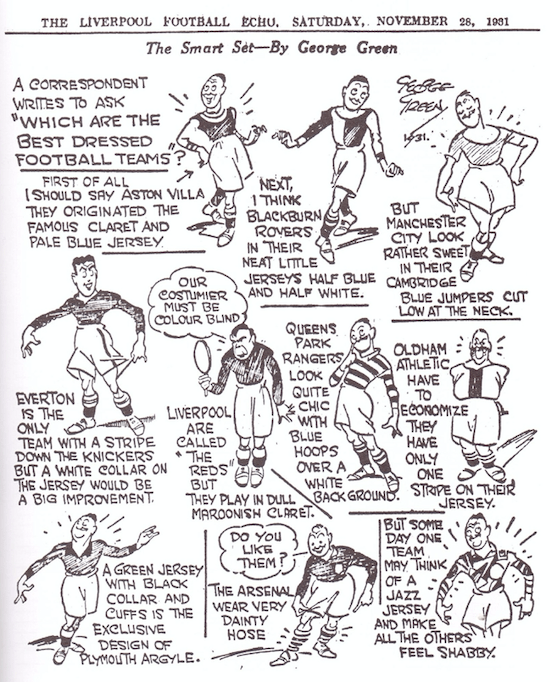
The Smart Set – Club Colours 90 Years Ago

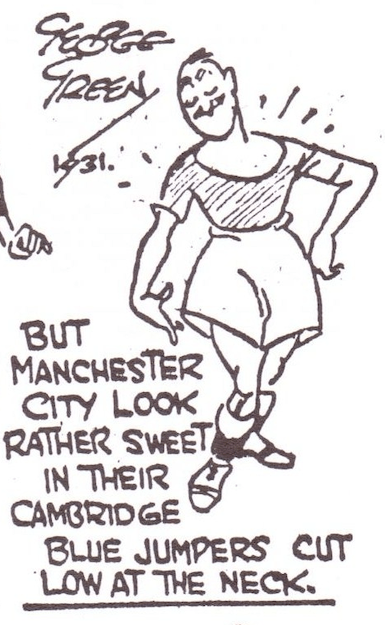
On this day (28th November) in 1931 the Liverpool Echo published this George Green cartoon of the kits worn by several leading clubs of the period. I thought I’d post it here to show how these things were often portrayed in the newspapers of the day. Thanks.

While you’re here I’d like to thank you for taking the time and trouble to visit my website. I have been researching and writing about Manchester football for a long time (no wonder I’m going grey!) with my first book published in 1989. I am not employed by anyone and I do not have sponsorship either and so I’ve set up this website to help share my 32 years plus writing and research. The intention is to develop the archive and to provide access to as much of my material as possible over the coming weeks, months & years. Subscribers can already access hundreds of articles/posts including the entire Manchester A Football History book and various audio interviews (including John Bond, Malcolm Allison & George Graham). 

It costs £20 a year (it works out £1.67 a month) or £3 if you’d like to sign up a month at a time to get full access for as long as you subscribe. Thanks for the support, Gary.

Subscribe to get access to the entire site

Read the in-depth content when you subscribe today.