Continuing here: the story of Manchester City’s origins. Today’s feature is a 3,300+ word feature on the earliest known game, played in November 1880. Have a look elsewhere on the site for other content on this period.
Subscribe to get access
These articles will be available to subscribers to this site. It costs £3 per month (cancel any time) or sign up for a year for the discounted price of £20 per year (works out about £1.67 a month to access every article on this site). To date in excess of 1,500 articles/features have been posted including interviews, talks and more.
If you enjoy all the free material on my website and would like to support my research and keep this website going (but don’t want to subscribe) then why not make a one-time donation (or buy me a coffee). All support for my research is valued and welcome. It allows me to keep some free material available for all. Thanks.
The new series of features on Manchester City in the 1910s continues today with a 2,400 word article on the 1919-20 season. This was an important season in the history of City. If you’re a subscriber you can read all about this season below. If you’re not a subscriber then why not sign up for a month and see what you think?
Subscribe to get access
Read more of this content when you subscribe today. It costs £3 per month (cancel anytime) or sign up a year at a time for the discounted annual fee of £20. This gives access to everything on the site, including PDFs of 3 of my books and various other articles, interviews and audio material. Each subscriber has access to all content posted during their subscription period too. Why not sign up for a month and see what you think?
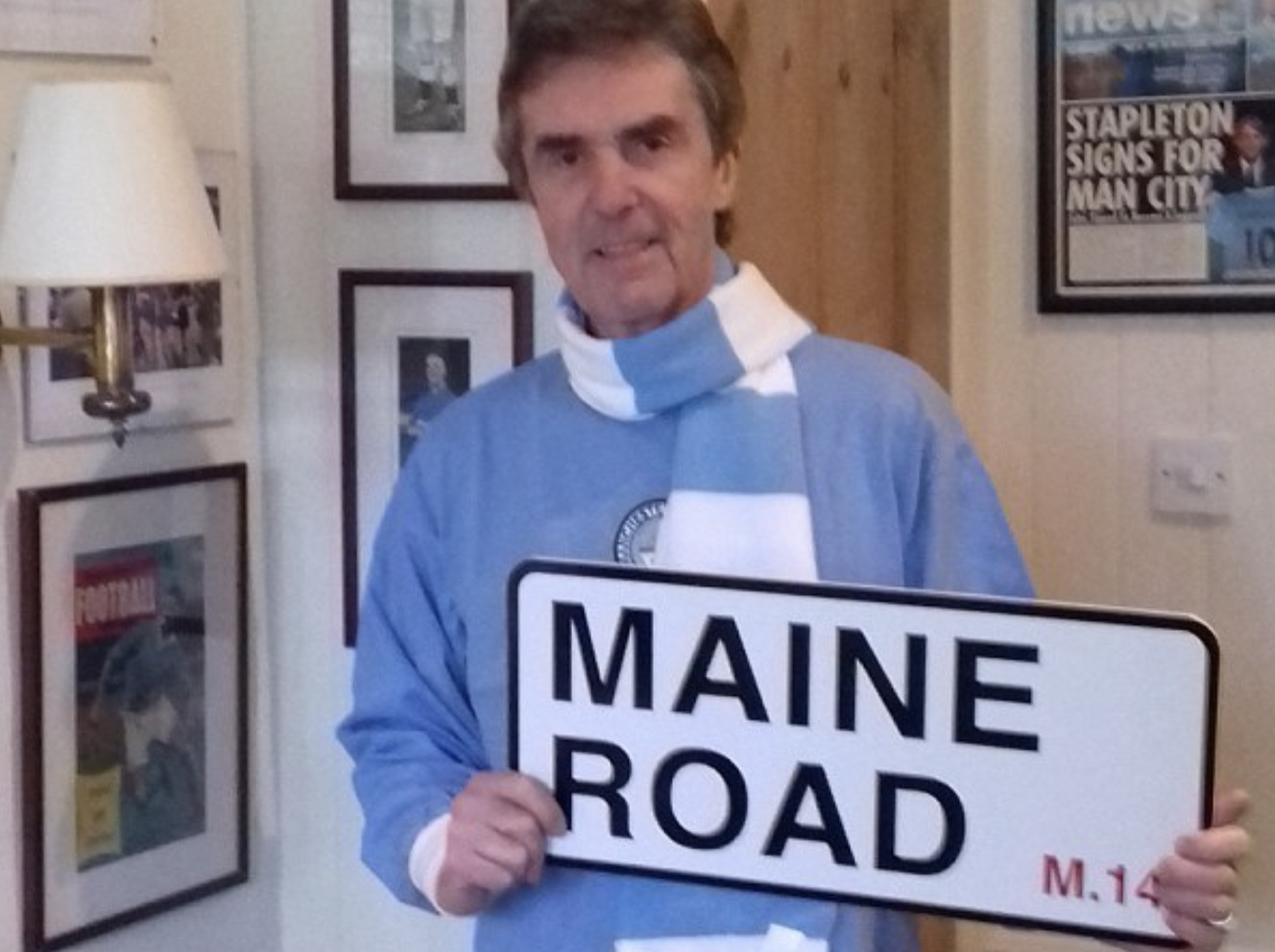
Back in August 2014 I interviewed John Stapleton on his career and support of Manchester City. As part of my tribute to him, I’m posting it here as it was published eleven years ago. Hopefully it adds to the positive stories of him that have been appearing over the last few days. I always enjoyed meeting and chatting with John. Here’s the feature as published in August 2014:
John, you’re known today for ITV’s Good Morning Britain but your career started in local newspapers, with your early TV work coming on This Is Your Life. It was your idea to make Joe Mercer a subject for one show wasn’t it?
Yes it was. I did it purely for the benefit of me and my dad. Eamon Andrews, the presenter, had of course a great interest in sport and I put the idea to him and the rest of the production team. Together with Norah, Joe’s wife who in recent years I often sat with at games sharing her boiled sweets, we concocted a situation where Joe and Malcolm were in a London hotel before a trip to watch a European game in 1970. Malcolm disappeared – deliberately as part of the show though Joe didn’t know this – and Joe was called to reception urgently. Eamon leaped out to do the big ‘This Is Your Life’ reveal and Joe had no idea whatsoever. It was a great day for us all and Joe was thoroughly deserving of it as well.
My grandfather, who lived in Denton, was at the first game at Maine Road and attended matches at Hyde Road and now my son Nick is a regular, so we’ve had a good four generations of Blues so far. When I was about 7 I was taken to watch City play Blackpool, in the days when Stanley Matthews played for them of course, and I loved simply being at the ground. It felt like home and that was it really. I was hooked. We used to have to go on two buses and a tram to get there from where we lived in Saddleworth – it seemed such a long journey at the time, but it was always worth it. No matter what the result.
Can you remember who your first heroes were?
Well, my dad went to the 1955 FA Cup final and then the year after we watched the final against Birmingham on our television. So exciting, because televisions were new to most of us back then and to be able to live the drama of the game, and of course Bert Trautmann’s injury, live in your own home was amazing really. The world’s moved on so much, but the black & white set felt so modern at the time. It was then that my first real hero emerged – Dave Ewing. A wonderful, uncompromising defender and I remember him protecting Bert in those final minutes as best he could.
Did you ever meet Dave?
Sadly, no, but I did meet his son. I left Manchester when I was 21 to work in Fleet Street and so opportunities to bump into your heroes were few. I was also less able to get back to Manchester as often as I do now, and so I watched City in the south and travelled back as often as work and finance allowed. I have since met quite a few of my heroes from that period, people like Ken Barnes and of course his son Peter. Two great City legends. Ken was a wonderful rascal and very funny and Peter is a really nice guy. I’ve also got to know Mike Summerbee quite well – and bought several of his shirts over the years and they weren’t cheap! He came to our house a few years back and charmed my parents. For my father it was great to be in his company and I think we all cherished that day. Even my lawyer was talked in to buying some of Summerbee’s shirts.
How do you feel about attending games today?
It’s an absolute joy and the fan in me never goes away. For my son, living in London and under so much pressure from his peers to support Arsenal, the years before the takeover were difficult. Those that had experienced the glories of the fifties to seventies had good memories of success, but the younger generation who had never seen us lift a major trophy must have found it tough. But it was all character building and fortunately he can now experience the success that this club deserves. It means more if you’ve been through the thick and thin – and he certainly experienced the thin alongside me!
Alongside the Mercer-Allison era, today is the best we’ve ever known and, hopefully, will keep on getting better. We’ve waited a long time but it’s been worth it. I’ve no complaints about any aspect of City today and the club is as friendly as ever, if not more so in some respects. It gives me a real buzz every time I walk into the stadium, or meet a former player, or chat to a fellow Blue like you Gary. We all have a shared bond and recognise that what we’re experiencing now is truly exceptional – long may it last!
In the mid 1970s you came in to contact with City professionally via the Junior Blues rally. What do you remember of it?
It was held at Belle Vue and there were thousands of Junior Blues there. It was a great event and we had the full team on the stage, giving fans the chance to ask questions to the team and the management. Peter Swales had asked me to present it – for free I might add but it was a major honour to do it – and it was probably the first time any club had opened up in such a way. City were quite forward thinking in terms of the media and fan relations at the time. I was also involved with the BBC Nationwide series on City.
That was another landmark moment in football’s relationship with the media. What was your involvement?
I was a Nationwide presenter and we’d managed to get City to open their doors for the cameras. Reporter Kevin Cosgrove did most of the progress reports and I came in at the end of the series to do a big outside broadcast on the last day of the season. I did some pre-recorded interviews, including one with Franny Lee, and then I did all the links at the ground. It went out to the full BBC network and was very good for the club and, of course, the BBC.
There’s a chant “City Are Back!” we’ve been singing for years, but I now feel that the club I first supported is back. Is this true for you?
In many ways yes. I’ve been a good friend of present day FA boss Greg Dyke for years as we’ve worked together in TV. He was given a tour of the club and the new facilities by Brian Marwood and he told me that this really is a friendly and forward looking club. He was very impressed and it’s satisfying to know others are now recognising how special this club is.
Those facilities will help City develop talented young players in future years. It’s ironic really that people have been urging certain other clubs to spend, spend, spend recently, but we’ve been the ones tagged as the big spenders.
That’s going away now I believe. The evidence is clear and we had to spend to catch up, just like other teams have throughout history. We should never forget either that two of our greatest and most consistent players – Vincent Kompany and Pablo Zabaleta – arrived before the takeover. Kompany is a truly great leader and I’ve been fortunate to meet him and he is also a wonderful man. He is the perfect captain for this club, but we’re so fortunate to have so many brilliant players. Just think of David Silva… outstanding quality!
You’ve worked with Manchester United supporter Eamon Holmes in the past, did the two of you ever discuss football?
We’ve had some good banter over the years. Good craic! In fact I took him to two games. The first was when Beckham scored from a free kick at Maine Road. Eamon jumped up in the directors’ box and you can imagine how that went down. The second time he was booed into the ground by City fans!
Your own personal greatest game?
Obviously, the last game v QPR in 2011-12, but also the 6-1 against United at Old Trafford. I turned to Nick my son and said ‘savour this moment. No matter how long you live you’re unlikely to experience this feeling again.’ And of course, there’s the 1999 play-off final without which we may never have come back at all. What a transformation in 15 years – hopefully, there’s more to come.
The new series on Manchester City in the 1920s continues today with a 1,700 word subscriber article on the 1926-27 season. If you subscribe (see below) I hope you enjoy it. If you are not currently a subscriber then why not try it for a month (£3 per month or sign up for a year at a discounted £20 per year)?
Here’s the article:
Subscribe to get access
Read more of this content when you subscribe today. It costs £3 a month (cancel anytime) or sign up for a year at £20 per year. Subscribers have access to the 1000s of articles, features, interviews etc. posted so far and all those posted during your subscription.
The new series on Manchester City in the 1920s continues today with a 1,500 word subscriber article on the 1922-23 season. If you subscribe (see below) I hope you enjoy it. If you are not currently a subscriber then why not try it for a month (£3 per month or sign up for a year at a discounted £20 per year)?
Here’s the article:
Subscribe to get access
Read more of this content when you subscribe today. It costs £3 a month (cancel anytime) or sign up for a year at £20 per year. Subscribers have access to the 1000s of articles, features, interviews etc. posted so far and all those posted during your subscription.
The new series on Manchester City in the 1950s continues today with this 3,900 word article on the 1955-56 season when City won the FA Cup final (nowadays known as the Trautmann Final) and Bert Trautmann was FWA Footballer of the Year (presented in the days before the final). Enjoy!
This is a subscriber article and you can read it by subscribing below.
Subscribe to get access
Read more of this content when you subscribe today. It costs £3 per month or you can subscriber for the discounted annual rate of £20 per year. Each subscriber gets access to everything posted so far, including PDFs of a couple of my books.
The series of features on Manchester City in the 1890s continues today with a 1900 word article on Manchester City in 1898-99 – the first season that any of the Manchester teams had achieved a national trophy success. Want to know more about this thrilling and landmark season? Then why not subscribe?
This series covers the final years of Ardwick, the birth of Manchester City and the Club’s first national success.
Subscribe to get access
Read more of this content when you subscribe today. It costs £3 per month (cancel anytime) or sign up a year at a time for the discounted annual fee of £20. This gives access to everything on the site, including PDFs of 3 of my books and various other articles, interviews and audio material. Each subscriber has access to all content posted during their subscription period too. Why not sign up for a month and see what you think?
Yesterday (23 March 2024) saw another Manchester City victory over United in the WSL Manchester derby. It’s always impressive seeing the Blues win and this City team has been in existence since 1988. The history of women’s football in Manchester does not always get the attention it deserves and many of us have been determined to change that for years (this year I’ll be publishing the Authorised History of the Manchester Corinthians after years of research – see below). So hopefully the following will be of interest. It includes a few quotes from those involved in previous decades and I’ve included it as part of my series on the 1990s as the first City-Utd women’s league derby took place in 1990.
While the perception will always exist that Manchester United’s women’s team has always been City’s rivals and vice versa, for both clubs the real rivals have varied over the years. Derby matches have been played against Manchester Belle Vue and other prominent local clubs. There were even derbies in the 1940s when Manchester Ladies and Manchester Corinthians played each other.
However, any game between City and United takes on extra significance. United fans established a Manchester United Ladies team in the 1970s with close ties to the men’s club. This eventually was closed down by the men’s club before re-emerging in 2018 as a WSL 2 club. In September 2019 the first WSL Manchester derby between City and United occurred at the Etihad following United’s move into the top flight. This was a truly special day for both clubs and for those of us present.
The first competitive derby between City and United was actually in September 1990 in the North West Women’s Regional Football League Second Division when Neil Mather was City’s manager: “I was nervous for weeks on end, and it was coming and coming and coming. I thought ‘we’ve got to beat United in the first competitive Derby.’ Being a big blue it was like ‘whatever we do we’ve got to beat them.’ We were 4-1 up with about five minutes to go and then had a five minute collapse where I thought we’re going to blow this. At one point it had looked like we were going to get five or six and annihilate them and then we nearly lost it! Thank God we hung on for a 4-3 win, but I’ll never forget that game. We had a girl called Jenny Newton who was a manic City fan and scored and I don’t think I’ve ever seen anything like it. When she scored her eyes were bulging and it meant the world and a lot of our girls were City fans. It meant the world to beat them.”
Lesley Wright: “The first time we played United in a competitive game there was about 150 there. They were a really strong team. Better than us at the time and they’d been established a lot longer.”
Rita Howard: “Despite being a United fan I loved playing as City Ladies against United. I absolutely loved it. Even though I’m a United fan I never contemplated joining them because the support from City, even when it waned a little, was far superior to anything United got. At best they’d get a kit and then it was ‘on your way.’ I know our closeness to City came from that beginning with Neil. His enthusiasm got us the kit, the tracksuits, the minibus…. All sorts of things. I know that wasn’t happening at United and at that time I don’t think any club connected in any way to a Football League side were as close as we were then. I think we got a lot more recognition from the beginning and that has carried on to today. Look at what City have done.”
Jane Morley: “I’m a season ticket holder at Manchester United but I was a manager at City Ladies. One day I’d been with City at a tournament and then went straight to Old Trafford for a men’s game. I was sat there when the bloke next to me – who I didn’t know – said ‘what you doing with that on!’ I realised I still had my City jacket on. I had to explain to him that I managed City Ladies.”
Bev Harrop was a Manchester United fan playing for City: “I had a United shirt underneath my City shirt! (laughs) Most of the time. Not later on, I grew out of it eventually, but at first, I did.”
Jane Morley: “It angers me when people say that Manchester United now have their first women’s team. As with City when the relaunch happened that implies the stuff we did for the club years before doesn’t count. I played for United in the 70s and 80s before a few of us broke away to set up FC Redstar. We left United because we wanted to test ourselves. We had some great players and wanted to progress but those who ran United wanted to stay in a Manchester League and not join the North West League. So we broke away in 1985 and formed FC Redstar.
“Many of the teams we know today as WSL clubs are actually men’s clubs that have taken over established women’s clubs. Teams like Leasowe Pacific became Everton. I have to bite my lip sometimes when some clubs claim they created a women’s team… no, you took and rebranded a team. There were quite a few big teams around the time City Ladies started such as Broadoak with Tracey Wheeldon.”
These snippets are from my book on Manchester City’s women’s team. Copies (signed by me) can be ordered here: https://gjfootballarchive.com/shop/
For more on the book on the Manchester Corinthians (who started in 1949) see:
If you would like to read all the in-depth articles on this site (including the entire Manchester A Football History book) then please subscribe. It works out about £1.67 a month if you take out an annual subscription (£20 per year) or £3 a month if you’d like to sign up for a month at a time. Each subscriber gets full access to the 500+ articles posted so far and the hundreds scheduled to be posted in the coming weeks.
Today’s guest blog follows on from last week’s guest blog in which Steve Bolton talked of the Manchester Ladies (who also went under the name Wythenshawe Ladies, City of Manchester Ladies, Manchester City Ladies the 1940s & 1950s) and their early years. Today is part two of Steve’s research into this pioneering women’s club (part one can be viewed here: https://gjfootballarchive.com/?p=1863 ).
Over the last few years much has been written about pioneering women’s football teams and Steve’s research is certainly adding to that. I’m sure anyone reading this already knows about my book on Manchester City Women (available here: https://gjfootballarchive.com/shop/ ) and about the other articles on this blog discussing other leading women’s clubs, including the Manchester Corinthians (see: https://gjfootballarchive.com/category/womens-football-2/ ).
If you played for a women’s team in the Manchester region during the 1940s to 1960s then please get in touch. I’m writing a detailed history of the Manchester Corinthians to be published in 2024 and your information may help both mine and Steve Bolton’s research. For more on the Corinthians book see:
If you played an active part in developing women’s football prior to the FA ban then please get in touch by emailing gary@GJFootballArchive.com or follow me on twitter: @garyjameswriter or facebook.com/garyjames4
Over the last few years much has been written about pioneering women’s football teams and I’m delighted to say that Manchester has had several of these over the years. I’m sure anyone reading this knows about my book on Manchester City Women (available here: https://gjfootballarchive.com/shop/ ) and about the other articles on this blog discussing other clubs, including the Manchester Corinthians (see: https://gjfootballarchive.com/category/womens-football-2/ ).
Thanks to the Manchester Corinthians the story of pioneering Mancunian female footballers has received some decent coverage in recent years but it would be wrong to think that the women who played for Corinthians were the first women who played football in our region. There are games staged in Manchester going back to the 1880s of course. However, following the 1921 ban (which saw the FA ban women’s football games from FA affiliated pitches) opportunities were restricted significantly.
In Preston the famous Dick Kerr Ladies have been heralded for their efforts and in the 1950s & 1960s Manchester Corinthians found global fame for their exploits, but football tends to overlook many other clubs and in 1940s Manchester, before the Corinthians became established there was another female football club that promoted the sport, charity work and female prowess.
For today’s guest blog researcher Steve Bolton provides the first part of his research into the stories, facts and evidence of this Manchester team:
If you played for a women’s team in the Manchester region during the 1940s to 1960s then please get in touch. I’m writing a detailed history of the Manchester Corinthians to be published in 2024 and your information may help both mine and Steve Bolton’s research. For more on the Corinthians book see:
If you played an active part in developing women’s football prior to the FA ban then please get in touch by emailing gary@GJFootballArchive.com or follow me on twitter: @garyjameswriter or facebook.com/garyjames4



 Gary James' Football Archive