The series of features/articles covering Manchester City in the 1970s continues with this brief post about average attendances. We hear so much baloney these days about which clubs are giants and so on but the truth is that in terms of success no team has ALWAYS been at the top and in terms of support most clubs have had highs and lows. There are some clubs that generation after generation have been popular with fans and this cutting from the Manchester City match programme of 1977-78 may interest some.
I’m not going to point to any club or anything but look at the numbers and make your own minds up. Manchester City, incidentally, tended to be the 3rd best supported club (no matter where they finished) behind United and Liverpool throughout the mid to late 70s and early 1980s. They occasionally dropped to 4th depending on whether Everton or Spurs had a good season and even in City’s 1982-83 relegation season Manchester’s Blues were the 4th best supported club. Not bad for a failing club!
This series of articles and features on Manchester City in the 1970s will run throughout January with indepth articles some days and smaller ‘on this day’ style posts on others. There will be flashbacks to great games, players and more. Every day in January will offer something to enjoy.
Subscribers will get access to everything. If you want to know more on this incredible decade for Manchester City Football Club then why not subscribe and read it all? You could even subscribe for a month and see what you think. The following 5,200 word article is on the 1970-71 season and is available to subscribers below. Enjoy!
Subscribe to get access – Monthly
Read more of this content when you subscribe today. It costs £3 per month (cancel anytime) to access everything posted since 1 October 2022 or there’s a special annual rate below which gives greater access and works out much cheaper.
Read more of this content when you subscribe today. It costs £3 per month (above) or £20 a year (here) to access everything posted since the site was created in December 2020. This special rate works out about £1.67 a week and gives access to everything posted, including PDFs of 3 of my books.
If you enjoy all the free material on my website and would like to support my research and keep this website going (but don’t want to subscribe) then why not make a one-time donation (or buy me a coffee). All support for my research is valued and welcome. It allows me to keep some free material available for all. Thanks.
Happy 79th birthday to former Arsenal manager George Graham. George was brought to England by Joe Mercer to play for Aston Villa and on 30 March 1993 I travelled to Arsenal’s old stadium, Highbury, to interview George. I wanted to capture his views on his former boss – and Arsenal legend – Joe Mercer.
As I mentioned earlier, Joe was the Aston Villa manager who brought George to England many, many years before George had found fame as a footballer and Joe had taken Manchester City to their first European honour. Joe did win the League Cup as Aston Villa boss, but these were not great days for the former Everton and Arsenal playing legend, but he did always feel responsible for bringing George to England (and loved the success he brought Arsenal).
My interview with George had been arranged for Tuesday 30 March 1993 some time in advance but then Arsenal’s FA Cup semi-final with Tottenham was scheduled for the following Sunday at Wembley (a highly unusual occurrence at the time!). I expected to get a call cancelling the interview but instead George decided to go ahead with it.
On the day I parked up outside Highbury quite early but as I pulled up I saw George leave the stadium and jump into a car. I was early, so wasn’t too worried. Then I remembered the FA Cup semi-final and assumed that George would be busy with plans. I expected to be told when I entered the marble hall at Highbury that the meeting would be off.
When I spoke with the reception staff they told me to take a seat. They said that George had been called away and so could be a few minutes late (which he was). I was relieved because I’d been convinced he would cancel (it’s happened often with other busy managers).
I sat in reception thinking about the chat and then, a few minutes after we were due to meet, George walked in. He spoke with the receptionist and then came towards me, hand out, saying ‘I’m George Graham’ (I remember thinking ‘I know’ but I did love the fact that he introduced himself). He took me up to his impressive office at Highbury – no other offices at any ground I had been to at that time could match the quality and status of that room.
We then did the interview. It’s not my best – I think I was overawed by the situation – but I was appreciative of George’s time. During the interview Stewart Houston, his assistant, popped in to check something with George (I turned off my recorder) and George ushered him away, telling him that he was busy. Again, I loved this – other managers have sometimes disappeared and not come back but for George he’d set this time aside to see me and chat about Joe Mercer and that’s what he was doing.
Arsenal beat Spurs that weekend so, I suppose, George knew what he was doing but I do remember watching that game on TV thinking that if Arsenal lose I’d never be able to tell anyone that George had spent time being pestered about Joe Mercer when he should’ve been preparing for Tottenham!
If you subscribe to this site you can hear the interview below. I have been researching and writing for a long time and my Joe Mercer book was my third (first published in 1993). I am not employed by anyone and I do not have sponsorship either and so I’ve set up this website to help share my 35 years plus writing and research. The intention is to develop the archive and to provide access to as much of my material as possible over the coming weeks, months & years. Annual subscribers can already access over 1250 articles/posts including the entire Manchester A Football History book, my first book on MCFC (published in 1989) and Farewell To Maine Road, plus audio interviews with Malcolm Allison and John Bond.
It costs £20 a year (it works out £1.67 a month) or £3 if you’d like to sign up a month at a time to get full access for as long as you subscribe.
Anyway, here’s the George Graham interview:
Subscribe to Listen – Monthly Subscription
To listen please subscribe. Each Monthly subscriber gets access to everything posted since 1 October 2022 and everything posted during their subscription. It costs £3 per month (cancel anytime). There’s also a special annual subscription available (see below).
To listen please subscribe. Each annual subscriber gets full access to the 1000+ articles posted so far and the hundreds scheduled to be posted in the coming months. This includes PDFs of 3 of my books and interviews with Malcolm Allison and others. Annual subscription is available at the special price of £20 a year (about £1.67 a month).
If you enjoy all the free material on my website and would like to support my research and keep this website going (but don’t want to subscribe) then why not make a one-time donation (or buy me a coffee). All support for my research is valued and welcome. It allows me to keep some free material available for all. Thanks.
A new daily series of articles for subscribers started last week covering the 1980s. This is a seasonal journey through a truly important decade in the history of Manchester City Football Club. Today’s article is a 2,500 word feature on the 1986-87 season. Enjoy!
Subscribe to get access – Monthly
Read more of this content when you subscribe today. It costs £3 per month (cancel anytime) to access everything posted since 1 October 2022 or there’s a special annual rate below which gives greater access and works out much cheaper.
Read more of this content when you subscribe today. It costs £3 per month (above) or £20 a year (here) to access everything posted since the site was created in December 2020. This special rate works out about £1.67 a week and gives access to everything posted, including PDFs of 3 of my books.
Today (14 September) in 2003 Manchester City won their first competitive League game at the City of Manchester Stadium (now Etihad). It was also a day that saw Steve McManaman make his League debut for the Blues. The game was a PayPerView TV match. You can watch highlights of the game here:
This is how the match was previewed in the Sunday Times:
With Manchester City facing Arsenal in the Community Shield tomorrow it seems appropriate to remember a time when City, like Arsenal this year, we’re given a place in the Charity Shield (now Community Shield). Coincidentally, on this day (August 5) in 1972 City faced another team who had been given a place in the Shield match (though this team had actually won something) and that was the Third Division Champions Aston Villa. This was the first time the Blues had played a Charity Shield match at Villa Park (but not the last). Here’s a feature on it and a match report from the game.
Subscribers can view the article and all others on here (including the entire Manchester A Football History and a PDF of my first book). It costs £20 a year (works out about £1.67 a month) and you can sign up below. Thanks.
Subscribe to get access
Read more of this content when you subscribe today.
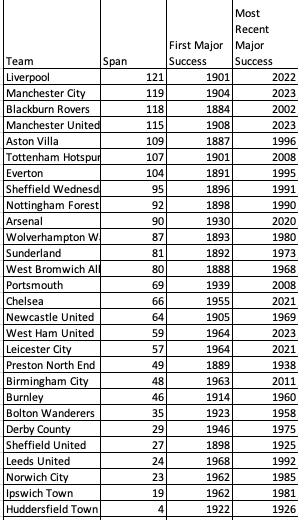
Congratulations to West Ham on your success in last night’s Europa Conference League. Great news for your club and for those clubs who wonder whether competitions like this are a drain or something to aim for. I’ve now updated the table showing the span of success – i.e. the number of years between a club’s first major success (FA Cup, League, League Cup, European trophy) and their most recent. West Ham have jumped some way up that list.
Okay, the span of success does not show how many trophies each club has won or how frequently that club has experienced great eras of success, but it does demonstrate how wrong those people are who believe certain clubs were unsuccessful until recent years, or those who think certain clubs have always been giants. The column on first major success helps to show when some clubs first became trophy-winning significant (often after transformational investment).
West Ham have proved that if you’re a club that hasn’t won a major trophy for a while putting your focus on achieving trophy success ahead of the odd Premier League position can bring significant reward. In future decades no one will remember who finished seventh, tenth or fifteenth but they will remember the trophies.
I know clubs focus on their financials but winning a trophy has longevity, gaining the odd Premier League place provides a bit of extra cash now but no long term kudos. Winning a trophy attracts new fans and brings money-spinning opportunities too.
If I was a supporter of Everton, Aston Villa or any of the other major clubs who have not found significant success in recent decades then I would absolutely want my team to go for whichever cup competition seems most likely to win. That’s what I always wanted from City before they were able to compete for the League again. Winning the FA Cup in 2011 helped everything that followed happen.
While you’re here… why not take a look at the free to read daily Maine Road features counting down to the old stadium’s 100th anniversary of its first game? Here are a sample couple of features (follow the Maine Road tag or search for more):
Today (29 April) is the anniversary of one of the most controversial games in the history of football. It was a match played at Aston Villa by Manchester City and took place on 29 April 1905. I know it’s a long time ago but I would urge all Manchester football fans to read this as it led to a change in the fortunes of both Manchester clubs and was to have repercussions for years.
This will be free to read today and tomorrow and after that will only be available to subscribers to my website. If you like what you read then why not support the site by either subscribing or making a donation to support its upkeep (see the end of this article for details)?
The story starts three days earlier… On 26 April Newcastle United levelled on points with City after a 3-1 victory over Sheffield Wednesday, making the final day of the season a tense affair. Either of those teams, plus League leaders Everton could win the title. With both Newcastle and City level, a mere one point behind Everton who had already completed their League programme, the title race was wide open. City knew they had to win and hope that Newcastle failed as the Blues goal average was inferior to the Geordies.
The final fixtures saw Newcastle away at near neighbours Middlesbrough, while the Blues travelled to Villa Park to face the Cup winners. City captain Billy Meredith later recalled: “Aston Villa had no chance of taking the honour. Our officials were very keen on us finishing with level points and we were offered a good bonus if we managed to do this. Our blood was up and the game wasn’t the pleasantest.”
As Meredith stated the game did not demonstrate the gentlemanly side of football, if anything it showed how physical football could become with numerous off the ball incidents and dangerous tackles. It seems that Villa, who had never really liked playing either Manchester club, wanted to finish the season in the style they had shown at the FA Cup final the week before (Villa had beat Newcastle 2-0). They did not want the ‘ungentlemanly professionals’ from Manchester to achieve further success, especially as they were still regarded as young upstarts with no tradition. Looking back it is difficult to understand exactly how the Blues were viewed, but as an analogy with the 2000s it is safe to say that Villa were the early century’s equivalent of Manchester United in terms of FA support and media interest, whereas City were similar to Abramovich’s Chelsea or even Sheikh Mansour’s City. In the eyes of many, they were a side with ‘no history’ that had appeared from nowhere to challenge the establishment. Sadly, the establishment, especially in the early 1900s, would always win.
With Villa determined to put City in their place, the Blues resorted to tactics many suspected came naturally. Manager Tom Maley’s City let themselves down, and conceded goals to Villa’s Garraty, Hampton, and Hall. The pressure was on. Two second half goals from George Livingstone and Sandy Turnbull brought the Blues back into it, but it wasn’t enough. During the final thirty minutes the game became progressively more violent with Sandy Turnbull seemingly involved in every incident. The Bolton Football Field reported: “Turnbull was in his dourest dribbling mood, dashing about the ball with his whole heart set on victory. Leake found him a real hard opponent and, becoming annoyed at the rough impact, gathered up a handful of dirt and hurled it at the City man. Turnbull was not hurt and responded with an acknowledgement favoured by the bourgeoisie – thrusting two fingers in a figurative manner at the Villa man.”
According to the report: “Leake appeared to look towards the referee as though appealing, and not catching his eye, ‘gave Turnbull a backhander’. The latter immediately responded with his fists and Leake was restrained by his fellow players from retaliating further.”
Although Turnbull had developed a reputation for a rough style of play it appears that he was not the guilty one this time. Unfortunately, Leake was viewed as a gentleman and many were convinced that he would only react, not provoke. The Villa biased Sports Argus tried to convince its readership that Leake was entirely innocent and that he had merely enquired what Turnbull was doing rather than throw dirt at him and give him a ‘backhander’. It also claimed the City man had hit Leake at least twice.
The game continued but frequent fights broke out, spoiling any chance the Blues had of equalising. Despite the result and the realisation that City had lost out in the title race, it was a relief when the final whistle went. However, the controversy did not end there as the Bolton Football Field reported: “Turnbull was coming off the ground (I think he was almost the first of the City players) and was going down the covered passage to the visitors’ dressing room when someone, not a player, sprang out from the urinal and grabbed Turnbull, pulled him inside the Villa dressing room and the door was shut behind him. I thought the whole thing was in fun until, within a few seconds, the door was opened and Turnbull was pitched out heavily, by whom I could not see. He was yelling with pain and fright, and he had obviously been badly handled for his right cheek was grazed with a black mark or dirt (something like a cyclist describes as a cinder rash) and he had a mark on his ribs where he had been kicked.”
Nobody disputed that Turnbull had been the victim of a deliberate attack by Villa men, but incredibly the Birmingham Sports Argus tried to justify it, thus causing further insults to fly from Manchester to Birmingham and vice versa. Significantly, it wasn’t merely the Villa players and employees who were attacking the City men as police had to be called into the ground to protect the Manchester players. An angry mob even stoned the City party. A season that had promised so much ended in disgraceful scenes.
The FA had to act, especially as City’s game against Everton eight days earlier had also been viewed as a battle. They set up a special committee to meet in Derby to consider the events at both matches. Meeting behind closed doors, the committee were taking considerable steps to understand everything that surrounded the two games and, as the summer progressed, they interviewed player after player in their quest for the full facts. This seemed rather suspicious, especially to the northern newspapers who were now convinced that the committee were fishing for a bigger catch than merely a disrepute charge against one or two players. With the FA meeting in secret rumour spread throughout football, with most northerners convinced the ‘southern’ FA would make City the scapegoats.
On 4 August 1905, a month before the new season started, the FA committee finally produced their surprising findings. Firstly, they suspended J.T. Howcroft and R. T. Johns – the referees of the games at Goodison and Villa respectively – for a month each for failing to control the games. Howcroft in particular was criticised for ‘extraordinary feebleness in a critical match’. Then they announced that Tom Booth of Everton and City’s Sandy Turnbull were to be suspended for one month, yet no mention was made of Villa’s Leake. Also, that Booth’s sentence would be suspended because of: “previous good conduct and the provocation received.” And finally, the most shocking news of the whole affair: “The Commissioners also reported on statements brought to their notice with regard to W. Meredith of Manchester having offered a sum of money to a player of Aston Villa to let Manchester City win the match. W. Meredith is suspended from football from 4th August until April 1906.”
The people of Manchester – and Wales – were outraged that Football’s greatest player could be found guilty of bribery. Meredith, staying in Chirk during the close season, spoke to the press: “I am entirely innocent and am suffering for others. Such an allegation as that of bribery is preposterous! I could never risk my reputation and future by such an action and I repeat that I never made such an offer. It is totally unjustifiable and grossly unfair. This sort of thing will demoralise Association Football. Manchester has not many friends among the Association officials and I doubt if the decision will be reversed or the suspension lessened if the whole case is reopened and enquired into.”
He added that Aston Villa had too much influence within the FA . The general feeling was that Manchester City had suffered because, as Meredith had stated that summer, City were simply too popular. In Simon Inglis’ review of football’s major scandals, Soccer in The Dock, that theory is followed in more detail: “Alec Leake was not even mentioned, even though it had been plainly stated that Turnbull had been assaulted by Villa players after the game. Small wonder therefore that in the eyes of many neutrals the FA appeared to bear a grudge against Manchester City, a nouveau riche club with no traditions. Villa, in contrast, were solidly reliable, brimming with honours and very much part of the football establishment. Some commentators noted caustically that Leake was an England international while the other players were not. Meredith meanwhile complained, ‘Had I been anyone but a Welshman I should have been better dealt with.’ But Harricus of Athletic News said the FA’s methods had seemed ‘un-English, most autocratic and arbitrary.”
It does appear that the Blues had suffered merely because of who they were and not through the actual actions.
As the weeks passed, further details emerged. It seemed that Leake had laughed off Meredith’s alleged bribery attempt at the time, thinking it to be very much a joke, but as the FA commission investigated the Villa-City match a ‘responsible gentleman from Birmingham’ came forward to state that he had overheard the conversation. Leake was interrogated further and was apparently forced to admit that Meredith had attempted to bribe him. Meredith claimed that he had not attempted to bribe the player but did admit to having a conversation with him. Instead of offering him £10, he claimed to have offered his congratulations to Leake for lifting the FA Cup.
The matter did not end there, however. City’s complaints and the anti-FA comments that appeared in the mainly northern sporting press upset the councillors of the FA They felt that their actions were right and, if anything, became more interested in the affairs of City because of the proclamation of innocence. They appointed an auditor, Tom Hindle, to keep a close watch on City and report anything out of the ordinary. Because of the state of most leading clubs at the time, not only City, it was not long before Hindle became suspicious.
Meredith, while banned from all football activity, still appeared at Hyde Road asking for his wages and he expected the Blues to look after him: “Though the FA suspended me, I felt strongly that my club would see that I was not the loser financially. At the beginning of the trouble it looked as if the club was going to recognise this, but later I found them shilly-shallying and putting me off until I got tired.”
Understandably, for a man who had dedicated over ten years to the club he expected that club to care for him, especially when on the first day of the ban (4 August 1905) Tom Maley sent him a letter suggesting that he would always be a member of the City, but would have to ‘lie low’ until Hindle had gone away. The fact was that the Blues were not allowed to support him – the FA had made it quite clear. Because of this, every visit or demand by Meredith caused tremendous embarrassment. There is no doubt that the club wanted to look after him, however they were forbidden from doing so. Meredith could not accept this and regularly arrived at the ground only to be told he was not welcome. Arguments were witnessed by Tom Hindle, the FA auditor, and the club were in real danger of being investigated once again. Hindle persuaded Maley to report Meredith to avoid an FA investigation.
Maley’s letter was a difficult one to write: “I am instructed by my directors to bring to the notice of your Association the conduct of William Meredith, a player of this club at present under suspension. This player has been in attendance at almost all the principal matches at our ground and invariably frequented the dressing room and offices despite requests not to do so.”
The letter sent on 14 February 1906 went on to say that Meredith had periodically approached the board for his wages, and that when his requests were turned down the player made threats. Basically, the letter gave the impression that Meredith was a parasite. This was something neither Maley nor the City Board believed, however with Hindle’s encouragement it seemed the only way to avoid further investigation. Unfortunately, it failed.
Meredith was so appalled by the Club’s actions that he started to speak out about the incident with Leake. The FA immediately set up a new commission and started to interview the City players and management not only about the bribe, but also about illegal payments to players. Meredith now claimed that he had in fact offered Leake £10, but told the commission that this was at Tom Maley’s suggestion with full approval from the rest of the City team. City were no longer a united team, and with their former captain revealing that he was not the only member involved in the attempted bribe, the rest of the squad were to be interrogated. Any spirit that existed prior to the Villa game must surely have disappeared by this point.
Tom Maley was adamant that he did not have anything to do with the attempted bribery. He was aware that three players had talked about the idea but that one of them clearly stated that he would not stoop so low. He did not reveal who the players were, but it is apparent that Meredith was one of the party. The other issue being pursued by the commission was the question of illegal payments. Maley did not deny that payments had been made to players more than the maximum, but claimed that this seemed common business practice in England and that he only continued to follow the club’s standard practices. He stated that if all First Division clubs were investigated, not four would come out ‘scatheless’.
City were certainly guilty of paying above the maximum but if the FA had carried out a similar investigation at all the leading clubs they would have found the same situation. Unfortunately, City were the team under the spotlight and, as they and their friends in the media, had already criticised the FA they were to be taught a lesson.
The Edward Hulton owned Athletic News not only blamed the FA it also pointed the finger at Meredith: “The famous footballer determined not only to admit that he had made an offer to Alec Leake – an offence which ought to have ended his football career – not only that he had been most lavishly and generously paid by the Club which ran dreadful risks to give him all they had except the goalposts, but dragged everyone else he could into the same mess. No sense of gratitude for all the managers who, over the years, remunerated him so that he became comparatively rich, no ideals of friendship for the men who, admitting his enviable playing skills, had done everything they could for him, and no feeling of loyalty for the comrades who had fought side by side with him in many a scrap of hard games restrained this man from divulging the secrets of his masters and colleagues. It would have been honourable to confess his own deeds, to express his sorrow and promise an amendment that he promised to fulfil but he took a course that amounted to revenge after he had been simply killed by kindness by the club whose colours he wore.”
On Thursday 31 May 1906 commissioners J.C. Clegg, Charles Crump, and D. B. Woolfall reported on what they had discovered. They were of the opinion that City had been overpaying for years and that the players had actually gained the power and had demanded illegal payments. With the maximum wage at £4, it was revealed that Meredith had been earning £6 and that Livingstone had demanded and received £6 10s. Even the amateur Sam Ashworth had received £50 on top of £25 expenses, and was subsequently declared a professional by the commission.
If all of this wasn’t bad enough then came the real shock. A total of seventeen current and former players were to be suspended until 1 January 1907. Tom Maley and former Chairman Waltham Forrest were to be suspended from English football sine die, while directors Allison and Davies were to be suspended for seven months. City were fined £250 and the suspended players had to pay a total of £900 in fines: Meredith (£100), Livingstone (£100), Hynds (£75), McMahon (£75), Hillman, Turnbull, Booth, Burgess, Frost, Bannister, Dearden, Gillespie, and Holmes (all £50), Edmundson, Davidson, Lyon, and Ashworth (all £25).
The club was virtually dead. No club in the history of football had ever suffered to such an extent, regardless of tragedy or bans, and survived. No matter what irregularities there were, did City really deserve to be treated so harshly? What makes the matter so incredible is that the club were no worse than most of their big name rivals, any of whom could have been investigated and banned to the same extent, as he media often stated.
City’s first golden period ended in shame. The 1905-6 season, which had seen the Meredith-less club challenge for the title once again, ended with the Blues in fifth place. Not surprisingly, a loss of form had coincided with the FA investigation. Although it is impossible to say what the Maley inspired City side may have achieved, it still angers many associated with the Blues that the club were so cruelly attacked at a time when they should have been dominating football. If the side had remained together, would they have won the League? Would the Cup have resided at Hyde Road again? An indication of what City should have achieved appears in the history of Manchester United from 1907 to 1911 when the Reds won two League titles and the FA Cup with several of the former Hyde Road stars, including Meredith and Turnbull. The Blues presented Manchester United with their first opportunity to be successful.
One point worth making is that City were not the only side to suffer as a result of the suspensions. Four of the players were already with other clubs – Ashworth with Everton, Lyon with Preston, Holmes at Clapton Orient, and Davidson at Airdrie. Those clubs felt they should not be penalised for another team’s errors, although it was only Airdrie who had the chance of going against the ban. They persuaded the Scottish FA to ignore their English equivalent body and managed to play Davidson whenever necessary.
Three players still left at Hyde Road appealed as they had been reserve players during 1904-5 and, even after bonuses were included, had not received the maximum £208. Their appeal failed, as did a petition signed by 4,128 City supporters against all the suspensions.
With all these players banned from playing for City, the Blues had to find replacements. They also had the small matter of finding a manager and directors.
If you enjoy all the free material on my website and would like to support my research and keep this website going (but don’t want to subscribe) then why not make a one-time donation (or buy me a coffee). All support for my research is valued and welcome. It allows me to keep some free material available for all. Thanks.
Read all the content on this website when you subscribe today. Annual subscribers get full access to the books, articles, interviews, videos, talks etc. posted since the site was created in December 2020 and all those to be posted during your subscription
Monthly subscribers (cancel anytime) get full access to everything posted since 1 October 2022 and all those to be posted during your subscription. Why not try it for a month?
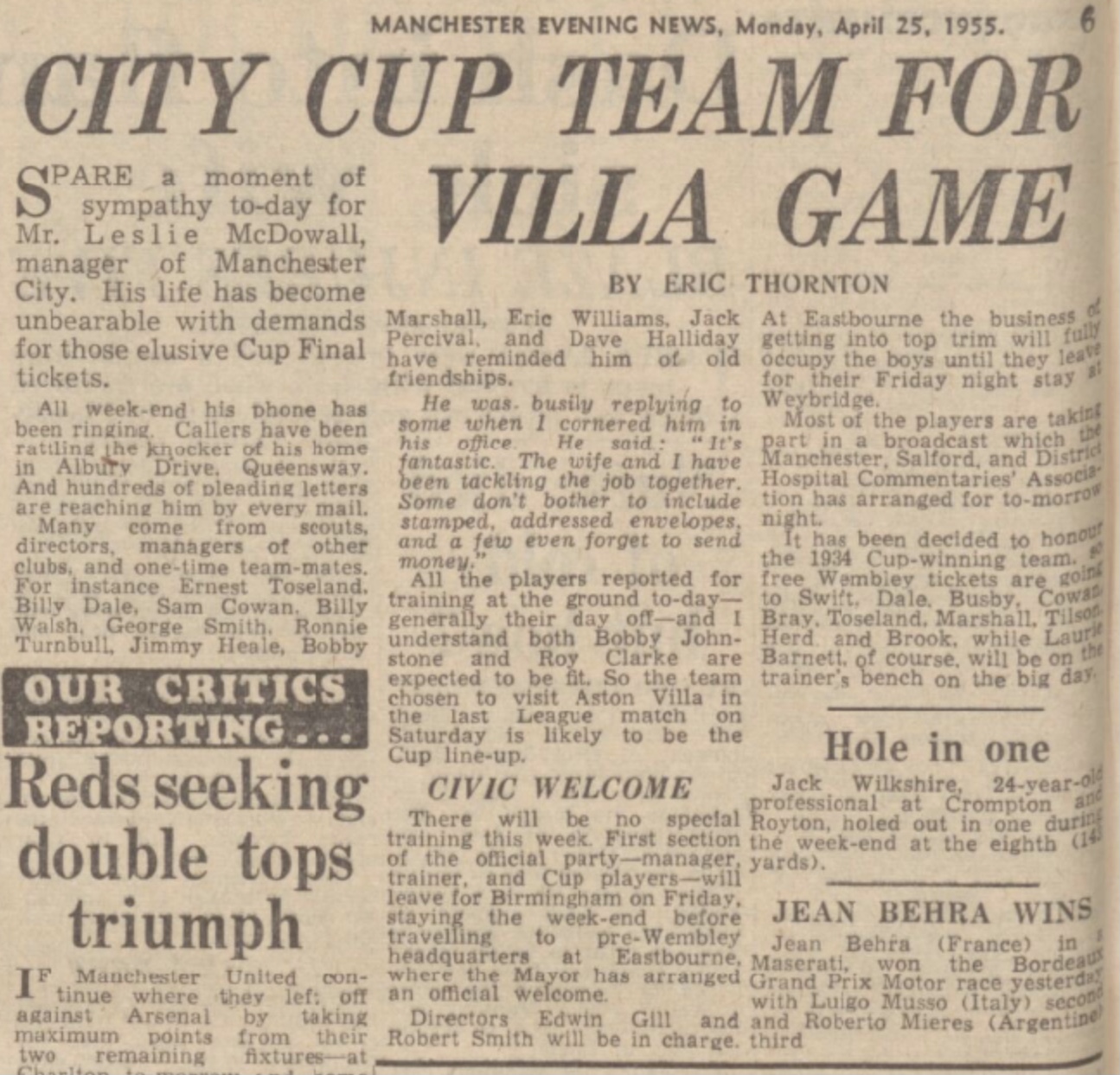
This is an odd article for a few reasons from today (25 April) in 1955. Basically the Manchester City manager Les McDowall was getting inundated with requests for FA Cup final tickets from fans, friends, former players and others. Some were turning up at his house…. So what did the Manchester Evening News do? It included the name of the street McDowall lived on! Surely that would’ve added to his woes?
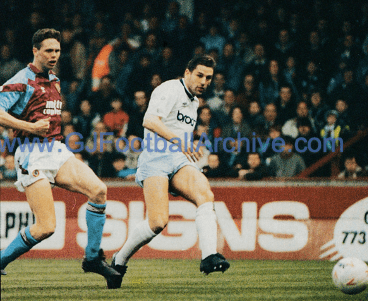
On this day (23 April) in 1991 a marvellous 5-1 win at Villa Park for Manchester City saw David White become the first City player since the war to score four in an away game. You can watch highlights here:
David White outpacing Comyn & McGrath for his second goal v Aston Villa, 23/4/1991
Broadcast live on this day (25 March) in 1970 was the This is Your Life TV episode with Joe Mercer as the subject. Here are the details plus a special recording which supporters of all the clubs Joe was involved with could be interested in.
This Is Your Life was viewed at the time as significant recognition for a lifetime’s achievement. Only major stars and personalities were featured in those days, and the main idea would be that the subject of the programme would be surprised by the sudden appearance of presenter Eamonn Andrews and his ‘Big Red Book’. The subject would then be whisked away to a studio or other location where a variety of figures from the person’s life would be brought out to tell anecdotes and the like. The main part of the show would be broadcast live.
This is Your Life Joe Mercer 1970
Back in 1970 young Manchester City supporter John Stapleton was working on the series and he suggested they feature Joe Mercer as the topic of one show. John, who has gone on to be a prominent broadcaster with a well-regarded TV career was interviewed by me a few years back and we discussed the programme and John’s part in the idea of featuring Joe: ‘I did it purely for the benefit of me and my dad. Eamon Andrews, the presenter, had of course a great interest in sport and I put the idea to him and the rest of the production team. Together with Norah, Joe’s wife who in recent years I often sat with at games sharing her boiled sweets, we concocted a situation where Joe and Malcolm were in a London hotel before a trip to watch a European game in 1970. Malcolm disappeared – deliberately as part of the show though Joe didn’t know this – and Joe was called to reception urgently. Eamon leaped out to do the big “This Is Your Life” reveal and Joe had no idea whatsoever. It was a great day for us all and Joe was thoroughly deserving of it as well.’
Joe was staying at a Hilton Hotel in London. As John described, He had been due to fly with Malcolm Allison to the continent to watch ECWC semi-final opponents Schalke but he had received a message to say the game was off. It was all a ruse of course. That night television viewers watched as Eamonn Andrews surprised Joe at the hotel reception desk: ‘Joe Mercer, former England playing star, now manager of Cup winning Manchester City, tonight. This Is Your Life!’
Eamon Andrews This is Your Life Joe Mercer 1970
At the start of the show the City team appeared. This had been an extremely busy time for the Blues. Over a 18 day period City had played two League games, the League Cup final, the second leg of the ECWC quarter-final with Coimbra and found time to work with television to honour their manager. This live show occurred on Wednesday 25 March and City were to face Derby in the League on 27th and Manchester United on 28th, plus they had to play the first leg of the ECWC semi-final with Schalke on 1st. It was incredible that a team would be involved in this at such a busy time but that’s the way it was.
This is Your Life Joe Mercer 1970 MCFC squad
As Joe explains in the show Malcolm Allison was nowhere to be seen. He had been staying with Joe at the hotel and the City manager commented: ‘I’m a great sleeper you see, and subconsciously I heard Malcolm getting up and I thought, oh, he’s going to the bathroom. I thought, well, he hasn’t come back, so he must be having a bath, and then I went back to sleep. I woke about ten and Malcolm had gone, but occasionally this happens – Malcolm disappears!’
Andrews explained that Allison had left early to watch the match which was still on. Joe was flabbergasted: ‘He’s left all his clothes! I’ve had to pack his bag as well!’
During the course of the show, Andrews informed Joe that Alf Ramsey had named the squad he was to take to the 1970 World Cup: ‘I know you haven’t had a chance to hear the news, but I’m going to tell it to you now, that two of your boys have been named by Alf for the World Cup – Francis Lee and Colin Bell. And two more in the twelve reserves – Mike Summerbee and Alan Oakes. Congratulations lads, and to the whole of the Manchester City.’
Joe was overjoyed.
Subscribers to this website are now in for a special treat as an audio of the entire episode has been preserved and can now be listened to here:
Subscribe to get access – Monthly
You can listen to this special recording of Joe Mercer, Eamon Andrews, Dixie Dean, Malcolm Allison, Stan Cullis, Stanley Matthews etc. by subscribing. It costs £3 per month (cancel anytime) to access everything posted since 1 Oct 2022 or there’s an annual option (below).
You can listen to this special recording of Joe Mercer, Eamon Andrews, Dixie Dean, Malcolm Allison, Stan Cullis, Stanley Matthews etc. by subscribing. It costs £20 per year (cancel anytime) to access everything posted since the site began in December 2020, that includes history talks, videos, a couple of my books, hundreds of articles etc.
Joe appeared on several other This Is Your Life shows including in November 1988 when Tom Finney was the subject and in 1980 when Emlyn Hughes was. He also appeared on two for Matt Busby, one in 1958 and one in 1971 (which opened at Maine Road).
The Programme details for the Joe Mercer episode are:
Edition No: 274
Subject No: 276
Broadcast live: Wed 25 Mar 1970
Broadcast time: 7.00-7.30pm
Venue: Euston Road Studios
Series: 10
Edition: 18
Director: Margery Baker
Producer: Robert Tyrrell
City supporter and broadcaster John Stapleton worked on the show
The guests were:
Norah – wife
members of Manchester City FC team
Francis Lee
Colin Bell
Mike Summerbee
Alan Oakes
Alan Percival
David – son
David & Joan Mercer, This is Your Life Joe Mercer 1970
Joan – daughter-in-law
Arthur – brother
Stan Cullis
Stan Cullis, This is Your Life Joe Mercer 1970
Billy Dixie Dean
Billy ‘Dixie’ Dean, This is Your Life Joe Mercer 1970
Jim Morris
Charles Palmer
Matt Busby
Frank Soo
Walley Barnes
Maurice Edelston
Bernard Joy
Roy White
George Hardwick
Raich Carter
Neil Franklin
Stanley Matthews
Stanley Matthews, This is Your Life Joe Mercer 1970
Filmed tributes:
Malcolm Allison
Susan – granddaughter
Albert Dyson – father-in-law
If you have enjoyed this article then why not subscribe (see above for details) for other material like this? If you don’t want to subscribe but would like to support the research into Manchester football by Gary James then it’s possible to donate below. All support is used to help perform further research that will be posted here for future generations. Thanks for the support.
If you enjoy all the free material on my website and would like to support my research and keep this website going (but don’t want to subscribe) then why not make a one-time donation (or buy me a coffee). All support for my research is valued and welcome. It allows me to keep some free material available for all. Thanks.






 Gary James' Football Archive