A Manchester Derby Reported in NY

This brief comment says everything you need to know about the 23 September 1989 Manchester derby. This was how the New York Post reported on Manchester City’s bargain basement Blues defeated United’s expensive Reds.

Subscribers can read about the 1989-90 season here:

Anti-owner demos: Just another day in Manchester football

One Manchester club seems to be getting everything right, winning League titles, European trophies and so on while the other appears to be in self-destruct mode with demonstrations against the owner and all sorts of worrying stories appearing in the media. Sound familiar? This was actually the situation on this day (11 September) in 1993 when Manchester City (not United) were the team in crisis and United (not City) were the team winning Leagues and European trophies.

This cutting is from 11 September 1993 and highlights the proposed takeover by Francis Lee of the Blues. Peter Swales had been City’s chairman for twenty years during which he’d taken the club from being a major, profitable power to one that was heavily in debt – debt that was hampering the club’s development – with a stadium that was being downgraded almost every day via a lack of serious investment. Across at United the club appeared relatively stable with a stadium that was being invested in. They also had one of the game’s most talented and successful managers while City had gone through a series of managers in the previous few years. City were a relatively stable top flight team though by 1993. Brian Horton was now City’s boss and he seemed to offer a positive style of football but the wider problems of the club were never far away. All sound familiar still?

I do find it amazing that City and United seem to have swapped roles so emphatically since 1993 in terms of how the clubs are managed, invested in, stadium developments and so on.

For those unaware of what happened to City or those who perhaps support United and are looking to see what happened and whether history will repeat here’s a brief overview: United dominated football for most of the 1990s & 2000s while City’s Lee takeover was successful. Lee, however, was unable to revive City’s fortunes and build on the fifth place finished that had occurred in 1991 and 1992. Although much of the financial infrastructure of City was improved following the takeover, the dismissal of Horton as manager and a poor appointment in Alan Ball led to relegation. Further issues followed as star players left, managers were sacked or left and the Blues ended up in the 3rd tier (for one season – too many believe City were a 3rd tier club who eventually got lucky but they were a top 6 team who fell apart!).

Could history repeat itself with the roles reversed? Unlikely United will ever fall as low as City but it is worth noting that City never expected to fall that low. Also, removing Swales from power was something that fans had been wanting for decades. It only became a possibility when a former hero announced he could take over the club BUT even then the hopes and ambition of all Blues could not be met.

Match stats here:

https://bluemoon-mcfc.co.uk/History/Matches/Match.aspx?id=4048

Mancini Leaves

Roberto Mancini has left his role as Italy’s men’s football manager. Hopefully, he’ll be back in club management soon and maybe in the Premier League too. His contribution to Manchester City’s history is huge and so I think it’s worth reposting this audio special I did a couple of years ago. It’s a special audio recording talking about the years building up to the 2011 FA Cup success brought to City by Mancini. It includes some audio I did with him back in 2011 too. Enjoy this reminder of a time when Mancini helped transform City’s fortunes.

Restored 2011: The All-Manchester FA Cup Semi Final is a special 1 hour audio recording looks at the game and the years between the 1976 League Cup success and the FA Cup glory of 2011. The 2011 semi-final was a crucial step in City’s journey since the 2008 takeover and I felt it was vital to do a special marking this.

So what’s in this special recording? Well, I’ve included exclusive material from interviews and recordings I’ve done over the years with Garry Cook, Brian Marwood, Roberto Mancini, Peter Barnes and Peter Swales.  Why Swales? Well, have a listen and you’ll hear why. Basically though I’m trying to set the tone for why the 2011 FA Cup semi final victory and overcoming Manchester United was so significant.

On Mancini… I include a few words from him recorded in 2011 and at one point he talks about the view that was then being expressed that City were ‘trying’ to buy success (now they say City ‘have’ bought success!). His words are a reminder that City have been having that particular criticism thrown at them for over a decade! Oh well, I wonder how long those criticisms were laid at other clubs who had seen major investment which propelled them forward?

Anyway, get yourself a brew and be prepared to be transported back in time. Here’s the recording:

If you enjoy the recording then please let me know, comment or subscribe to the site. I’ve produced videos/talks like this highlighting key points in Manchester City’s footballing history which subscribers can watch. 

Subscribe to get access – Annual

Read more of this content when you subscribe today. It costs £20 a year to subscribe (it works out £1.67 a month) or £3 if you’d like to sign up a month at a time. Annual subscribers get full access for as long as you subscribe (you can always try it for a month). It’s worth bearing in mind that the 2010 Manchester A Football History cost £24.95 and all subscribers will be able to access all of that for as long as they are a subscriber (plus all the other stuff of course).

Subscribe to get access – Monthly

It costs £3 a month to subscribe a month at a time. Why not give it a try! Monthly subscribers get access to everything posted since 1 October 2022 for as long as you subscribe.

Match Stats for the 2011 FA Cup Semi-final

City 1-0 United (HT 0-0)

Yaya Toure 52

City: 25 Hart 04 Kompany (yellow card), 05 Zabaleta (yellow card), 13 Kolarov, 19 Lescott, 11 Johnson (Wright-Phillips 79), 18 Barry, 21 Silva (Vieira 86), 34 De Jong (yellow card), 42 Y Toure, 45 Balotelli (yellow card). Substitutes 12 Taylor, 38 Boyata, 07 Milner, 08 Wright-Phillips, 24 Vieira, 10 Dzeko, 27 Jo

United: 01 Van der Sar, 03 Evra, 05 Ferdinand, 15 Vidic, 22 O’Shea (Fabio Da Silva 84), 13 Park Ji-Sung, 16 Carrick, 17 Nani, 18 Scholes (red card), 25 Valencia (Hernandez 65), 09 Berbatov (Anderson 74). Substitutes 29 Kuszczak, 12 Smalling, 20 Fabio Da Silva, 08 Anderson, 28 Gibson, 07 Owen, 14 Hernandez

Referee: Dean

Attendance: 86,549

If you enjoy all the free material on my website and would like to support my research and keep this website going (but don’t want to subscribe) then why not make a one-time donation (or buy me a coffee). All support for my research is valued and welcome. It allows me to keep some free material available for all. Thanks.

Choose an amount

£2.50
£5.00
£7.50

Or enter a custom amount

£

Your contribution is appreciated.

Donate

Maine Road 100 – Day 36

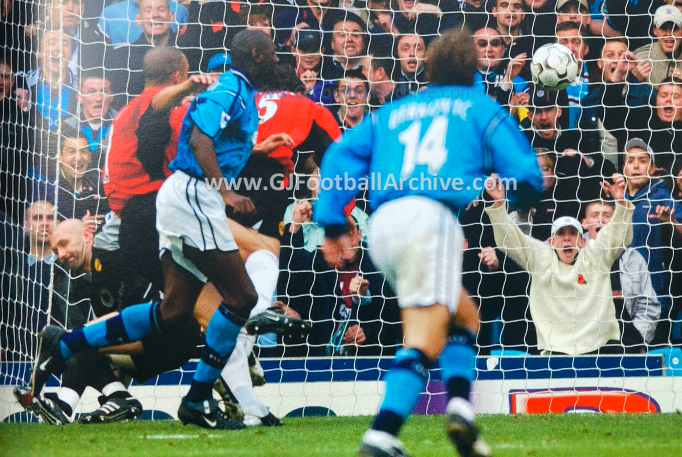
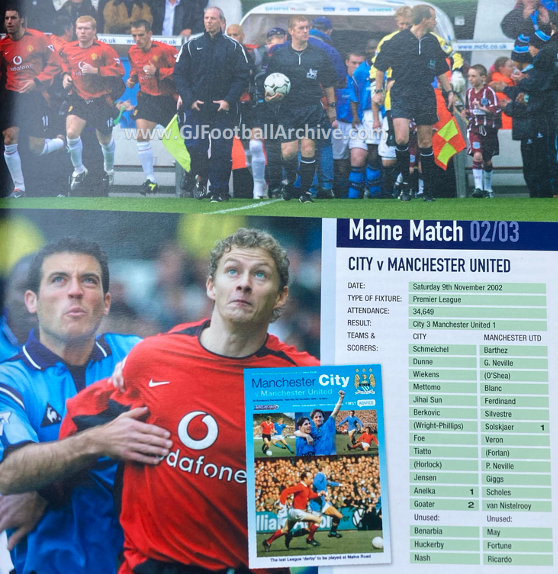
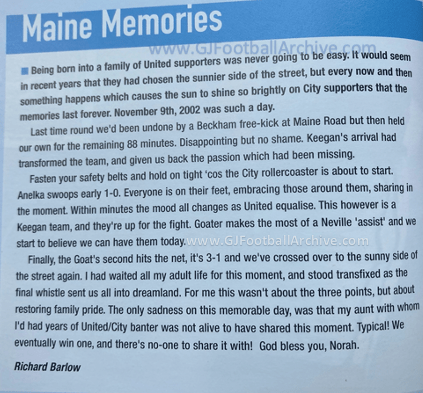
It’s day 36 of my posts counting down to the centenary of Maine Road’s opening game. Yesterday I featured Maine Road’s first derby match and today’s images are a reminder of the last Manchester derby played at Maine Road.

The game, played on 9 November 2002 saw City defeat United 3-1 with goals from Anelka and Goater (2). United’s historic last goal at Maine Road was scored by Solksjaer.

Fan memories of that day in Farewell To Maine Road

These images are taken from Farewell To Maine Road and subscribers can now download a PDF of that book. The feature on Maine Road’s last derby was in chapter one: End of an Era. See below for details of how to get that book.

Goater’s 100th goal, scored v MUFC in November 2002.

For those unfamiliar with Maine Road this photo may help locate the the tunnel image (number 1):

Maine Road aerial 1971 from Farewell To Maine Road

If you’d like to read more on the history of Maine Road, take a look at Farewell To Maine Road, which can be downloaded from this page:

If you enjoy all the free material on my website and would like to support my research and keep this website going (but don’t want to subscribe) then why not make a one-time donation (or buy me a coffee). All support for my research is valued and welcome. It allows me to keep some free material available for all. Thanks.

Choose an amount

£2.50
£5.00
£7.50

Or enter a custom amount

£

Your contribution is appreciated.

Donate

2023, 1999 & 1975 Comparisons – Any Point?

Driving back from Wembley last Saturday both Talksport and BBC Radio 5 Live had phone-in shows where the question kept being brought up about comparing Manchester United’s treble in 1999 with the possibility of City managing the same achievement this year. Obviously, a football game can go any direction and no success is guaranteed ever, so I am absolutely not going to talk as if something has been achieved when it hasn’t. If City do manage this incredible feat then the comparisons are likely to be made again BUT how sensible is this?

I am against making these comparisons because I think they’re futile. A bit like when I asked former City player Johnny Williamson, who had played with both Frank Swift and Bert Trautmann, which was best. He said: ‘It doesn’t matter. You pick one and I’ll pick the other because the two of them were head and shoulders above the rest!’

United’s treble in 1999 was absolutely incredible and a major achievement. If City manage the same this weekend then that will also be incredible and a major achievement. Which is best doesn’t matter and even if it did can we really do an accurate comparison? 24 years is a long time in football and the game changes so much in that time.

Much has been made about where City were in 1999 (winning promotion from ‘new’ Division Two) when United won their treble. People have said: ‘How can a team go from promotion challengers to potential treble winners in 24 years?’ Well, guess where United were 24 years before their treble…. they were promotion challengers in ‘old’ Division Two!

Martin Buchan and Alex Stepney celebrating United’s promotion in 1975 at Old Trafford

In the years that followed United’s promotion in 1975 they had a few peaks and troughs as City have. It wasn’t until 1993 (18 years after promotion) that they won the League for the first time since the 1960s but they had won the FA Cup 2 years after promotion. It took City only 13 years after their 1999 promotion to win the League but the FA Cup came in 2011 (12 years after the 1999 promotion). Both clubs spent a lot of money to find those first successes with City receiving Abu Dhabi investment and United borrowing heavily (the increasing level of debt was frequently raised by shareholders back then who questioned whether the club could sustain making purchases like they had to create the most expensive British team ever up to that point) to fund Ferguson’s first successful team.

Comparisons would need to look into every aspect of both clubs – for example Pep’s team are the only team to win a domestic treble as well, so does that elevate their current achievements? Similarly, Ferguson led United to a period of sustained success and dominance that no one else has matched so far. Comparisons are really fairly pointless.

To United fans their treble will always be the best and to City fans, if the club is lucky enough to achieve the same, that will be the best. For most neutrals it will be ‘so what?’, although they’ll downplay any success by a rival. I remember in 1999 someone phoning in a BBC radio show after United had won the Champions League for the second time. The caller was a Nottingham Forest fan who had got fed up with all the praise being heaped on United and, like many United fans today about City, he felt his club was more worthy. He said something like: ‘You keep going on about this United team but what have they done? They’ve just matched what Forest and Brian Clough achieved years ago. We’ve had two European Cups for years and our team was better and cheaper than this lot!’

It’s all a game to fill programmes and articles. It’s not needed. If you think about it 24 years is an extremely long time. If both Manchester clubs can go from promotion chasing teams to European finals in those years then that’s some journey. You have to be well into your 30s to stand a chance of being able to compare 1999 and 2023 and for anyone under that age it’s ancient history and another ‘so what?’.

When United won the treble in 1999 I was an adult with two kids and was just in my 30s. I’d written four major books on Manchester football (including the Pride of Manchester on Manchester derby matches) by this time and had researched the history of both clubs in-depth, so I did get interviewed a lot by TV and radio. I was perceived as an expert, but if you’d have asked me to compare United’s 1975 promotion team with City’s 1999 promotion team I would’ve had to admit I was too young to appreciate what United’s 1975 achievement was like. I’d be able to quote journalists and interviewees but I couldn’t give an honest view which group of players was better. It’s the same now, yet we’ve a whole range of people offering views who are either invested in one club or who are too young to be able to talk with knowledge about it. In any case football in 2023 is somewhat different to football in 1999 – just as that was so different from 1975 and that so different from 1951.

Paul Dickov at Wembley 1999

Maybe we should have filled phone-ins after City had won the double on Saturday with questions like: ‘How does City’s League and Cup double compare with past doubles? Was this City team better than Preston in 1889?’ It’s ludicrous to even try.

The 2023 FA Cup Final – All Manchester

Well, the first all-Manchester FA Cup final has been and gone but what a day? Before any major fixture you hope that it will live up to the hype and, as a historian, I always hope that something different than normal will occur, or a record will be broken.

I’m always keen on pointing out that history is made every day and that historians have to constantly re-evaluate what stories they are telling if they want to represent and record society as it changes. I am totally against those that think history is something that doesn’t move with the times and I always try to think about those who may be experiencing something for the first time. City’s 2023 FA Cup success could easily be the earliest footballing memory for some and what a memory it will be!

As I entered the stadium the entry gate and stairway I used had the usual years and landmark moments decorating its walls and I did notice the comment about the fastest goal in a FA Cup final (it claimed Di Matteo’s goal after 43 seconds was still the record, so that needed updating even before the game!). I didn’t expect any goal to occur in the first few minutes of the game, never mind the first few seconds. More on that in a moment.

The journey to Wembley was more difficult than normal, due to the rail strike and the fact so many were going down the same routes. The route I took, mostly M1, seemed busier than normal (normal – it’s ‘normal’ going to Wembley now!) but it was mostly City fans I saw. I’m sure others experienced something else but for me there were the occasional United vehicles. Most of the cars and coaches that I saw with colours showing (scarves out the window is an absolute must on days like these for many of us!) were blue not red. That reminded me a lot of the 2011 FA Cup semi final when every City car we saw was full of happy, laughing, smiling City fans pre-match but United fans seemed more serious or concerned with what the day would bring. The similarities between the two days were striking.

Traffic jams meant the journey was longer than anticipated but once we parked up in our usual spot (‘usual’, ‘normal’ – I hope that never changes) we were ready. A quick wander around was followed by buying the programme. I had two articles in this year’s FA Cup final programme – one on City & United’s first FA Cup successes in 1904 and 1909 and another was a peaks and troughs sort of timeline. Both pieces were neutral and I was delighted to be asked to contribute to the programme once more.

Inside the stadium the tickets we had bought were up at the back of level 5 block 546. Coincidentally just before kick off the people on the row behind us arrived and one was Ian Brightwell, one of the players when City defeated United in the only previous All-Manchester FA final (that was the 1986 FA Youth Cup).

As for the game. Well, what an opener! We’d not had chance to settle really when Gundogan netted that wonderful strike. I remember looking straight up to the video screen and seeing the clock change from 12 to 13 seconds. Incredible.

As Brightwell was behind me I couldn’t resist turning to him and saying ‘I see Gundogan “just wellied it!” like you did in 1990.’ For those that don’t remember or are too young Brightwell did a similar goal from several yards out in an Old Trafford derby in 1990. Afterwards while being interviewed he was asked about the goal but the interview kept being interrupted and so he had to answer the question multiple times. On the last occasion he simply answered: ‘I just wellied it!’ and the phrase entered City folklore.

There was the penalty given to United of course – I won’t go into the rights and wrongs of that but i do want to mention VAR. I find it absolutely ridiculous that those of us who have spent considerable time and effort in getting to Wembley and attending the final are the ones who knew least about what was going on. We had nothing on the screen to tell us a check was in progress; we had no opportunity to see the video clips and we only knew it was being reviewed when the ref stopped the game (after some time too! What if a player had been injured or another goal had been scored in the meantime?) and went over to the monitor.

The moment he headed towards the monitor we knew something was going to be given because I can’t think of a time when a ref has stuck to his guns in England (I’m sure it’s happened but I don’t remember).

The penalty changed the mood for a while, but City fans were in good voice when the second half started and it seemed inevitable then that the Blues would score again. I don’t think any of us expected Gundogan to be the man again but over these last few months he’s clearly led by example. He deserved the man of the final award and hopefully he’ll get further honours this season.

So the game ended 2-1 and City have achieved a coveted double again (last time was the only time an English club had won a domestic treble!). Brilliant work City and the season isn’t over yet!

It was wonderful to see the players celebrate. Those celebrations on the pitch demonstrated how much this all meant to them. People often try to suggest a domestic cup isn’t anything special but it absolutely is. How many of us have ever won a FA Cup? These players were outstanding and deserve tremendous praise, as does the manager of course.

People talk about money but City are not the biggest spenders either in actual outflow terms or in net spend terms. Like Alex Ferguson and United in the late 1980s/early 1990s, City have spent money on players to find success. Also, like United at that time trophy success brings additional income, gate receipts, prize money, sponsorship etc. which in turn can be used to invest in youth development and finding ways to sustain success. There’s no point going on about this but I do wish that people looked at the history of football and focused on fact rather than the fiction that often gets spouted.

On the way home there was a lot of talk on the radio about possible trebles and it was interesting that almost every phone-in I could find was trying to compare United’s 1999 treble with the possibility of City winning one this season. Who knows how Saturday will go and I won’t get drawn into that but I do want to say that United winning the treble was an incredible achievement. If City manage to do the same this year then that will also be an incredible achievement. So much has changed in 24 years that comparisons are ridiculous.

Actually, I did hear on the radio one presenter go on about how City have spent because ‘in 1999 when United were winning their treble they were getting promoted’ (paraphrased but basically that comment). Had I been able to call in I might have done because 24 years ago that is true but it is also true that 24 years before 1999 United were also getting promoted. It’s a similarity people have overlooked, but if somehow it is wrong for City to go from struggling team to potential treble winners in 24 years then surely it would also be wrong for United to do the same? Ah well! Facts not fiction.

When City got back to Manchester they were greeted by Elton John who, it has been said, waited to meet and congratulate them. The videos and photos are wonderful to watch. Noel Gallagher may have to watch out – usually he’s the one singing along with Pep and the players after a major trophy success.

While you are here why not have a look at the 100 day countdown I’m doing to mark the centenary of Maine Road’s first game? You can do a search on Maine Road or start by looking at this one:

Getting Ready For Wembley

Looking forward to the first ever all Manchester FA Cup final at Wembley tomorrow. To get in the mood why not watch the highlights of the 2011 FA Cup semi here (follow the link):

Prior to this year’s final, the FA Cup semi finals in 1926 and 2011 were the closest we got to one. I wasn’t around in 1926 but I definitely was in 2011! So a couple of years ago I made this special audio recording talking about the years building up to the semi and the day itself from a Manchester City perspective. Many of you have listened to this already but if you haven’t then it tells the story of the 2011 FA Cup semi final and the years between 1976 and that moment in 2011 for City.

I include audio from interviews I did with a variety of people including Khaldoon, Peter Swales, Garry Cook, Brain Marwood and many others.

If you have heard it before then maybe you should listen again to remind yourself of how we all felt and why that game was so significant.

I include a few words from Roberto Mancini recorded in 2011 and at one point he talks about the view that was then being expressed that City were ‘trying’ to buy success (now they say City ‘have’ bought success!). His words are a reminder that City have been having that particular criticism thrown at them for over a decade! Oh well, I wonder how long those criticisms were laid at other clubs who had seen major investment which propelled them forward?

Anyway, get yourself a brew and be prepared to be transported back in time. Here’s the recording:

If you enjoy the recording then please let me know, comment or subscribe to the site. If you don’t fancy doing that then there’s also the option to make a welcome donation to keep this site going (see below). I’ve produced videos/talks like this highlighting key points in Manchester City’s footballing history which subscribers can watch too. 

If you enjoy all the free material on my website and would like to support my research and keep this website going (but don’t want to subscribe) then why not make a one-time donation (or buy me a coffee). All support for my research is valued and welcome. It allows me to keep some free material available for all. Thanks.

Choose an amount

£2.50
£5.00
£7.50

Or enter a custom amount

£

Your contribution is appreciated.

Donate


Subscribe to get access – Annual

Read more of this content when you subscribe today. It costs £20 a year to subscribe (it works out £1.67 a month) or £3 if you’d like to sign up a month at a time. Annual subscribers get full access for as long as you subscribe (you can always try it for a month). It’s worth bearing in mind that the 2010 Manchester A Football History cost £24.95 and all subscribers will be able to access all of that for as long as they are a subscriber (plus all the other stuff of course).

Subscribe to get access – Monthly

It costs £3 a month to subscribe a month at a time. Why not give it a try! Monthly subscribers get access to everything posted since 1 October 2022 for as long as you subscribe.

Match Stats for the 2011 FA Cup Semi-final

City 1-0 United (HT 0-0)

Yaya Toure 52

City: 25 Hart 04 Kompany (yellow card), 05 Zabaleta (yellow card), 13 Kolarov, 19 Lescott, 11 Johnson (Wright-Phillips 79), 18 Barry, 21 Silva (Vieira 86), 34 De Jong (yellow card), 42 Y Toure, 45 Balotelli (yellow card). Substitutes 12 Taylor, 38 Boyata, 07 Milner, 08 Wright-Phillips, 24 Vieira, 10 Dzeko, 27 Jo

United: 01 Van der Sar, 03 Evra, 05 Ferdinand, 15 Vidic, 22 O’Shea (Fabio Da Silva 84), 13 Park Ji-Sung, 16 Carrick, 17 Nani, 18 Scholes (red card), 25 Valencia (Hernandez 65), 09 Berbatov (Anderson 74). Substitutes 29 Kuszczak, 12 Smalling, 20 Fabio Da Silva, 08 Anderson, 28 Gibson, 07 Owen, 14 Hernandez

Referee: Dean

Attendance: 86,549
The All-Manchester FA Cup Final

Well, the Premier League is now over for another year and we know who the Champions are and who has qualified for Europe etc. so it’s time to look forward to the first ever all Manchester FA Cup final. There have been FA Cup finals between two teams from present day Greater Manchester before (the first one being City v Bolton in 1904) but this is the first to involve both Manchester clubs.

Prior to this year’s final, the closest Manchester City and Manchester United have got to playing each other in a Wembley FA Cup final were the FA Cup semi finals in 1926 and 2011. I wasn’t around in 1926 but I definitely was in 2011! So a couple of years ago I made this special audio recording talking about the years building up to the semi and the day itself from a Manchester City perspective. Many of you have listened to this already but if you haven’t then it tells the story of the 2011 FA Cup semi final and the years between 1976 and that moment in 2011 for City.

I include audio from interviews I did with a variety of people including Khaldoon, Peter Swales, Garry Cook, Brain Marwood and many others.

If you have heard it before then maybe you should listen again to remind yourself of how we all felt and why that game was so significant.

I include a few words from Roberto Mancini recorded in 2011 and at one point he talks about the view that was then being expressed that City were ‘trying’ to buy success (now they say City ‘have’ bought success!). His words are a reminder that City have been having that particular criticism thrown at them for over a decade! Oh well, I wonder how long those criticisms were laid at other clubs who had seen major investment which propelled them forward?

Anyway, get yourself a brew and be prepared to be transported back in time. Here’s the recording:

If you enjoy the recording then please let me know, comment or subscribe to the site. If you don’t fancy doing that then there’s also the option to make a welcome donation to keep this site going (see below). I’ve produced videos/talks like this highlighting key points in Manchester City’s footballing history which subscribers can watch too. 

If you enjoy all the free material on my website and would like to support my research and keep this website going (but don’t want to subscribe) then why not make a one-time donation (or buy me a coffee). All support for my research is valued and welcome. It allows me to keep some free material available for all. Thanks.

Choose an amount

£2.50
£5.00
£7.50

Or enter a custom amount

£

Your contribution is appreciated.

Donate


Subscribe to get access – Annual

Read more of this content when you subscribe today. It costs £20 a year to subscribe (it works out £1.67 a month) or £3 if you’d like to sign up a month at a time. Annual subscribers get full access for as long as you subscribe (you can always try it for a month). It’s worth bearing in mind that the 2010 Manchester A Football History cost £24.95 and all subscribers will be able to access all of that for as long as they are a subscriber (plus all the other stuff of course).

Subscribe to get access – Monthly

It costs £3 a month to subscribe a month at a time. Why not give it a try! Monthly subscribers get access to everything posted since 1 October 2022 for as long as you subscribe.

Match Stats for the 2011 FA Cup Semi-final

City 1-0 United (HT 0-0)

Yaya Toure 52

City: 25 Hart 04 Kompany (yellow card), 05 Zabaleta (yellow card), 13 Kolarov, 19 Lescott, 11 Johnson (Wright-Phillips 79), 18 Barry, 21 Silva (Vieira 86), 34 De Jong (yellow card), 42 Y Toure, 45 Balotelli (yellow card). Substitutes 12 Taylor, 38 Boyata, 07 Milner, 08 Wright-Phillips, 24 Vieira, 10 Dzeko, 27 Jo

United: 01 Van der Sar, 03 Evra, 05 Ferdinand, 15 Vidic, 22 O’Shea (Fabio Da Silva 84), 13 Park Ji-Sung, 16 Carrick, 17 Nani, 18 Scholes (red card), 25 Valencia (Hernandez 65), 09 Berbatov (Anderson 74). Substitutes 29 Kuszczak, 12 Smalling, 20 Fabio Da Silva, 08 Anderson, 28 Gibson, 07 Owen, 14 Hernandez

Referee: Dean

Attendance: 86,549

Significant Praise is Due for Pep & City

Both the 2010s and the 2020s (already!) have been incredible decades for Manchester City with phenomenal success coming City’s way. Thanks to the astute management and coaching by Pep Guardiola and his staff, together with some extremely talented players, the Blues have been able to celebrate trophy successes on a regular basis. Pep deserves significant praise for what he has achieved and with the potential that City could win the Premier League next weekend it’s time to think back and consider what has been achieved in recent years.

Before I go on (I’ll explain more later) but it is important to spell out that while some in the media keep telling us that the League is less competitive now than ever before, it’s worth pausing to consider that in only the last 3 complete seasons we’ve had 2/3rds the number of title winners they had in the entire decade of the 2000s and half what they had in the 80s and 90s decades too! But, apparently, it’s less competitive now. Think about that as you read what follows please. Thanks.

These are incredibly special times and City fans are truly grateful. The Blues have a Champions League semi final 2nd leg on Wednesday; the prospect of a League title on Sunday and also have the FA Cup final to look forward to. If that’s anything like City’s first trip to the new Wembley in 2011 that will be a special day. No City fan I know are complacent or take anything for granted though and that’s important. As fans it’s important to act like the players and retain an hunger for further glory. City’s brilliant 1960s/70s coach Malcolm Allison once told me to ‘celebrate every success as if it’s your first’ because it’s important to retain the drive and determination.

It’s worth pausing at this stage in the season to reflect on the last decade or so to fully appreciate what the club has achieved. I’ve been doing a few decade comparisons recently, looking at dominant clubs each decade and the competitive nature of English football. I’ve taken each decade (starting with the first complete season, such as 1960-61 through to 1969-70), and looked at the successful teams of that era.

During season 2010-11 through to the end of 2019-20 City managed to win an incredible total of 11 major trophies – a phenomenal figure, especially when compared with the nearest rivals Chelsea who won seven major trophies during that time. No doubt critics will say ‘ah, but there’s less competition’ but that’s absolutely not true, certainly not in terms of our major domestic competitions. It keeps being drummed into us that there’s less competition but that’s really downplaying the achievements of those teams that have challenged.

Between 2010-11 and 2019-20 there were five different Premier League winners. That’s more top flight champions than in each of the previous three decades and the same as in the period 1970-71 to 1979-80 when many people talk of a relatively open title race. How many times do we hear people say ‘back in the 70s and 80s anyone could win the title.’ Well, that may have appeared true at the time but the truth is that only a small group of clubs actually did win it. Even in the 1930s there were only four different champions (Arsenal, Everton, Sunderland & City), although that was only nine complete seasons due to war.

The total number of different champions in each decade since the start of the 1960s is:

1960-61 to 1969-70: 7 (Spurs, Ipswich, Everton, Liverpool, United, City & Leeds)

1970-71 to 1979-80: 5 (Arsenal, Derby, Liverpool, Leeds & Nottm Forest)

1980-81 to 1989-90: 4 (Aston Villa, Liverpool, Everton & Arsenal)

1990-91 to 1999-00: 4 (Arsenal, Leeds, United & Blackburn)

2000-01 to 2009-10: 3 (United, Arsenal & Chelsea)

2010-11 to 2019-20: 5 (United, City, Chelsea, Leicester & Liverpool))

Most fans who were around in the 1990s and 2000s will remember that in both those decades the League seemed totally out of the grasp of most of clubs and that it was only because of the investment in Blackburn (1990s) and Chelsea (2000s) that the duopoly of Arsenal and United was broken. Similarly, the investment in City from 2008 allowed the Blues to challenge again and, to be frank, the same is true for Leicester though clearly on a smaller scale (remember Leicester’s own Financial Fair Play issues – Worth thinking about their example and those of Blackburn, City & Chelsea, plus of course United decades ago, Huddersfield in the 20s and many other clubs which prove that investment is often needed to help increase competition?).

Investing in squads obviously increases the chance of trophy success but it takes an awful lot more than simply buying players to generate major success and to sustain it for a decade or more. As a stark reminder those fans old enough will remember the late 1970s and early 80s when the former West Ham players Malcolm Allison and then John Bond had spells in charge at Maine Road. Both flamboyant characters were hugely talented coaches and they spent a lot of money during their time managing the Blues. But Allison’s side was described as the most expensive team ever assembled when it was embarrassed at Fourth Division Halifax while Bond’s side was unable to mount a serious challenge for the title (though he did manage to get to the FA Cup final with mostly Allison’s team in 1981).

There are plenty of examples, including this season, of teams that have spent an awful lot of money but have failed to achieve the success expected. Money helps but it doesn’t guarantee success.

Talented coaches challenge traditional thinking. They bring in fresh ideas and force rivals to adapt and re-evaluate their own way of doing things. They lift ordinary players into trophy winners and they take supremely talented players to the next level, making them all-time legends who can compete at the very highest levels of European and world football.

Pep Guardiola has achieved all of that and is absolutely the most talented coach working in English football today. He has brought his club sustained success while identifying and developing players to replace established City legends. Throughout his time at City he has kept the club focused and hungry for glory in a way that so few managers ever achieve. Alex Ferguson managed it at United but apart from him and, to a lesser extent, Arsene Wenger at Arsenal no manager has managed to achieve and sustain this at any English club for decades. Let’s not forget either that United borrowed heavily in the late 1980s to give Ferguson the funds to create the most expensive British squad ever assembled at the time. It took a few years and caused much friction with shareholders as the club borrowed more and more but ultimately it all paid off and the success that followed strengthened United’s position significantly – something that is happening at City, though City didn’t fund their success on borrowing, it was from investment (I still find it hard to accept that in any other business investment is good but in football it’s the enemy while borrowing & debt is something we should celebrate!).

In terms of finance, let’s pause to think of turnover and profitability. These have increased significantly for City since the investment in the club in 2008. Sponsorships have increased, attendances have increased, kit deals have increased etc. Some say that there’s something ‘dodgy’ about that. I don’t know the financial ins and outs of any club but I do know that when Alex Ferguson became manager of United there were United did not have the same level of sponsorship they had 15 years later. At United those first 15 years of Ferguson’s reign saw sponsorships increase, attendances increase, kit deals increase etc. exactly like the last 15 years at City. Trophy success, global TV audiences, capacity increases all lead to growth. A forensic financial expert would need to research this but it’s clear that these things happen when a team is successful. Each year we are told of the financial ‘bonus’ a lower tier club gets when it plays in the later stages of a major cup competition, or reaches the play offs. It’s not rocket science and those owners that invest in their clubs do so because they see a return or an increase in the value of their club…. Anyway, back to the competitive nature of football…

Looking at domestic cup competitions the 2010s also saw more different winners than the previous decade. During the seasons 2010-11 to 2019-20 there were eight clubs (Birmingham, Liverpool, Swansea, City, Chelsea, United, Wigan & Arsenal) who found success in the domestic cups as opposed to seven between 2000-01 and 2009-10 (Liverpool, Middlesbrough, Chelsea, United, Spurs, Arsenal & Portsmouth). Okay, so it’s only one extra club but it means that seven different clubs won major domestic trophies between 2001-09 and nine between 2010-11 to 2019-20 in total.

Whichever way you look at it the 2010s demonstrated a greater variety of English clubs finding major trophy success than the previous decade. We’re often being told that football is less competitive now than it was before but in terms of the game’s top domestic honours that’s not true. Obviously, there are disparities within football – most City fans experienced the negatives of that in the 1980s and 1990s – and those of us in Greater Manchester know only too well the plight of our neighbours Oldham, Rochdale and Bury. However, in terms of challenging for titles and domestic honours at the top of the pyramid the statistics prove that competition has been there throughout City’s modern era success. Every trophy has been a challenge and every success has been achieved through dedication and determination.

City fans have a lot to be thankful for and this last decade or so has been remarkable thanks to the endeavours of many, many people. Here’s a reminder of City’s major trophies during the last decade or so under each manager:

Roberto Mancini: Premier League (2012) & FA Cup (2011)

Manuel Pellegrini: Premier League (2014) & League Cup (2014 & 2016)

Pep Guardiola: Premier League (2018, 2019, 2021 & 2022), FA Cup (2019) & League Cup (2018, 2019, 2020 & 2021)

With a FA Cup final coming up, a mouth-watering Champions semi-final v Real Madrid and the rest of the League campaign to play, there’s a strong possibility the trophy honours can be added to soon.

Restored 2011: The All-Manchester FA Cup Semi Final

The closest Manchester City and Manchester United have got to playing each other in a Wembley FA Cup final were FA Cup semi finals in 1926 and 2011. I wasn’t around in 1926 but I definitely was in 2011. So a couple of years ago I made this special audio recording talking about the years building up to the semi and the day itself.

Restored 2011: The All-Manchester FA Cup Semi Final is a special 1 hour audio recording looks at the game and the years between the 1976 League Cup success and the FA Cup glory of 2011. The 2011 semi-final was a crucial step in City’s journey since the 2008 takeover and I felt it was vital to do a special marking this.

So what’s in this special recording? Well, I’ve included exclusive material from interviews and recordings I’ve done over the years with Garry Cook, Brian Marwood, Roberto Mancini, Peter Barnes and Peter Swales.  Why Swales? Well, have a listen and you’ll hear why. Basically though I’m trying to set the tone for why the 2011 FA Cup semi final victory and overcoming Manchester United was so significant.

On Mancini… I include a few words from him recorded in 2011 and at one point he talks about the view that was then being expressed that City were ‘trying’ to buy success (now they say City ‘have’ bought success!). His words are a reminder that City have been having that particular criticism thrown at them for over a decade! Oh well, I wonder how long those criticisms were laid at other clubs who had seen major investment which propelled them forward?

Anyway, get yourself a brew and be prepared to be transported back in time. Here’s the recording:

If you enjoy the recording then please let me know, comment or subscribe to the site. I’ve produced videos/talks like this highlighting key points in Manchester City’s footballing history which subscribers can watch. 

Subscribe to get access – Annual

Read more of this content when you subscribe today. It costs £20 a year to subscribe (it works out £1.67 a month) or £3 if you’d like to sign up a month at a time. Annual subscribers get full access for as long as you subscribe (you can always try it for a month). It’s worth bearing in mind that the 2010 Manchester A Football History cost £24.95 and all subscribers will be able to access all of that for as long as they are a subscriber (plus all the other stuff of course).

Subscribe to get access – Monthly

It costs £3 a month to subscribe a month at a time. Why not give it a try! Monthly subscribers get access to everything posted since 1 October 2022 for as long as you subscribe.

Match Stats for the 2011 FA Cup Semi-final

City 1-0 United (HT 0-0)

Yaya Toure 52

City: 25 Hart 04 Kompany (yellow card), 05 Zabaleta (yellow card), 13 Kolarov, 19 Lescott, 11 Johnson (Wright-Phillips 79), 18 Barry, 21 Silva (Vieira 86), 34 De Jong (yellow card), 42 Y Toure, 45 Balotelli (yellow card). Substitutes 12 Taylor, 38 Boyata, 07 Milner, 08 Wright-Phillips, 24 Vieira, 10 Dzeko, 27 Jo

United: 01 Van der Sar, 03 Evra, 05 Ferdinand, 15 Vidic, 22 O’Shea (Fabio Da Silva 84), 13 Park Ji-Sung, 16 Carrick, 17 Nani, 18 Scholes (red card), 25 Valencia (Hernandez 65), 09 Berbatov (Anderson 74). Substitutes 29 Kuszczak, 12 Smalling, 20 Fabio Da Silva, 08 Anderson, 28 Gibson, 07 Owen, 14 Hernandez

Referee: Dean

Attendance: 86,549

If you enjoy all the free material on my website and would like to support my research and keep this website going (but don’t want to subscribe) then why not make a one-time donation (or buy me a coffee). All support for my research is valued and welcome. It allows me to keep some free material available for all. Thanks.

Choose an amount

£2.50
£5.00
£7.50

Or enter a custom amount

£

Your contribution is appreciated.

Donate