On 27 May 1986 Billy McNeill’s Manchester City defeated Seattle Storm 1-0 as part of their post season North American tour. The City scorer was Mark Lillis and that season’s FA Youth Cup winners David White, Steve Redmond and Andy Hinchcliffe were in the starting 11. Other FA Youth Cup winners such as Ian Brightwell were also part of the official touring party. Here’s the starting 11 from my ledgers:
Here’s a team photo of Seattle Storm soccer team in 1987:
Subscribers can read more on 1985-86 in this 2,500 word feature below:
Subscribe to get access – Monthly
Read more of this content when you subscribe today. It costs £3 per month (cancel anytime) to access everything posted since 1 October 2022 or there’s a special annual rate below which gives greater access and works out much cheaper.
Read more of this content when you subscribe today. It costs £3 per month (above) or £20 a year (here) to access everything posted since the site was created in December 2020. This special rate works out about £1.67 a week and gives access to everything posted, including PDFs of 3 of my books.
On 26 May 1964 Mancunian Mike Doyle signed professional forms for Manchester City. He embodied a spirit and determination as a player that brought great success and the loyal support of City fans. He was a vital member of two successful periods at Maine Road, and had managed to bridge the gap between Mercer and Allison’s great team of the late 60s and Book’s mid-70s entertainers. In fact he was also there for the miserable period that predated Mercer’s arrival!
Doyle joined the City groundstaff in May 1962 and made his debut in the 2-2 draw at Cardiff on 12 March 1965 and appeared in 6 games during the latter end of a traumatic season. That summer Mercer & Allison arrived and transformed the Blues with Doyle playing a leading role in every City triumph of the period. In fact, until recent years he shared the distinction with Tommy Booth of appearing in more finals than any other City player. He appeared in ECWC, FA Cup and 3 League Cup finals but also played his part in the League title success in 1968 and Second Division title in 1966. He even captained City to their 1976 League Cup triumph and scored in the 1970 victory.
Ever the determined player City fans loved his fighting spirit and never say die attitude. Significantly, in an era of major talent and success, Doyle was voted City’s player of the year twice (1971 & 1974). After making five appearances for England and over 550 competitive first team appearances for the Blues he moved to Stoke in 1978, where he was voted their player of the year in 1979, and later had spells at Bolton and Rochdale.
Mike Doyle was a tremendous City player who played in a determined manner. He won many admirers with his total dedication to the Blue cause. He died on 27 June 2011.
On this day (25 May) in 1971 defender Howard White signed professional forms for Manchester City. White had a very unlucky career at Maine Road. He had alread made his debut on 24 April 1971 in a controversial League game with Liverpool.
Basically, Liverpool were enjoying a busy, competitive season and decided to rest several key players. This was against League rules and as City had also fielded a side that seemed to be relatively inexperienced, the League investigated.
The game ended 2-2 and the League eventually fined Liverpool for fielding a weakened side, but judged that City had managed to field their strongest side considering injuries etc. For White the game was a low point as he suffered a broken ankle shortly before half time and was never again able to make a first team appearance.
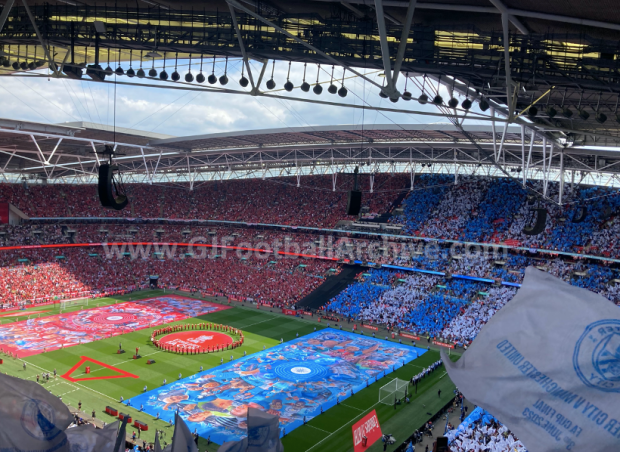
Good luck to all those interested in, attending and watching the second all-Manchester FA Cup final today. Let’s make sure it’s another that makes the world see the quality of Manchester’s football and fans.
Tomorrow will see Manchester City and Manchester United face each other in the second All-Manchester FA Cup final. This promises to be another dramatic day in the history of Manchester football (we are so blessed being able to see days like these).
Obviously, the game could go either way and I don’t want to make predictions as derby days are often difficult to predict. I well remember arriving at Maine Road in September 1989 when Alex Ferguson’s United were most expensive squad ever assembled in British football at the time. That day City fans feared the worst and by full-time the Blues had defeated the Reds 5-1 with chants of Fergie Out coming from the fans left in the away section of the Platt Lane Stand. Who would have thought that night that he would keep his job and bring so much success to the Reds?
Whatever happens enjoy the day and game. Clearly, if United win then that will help their development and if City win then that will mean four major trophies have been won this season – the other three are of course the Premier League, the UEFA Super Cup and the FIFA Club World Cup. Not bad hey? Add to that the FA Youth Cup and it’s been another great season.
Thanks to everyone who has subscribed to Manchester Corinthians: The Authorised History. Research and interviews have been continuing for the book, which will be published later this year. I’ll keep subscribers posted with details over the coming month.
I can state with real accuracy that I have captured voices from every season of the club’s history from 1948-49 through to its final game. I’m really pleased with that and, together with the deepest research ever into the club’s history, this promises to be a fairly definitive story of the club. I say ‘fairly’ because it’s impossible for anything to be definitive but this will contain more information than any other source.
Thanks to all those who have subscribed to the book – it helps enormously as the book and the years of research that have gone into this is all self-funded.
For those who haven’t subscribed or would like to know more on what the book will entail, here’s the latest information:
The book will tell the story via the voices of those involved from beginning to end (and beyond!), backed up with detailed archival research.
Myths, including some connected with the formation of the club, persist and still get promoted. For the first time, this Authorised History will highlight the key steps and people involved with the formation of the club, dispelling myths and properly acknowledging those who ensured the team had a life.
Hundreds of games have been identified with official – and unofficial – match reports adding flavour and supporting the words of the women who played.
Rare objects, cuttings, match programmes, trophies and more have been located for this book, with many of the players lending their collections to help ensure this is a wonderful record of the club’s full life.
The Manchester Corinthians’ tours across the globe will be featured extensively within the book, while the key managers (especially the club’s manager and guiding figure from 1948-49 until his death in 1967, Percy Ashley) and other personalities will be profiled.
Dozens of interviews have been performed for the book and include women who played in the club’s first ever game in 1948-49 and others who played in the last ever game, decades later. It’s a wonderful period of football history.
Voices from every season of the club’s existence have been captured. There are some truly remarkable stories gathered in interviews performed across the country. These wonderful women have provided their memories of every period of the club’s development. Every season is covered.
Over 300 players have been identified as playing for the Corinthians to date. These women come from every era of the club’s existence (but the search continues for other names – please get in touch: Gary@GJFootballArchive.com). Every player identified will be listed within the book.
Every person ordering the book before publication will not only have the book posted to them before it appears in any shop, but they will also have their name (or another name of their choosing) published within a special roll of honour at the back of the book.
The book will consist of over 320 pages and will include hundreds of images from every era of the Corinthians, alongside the story of the club and its players.
As with Gary’s book on Manchester City Women this book is destined to be a landmark history on a true Manchester institution and pioneering football club. In some ways this new Corinthians’ history will be a prequel to the City Women book.
This book is being self funded by Gary and so every pre-publication order helps the research enormously. Thanks for your support. It is appreciated.
UK readers can subscribe to the book here (If you live outside the UK then please contact for details of additional postage costs):
Manchester Corinthians: The Authorised History
The story of a pioneering women’s club as told to Gary James by those who were there
£19.95
You do not need to have a PayPal account to order – use the ‘Pay with PayPal’ button above and it will give you the option to pay by credit/debit card without creating a PayPal account.
Here’s one of the TV reports that covered our plaque unveiling back in October. This is from ITV National News:
Here are a few words from a review of the Manchester City Women book the Corinthians will be based on (this is from a review by Fiona Cosson, for the Oral History Society):
ABOUT THE AUTHOR
Manchester football historian Dr Gary James has been researching and writing about football for around forty years, with his first book published in 1989. By that time Gary was a regular at women’s football games in the region and already knew several Corinthians featured in the Corinthians’ book. His connections with the team go way back, in fact his sister was taught PE in the 1980s by a prominent player with the club, while his mum once told him about an older girl being brought to the front in her school assembly during the 1950s to talk about travelling abroad as a Manchester Corinthian.
Gary was on the steering committee for the National Football Museum project Unlocking the Hidden History of Women’s Football and was the Trafford lead for the UEFA/FA project on the history of women’s football for the Women’s Euros in 2022. He has performed various talks and written many significant articles on the Manchester Corinthians throughout the last six years. He established the campaign to create a blue plaque and other tributes for the women who played for the club, working tirelessly to ensure the Corinthians’ receive the accolades they so richly deserve.
Gary’s research and writing is recognised for his quality and depth, and he has written several landmark publications on Manchester football (both men’s and women’s), as well as being historical consultant with films, such as The Keeper, and TV (including researching and producing a 6 part TV series). Gary is the founder of the International Football History Conference and in 2023 was appointed Visiting Research Professor at New York University. He is also an Honorary Research Fellow at De Montfort University.
You can watch a one hour talk Gary did at the National Football Museum on the history of women’s football in the Manchester region here:
The cover is still in development but the two cover images are draft proposals which will be worked up further. If you’d like to purchase Gary James’ earlier book on Manchester City Women’s team then a limited number of copies, signed by me, are still available. You can order here:
On this day (23 May) in 1947 Roy Clarke signed for Manchester City. His debut came on 14 June when the Blues defeat Newport 5-1. Until the Covid affected seasons, this was the latest finish to a season for the Blues. It had been delayed due to poor weather causing postponements.
Years ago I wrote the Manchester City Hall of Fame book and as part of that I featured Roy. The game selected for his ‘most significant’ was the 1955 FA Cup semi final and subscribers can read that below.
If you would like to read this and all the in-depth articles on this site (including the entire Manchester A Football History book and the audio interviews with Malcolm Allison & John Bond) then please subscribe. It works out about £1.67 a month if you take out an annual subscription (£20 per year) or £3 a month if you’d like to sign up for a month at a time.
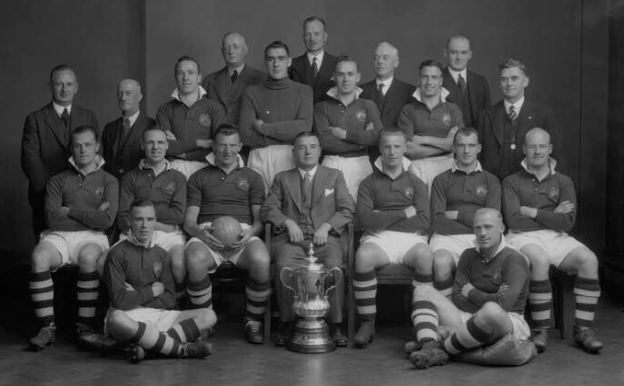
This weekend Manchester City and Manchester United meet in the FA Cup final. It’s only the second FA Cup final between the two teams and follows on from last year’s City victory. I have been asked to select Manchester City’s best ever FA Cup winning eleven for the FA Cup final match programme. The rules were: They couldn’t be a current City player and they had to have physically appeared for City in a FA Cup final winning team (i.e. no unused subs; only starting 11 or subs who came on in a winning final).
I wanted to make sure every era was included as well. So the eleven has been picked and that will appear in this weekend’s match programme. It was a difficult task. So who would make your eleven? Remember they had to play in a winning final for City.
Feel free to comment on who you would pick below and then on Saturday don’t be afraid to challenge my selection (I’m not Pep, so my team may not be the best to coach!).
I’ve left it a few days to let it all sink in but ‘wow!’ What an achievement for Manchester City! Never in the near 140 years of League football has any club achieved such a remarkable feat of four successive titles. This record, like the domestic treble, will last for an eternity with future generations aware of how brilliant these players and this manager was.
So for today’s piece I thought I’d look back at the successive titles record and see how that has developed. This demonstrates what a truly remarkable achievement this has been, but it also adds to the debate about whether teams have dominated particular eras or not. We’re often told that City’s era of dominance is new and no team has ever done this before – well no team has ever won 4 consecutive titles that’s for certain – but we’re also told that other clubs, Liverpool, Arsenal and United for example, have had greater periods of dominance (though that’s acceptable and City’s is not – that’s odd in itself!). It seems your view depends on which team you support. For neutrals and those prepared to explore the facts, the following can help with all of this assessment.
Record 2 in a row progression
Preston won the first two League titles in 1888-89 and 1889-90 (and were runners up in the three seasons that followed).
Sunderland equalled the record in 1891-92 and 1892-93 (and were runners up in 1893-94 6 points behind Villa) before winning it again in 1894-95
Aston Villa matched the 2-in-a-row twice in 1895-96 & 1896-97 and 1898-99 & 1899-1900. They actually won 5 out of 7.
Wednesday were next winning 2-in-a-row 1902-03 & 1903-04 (pipping FA Cup winners City to the title).
Liverpool were next with successes in 1921-22 & 1922-23
After Liverpool’s 2-in-a-row came a new record:
Record 3 in a row progression
Huddersfield Town were the first to win three successive title. Their successes came between 1923 and 1926 BUT they also were runners-up in 1926-27 & 1927-28 (missing it by 2 points).
Arsenal achieved the feat of 3-in-a-row between 1932 and 1935. The gunners had won the title in 1931 and were runners up in 1932 (missing it by only 2 points – 1 win), so came close to five.
Liverpool matched the 3-in-row between 1981 and 1984 but they’d come close to 5-in-a-row between 1975 and 1980 when they won the League in 1976, 1977, 1979 and 1980 and were second in 1978. In total Liverpool won 7 out of 9 between 1975 and 1983 (8 out of 11 too).
Manchester United were the next to achieve 3-in-a-row between 1998 and 2001. They had also won 7 out of 9 (1992 to 2001) and 8 out of 11. The years they managed 7 out of 9 saw them finish as runners up in the other two seasons, missing it by only 1 point in both 1994-95 and 1997-98. Rightly, this was heralded as a remarkable achievement.
Manchester United matched their own 3-in-a-row with another between 2006 and 2009. They also finished as either champions or runners up in the following four seasons. This meant that between 1992 and 2009 United had won 11 out of 17 titles and finished second in a further three.
Record 4 in a row setting
Manchester City are the only team to win 4-in-a-row English League titles. This remarkable feat has been achieved with title successes in 2020-21, 2021-22, 2022-23 and 2023-24. City also won consecutive League titles in 2018 and 2019 and were runners up in 2020. This means City have won 6 out of 7 Premier Leagues.
There have been a lot of people out there claiming that this year’s League title was a ‘foregone conclusion’ and that it was ‘boring’. As I pointed out last week that all depends on whether things become boring once your own team are unable to challenge, but for many neutrals it’s about title races going to the final day or ones that are close.
Did you know that only 10 of the Premier League’s 32 seasons have finished with 3 points or less separating the top two teams? In exactly 50% of those seasons Manchester City were the champions – more than any other club! Also, if you’re the kind of person who believes City are the ‘only’ team to challenge and that it’s a foregone conclusion then it may surprise you to learn that 62.5% of ALL City’s Premier League titles have been won by 2 points or less! That’s not even a victory – how close do you want it? How much less of a foregone conclusion works for you?
As a comparison only 15% of Manchester United’s Premier League titles have been won by 3 points or less! I know Liverpool have only won one title since the Premier League was created (yes, and many, many more before that of course!) which means that 100% of LFC’s Premier Leagues have been won by 18 points (that was a foregone conclusion and boring if we believe that the earlier the competition is won the more boring it is!).
If you enjoy all the free material on my website and would like to support my research and keep this website going (but don’t want to subscribe) then why not make a one-time donation (or buy me a coffee). All support for my research is valued and welcome. It allows me to keep some free material available for all. Thanks.
Well, the Premier League is now over for another year and we know who the Champions (4-in-a-row) are and who has qualified for Europe etc. so it’s time to look forward to the second all Manchester FA Cup final. The first was of course last season and started off wonderfully for Manchester’s Blues with that record-making Gundogan opener.
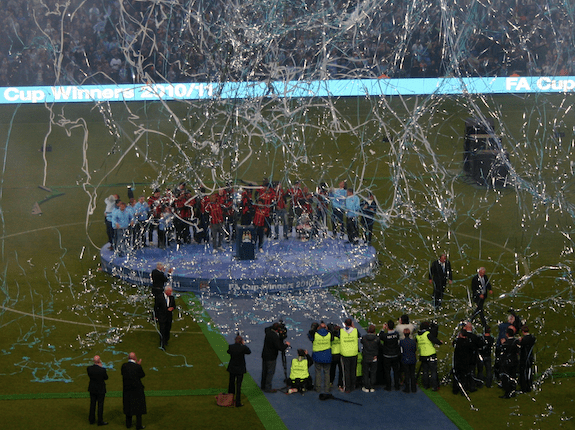
Prior to this last year’s final, the closest Manchester City and Manchester United got to playing each other in a Wembley FA Cup final were the FA Cup semi finals in 1926 and 2011. I wasn’t around in 1926 but I definitely was in 2011! A few years back I made this special audio recording talking about the years building up to the semi and the day itself from a Manchester City perspective. Many of you have listened to this already but if you haven’t then it tells the story of the 2011 FA Cup semi final and the years between 1976 and that moment in 2011 for City.
I included audio from interviews I did with a variety of people including Khaldoon, Peter Swales, Garry Cook, Brain Marwood and many others.
If you have heard it before then maybe you should listen again to remind yourself of how we all felt and why that game was so significant.
I included a few words from Roberto Mancini recorded in 2011 and at one point he talks about the view that was then being expressed that City were ‘trying’ to buy success (now they say City ‘have’ bought success!). His words are a reminder that City have been having that particular criticism thrown at them for over a decade! Oh well, I wonder how long those criticisms were laid at other clubs who had seen major investment which propelled them forward?
Anyway, get yourself a brew and be prepared to be transported back in time. Here’s the recording:
If you enjoy the recording then please let me know, comment or subscribe to the site. If you don’t fancy doing that then there’s also the option to make a welcome donation to keep this site going (see below). I’ve produced videos/talks like this highlighting key points in Manchester City’s footballing history which subscribers can watch too.
If you enjoy all the free material on my website and would like to support my research and keep this website going (but don’t want to subscribe) then why not make a one-time donation (or buy me a coffee). All support for my research is valued and welcome. It allows me to keep some free material available for all. Thanks.
Read more of this content when you subscribe today. It costs £20 a year to subscribe (it works out £1.67 a month) or £3 if you’d like to sign up a month at a time. Annual subscribers get full access for as long as you subscribe (you can always try it for a month). It’s worth bearing in mind that the 2010 Manchester A Football History cost £24.95 and all subscribers will be able to access all of that for as long as they are a subscriber (plus all the other stuff of course).
It costs £3 a month to subscribe a month at a time. Why not give it a try! Monthly subscribers get access to everything posted since 1 October 2022 for as long as you subscribe.








 Gary James' Football Archive