The 1890s: 1892-1893 League Leaders

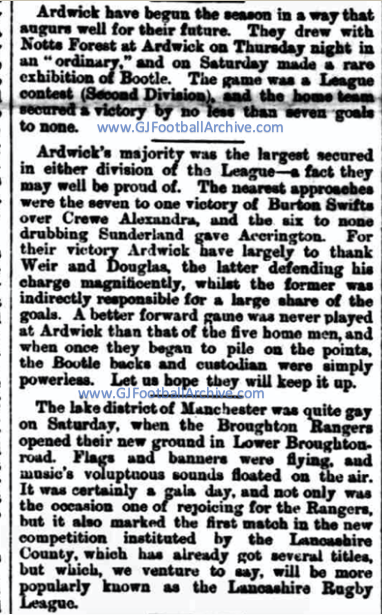
The series of features on Manchester City in the 1890s continues today with a 1800 word article on Ardwick’s first season in the Football League, 1892-93

Ever wondered how MCFC came into being and what happened to Ardwick AFC? Well, now’s your chance to find out. This series covers the final years of Ardwick and the birth of Manchester City.

Subscribe to get access

Read more of this content when you subscribe today. It costs £3 per month (cancel anytime) or sign up a year at a time for the discounted annual fee of £20. This gives access to everything on the site, including PDFs of 3 of my books and various other articles, interviews and audio material. Each subscriber has access to all content posted during their subscription period too. Why not sign up for a month and see what you think?

More on the 1890s tomorrow. Why not subscribe and read this and all the other subscriber features?
The 1890s: 1891-1892 A Second Manchester Cup

The series of features on Manchester City in the 1890s continues today with a 1100 word article on Ardwick’s exploits in the 1891-92 season. The last season before the club joined the Football League.

Ever wondered how MCFC came into being and what happened to Ardwick AFC? Well, now’s your chance to find out. This series covers the final years of Ardwick and the birth of Manchester City.

Subscribe to get access

Read more of this content when you subscribe today. It costs £3 per month (cancel anytime) or sign up a year at a time for the discounted annual fee of £20. This gives access to everything on the site, including PDFs of 3 of my books and various other articles, interviews and audio material. Each subscriber has access to all content posted during their subscription period too. Why not sign up for a month and see what you think?

More on the 1890s tomorrow. Why not subscribe and read this and all the other subscriber features?

The 1890s: 1890-1891 The Brewery Men

The series of features on Manchester City in the 1890s continues today with a 1300 word article on Ardwick’s exploits in the 1890-91 season. This team image has been coloured to show the club’s colours of that season. Note: the story of City adopting blue and white for the first time due to Masonic influence in 1894 is a myth. The Club had been wearing blue and white from as early as 1887.

Ever wondered how MCFC came into being and what happened to Ardwick AFC? Well, now’s your chance to find out. This series covers the final years of Ardwick and the birth of Manchester City.

Subscribe to get access

Read more of this content when you subscribe today. It costs £3 per month (cancel anytime) or sign up a year at a time for the discounted annual fee of £20. This gives access to everything on the site, including PDFs of 3 of my books and various other articles, interviews and audio material. Each subscriber has access to all content posted during their subscription period too. Why not sign up for a month and see what you think?

More on the 1890s tomorrow. Why not subscribe and read this and all the other subscriber features?

The 1890s: 1889-1890 Illuminated Ardwick

Starting today: A new series of features on Manchester City in the 1890s! Ever wondered how MCFC came into being and what happened to Ardwick AFC? Well, now’s your chance to find out. This series covers the final years of Ardwick and the birth of Manchester City. It starts with the second half of the 1889-90 season for Ardwick and includes a story of a floodlit game.

Subscribe to get access

Read more of this content when you subscribe today. It costs £3 per month (cancel anytime) or sign up a year at a time for the discounted annual fee of £20. This gives access to everything on the site, including PDFs of 3 of my books and various other articles, interviews and audio material. Each subscriber has access to all content posted during their subscription period too. Why not sign up for a month and see what you think?

More on the 1890s tomorrow. Why not subscribe and read this and all the other subscriber features?

The 1890s: Ardwick and Manchester City

A new series of features starts tomorrow. This series provides a season by season account of Ardwick AFC and Manchester City FC in the 1890s. Some are 2000+ word articles, others are a bit less, but each adds to the story of how the club evolved. So, if you’ve ever wondered how MCFC came into being and what happened to Ardwick AFC, here’s your chance to find out. This series covers the final years of Ardwick, the birth of Manchester City and Manchester’s first national title.

Watch this space tomorrow for details.

Manchester’s Football Origins

For well over a century football has been a crucial and popular aspect of Mancunian life. It’s been part of the city’s identity. So for today’s piece I’m taking a look at football’s early years. Here is a 1800 word overview of the major Manchester clubs that existed before today’s giants, followed by the origins of Newton Heath and St. Mark’s, who both played their earliest known games in November 1880.

This article is available to subscribers to my site.

Subscribe to get access

Read more of this content when you subscribe today. It costs £20 a year (or £3 per month if signing up a month at a time). Throughout your membership you have full access to everything on this site including interviews, recordings and PDFs of a couple of my books that have been long out of print. Why not sign up for a month and see what you think? I commit to 4 new lengthy articles per month, though in practice it’s been much more than that.

The 1890s: Manchester’s First National Success

On this day (April 22) in 1899 Manchester City became the first side to gain automatic promotion when they won the Second Division title after a 4-1 victory over Blackpool. Goals from Meredith (2), Gillespie and Ross gave the Blues the win.

A series of test matches, similar to play offs, had been utilised in previous seasons. The Blues were also the first of the Manchester teams ever to earn promotion and the football season ended with Manchester City as comfortable champions of the Second Division. This meant they were the first Manchester team to win a national League competition too. 

Near neighbours Glossop were also promoted that day. Here’s the final table:

Subscribers can read about the final game and other information from that season below:

Subscribe to get access

Read more of this content when you subscribe today. It costs £20 a year (here) to access everything since December 2020 or for £3 per month (below) you can access everything from 1 October 2020.

Subscribe to get access

Read more of this content when you subscribe today. It costs £20 a year (above) to access everything since December 2020 or for £3 per month (here) you can access everything from 1 October 2020. Why not join for a month and see what you think?

Manchester Home To A League First & Myth Busting

On this day (17 April) in 1888 the first meeting of the Football League was held in Manchester. The following report names the clubs accepted and the others who wanted to join the League. It has often been written in Manchester United related books that Newton Heath applied to join the League in 1888 but didn’t receive enough votes to be accepted. That is completely untrue as no one actually had to apply nor was a vote taken. Clubs were asked and some tried to push to get included but Newton Heath were neither asked nor were they pushing for acceptance either. Nor were Ardwick or Manchester Asoociation who, to be frank would’ve been the most famous Manchester club at this time.

Bolton Wanderers were the only team from present day Greater Manchester to be asked/selected for the first League season.

Manchester Courier, 18 April 1888

The plaque is positioned on the corner of Mosley Street and Market Street/Piccadilly in Manchester.

Interview – History of Manchester Football

I was recently interviewed for the Christie Scanlon podcast and the video has now been posted. I talk about origins of both City and United, City’s badge consultation, chants and much more. It lasts about one hour and you can watch it on Christie’s channel here:

I enjoyed doing this and Christie’s a good interviewer and host. It looks like Christie’s used an automated captioning software that has made a few typos with names etc. – that’ll be because of my accent – but listen and watch. I’m sure you’ll enjoy it.

Newton Heath/MUFC’s First Game and Their Colours

On this day (20 November) in 1880 as Newton Heath L&Y Railway Manchester United played their earliest known game. It was against Bolton Wanderers 2nd team and United lost 6-0. In the years that have followed some have claimed they wore green and gold at this game but the contemporary references given do not say anything of the sort.

It is still repeated often that a newspaper report in the Bolton Evening News mentioned the colours of green and gold were worn for Newton Heath’s first reported match. The origin of this is unclear but the Manchester United Pictorial History and Club Record (Charles Zahra, Joseph Muscat, Iain McCartney and Keith Mellor; Nottingham: Temple Press, 1986) specifically refers to the match report on page 11 as being published on 24 November 1880 and implies it stated the team colours. It also suggests that Bolton wore scarlet shirts. 

My research over the decades has included a review of every Bolton newspaper for that period and I did discover a match report in the Bolton Evening News on the date mentioned in the above book but this did not include any reference to the colours worn.  This is actually the report that gets quoted. You can see there’s no mention of colours:

Like so many football clubs the early history of Newton Heath has lots of myths associated with it. The facts are that at the railway works in Newton Heath various sporting activities were established during the 1870s. In 1922 Herbert Dale, a railway worker who played football for a decade from the formation of what became Newton Heath, was asked how football became established at the works. He explained that the club when initially formed had been a cricket team (suggesting it was established in 1878), and that after some time a member of the committee bought a football from a shop on Market Street in the city centre. This appears to be in 1880 and, according to Dale, the instigator of the club was Sam Black and that the original colours were red and white quartered shirts (NOT green and gold; quartered shirts meant 2 panels on front and 2 on back with a red and a white panel on both the front and the back). Those colours may surprise some but I do provide references and explain more in a book The Emergence of Footballing Cultures: Manchester 1840-1919 published by Manchester University Press. In that I talk about all the early clubs of the Manchester area such as Hulme Athenaeum, Manchester Association and Hurst.

Black was seventeen when the club played its earliest known game on 20 November 1880 and his age then seems consistent with others, such as those at St Mark’s (Manchester City) who are known to have played in November 1880.

The was a Sportsman’s Yearbook for 1880 produced which the Newton Heath club was mentioned in. It appeared in both the cricket and football sections. Here are the details published in the cricket section:

Sportsman’s year book 1880 Newton Heath cricket section

You’ll notice mention there of the cricket whites/kit to be worn: white with a blue cord. Typically, this is believed to mean ‘white cricket shirts and trousers’ with a blue cord as belt (to differentiate between opponents). Some cricket clubs wore different coloured belts/cords; some wore specific caps with their whites and some wore badges (or even different colours).

In that same yearbook the following appeared in the football section (back then a football section had rugby and association football clubs alongside each other):

Sportsman’s year book 1880 Newton Heath football section

You’ll notice the details are simply a repeat of the cricket section and it may well be that the club had decided to be listed in both sections without thinking specifically about football, or it could even be that it was a mistake to publish in both sections. For me it does seem that having the club’s details in both sections was deliberate, afterall it says the club is all year around and not specific to the cricket or football/rugby season. But I don’t believe the colours can be trusted for the association football team, especially as Dale talks of red and white being the club’s earliest football colours. Whatever is true it is important to recognise that to date no contemporary evidence has been found saying the club wore green and gold when they played their earliest games. They did wear those colours at times later on though.

Newton Heath reformed as Manchester United in 1902, winning the club’s first major trophy in 1908 (the League).

Incidentally Bolton Wanderers’ first team beat Irwell Spring (Bacup) 7-1 in the Lancashire Cup on the same day as the earliest known game for the Heathens. A good day all round for the Wanderers it seems.

For those wondering the earliest known MCFC game took place one week earlier (St Mark’s v Macclesfield Baptists).