On this day (30 March) in 1960 Manchester City defeated West Ham United 3-1 with goals from Colin Barlow, Denis Law and Billy McAdams. You can read more on this period for City with a series of articles posted on the 1950s and 1960s. Why not start with the following subscriber article on Manchester City during the 1959-60 season? If you’d like to read this 1200 word article, plus all other articles on the site, then please subscribe (see below).
Subscribe to get access
Read more of this content when you subscribe today. It costs £3 per month (cancel anytime) or sign up for a year at the discounted price of £20 per year (works out £1.67 per month). Subscribers access the 1000+ articles posted so far and the others scheduled during the life of your subscription.
100 years ago today (27 March 1926) the first all-Manchester FA Cup semi final occurred. You can see film of that game here and subscribers can read about the match below. Here’s the film from Bramall Lane:
Read everything on the site when you subscribe today. Monthly subscription is £3 per month (cancel anytime). Monthly subscribers access everything posted since 1 October 2022. Alternatively, sign up for a year at a time for the special discounted annual subscription of £20 for access to everything posted since the site’s creation in 2020.
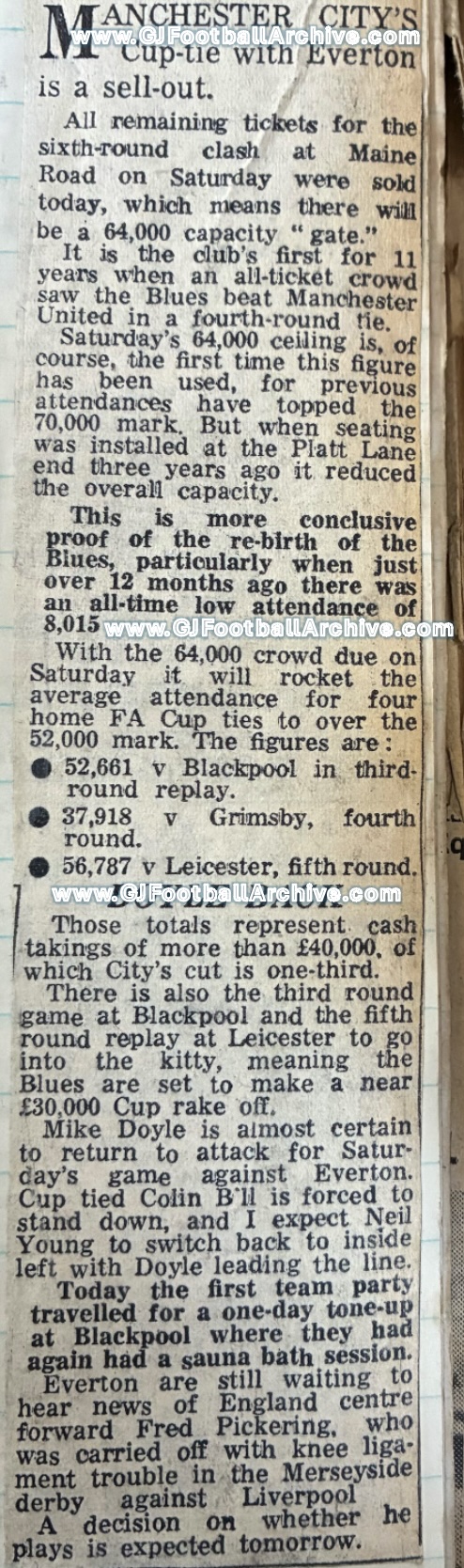
60 years ago this week (March 1966) Manchester City announced that their FA Cup quarter final was a 63,000 sell out. Why is this significant? Because the attendance was larger than any domestic crowd at Old Trafford that season, but why is that significant? Because at the start of the season United’s Pat Crerand bet City assistant manager Malcolm Allison that City would never get more than 30,000 for a game again! I interviewed Malcolm back in 1993 when we talked about this and he also mentioned it in he biography. The story…
Basically, Allison was sat at United’s League championship celebration and became somewhat frustrated by the glorification of United that night. While Joe Mercer took a diplomatic approach, afterall it was United’s celebration dinner, Allison decided to speak out. He told Matt Busby’s son Sandy that his dad had a twenty year start but ‘I’ll pass him in three’ and then Allison claimed he got into a discussion with Crerand about ‘little City’ compared to United. Allison claimed Crerand made a £10 bet with him that City would never again get 30,000+ in Maine Road.
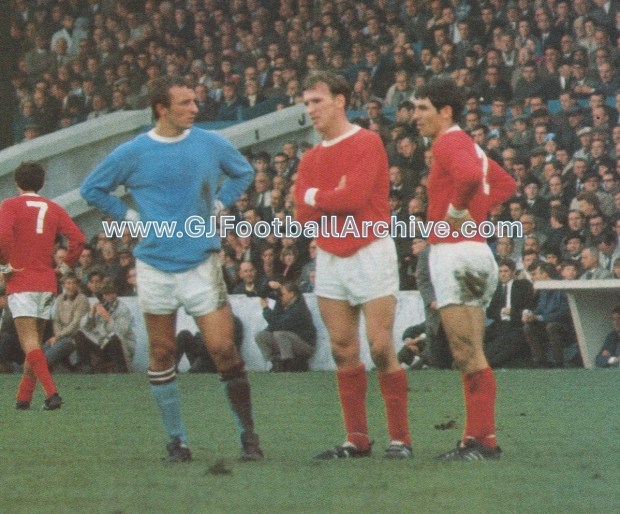
A pause in the action (September 1967 Manchester derby) gives Summerbee Crerand and Dunne an opportunity to debate the action so far (Image: The Pride of Manchester, 1991)
On a Wednesday night in October (27/10/65) City attracted 34,091 for the visit of Norwich in the Second Division. Allison told me he couldn’t remember whether he ever got his £10 but he did laugh a great deal when I told him that United’s attendance the previous Saturday was 32,716 for the top flight visit of Fulham.
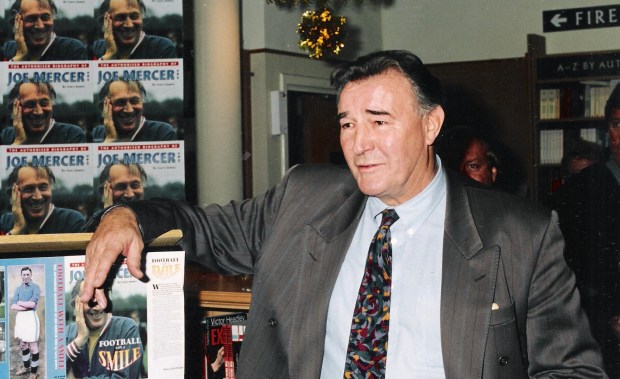
Malcolm Allison at the launch of Gary James’ Football With A Smile: The Authorised Biography of Joe Mercer, OBE in December 1993. Note Francis Lee appearing behind Allison.
What was even more remarkable was that the City-Everton FAC tie on 26 March 1966 was watched by 63,034 and that was higher than any domestic crowd at United that season. Allison laughed again when we discussed that briefly. As a comparison, United attracted 58,161 for their League game with Liverpool (lowest home League attendance 23,039 v Aston Villa) and they did get 60,433 for their FAC Cup quarter-final replay with Preston. Plus United managed to better all these attendances with 64,035 for their European Cup quarter-final with Benfica.
I did an earlier interview with Allison that can be listened to here:
If you’re new to this website there’s lots more like this elsewhere on the site. Some is available for subscribers and some is available for all. If you’d like to subscribe then see see ‘How To Subscribe’ lower down. If not why not help keep it going and support the research too:
If you enjoy all the free material on my website and would like to support my research and keep this website going (but don’t want to subscribe) then why not make a one-time donation (or buy me a coffee). All support for my research is valued and welcome. It allows me to keep some free material available for all. Thanks.
Forty years ago today (22 March 1986) Manchester United hosted Manchester City in the 108th League derby between the teams. The fixture was the first of two high profile games for the Blues in consecutive days with the other game coming on Sunday at Wembley. See this story for news of that Wembley final:
Here for subscribers are the match stats, background, match report, film and other details from the 1986 Old Trafford derby:
Subscribe to get access
To access this please subscribe. It works out about £1.67 a month if you take out an annual subscription (£20 per year) or £3 a month if you’d like to sign up for a month at a time. Each subscriber gets full access to everything posted so far and those scheduled during your subscription.
70 years ago today (17 March 1956) Manchester City defeated Tottenham Hotspur 1-0 in the FA Cup final with a goal from Bobby Johnstone. The game was watched by 69,788 at Villa Park and you can watch film of it here:
Here for subscribers is a 3,900 word article on the 1955-56 season when City won the FA Cup final (nowadays known as the Trautmann Final) and Bert Trautmann was FWA Footballer of the Year (presented in the days before the final). Enjoy!
You can read the article by subscribing below.
Subscribe to get access
Read more of this content when you subscribe today. It costs £3 per month or you can subscriber for the discounted annual rate of £20 per year. Each subscriber gets access to everything posted so far, including PDFs of a couple of my books.
The first Manchester derby at Manchester City’s new stadium (then called the City of Manchester Stadium, now the Etihad) occurred on this date (14 March) in 2004. For pride’s sake it was important Kevin Keegan’s side did not lose that fixture, but with United some 13 places above the Blues pre-match Ferguson’s side were clear favourites. It was time for City to upset the form book.
On a wonderful day, perhaps the best the stadium had enjoyed in its inaugural year, a terrific atmosphere helped Keegan’s side achieve a memorable victory. Fowler opened the scoring in the third minute and Macken made it 2-0 after 32 minutes. Scholes made it 2-1 three minutes later.
In the second half goals from Mancunian Trevor Sinclair (73) and Shaun Wright-Phillips made it 4-1 to the Blues. You can hear my interview with Trevor Sinclair about this game here:
Matt Dickinson (The Times): “Humiliated by Manchester City last season, Sir Alex Ferguson and his men used the pain to fuel their drive to the title. Humiliated again yesterday, they are condemned to live with the despair for months – perhaps even years.”
Keegan felt the win was thoroughly deserved: “We had played better against Chelsea and lost. But against United we got that important early goal which gave us something to hang on to. We had personnel problems because we had players doing jobs that don’t come naturally to them and also had to make two enforced changes at the interval.”
Chris Bailey explained the significance of the match in the Manchester Evening News: “Maine Road saw some pulsating derbies in its time but few could have matched this first-ever neighbourly spat at Eastlands. And how satisfying that Kevin Keegan’s side should choose this day of all days to win their first home game since October 18 and banish all thoughts of the drop.”
In 2012 Dennis Tueart, who was a director at the time of the stadium move, told me his memories of that derby match, believing it was an important moment in the stadium’s inaugural season: “When we moved to the stadium Kevin Keegan worried about whether the atmosphere would be the same and I told him that fans would take a bit of time getting used to it because they were no longer sat with the people they’d been with for years. The dynamics were different. He felt we should try and get fans in the ground earlier, but I said that performance on the pitch would be the most significant factor.
“When we beat United 4-1 in the first derby at the stadium the atmosphere was incredible. Kevin came to me afterwards and said ‘I see what you mean’. That then set the tone of the place. The place was rocking – people were singing as they walked down the spirals at the end of the match and the atmosphere was absolutely superb.”
If you would like to read about other Manchester derbies then check out this:
This was a brief taste of the material on http://www.GJFootballArchive.com If you would like to read all the in-depth articles (including the entire Manchester A Football History book and the audio interview with John Bond) then please subscribe. It works out about £1.67 a month if you take out an annual subscription (£20 per year) or £3 a month if you’d like to sign up for a month at a time. Each subscriber gets full access to everything posted so far and everything scheduled to be posted during your subscription.
Continuing here: the story of Manchester City’s origins. Today’s feature is a 3,300+ word feature on the earliest known game, played in November 1880. Have a look elsewhere on the site for other content on this period.
Subscribe to get access
These articles will be available to subscribers to this site. It costs £3 per month (cancel any time) or sign up for a year for the discounted price of £20 per year (works out about £1.67 a month to access every article on this site). To date in excess of 1,500 articles/features have been posted including interviews, talks and more.
If you enjoy all the free material on my website and would like to support my research and keep this website going (but don’t want to subscribe) then why not make a one-time donation (or buy me a coffee). All support for my research is valued and welcome. It allows me to keep some free material available for all. Thanks.
For today’s feature I’ve decided to look back to a remarkable day in 1924 when Manchester City and Brighton met in their first competitive game. This ‘first’ also became significant as a ‘last’ moment for one of City’s greatest ever players. That day the legendary Billy Meredith scored his last competitive goal. Remarkably, he was 49 and his return to City’s first team brought significant media coverage.
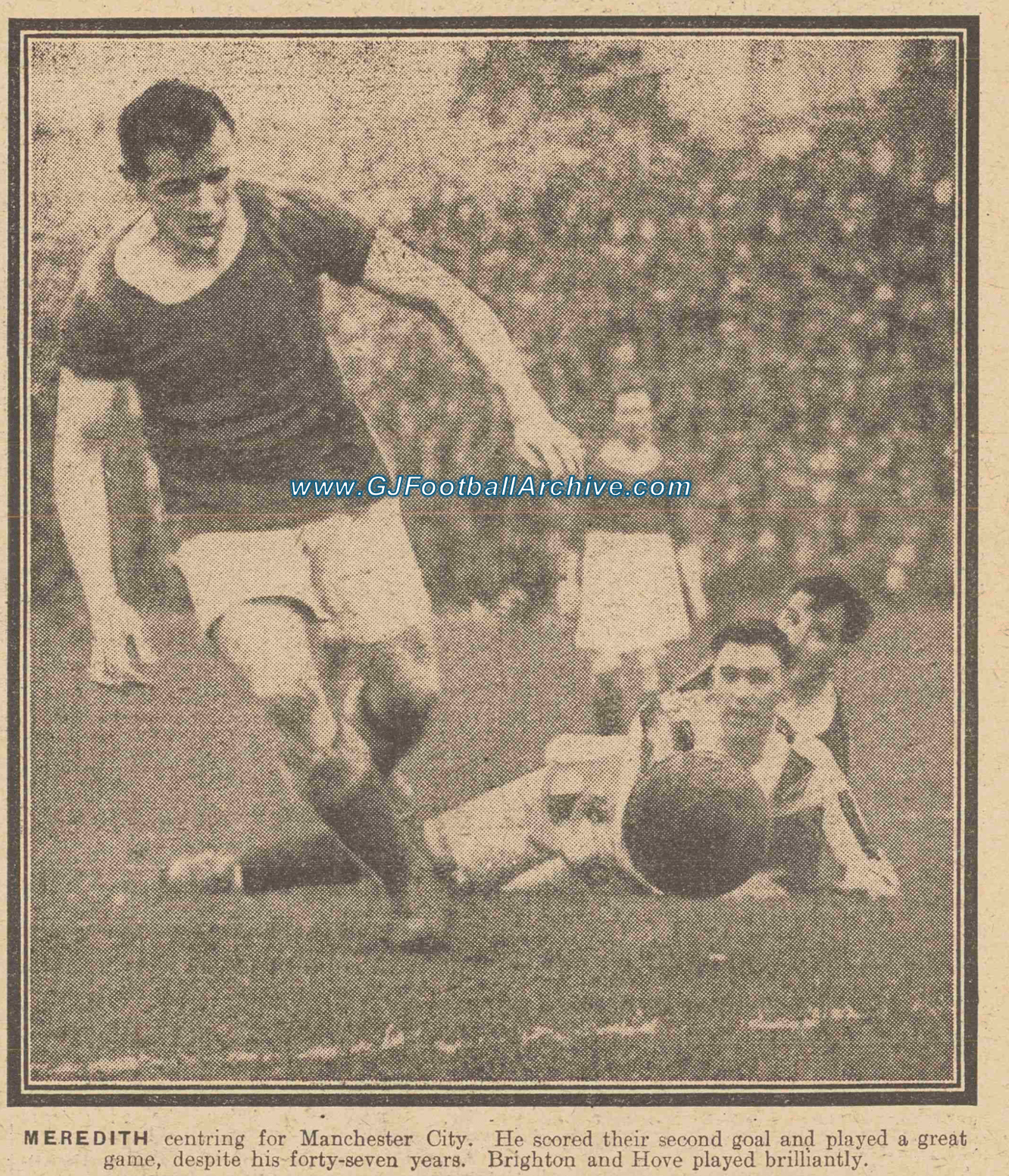
The first ever meeting between City and Brighton was on this day (23 February) in 1924 and this photo is of Meredith during that game. It was a FA Cup tie at Brighton and newspapers were full of Meredith stories. His return was big news. The Manchester Evening News explained: ‘To all intents and purposes, Meredith ceased to be an active member of the first team two seasons ago. Two things have combined to bring him within range of the rather sensational choice now made – sentiment and his own indomitable will to fret his hold on the football stage a little longer… The chief argument in his favour is that from one of his classic centres any match might be won, just as it was when he scored the goal that served to bring the English Cup to Hyde Road twenty years ago next month.’
Meredith had not played in a League game all season – in fact he’d only played one game the previous season! – and he was aged 49. However, he remained the biggest name in football and had captained City to FA Cup success in 1904, scoring the winning goal in the final.
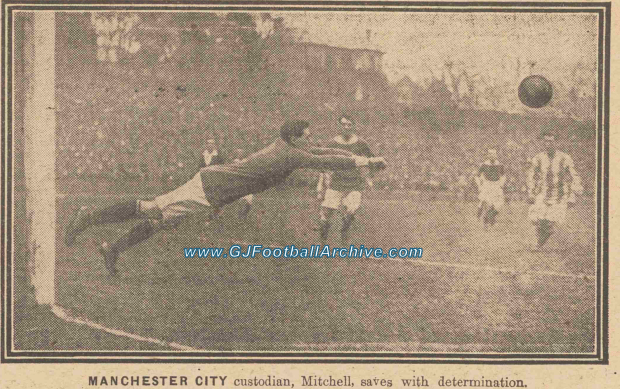
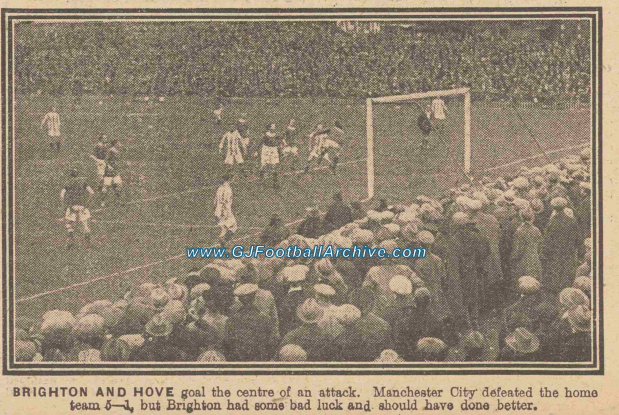
A record crowd of 24,734 packed into Brighton’s Goldstone Ground and Meredith’s inclusion inspired the rest of the team. City defeated Brighton 5-1 and there was even a sentimental moment when a minute into the second half Meredith scored. The Daily Mail described the goal: ‘[Meredith’s] old inimitable ball magic along the touch line remains… Those bow legs still mesmerise the ball, and that great right foot still placed the ball perfectly in the mouth of goal. In this way Meredith got his goal. Hayes grasped the ball, but it spun out of his hands into the net.’
This was to be Meredith’s last-ever first team goal.
This season City reached the FA Cup semi-final, establishing attendance records along the way. Meredith’s inclusion was a masterstroke. The chance of Meredith reaching the FA Cup final had been the nation’s footballing dream, but it could not be fulfilled. In the semi-final City were defeated by Newcastle and the Welshman’s career came to an end. You can read about that game here:
Billy Meredith stopped playing more than 100 years ago but his name remains one all Blues should know. He was our first truly great player and was the game’s biggest star. He joined City in 1894 and, despite a spell at Manchester United, remained a City fan all his life, attending every FA Cup final the Blues played in until his death in 1958.
In 2004 I chatted with his then 98-year-old daughter Winifred, and she said that his heart was always with City: ‘He felt at home at City. I know he had great success at United, but I don’t think they ever really appreciated him in the way City did. I think United were not paying him properly after the war and, because of his age, they probably didn’t value him. But City did, and it’s clear they still love him today. City was always his team and meant more to him than United ever could.’
Other images from the game:
One-Time
Monthly
Yearly
If you enjoy all the free material on my website and would like to support my research and keep this website going (but don’t want to subscribe) then why not make a one-time donation (or buy me a coffee). All support for my research is valued and welcome. It allows me to keep some free material available for all. Thanks.
Manchester City’s winning streak was extended to 13 games following a comfortable victory at Burnley on this day (3 February) in 2021. Not only that but the win placed Pep Guardiola’s side top of the League, three points ahead of rivals Manchester United, and this was City’s sixth consecutive clean sheet. Here’s a Mini-report and highlights of the game…
The game started wonderfully for City when a stinging shot by Bernardo Silva was parried straight to Gabriel Jesus by Burnley ‘keeper Nick Pope. Jesus headed in from a couple of yards out after only three minutes.
In the 38th minute the lead was doubled when an Ilkay Gundogan pass found its way to Raheem Sterling who scored his tenth goal of the season to date. There were other chances and City were always in control, but the game ended 2-0. Afterwards Burnley boss Sean Dyche admitted: ‘City were very good. They’re on a good run of form. They are really sharp in transition and attack… They play with three and a half [at the back]. The right-back or left-back goes into midfield when they have the ball.’
An odd stat was highlighted after this game recording that City had become the first team ever to win 12 consecutive Premier League games played on a Wednesday. By this time of Pep’s reign so many longstanding records had been broken that the statisticians began looking for something new to highlight!
Here’s film of the FA Cup 4th round tie from this day (29 January) in 1955 when Manchester City defeated Manchester United 2-0. Joe Hayes and Don Revie were the City scorers. Enjoy: https://www.britishpathe.com/asset/59278/
This series on Manchester City in the 1950s includes free items and items only available to subscribers. If you’d like to find out more on the 1954-55 season then subscribe and read the following 3,400 word article on it. It’s a season when City reached the FA Cup final and Don Revie was FWA Footballer of the Year.
This is a subscriber article and you can read it by subscribing below.
Subscribe to get access
Read more of this content when you subscribe today. It costs £3 per month or you can subscriber for the discounted annual rate of £20 per year. Each subscriber gets access to everything posted so far, including PDFs of a couple of my books.





 Gary James' Football Archive