Dickov and Goater

On this day (26 September) in 1998 Manchester City drew 2-2 with Northampton Town in ‘new’ Division Two (third tier). City goalscorers were Paul Dickov and Shaun Goater. Twice City had come back from being behind. This is the Manchester Evening News report of the game:

Air Raids Around Maine Road

It’s 1941 and there are air raids across Manchester… Have a look at this map. What does it signify? Well, the map shows Manchester City’s Maine Road Stadium as it looked between 1931 and 1934, before the main part of the Platt Lane Stand was built (and after the corner was erected). But that’s not why I’ve posted it. I’ve posted it because of those pen circles that appear on it.

This is actually a Manchester City Council plan of buildings hit by bombs in the area immediately east of the Maine Road stadium. As you can see a house in Thornton Road was hit but none of the Maine Road stadium itself was hit in those January 1941 raids on Manchester. The stadium had a lucky escape but sadly many residents and Mancunians did not.

1941 Bomb damage near Maine Road

Here’s an aerial photo of Maine Road from 1971 to give a feel for the site. The Platt Lane corner is number 3 and Thornton Road is the street that backs on to Maine Road near number 6.

Maine Road aerial 1971 from Farewell To Maine Road

If you’d like to read more on the history of Maine Road, take a look at Farewell To Maine Road, which can be downloaded from this page:

If you enjoy all the free material on my website and would like to support my research and keep this website going (but don’t want to subscribe) then why not make a one-time donation (or buy me a coffee). All support for my research is valued and welcome. It allows me to keep some free material available for all. Thanks.

Choose an amount

£2.50
£5.00
£7.50

Or enter a custom amount

£

Your contribution is appreciated.

Donate

On This Day in 1999

The 1999 Play Off Final was played on Sunday 30 May in 1999 with Manchester City clearly the favourites.  According to the media Gillingham were going to be swept aside by Royle’s men.  For many Blues the day began with a long journey down to the capital.  Some stayed overnight close by – the Wembley Hilton seemed to have City banners and flags hanging from every window.

When the players were brought out on to the pitch for the commencement of play they were greeted by smoke, fireworks, and inflatable Nationwide Building Society men.  It all seemed a little surreal, but this was nothing compared to the match itself.

When the action started City were not the great force the media expected, instead they slipped their way across a wet surface and relied on the 20 year old Nicky Weaver to keep Gillingham at bay, particularly in the 9th minute when he palmed away an effort from Galloway.  As the game wore on confidence grew and in the 26th minute a downward header from Horlock was superbly saved by Gillingham’s Bartram.

Mixed play followed, although it’s fair to say that City several chances and should have taken the lead, especially in the 75th minute when Goater sidefooted a shot against the post.  As the game progressed City fans became nervous, then with only 9 minutes remaining the Blues were dealt a major blow when Asaba toe-poked a shot into the roof of City’s net.  Worse was to follow for City as Robert Taylor made it 2-0 in the 86th minute.  Two thirds of the stadium fell silent, then many, many Blues decided enough was enough and left for home.  Those that remained were in for a treat.

Radio Five commentator Alan Green told his listeners about the plight of the thousands of City fans silent at Wembley adding:  “That many fans go to every home game.  Why do they do it?”  It wasn’t long before he found the answer.

With a mere 17 seconds of normal time remaining Horlock sidefooted a goal, prompting those in the stands to start to believe that an equaliser could be possible.  Four and a half minutes into injury time Dickov fired an equaliser into the top corner.  For a few seconds the stadium fell silent as City supporters struggled to comprehend the importance of the goal, and then wild celebrations erupted.  Outside Wembley those that had left early heard the news and rushed back.

An extremely tense period of extra time followed, and then came penalties.  The City players huddled together as a team, showing the unity that previous sides had clearly not enjoyed.  This unity helped City win the penalty shoot out 3-1, but this score says nothing about the drama and the excitement of it all.  The penalty sequence started with Kevin Horlock scoring the first at the City-filled Players Tunnel end of the stadium.  Then Weaver’s legs blocked Gillingham’s first effort by midfielder Paul Smith.

A confident looking Paul Dickov marched forward to take City’s second, but he watched in agony as his attempt bounced off both posts to leave the score at 1-0.  Adrian Pennock then shot wide for Gillingham, before Terry Cooke calmly slotted his effort into the bottom corner to make it 2-0.

Gillingham’s third penalty was sent clinically into the roof of the net by John Hodge to make the score 2-1, then Richard Edghill sent his spot kick in off the bar.  The pressure was at long last on Gillingham.  Guy Butters looked a little on edge as he prepared for the eighth penalty, while in the nets Weaver seemed relatively composed.  The young City goalkeeper dived the right way and blocked Butters’ effort to give City victory.  He immediately went on a rather manic run across Wembley, until he was dragged back to reality by Morrison and the other players.

Wild celebrations followed, with the players bowing to the supporters to show their appreciation of sticking by the club through an extremely difficult period.

Manager Joe Royle was delighted, although it’s fair to say he looked absolutely worn out when he made it into the dressing room after City’s extravagant celebrations.  In a rather down to earth manner he told the media:  “We’re not getting too excited about this.  A club this size should not be too euphoric about getting out of the old Division Three.  And even though we won today, I still think the play offs are a joke.  After 46 League games it comes down to a lottery.”  This was a comment many at Gillingham would have agreed with.

Royle added:  “I think we have gone a long way to curing Man City-itis.  We can handle the big games now, even though we weren’t at our best today.”

Stats:  Division Two Play Off Final. 30th May 1999.

Gillingham 2-2 Manchester City

City won 3-1 on penalties

Scorers – City: Horlock, Dickov

Gillingham: Asaba, R. Taylor

CITY: Weaver, Crooks (Taylor), Edghill, Wiekens, Morrison (Vaughan), Horlock, Brown (Bishop), Jeff Whitley, Dickov, Goater, Cooke

GILLINGHAM: Bartram, Southall, Ashby, Smith, Butters, Pennock, Patterson (Hodge), Hessenthaler, Asaba (Carr), Galloway (Saunders), Taylor

ATTENDANCE: 76,935

REFEREE: M Halsey (Welwyn Garden City)

GUEST OF HONOUR: Mike Lazenby, Divisional Director of Marketing, Nationwide Building Society

While you’re here why not subscribe and read an indepth article on the 1998-99 season. It saw the Blues reach their all-time low before an incredible fight back. It’s City’s one and only season at that level. The article is almost 8,000 words long. It’s available to subscribers, so why not subscribe and relive this extraordinary season? It contains material from interviews I’ve performed with key figures from that time.

Subscribe to get access – Monthly

Read more of this content when you subscribe today. It costs £3 per month (cancel anytime) to access everything posted since 1 October 2022 or there’s a special annual rate below which gives greater access and works out much cheaper.

Subscribe to get access – Annual

Read more of this content when you subscribe today. It costs £3 per month (above) or £20 a year (here) to access everything posted since the site was created in December 2020. This special rate works out about £1.67 a week and gives access to everything posted, including PDFs of 3 of my books.

If you’d like to know more about subscribing then see:

If you enjoy all the free material on my website and would like to support my research and keep this website going (but don’t want to subscribe) then why not make a one-time donation (or buy me a coffee). All support for my research is valued and welcome. It allows me to keep some free material available for all. Thanks.

Choose an amount

£2.50
£5.00
£7.50

Or enter a custom amount

£

Your contribution is appreciated.

Donate

Maine Road’s 1994 Redevelopment Plan

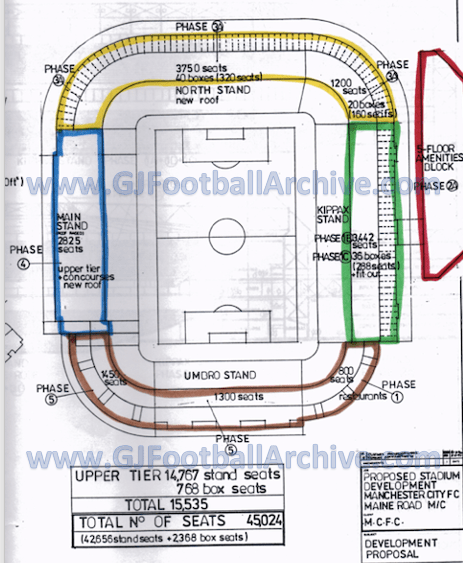
Here’s a 1994 plan of what might have been in terms of Maine Road’s development. This image is of how the entire stadium was supposed to look. To explain the colour image looks towards the stadium from above the Kippax car park. The North Stand is on the right and the Platt Lane on the left. The black and white image is from the other side of the ground, looking towards the Kippax from the Main Stand.

1990s Maine Rd redevelopment plans as seen in Farewell To Maine Road

You can see from the black and white image that the plan was to replicate the general look of the new Kippax (being planned at this stage – this was January 1994 and the old Kippax was still standing) around the ground. The North Stand was to have a second tier added and hospitality boxes between the levels, like the new Kippax. The Platt Lane was to have a second tier added above the two lines of existing hospitality boxes.

The Main Stand would have part of the seating chopped away and a new second tier added.

To facilitate all of this some houses were to be bought and demolished on the streets immediately behind the North Stand and the Kippax/Platt Lane corner.

The new Kippax was the first phase of the development but Manchester’s bids for the Olympics changed thinking. Couple that with relegation in 1996 and the wholesale redevelopment of Maine Road was postponed after the Kippax opened and then dropped completely.

As mentioned previously, Francis Lee’s plans would have seen the new Kippax followed by a phased development of each of the other three stands. These images might give an indication of how it would have progressed.

The following 1971 aerial image shows the proximity of the housing on Thornton Road (bottom left, near number 6) and behind the North Stand (number 10). They were planned to be demolished in Lee’s 1994 plan.

Maine Road aerial 1971 from Farewell To Maine Road

If you’d like to read more on the history of Maine Road, take a look at Farewell To Maine Road, which can be downloaded from this page:

If you enjoy all the free material on my website and would like to support my research and keep this website going (but don’t want to subscribe) then why not make a one-time donation (or buy me a coffee). All support for my research is valued and welcome. It allows me to keep some free material available for all. Thanks.

Choose an amount

£2.50
£5.00
£7.50

Or enter a custom amount

£

Your contribution is appreciated.

Donate

The 1990s: A Goalkeeping Record

On this day (8 May) in 1999 a 4-0 victory over York for Manchester City saw ‘keeper Nicky Weaver equal Joe Corrigan’s record of 22 clean sheets in a League season. Corrigan had set the record in 1976-77 and played 42 League games that season. Weaver was to make 45 League appearances in 1998-99.

You can find out more on the 1998-99 season by reading the following 8000 word article? It’s available to subscribers, so why not subscribe and relive this extraordinary season? As with all these 1990s subscriber features it contains material from interviews I’ve performed with key figures from that time.

Here’s the 4900 word article on that season:

Subscribe to get access

Read more of this content when you subscribe today. It costs £3 per month (cancel anytime) to access everything posted since 1 October 2022 or there’s a special annual rate of £20 a year to access everything posted since the site was created in December 2020. This special rate works out about £1.67 a week and gives access to everything posted, including PDFs of 3 of my books.

If you want to know more on this incredible decade for Manchester City Football Club then why not subscribe and read it all? If you’d like to know more about subscribing then see:

Lowest Crowd

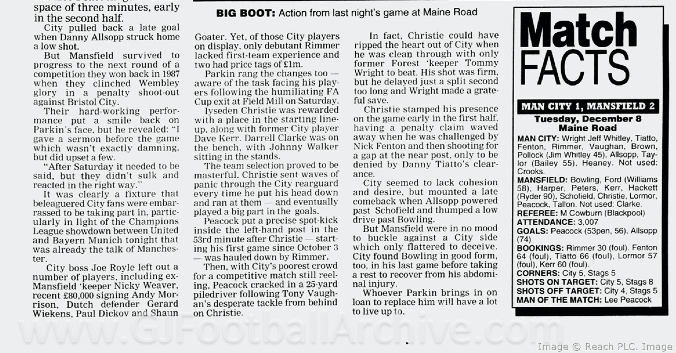
On this day (8 December) in 1998 the infamous Auto Windscreen Shield tie between Manchester City and Mansfield Town took place. It’s okay we can talk about this now that City are treble winners!

It was a competition City did not want to be in and it was a fact known across City’s supporter base. They also knew that a weakened team would be played and, to be frank, we were mostly full of apathy for the competition. The League was the only competition that mattered that season.

For the record future Blue Lee Peacock scored twice for Mansfield – a 53 minute penalty and another three minutes later – before Danny Allsopp scored City’s consolation in the 74th minute. If you want to relive that game (why would you?) here’s a match report from a Mansfield based newspaper:

Andy Morrison Debut

On 31 October 1998 an influential figure in MCFC history made his debut…

Manchester City’s first ever third tier season had been one of struggle so far prompting manager Joe Royle to search for changes. He brought in loan signings Michael Branch and Andy Morrison and they made impressive debuts at home to Colchester. The game had been goalless at half time – and City had been booed off! – but substitute Ian Bishop brought some drive to the team in the second half. In the 49th minute Horlock netted a penalty and four minutes later his corner was headed home by Morrison for a debut day goal. Colchester scored a consolation via Jason Dozzell but it was Morrison who ended the day the happiest. Royle: “Morrison was strong-willed and proved a good passer. And at least we have someone who talks at the back!”  A week later the Blues made Morrison’s move a permanent one, signing him for £80,000.

Morrison continued to impress in the next game, a 3-0 victory over near neighbours Oldham. Kevin Horlock was actually the star man, scoring twice in the first half, with Morrison netting a volley for the third. Royle was happy with the win but not the specifics of the match: “We were nowhere near our best but we scored three terrific goals, had one disallowed, hit the bar and didn’t get a blatant penalty so I can’t be disappointed.”

The Blues were now up to fifth and there was a feeling that a corner had been turned – but the season had many twists to come yet!

Match stats: 31 Oct 1998 Colchester United (H) W 2-1 Horlock (pen), Morrison   Attendance 24,820

Where Were You?

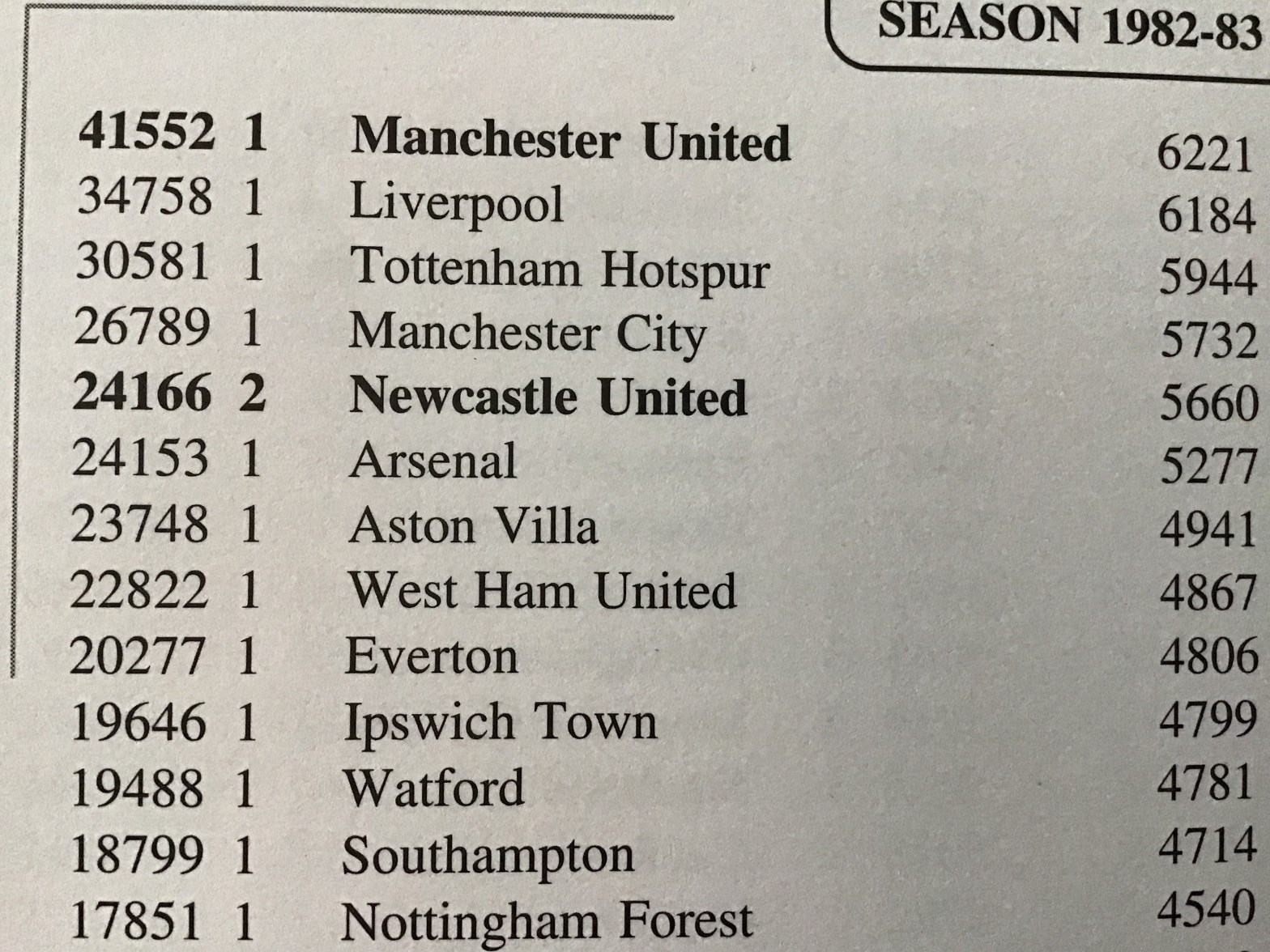
Fairly early on in the game between Manchester City and Arsenal the fans of the London club started to sing the old ‘Where were you when you were…’ chant. You’d think they’d know because often City were attracting better crowds than Arsenal. Let’s look at 1982-83 when I experienced my first relegation as a City fan. Back then City were the 4th best supported club (26,789) and Arsenal were 6th (24,153) – see the average attendance table above. City finished in a relegation position and Arsenal were 10th.

The following season Arsenal did attract a better average than City but they were the 5th best supported club in the entire 4 divisions and City were the 6th. In terms of League position Arsenal were 6th and City were 4th in Division Two.

We could talk about the late 1990s but neither club had a ground that could satisfy the demand to see them, so a sell out Maine Road in 1998-99 for third tier City has to compare with a sell out Highbury for title challenging Arsenal.

Since then stadium size has dictated average support but if we go back to earlier decades and assume that Arsenal’s ‘Where were you when you were sh*t’ refers to City heading towards relegation or being out of the top flight then City’s record is impressive overall. In 1965-66 (the last 2nd division season before the 1980s) City averaged 27,739 (10th best in entire League) while First Division Arsenal were the 9th best supported club on 29,036.

We can jump back even further. In the 1920s Arsenal were perceived as a popular club and in 1925-26 they averaged 31,471 – the 3rd best in the League. Where were City? Oh, City who were relegated that season were the 2nd best supported team with an average of almost 32,000. Not much more than Arsenal but the Gunners were 2nd in the League and City were relegated!

The year after Second Division City were the 3rd best supported club and top flight Arsenal were 4th!

1926-27 Average attendances. Manchester City in Second Division

The year after that (1927-28) Second Division City were the best supported club in the entire League with 37,468. Where were top flight Arsenal? 7th best supported with 27,434.

1927-28 Average attendances. Manchester City were the best supported club despite being in Second Division

It’s all a nonsense but if Arsenal fans, or any other team, want to sing songs like this then it would help if they knew their own history of support.

That day – 25 Years Ago

Today (30 May 2024) is the 25th anniversary of Manchester City’s play off final victory over Gillingham. Rightly, Paul Dickov’s goal in the 1999 Play Off final has often been described as the most important Manchester City goal of all time.  However some also forget about the penalty shoot-out and, before either that or the all-important Dickov goal, came the opening City goal scored by Kevin Horlock.

The late 1990s had been a very difficult period for City and Horlock’s goal came at a moment when all hope that the Club could resurrect itself seemed to have vanished.   This goal was obviously important as it gave City hope and ultimately that transferred into achievement.

The following article, covering Horlock’s goal and the story of that day, is available for subscribers to the website. It costs £20 a year (it works out £1.67 per month) or £3 per month (cancel anytime) and you get full access to all articles posted, including PDFs of the out of print Manchester A Football History and my first ever book about Manchester City. There are also audio interviews & more. Do a few searches on past content to see what’s available. Why not try subscribe on a monthly basis and try it out?  

Subscribe to get access

Read more of this content when you subscribe today.

The 1990s: Crowd Records

Today’s feature in the series covering Manchester City in the 1990s is a reminder of crowd related activities in the 1998-99 season. It was City’s only ever season in the third tier and they were met with capacity crowds throughout the season. These newspaper cuttings are from today (29 March) in 1999 and follow City’s game at Reading on 27th.

The match made the front page of the local paper in Reading. There was no crowd trouble or anything but the remarkable scenes of a full house at Reading made the news. Have a read of these to remember those days when the loyalty of City’s support was often the story.

Here’s an actual report of the game too (from the Reading perspective):

While you’re here, why not read the following 8000 word article? It’s available to subscribers, so why not subscribe and relive this extraordinary season? As with all these 1990s subscriber features it contains material from interviews I’ve performed with key figures from that time.

Here’s the 4900 word article on that season:

Subscribe to get access – Monthly

Read more of this content when you subscribe today. It costs £3 per month (cancel anytime) to access everything posted since 1 October 2022 or there’s a special annual rate below which gives greater access and works out much cheaper.

Subscribe to get access – Annual

Read more of this content when you subscribe today. It costs £3 per month (above) or £20 a year (here) to access everything posted since the site was created in December 2020. This special rate works out about £1.67 a week and gives access to everything posted, including PDFs of 3 of my books.

This series of articles and features will run throughout March with indepth articles some days and smaller ‘on this day’ style posts on others. There will be flashbacks to great games, players and more. Every day in March will offer something to enjoy.

Subscribers will get access to everything, while some on this day material will be free for all to view.

If you want to know more on this incredible decade for Manchester City Football Club then why not subscribe and read it all? If you’d like to know more about subscribing then see: