It seems appropriate in the week that Tony Book died that I write an article highlighting how significant Tony was as a player.
As a player Tony was a hugely successful captain with Manchester City during the Mercer-Allison period. He was undoubtedly a key figure in each of City’s trophy successes during the seasons 1967 to 1970, and was regarded by many at the time as the greatest ever captain to have appeared for the Blues. Certainly his record of trophy success placed him some way ahead of all earlier captains. His trophy record has been eclipsed of course but do not let that downplay anything of what he achieved. Few in the game had ever achieved what he had. It’s even more remarkable when you consider his age when he arrived at Maine Road.
Book joined the Blues in July 1966 for £17,000 after a relatively brief League career with Plymouth Argyle. The transfer was one that saw Malcolm Allison use all his skills to persuade City boss Joe Mercer to take a gamble.
Allison had been a fan of Book’s ever since their days together at Bath City and the City coach explained the player’s strengths to Mercer. It should be remembered that Book had only made his League debut a month before his 30th birthday. Mercer, remembering how his own career had been given a new lease of life at a similar age, backed Allison’s judgement, and the Tony Book fairy tale began.
Within weeks, Book was considered to be one of the driving forces on the pitch at City. The following cutting is from the end of August 1966 and mentions him:
Inevitably, Book played a major part in each City trophy success following his arrival at Maine Road, but he was also voted FWA Footballer of the Year (held jointly with Derby’s Dave Mackay) in 1969. It was a fitting award and said much about what made Manchester City tick – potentially he should have been awarded it in 1968 but there are several stories about that season’s award which we’ll save for another day.
Alan Jubb’s photo of Tony Book with League Championship trophy, 1968
Had the FWA award been given to one of City’s more familiar names – Bell, Lee or Summerbee – then that would of course have been a great honour, but going to Book proved that the side was more about teamwork than about individuality. Book was City’s influential captain. He did more than most to bring glory to the Blues.
People often overlook what happened when he was missing from the team. After winning the title in 1968 Book was injured during the close season and ended up missing the opening 25 League games, plus City’s first European Cup tie. It is significant that during his absence City struggled to find consistency both in the league and the other competitions. Once he returned to the side the Blues powered their way to FA Cup glory. It makes me wonder what would have happened that season had he been fit from the start. He ended that season after playing only 21 League and FA Cup games – and was still judged FWA Footballer of the Year! What an achievement.
1969 MCFC
Tony eventually moved into coaching and, once his playing days came to an end, he developed a new career as an inspirational coach and manager. I’ll talk about that another day.
It cannot be stressed highly enough that Tony Book’s position in City’s history is a significant one. He was a tremendous player, inspiring coach, and a loyal club servant. His time as a player was one of significant achievement, with him taking the lead for most of his playing days. His time as manager was also, without doubt, one of the most exciting periods in the club’s history. He brought major success and allowed City to challenge the near-dominant Liverpool. It wasn’t until the arrival of Roberto Mancini that a City manager found major trophy success again.
If you enjoy all the free material on my website and would like to support my research and keep this website going (but don’t want to subscribe) then why not make a one-time donation (or buy me a coffee). All support for my research is valued and welcome. It allows me to keep some free material available for all. Thanks.
I’ve just heard the news that Manchester City’s legendary captain and manager Tony Book has died. I’ve met Tony many times over the decades and it’s difficult to put into words how significant he remains in City’s history. My thoughts are with his family and close friends. I last saw Tony at the former players dinner a few months back. To commemorate his life here’s a profile of him I wrote only a few months ago.
Tony was of course a major footballing star of the 60s and early 70s. It seems appropriate today to highlight some of his achievements with quotes here from interviews I’ve performed over the years.
Tony arrived at Maine Road in 1966 and captained Manchester City to phenomenal success. When he arrived at City Book he was in his thirties: “I hoped I’d get a couple of years and I would have been very happy with two years at City, of course. Because of what happened and the way the success came in my second year, I felt I could go on again. Winning the League in 1968 was like a spark and I wanted to keep the flame going.”
Book lifted more trophies as captain than any other Blue, until the incredible success experienced during Vincent Kompany’s time. Back in 2015-16 as Kompany was nearing Book’s record, Book told me: “Next time he lifts a major trophy he’ll have matched my record as captain. I hope that success comes soon, and that he then goes on to pass my record this season.”
His time as captain and player was incredible and this was a golden era for City. What is often overlooked though is Tony’s contribution as a manager. In 1973-74 he became manager of City for the final month of the season – a spell that was noteworthy for the infamous Manchester derby when Denis Law netted against United in the Reds’ relegation match. In the years that followed, Book developed a squad of real talent, blending well-regarded internationals with enthusiastic youth to create a flamboyant and entertaining team.
Book’s second full season saw his team of entertainers annihilate United 4-0 in the 4th round of the League Cup – on a night remembered more for the devastating injury to Colin Bell – and progress to the competition’s final where they defeated Newcastle 2-1. The victory meant Book was the first man to win the trophy as a player and as a manager. He said at the time: “Two weeks ago I met Gordon Lee (Newcastle manager) and we agreed that whoever won, it was more important for us to provide a good final. I think we have done that. This was my greatest moment. It was a tremendous final and Tueart’s goal was something special… quite out of this world.”
Looking back on 1976 Book believes the key to the success lay in City’s preparation: “We wanted everything to be low key and travelled down early in the week. We did simple training and tried to build an environment around us that was positive. It worked well and by the day of the final we were ready.”
City were missing Kenny Clements, and Colin Bell was still out of action, causing Book to bring youngster Ged Keegan in. There had been media talk that Keegan and another youngster, Peter Barnes, would feel the pressure but Book felt differently: “I had total faith in my lads. Barnes scored the first – in a move that we’d worked on in training – and Keegan more than justified his place. I never had a doubt.”
Book managed City through one of the club’s most exciting periods: “As a manager I was proud that in five years we won the League Cup; finished runners up by a point to Liverpool; we were in Europe for three consecutive seasons; and we reached the quarter-finals of the UEFA Cup. I had some good players that came in – Dave Watson, Brian Kidd, Joe Royle, Asa Hartford – and did an excellent job for me.”
City fans loved what he had brought the club and at the 1976 League Cup homecoming they chanted ‘Tony, Tony’ repeatedly for some time. At various film shows over the last decade I’ve shown (together with Will McTaggart from the North West Film Archive) a rediscovered film of the homecoming parade which shows exactly what the success meant to the City boss: “I wanted to win the League Cup for them and I remember looking out over the crowd in Albert Square. They were celebrating and singing. Everything we did was for the fans. These fans have been so loyal over the years and they had made me so welcome when I arrived in 1966. Such a special club and wonderful fans. They deserved that success – and so many more for the way they stood by this club during the painful years that came later.”
Almost sixty years after he first arrived at City, Tony Book remained a regular and popular presence around the club: “I love this club and am grateful to all those who brought me here and involved me for so long. Whenever I’ve been given a job to do I’ve always tried to give my best.”
Book certainly represents all that is good about football and he is a powerful reminder of the successes Manchester City achieved during his captaincy and as manager.
Today (24 November) in 1973 new Manchester City chairman Peter Swales appointed Ron Saunders as the club’s new manager. He didn’t last the season! You can read about both the appointment and the sacking in this 1,700 word article on the 1973-74 season – a season which included a Wembley final, multiple managerial changes and a controversial Manchester Derby at Old Trafford! You can read this below. Enjoy!
Subscribe to get access
Read more of this content when you subscribe today. It costs £3 per month or £20 a year to access everything. The site was created in December 2020. This special annual rate works out about £1.67 a week and gives access to everything posted, including PDFs of 3 of my books.
If you enjoy all the free material on my website and would like to support my research and keep this website going (but don’t want to subscribe) then why not make a one-time donation (or buy me a coffee). All support for my research is valued and welcome. It allows me to keep some free material available for all. Thanks.
On 30 October in 1973 The second round League Cup tie between Manchester City and Walsall went to a second replay. City won the game 4-0 with a hat-trick for Francis Lee, but a pitiful crowd of 13,646 witnessed the match at Old Trafford. City fans didn’t mind playing a 2nd replay, but they did object to it being played at United’s ground.
If you’d like to support my research then why not subscribe? Every subscription directly helps support my research and provides annual subscribers with access to everything posted on this site, including the entire Manchester A Football History and From Maine Men To Banana Citizens books, plus interviews, articles and more. I am not employed by anyone and all my research is self funded or comes from subscriptions to this site.
If you enjoy all the free material on my website and would like to support my research and keep this website going (but don’t want to subscribe) then why not make a one-time donation (or buy me a coffee). All support for my research is valued and welcome. It allows me to keep some free material available for all. Thanks.
On this day (5 October) in 1973 Peter Swales became Manchester City’s chairman. There was an initial positive blip but after that it was more or less downhill all the way for City. Bad times!
In 1977 the BBC in the northwest showed the following incredible profile of him. On several occasions over the last decade or so myself & Will McTaggart have included this video profile of MCFC chairman Peter Swales in our Boys In Blue film show. Each time those who missed it have asked if they could see a video of it. That wasn’t possible for years but now it is. You can see the Swales profile here…
I would urge all MCFC fans and others to watch this. Some of you may wish to jump to the David Brent-esque clip at 3 mins 20. Others may want to see the Ian Niven roof plan that was thwarted by signing Dave Watson at 1 min 45 secs. Then there’s the scene where Swales gives Watson financial advice (45 secs) and it ends with Swales telling us he was a bit like Kevin Keegan (4 mins).
The postponement of any game is rare. Obviously, the 2019-20 Covid hit season was different and in the days before undersoil heating icy conditions would often lead to postponements. However, Manchester City have suffered many postponements over the years. So for today’s feature I’m talking a look at some of them.
This is available to subscribers. Why not subscribe for a month and see what you think?
Subscribe to get access
Read more of this content when you subscribe today. It costs £3 per month or join up for a year at the discounted rate of £20. See link below for details.
On this day (4 September) in 1934 Tony Book was born. Happy 90th birthday Tony! Tony was of course a major footballing star of the 60s and early 70s. It seems appropriate today to highlight some of his achievements with quotes here from interviews I’ve performed over the years. Enjoy!
Tony arrived at Maine Road in 1966 and captained Manchester City to phenomenal success. When he arrived at City Book he was in his thirties: “I hoped I’d get a couple of years and I would have been very happy with two years at City, of course. Because of what happened and the way the success came in my second year, I felt I could go on again. Winning the League in 1968 was like a spark and I wanted to keep the flame going.”
Book lifted more trophies as captain than any other Blue, until the incredible success experienced during Vincent Kompany’s time. Back in 2015-16 as Kompany was nearing Book’s record, Book told me: “Next time he lifts a major trophy he’ll have matched my record as captain. I hope that success comes soon, and that he then goes on to pass my record this season.”
His time as captain and player was incredible and this was a golden era for City. What is often overlooked though is Tony’s contribution as a manager. In 1973-74 he became manager of City for the final month of the season – a spell that was noteworthy for the infamous Manchester derby when Denis Law netted against United in the Reds’ relegation match. In the years that followed, Book developed a squad of real talent, blending well-regarded internationals with enthusiastic youth to create a flamboyant and entertaining team.
Book’s second full season saw his team of entertainers annihilate United 4-0 in the 4th round of the League Cup – on a night remembered more for the devastating injury to Colin Bell – and progress to the competition’s final where they defeated Newcastle 2-1. The victory meant Book was the first man to win the trophy as a player and as a manager. He said at the time: “Two weeks ago I met Gordon Lee (Newcastle manager) and we agreed that whoever won, it was more important for us to provide a good final. I think we have done that. This was my greatest moment. It was a tremendous final and Tueart’s goal was something special… quite out of this world.”
Looking back on 1976 Book believes the key to the success lay in City’s preparation: “We wanted everything to be low key and travelled down early in the week. We did simple training and tried to build an environment around us that was positive. It worked well and by the day of the final we were ready.”
City were missing Kenny Clements, and Colin Bell was still out of action, causing Book to bring youngster Ged Keegan in. There had been media talk that Keegan and another youngster, Peter Barnes, would feel the pressure but Book felt differently: “I had total faith in my lads. Barnes scored the first – in a move that we’d worked on in training – and Keegan more than justified his place. I never had a doubt.”
Book managed City through one of the club’s most exciting periods: “As a manager I was proud that in five years we won the League Cup; finished runners up by a point to Liverpool; we were in Europe for three consecutive seasons; and we reached the quarter-finals of the UEFA Cup. I had some good players that came in – Dave Watson, Brian Kidd, Joe Royle, Asa Hartford – and did an excellent job for me.”
City fans loved what he had brought the club and at the 1976 League Cup homecoming they chanted ‘Tony, Tony’ repeatedly for some time. At various film shows over the last decade I’ve shown (together with Will McTaggart from the North West Film Archive) a rediscovered film of the homecoming parade which shows exactly what the success meant to the City boss: “I wanted to win the League Cup for them and I remember looking out over the crowd in Albert Square. They were celebrating and singing. Everything we did was for the fans. These fans have been so loyal over the years and they had made me so welcome when I arrived in 1966. Such a special club and wonderful fans. They deserved that success – and so many more for the way they stood by this club during the painful years that came later.”
Almost sixty years after he first arrived at City, Tony Book is still a regular and popular presence around the club: “I love this club and am grateful to all those who brought me here and involved me for so long. Whenever I’ve been given a job to do I’ve always tried to give my best.”
Book certainly represents all that is good about football and he is a powerful reminder of the successes Manchester City achieved during his captaincy and as manager.
While you’re here why not read other content. There are plenty of free articles here but also there are many, many more only available to subscribers. Subscribers have access to everything. You could even subscribe for a month and see what you think. The following 1,700 word article is on the 1973-74 season and is available to subscribers below. Enjoy!
Subscribe to get access – Monthly
Read more of this content when you subscribe today. It costs £3 per month (cancel anytime) to access everything posted since 1 October 2022 or there’s a special annual rate below which gives greater access and works out much cheaper.
Read more of this content when you subscribe today. It costs £3 per month (above) or £20 a year (here) to access everything posted since the site was created in December 2020. This special rate works out about £1.67 a week and gives access to everything posted, including PDFs of 3 of my books.
If you enjoy all the free material on my website and would like to support my research and keep this website going (but don’t want to subscribe) then why not make a one-time donation (or buy me a coffee). All support for my research is valued and welcome. It allows me to keep some free material available for all. Thanks.
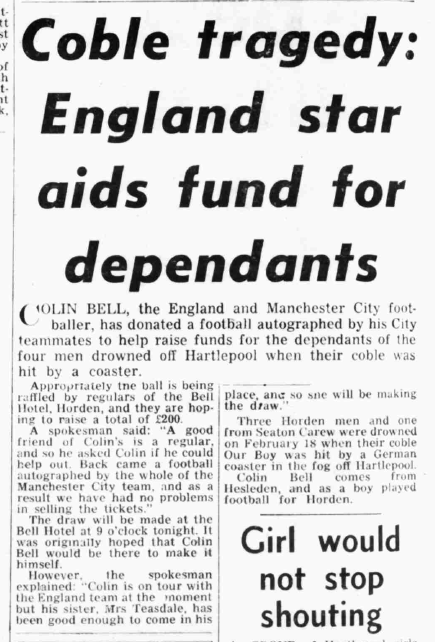
These days most football clubs have community and charity connections with staff determining whether a worthy cause fits with the club’s plans. If letters are sent to players asking for support then these quite often are handled by other personnel. Back in the 1970s things were different.
On 31 May 1974 this article appeared in a newspaper in the north east following a tragedy at sea. A letter had been sent to Colin Bell asking if he could help raise funds for the dependents of four men drowned in the tragedy. Not only did Colin reply, but he sent a signed football and arranged for his sister to attend the fundraising draw. He had hoped to be there himself but he was on international duty.
For Colin, replying to supporter or charity letters like this was something that mattered.
Today (29 April 2024) marks the 80th anniversary of Francis Lee’s birth. I met Francis a lot over they years and interviewed him frequently. So, to mark this anniversary, here’s an interview I did with him at his home in February 2010. This was published in the City match programme back then and you can read Franny’s views on his career here as published at the time. Enjoy!
In a glittering career Francis won two League Championships, the ECWC, League Cup and the FA Cup.
Francis, let’s begin with your early career at Bolton. Is it true you started on the groundstaff?
That’s right. I set myself a target that I had to get into the first team by the time I was 17 or 18. If I didn’t I was going to go back to college and train as a draughtsman. That was my plan, but I managed to get into the first team at 16 and I made my debut against City (5/11/60). We won 3-1 and I scored a header at 3.15 against Bert Trautmann – I think Bert must have thought he was getting over the hill for me to score a header past him!
I had about a dozen games over two seasons, then in 1962-63 I was top scorer with 12 goals from 23 League games.
You topped the goalscoring charts each season at Bolton from 1962 until you left. You were playing on the wing. Was that your preferred position?
I think my best position was as support striker to a big fella. I only played in that role twice really – at Bolton with Wyn Davies when I scored 23 League goals one season and then at City with Wyn again when I scored 33 League goals in 1971-72. A lot of my career was spent at centre-forward which is a bit of a difficult position to play if you’re only 5ft 7. When I played for England I was support to Geoff Hurst and that suited me. At centre-forward I had my back to the ball but when I was support striker – the free player – that suited me fine. I could pick up the ball going forward and that was great.
At Bolton you scored 106 goals in 210 appearances. A great record, but when you left the club the stories were that you were in dispute. Is that true?
Well, what happened is that we were relegated in 1964 and, despite a near-miss in 1965 when we finished third, it didn’t feel as if we were going forward. My ambition was still to see how far I could develop in the game and in the back of my mind I had the ambition to play for England, but I wasn’t even selected for the under 23s. The story was going around that I was difficult to handle – which is funny because Joe Mercer said that I was the easiest player to handle at one point.
Were you difficult to handle at Bolton?
I was opinionated and ambitious, but not difficult. I think that message was going around because I was on a weekly contract at that time. The club knew that it would be difficult for them to stop me moving on if another club came in. So any player with a reputation for being difficult would not be on anyone else’s shopping list, would they? Bolton offered me a new contract worth something like £150 a week but my wage was only £35. That actually upset me and I said: “if you now think I’m worth £150 a week what about all those years you’ve been underpaying me?” It wasn’t the money that was an issue it was the way they handled it. What they were doing was trying to get me on that contract and then my value would increase if someone came in to buy me. Once they saw how dissatisfied I was with the way they were handling it, they said that it’d be best if we made a clean break, and so I said I’d pack the game in. I had my business by then and so I said: “give me my employment cards and I’ll pack it in.” They thought I was bluffing.
It’d been a decent season – I’d scored 9 goals in 11 games including when we beat the great Liverpool side in the League Cup – but then it ended in September 1967. They gave me my cards and that was it.
Were you absolutely certain you’d pack it all in at that point?
I kept myself fit but I was working on my business. I was driving my lorry around, collecting the waste paper and so on. The business was growing and I felt that if I wasn’t wanted then I’d concentrate on that. It was always my fallback.
I know how stories can get exaggerated over the years, but is it true that in between games you were going around collecting the waste paper?
I used to drive my lorry during the week and even on the Thursday or Friday before a game I’d be collecting waste paper. I used to put on a flat cap and muffler so that nobody would recognise me! In the end I was driving articulated lorries and it was getting to be a very good business. My last pick up was the day before I signed for City! I roped and sheeted about 15 ton of paper and cardboard from a spinning mill in Bolton. Took it to the Sun Paper Mill in Blackburn and when I got back about 5pm I got a call from Joe Mercer. He didn’t give his name at first but I recognised him. “Who is that?” He said: “Tom Jones.” I said: “It doesn’t sound like Tom Jones, sounds more like a man called Mercer!” and he asked: “Where’ve you been?” I told him I’d been playing golf – I couldn’t play the game at all then but I couldn’t tell him what I had been doing!
This is Your Life Joe Mercer 1970 MCFC squad
Did you immediately want to sign for City?
Other teams had shown interest in signing me. Liverpool offered £100,000 I understand but then when I wasn’t playing it affected my price. In later years Shanks often used to grab me and say in that strong Scottish accent: “Son, I should’ve signed ya the night I saw ya!”
City was just right of course. It meant the business could carry on. I don’t know if Bolton had told Joe about my contract or the £150 offer but the first thing he said to me before we talked it through was: “I’ll be honest with you son. We’ve no money. We’re skint!” I said: “It doesn’t matter. I’ll just be delighted to start playing again.” I meant it as well.
I signed for City for £60 a week – remember I’d turned down £150 at Bolton! But it was well worth it. The way the team developed and, of course, when I realised my ambition and played for England.
I left a lot of friends of mine at Bolton – Freddie Hill, Tommy Banks, Roy Hartle, Gordon Taylor – and we had some great times. Those of us who had come through the ranks were poorly paid for the job we were doing at the time, but we enjoyed ourselves. I never had any argument with the players, fans or people at Bolton, it was just those that ran it. I loved my time at Bolton.
When you joined City the Blues were ninth in Division One after losing 5 of the 11 games played. But the side was transformed from the moment you came. Unbeaten in your first 11 League games. Were you the difference?
The team just clicked and I was only part of a good group of players. We had that great run up to Christmas, then a bit of a blip, but in the New Year we just rattled on. It was a terrific period. Mike Summerbee was playing at centre-forward and our culture at the time was to play with five forwards. It was very unusual for the time. The only system we played was that we all played – we had ten players who went up together, and ten who defended together. When we won the League at Newcastle at the end of the season it was wonderful and particularly special because none of us had ever won anything significant. This was our first major success and that’s why the following season the ordeal of playing a European Cup tie was so tough.
Francis Lee after scoring at Newcastle
Was it just inexperience that caused City to lose the Fenerbahce European Cup tie 2-1 on aggregate?
None of us had played in Europe before. Mike Summerbee had only made his England debut against Scotland in February 1968. Colin Bell had played in two England friendlies, but apart from that none of us had any concept of what it could be like in Turkey. Had we played the first leg in Istanbul and the second at Maine Road I think we’d have gone through, but the goalless 1st leg at Maine Road killed us really. We worked hard in Istanbul and it was a creditable result over there but we were out and it was because we were inexperienced. It was a culture shock.
Confidence was at a real low after that game. We’d had a bad run and only had a small squad so we struggled. But that was the way it was. Back then the motivation for all of us was to be in the team and to keep your place.
I think younger readers may be surprised to read that City tried to keep the same eleven players game after game, competition after competition. Would you have enjoyed a squad rotation policy when you played?
The aim of a footballer is to play. Why would anyone want to be rested? If a manager had said to me ten minutes before full time that he wanted to bring me off even though I was playing well, I’d have told him “no way! I’m enjoying myself. This is what you bought me for, now let me do it!” It wouldn’t matter what the manager says I’d want to stay on. That’s what the game is about – enjoyment! Every player wanted to play. None of us wanted to be on the bench.
People talk about the number of games played today but in 1969-70, ignoring friendlies, you played 72 competitive games for England and City. Would squad rotation have helped?
No. Playing is always better than being on the training pitch and I used to love playing, so I tried not to miss a game. It didn’t matter whether it was an England friendly, Anglo-Italian cup or whatever, I wanted to play and represent my club and my country. I think it’s best for all players. Look at Tevez. He’s improved his fitness and form by playing, and I think a lot of players are like that. He needs to play, and that’s what I always wanted.
Some of the other players from the 1969-70 season have talked about Franny’s Grand Slam. Your aim to win four trophies in one season inspired them. What do you remember of that?
Well, we wanted to win every game so it seemed natural to me that we should go for all four. We won the League Cup and Cup Winners’ Cup, so that wasn’t bad. In the FA Cup we ended up suffering a rare defeat at United. We were doing okay in the League then we had a few injuries – Mike, Colin Bell and Neil Young were injured at key times – otherwise I think we would have won three trophies. But the thing about the ‘Grand Slam’ was that it was the ambition of the place. I remember we were going to London on the train and could see Wembley, and I shouted to the lads to take a look because two of our ‘Grand Slam’ games would be played there!
1970 ECWC
Moving forward a couple of years, we missed the title by a point in 1972. Why?
Rodney Marsh has told you himself that his signing affected the 1971-72 season. Malcolm played Rodney and disrupted a team that I’m convinced would have won the League that year. I don’t blame Rodney. There was one game near the end where we should have had a couple of penalties for hand ball but, because this was the season when we got that record number of penalties, they weren’t given. That season our luck changed and everything went against us.
A lot has been made about you ‘diving’ but the factual evidence is that the majority of those penalties were given for things like handball or fouls on other players. Nevertheless, the myths survive. So, big question, did you ever dive?
I couldn’t say that I always stayed on my feet unless I was absolutely knocked down. In those days you used to get some horrendous treatment by the defenders, but I will tell you that the season before those penalties we only had a couple, and before that I think it was one. The reason we got so many in 1971-72 is that they had changed the law, plus we were going for the title so we were putting sides under a lot of pressure and they reacted. I was fouled only 5 times out of the 13 league penalties we got.
When I was attacking I used to play the odds. If a defender was coming towards me I’d carry on, or I’d run towards the defender because there were only three things that could happen – he pulls me down, he gets the ball off me – well done, or I get a cracking shot at goal. So the odds were in my favour. You have to play them.
I think the reason people go on about penalties with me is because I was the one taking them. It didn’t seem to matter what they were given for, the headlines were that I had scored from a penalty. The season after I think we only got one penalty. I would say that for every dubious penalty that was awarded there were another twenty that we should have had.
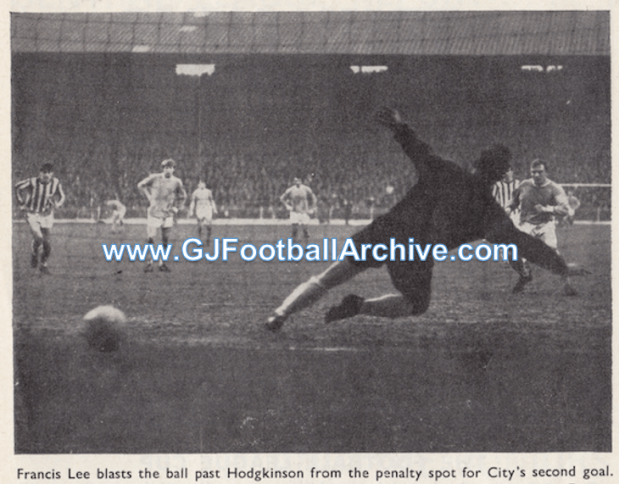
Francis Lee’s first penalty for City January 1968 v Sheffield United
Was the move to Derby something you really wanted?
By that time my business was substantial so going to Derby was going to cause problems. Derby offered City more than anyone else and that was that. We won the title in my first season – I’d only signed a contract for a year – and they were a very good side, so I stayed with them for another season. The pitch was awful – even Maine Road’s pitch was better – but I felt we could have won the European Cup that second season. We beat Real Madrid 4-1 but I missed the return game because I’d been sent off in the Hunter incident against Leeds. We lost 5-1.
They actually changed the rule after that saying it was unfair to automatically ban a player from a European game after a domestic match when the player had yet to be proved to be guilty. There wasn’t much chance of me being ‘not guilty’ – the footage was there for everyone to see!
People often suggest that City sold you too soon and that had you stayed a couple of seasons longer we might have won the title again. Do you hold this view?
I think if I’d have stayed and Mike Summerbee – remember he was sold a year after me – then I do think we’d have mounted a serious challenge for the title. Mike had plenty to offer and should not have been sold.
You came back to Maine Road and scored for Derby (28/12/74). I was in Platt Lane that day and I remember a surreal moment when City fans cheered your goal. Did that actually happen?
Yes, it did. Then I think they thought: “What have we done, he’s playing for them!”
I enjoyed my football and I loved scoring. I loved that goal. I picked it up with my back to the line, went through two people and on to score the goal. The film shows me smiling because I’d scored what I thought was a good goal. It had nothing to do with City or revenge or anything like that. I think I enjoyed about 95% of every game I ever played. It was fun. A great way to earn a living, so on that day I was happy.
Why did you retire in 1976 only a few weeks after your 32nd birthday?
My business was taking over. I had about 110 people working for me and was travelling all over the country. Had I been playing closer to Bolton then I may have carried on. Derby wanted me to stay on, and I made a promise to Dave Mackay that if I was to play again then I’d do it for him. Tommy Docherty tried to persuade me to join United but I wouldn’t break my promise to Derby.
Your business and horse racing interests grew, but then in 1993 you were back, mounting a takeover of City. Why?
I wasn’t looking to get back into the game at all during those years. I had a successful career and was happy. But City were in a desperate state and I genuinely felt that I could not let a club I cared passionately for struggle like that.
When we finally gained control there were so many issues. So many skeletons coming out of the cupboards. The financial state of the club was appalling. I should have known then that it wouldn’t work!
The biggest problem at the start was having to build the new Kippax Stand –there really wasn’t a workable plan in place before we arrived and yet the stand had to be replaced within months of us arriving. We ended up spending about £16m in the end – even removing the waste from underneath the old terracing cost £1.8m because it was contaminated. I thought then that my luck had changed. Everything we tried to do became an issue and the Kippax was a millstone.
1994-95 the new Kippax takes shape
It’s extraordinary when you think that prior to us, Blackburn and Everton, no one ever put money into a football club. People bought shares but never invested, we did invest.
Off the pitch things did improve significantly, but on the pitch we struggled. What’s your view?
People like John Dunkerley worked very hard during that spell and the training facilities were improved and so on. Then, just when we finished the Kippax, Manchester Council started to talk to me about becoming tenants of the new stadium – now that turned out to be the best thing that happened to City during the decade that followed. We spent a lot of time working with them and talking with various people to make it happen. Full marks must go to the Council for having the foresight and it became very important for City to become anchor tenants. I think I had a lot of bad luck as Chairman and things certainly didn’t work on the pitch, but I do think that was one thing that the club got right.
Finally, thinking of your time as a player, many people claim the 1970 League Cup Final was your greatest City game, do you feel that?
I don’t think of individual games in that way. You have to look at the club during your time there and see what that club won and what you contributed to the overall success of the club, not necessarily individual games.
1970 League Cup final. Francis Lee facing ball and Glyn Pardoe
My role was to make things happen, and if I was making things happen, especially if it was causing some aggravation for the opposition, then I was happy. When you hear the opposition players shouting things like: “don’t let him turn!” that’s a real pat on the back. You know you’re getting to them.
In terms of individual games or goals… I think one of the goals I scored at West Ham (18/11/67) was the best goal I’ve ever scored. I was playing against Bobby Moore and I think I had a fantastic game.
I always think that a top class player should go on to the pitch and have enough confidence in his own ability to know that it is very rare for him to have a bad game. It’s not arrogance or anything, but it is the mark of a top class player. If you go onto the pitch feeling that then more often than not you will have a good game. The next step is to take it up the levels until you walk on to the pitch believing you’ll have a great game and score a couple of goals.
At City most of us developed that confidence and on some days, when the entire team was at that level, we had some tremendous games. There are signs that the current side are heading in that same direction.
You can read more on Francis throughout the website. Use the Francis Lee tab lower down on this page or search using his name. As an example, here’s a detailed profile of him I wrote a few years back:
Subscribe to access great content and support Gary’s research
If you’ve enjoyed this piece then why not subscribe and read the rest of the great material on here. At the same time you’ll be supporting my research and writing (I’m not employed by anyone and my research/writing is self-funded). It costs £3 per month (here; access everything posted since 1 October 2022) or £20 per year (below; access everything posted since December 2020). You’ll also get to read all content posted during your subscription. Thanks.
Subscribe to access great content and support Gary’s research
If you’ve enjoyed this piece then why not subscribe and read the rest of the great material on here. At the same time you’ll be supporting my research and writing (I’m not employed by anyone and my research/writing is self-funded). It costs £3 per month (above) or £20 per year (here; access everything posted since December 2020). You’ll also get to read all content posted during your subscription. Thanks.
Here’s an interesting article from today (18 February) in 1974 which tells the story of FH Drabble & Sons, Tansley, Matlock. Who? Well look at these wonderful shirts from the 1974 League Cup final – They were that colourful because of Drabble! So who was Drabble & Sons? Read on…
This was an important company in the production of football shirts and they dyed shirts for Manchester City, Wolves and many international teams. In essence, if you had an Umbro shirt (or another British manufacturer prior to the late 1970s) then there’s a good chance it was dyed at their works.
I’ve been interested in football kit production for many, many years and spent some great time about twenty years ago with Umbro people going through collections and spotting unique work etc. There are a lot of people interested in kits today and, rightly so, they define great eras and often show football clubs at their best. Think of a great team and no doubt you’ll remember the style of kit worn.
One area that is often overlooked though is the actual process of kit manufacture, especially the dyeing. This is odd seeing as it’s so often the colour, especially for teams wearing unique or rare colours (I see MCFC as one of these – other clubs have copied City’s blue but for MCFC this colour or a shade of it goes back to their days as Ardwick when they wore ‘quartered’ shirts of pale blue and white), that is the brand or identity as far as many of us are concerned.
Ah well, I could go on for hours, but have a read of this. Sadly, Drabble’s dye works was derelicht by the 2000s. Maybe polyester football shirts/overseas production put an end to their operation. Did you work at Drabbles? Any memories of their football related dyeing?
This series of articles and features on Manchester City in the 1970s has been running throughout January with indepth articles some days and smaller ‘on this day’ style posts on others. Every day in January will offer something to enjoy.
Subscribers will get access to everything. If you want to know more on this incredible decade for Manchester City Football Club then why not subscribe and read it all? You could even subscribe for a month and see what you think. The following 1,700 word article is on the 1973-74 season and is available to subscribers below. Enjoy!
Subscribe to get access – Monthly
Read more of this content when you subscribe today. It costs £3 per month (cancel anytime) to access everything posted since 1 October 2022 or there’s a special annual rate below which gives greater access and works out much cheaper.
Read more of this content when you subscribe today. It costs £3 per month (above) or £20 a year (here) to access everything posted since the site was created in December 2020. This special rate works out about £1.67 a week and gives access to everything posted, including PDFs of 3 of my books.
If you enjoy all the free material on my website and would like to support my research and keep this website going (but don’t want to subscribe) then why not make a one-time donation (or buy me a coffee). All support for my research is valued and welcome. It allows me to keep some free material available for all. Thanks.







 Gary James' Football Archive