A few years back I set myself the task of trying to find connections from the Manchester City’s first competitive game in 1890 through to the Premier League successes of today.
The idea was to see how few players I could find to form a chain through the decades. It was an interesting idea linking today’s Manchester City with the key players of the past and so can you work out how many players were included in this chain? The idea was that each player had to have played alongside the next one on the list and also the previous one.
Can you work out how many players and also can you provide your own chain, naming players that fit the criteria?
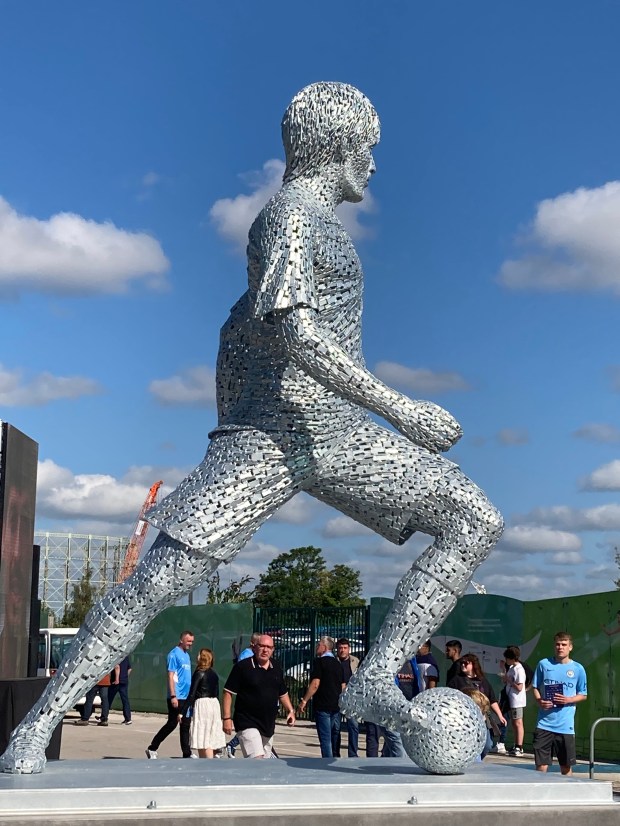
Subscribers can read the smallest number I found to make this chain and who they are below (there is a clue in the photo – the goalscorer is the final player in my chain):
Subscribe to get access
Read more of this content and all the other 370+ articles posted so far when you subscribe today.
So far I’ve told you about the eleven players selected for my all-time best Manchester City FA Cup final winning team and today it’s the time for the manager.
I was asked to select an all-time City eleven and had two rules – they had to actually play in a winning final (so, unused substitutes were not allowed) and they could not be a member of the current playing squad. I also tried to focus on the fact that this eleven would also be facing an all time Manchester United eleven. Therefore victories over United in key games were always in the back of my mind.
For the manager I could select anyone who had managed the Blues in a FA Cup winning final. It was tough because of the wonderfully talented and inspirational leaders the club has had, starting with Tom Maley in 1904. In the end I went for:
Manager Pep Guardiola (since 2016)
Imagine this talented team being guided by this inspirational coach! A tactical innovator he would love the versatility of this team with attack-minded defenders, a hugely talented midfield and some of the best goalscorers the FA Cup has ever seen. Forward-thinking 1960s coach Malcolm Allison would be enthralled watching him in action.
I have no idea how many of you read the article in the FA Cup final but another writer picked the United all-time FAC eleven. When comparing the two I’m convinced my 11 would easily defeat United’s. Maybe I should post that and see what you all think?
So far I’ve told you about Bert Trautmann, Tony Book, Glyn Pardoe, Vincent Kompany, İlkay Gündoğan, David Silva, Billy Meredith, Colin Bell and Fred Tilson in my all-time best Manchester City FA Cup final winning team and today it’s the time for the final couple of names.
I was asked to select an all-time City eleven and had two rules – they had to actually play in a winning final (so, unused substitutes were not allowed) and they could not be a member of the current playing squad. I also tried to focus on the fact that this eleven would also be facing an all time Manchester United eleven. Therefore victories over United in key games were always in the back of my mind.
The final two players selected are heroes from the 1969 and 2011 finals:
Neil Young (1961-1972)
A Mancunian who scored the only goal of the 1969 final – a trademark left foot shot past Peter Shilton – and followed this with the opening goal in City’s first European trophy success the following season. The leading goalscorer during the 1967-68 title winning season, Young played in a variety of attacking roles, always contributing goals.
1971 ECWC v Chelsea North Stand being built but used for terracing. Neil Young. Photo by Alan Jubb.
There are lots of articles that mention Neil Young on this site. You can read some here:
Bustling, powerful and rampaging, the African Footballer of the Year was goal scorer in the 2011 FA Cup semi against United and that season’s final too. This versatile midfielder can play a holding role or play box-to-box, adding many options to this team. He is adept at turning any game.
Yaya Toure
You can read about the significance of 2011 and Yaya’s significant role in that in this feature here:
So far I’ve told you about Bert Trautmann, Tony Book, Glyn Pardoe, Vincent Kompany, İlkay Gündoğan, David Silva and Billy Meredith in my all-time best Manchester City FA Cup final winning team and today it’s the time for another couple of names.
I was asked to select an all-time City eleven and had two rules – they had to actually play in a winning final (so, unused substitutes were not allowed) and they could not be a member of the current playing squad. I also tried to focus on the fact that this eleven would also be facing an all time Manchester United eleven. Therefore victories over United in key games were always in the back of my mind.
The next two players selected are (and the first one will be no surprise but the second may be!):
Colin Bell (1966-1979)
The King and first name on this team sheet. 1969 FA Cup winner whose courage, stamina, speed, skill, enthusiasm and strength all combined to make him one of the game’s biggest legends. Bobby Charlton called him: ‘One of my great heroes… He was an outstanding player.’ Who would argue with that?
There are lots of articles on Colin Bell on this site. You can read some here:
This England international’s best performances often came in the Cup, scoring more goals (22) in the competition than any other City player. In 1934 he netted 9 goals in 8 games, including two at Wembley, meaning he edges Francis Lee for selection. This centre-forward was a key contributor when City won the 1937 League Championship too.
More on the all-time Manchester City FA Cup winning eleven tomorrow. It was a tough selection and over the next few days I’ll post the rest of the starting eleven.
You can read about the significance of 2011 in this feature here:
So far I’ve told you about Bert Trautmann, Tony Book, Glyn Pardoe, Vincent Kompany and İlkay Gündoğan in my all-time best Manchester City FA Cup final winning team and today it’s the time for another couple of names.
I was asked to select an all-time City eleven and had two rules – they had to actually play in a winning final (so, unused substitutes were not allowed) and they could not be a member of the current playing squad. I also tried to focus on the fact that this eleven would also be facing an all time Manchester United eleven. Therefore victories over United in key games were always in the back of my mind.
The next two players selected are:
David Silva (2010-2020)
This World Cup winner joined City in 2010 and immediately impressed. ‘El Mago’ (the magician) was a member of both the 2011 and 2019 FA Cup successes, but was also the star man time and time again as the Blues won eleven major trophies in his decade.
Billy Meredith (1894-1906 & 1921-1924)
A Welsh international and Manchester’s first superstar who was idolised by both Blues and Reds. Captain and goalscorer in City’s first FA Cup success in 1904. This talented right-winger narrowly pipped 60s & 70s legend Mike Summerbee to this spot. Imagine either man playing in a side managed by Pep!
Meredith is the earliest name in my list and you can read more about 1904 here:
More on the all-time Manchester City FA Cup winning eleven tomorrow. It was a tough selection and over the next few days I’ll post the rest of the starting eleven.
You can read about the significance of 2011 in this feature here:
So far I’ve told you about Bert Trautmann, Tony Book and Glyn Pardoe in my all-time best Manchester City FA Cup final winning team and today it’s the time for another couple of names.
I was asked to select an all-time City eleven and had two rules – they had to actually play in a winning final (so, unused substitutes were not allowed) and they could not be a member of the current playing squad. I also tried to focus on the fact that this eleven would also be facing an all time Manchester United eleven. Therefore victories over United in key games were always in the back of my mind.
The next two players selected are:
Vincent Kompany (2008-2019)
Captained City to a record 6-0 victory in the 2019 final and played in the 2011 success over Stoke. This determined Belgian led by example through many glorious trophy-winning seasons and had a knack of scoring crucial goals at important moments. Solid, reliable and a great motivator. My captain.
İlkay Gündoğan (2017-2023)
The hero of the 2023 final. Selected here to get City off to a great start and, if the game is in the balance, to pop up with a second goal! This German international is another true leader, captaining City to a remarkable treble. He was also a member of the 2019 FA Cup winning team.
More on the all-time Manchester City FA Cup winning eleven tomorrow. It was a tough selection and over the next few days I’ll post the rest of the starting eleven.
You can read about the significance of 2011 in this feature here:
Yesterday I posted the goalkeeper of my all-time best Manchester City FA Cup final winning team and so today it’s the time for another couple of names.
I was asked to select an all-time City eleven and had two rules – they had to actually play in a winning final (so, unused substitutes were not allowed) and they could not be a member of the current playing squad. I also tried to focus on the fact that this eleven would also be facing an all time Manchester United eleven. Therefore victories over United in key games were always in the back of my mind.
The next two players selected are:
Tony Book (1966-1974)
As FWA Player of the Year in 1969 Book captained City to FA Cup success and led the Blues through a glorious era when derby games tended to end in a City victory. Still revered, this humble legend was also a trophy winning manager and coached City to FA Youth Cup success over United in 1986.
Glyn Pardoe (1962-1976)
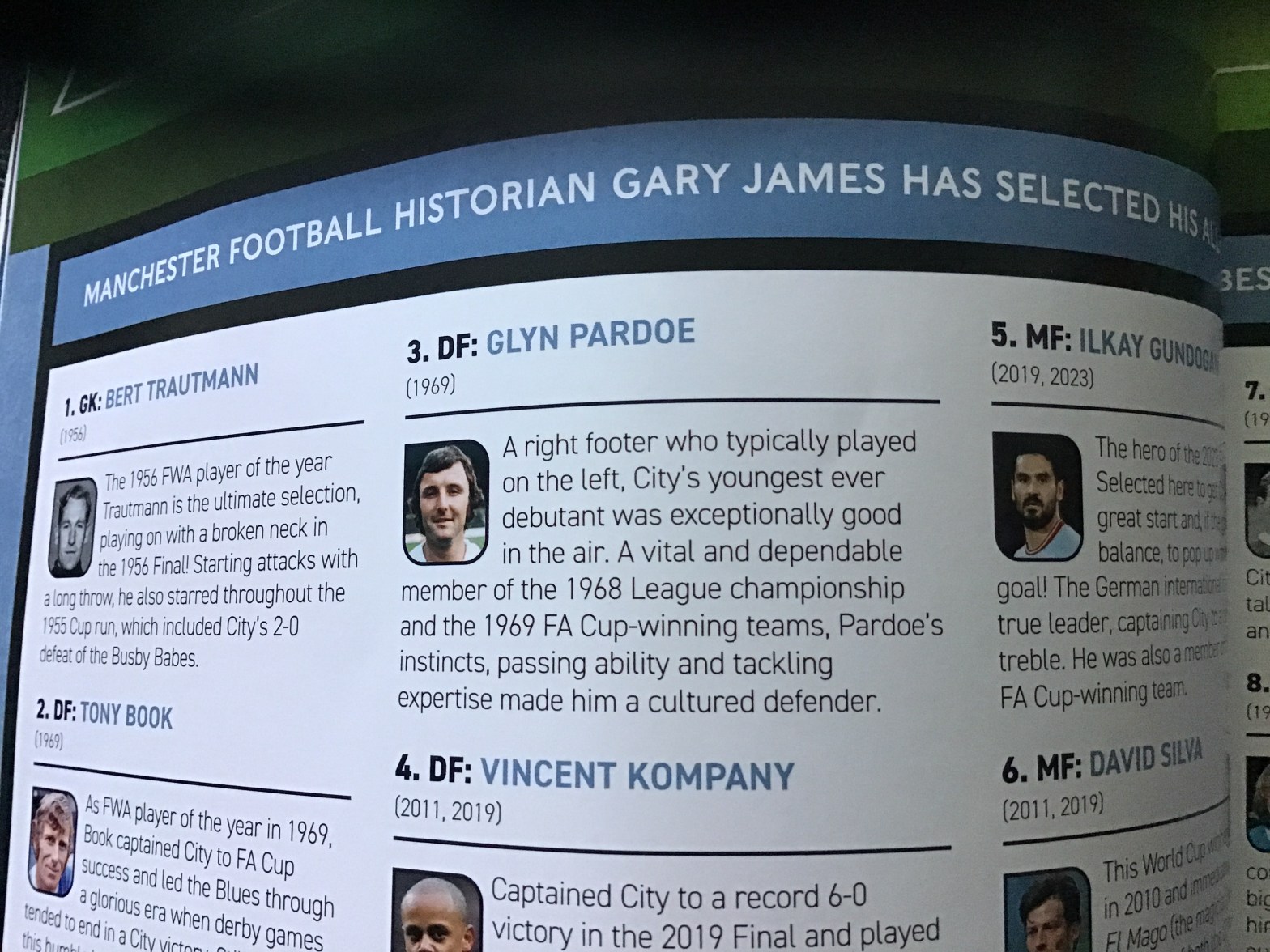
A versatile right footer who typically played on the left, City’s youngest ever debutant was exceptionally good in the air. A vital and dependable member of the 1968 League championship and the 1969 FA Cup winning teams, Pardoe’s instincts, passing ability and tackling expertise made him a cultured defender.
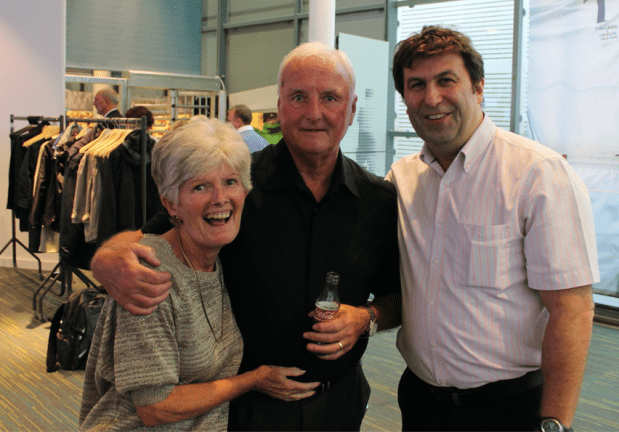
Janice Monk (former City Store), Glyn Pardoe and Steve Mackenzie at the launch of Manchester The City Years in 2012
Both Book and Pardoe played in the 1969 FA Cup final. You can read all about that here:
More on the all-time Manchester City FA Cup winning eleven tomorrow. It was a tough selection and over the next few days I’ll post the rest of the starting eleven.
For the 2024 FA Cup final match programme I was asked to select my all-time best Manchester City FA Cup final team. I set two rules – they had to actually play in a winning final (so, unused substitutes were not allowed) and they could not be a member of the current playing squad. I also tried to focus on the fact that this eleven would also be facing an all time Manchester United eleven. Therefore victories over United in key games were always in the back of my mind.
It was a tough job and so over the next few days I’ll post the names of the starting eleven I chose with some basic information why. I’ll start with the obvious one – the goalkeeper (although those who attended finals prior to 1956 may disagree!):
Bert Trautmann (1949-1964)
As far as FA Cup goalkeepers go 1956 FWA Player of the Year Trautmann is the ultimate selection. The ‘keeper who played on with a broken neck in the 1956 FA Cup final! Starting attacks with a long throw, he also starred throughout the 1955 cup run which included City’s 2-0 defeat of the Busby Babes.
I’ve written a lot about Trautmann over the years and was lucky to chat with him often over the decades. I was also the Manchester football historical consultant for the film The Keeper, about his life. Here’s a brief video of me talking about Trautmann for Dutch TV a while ago:
More on the all-time Manchester City FA Cup winning eleven tomorrow.
Each year, following the end of the UEFA football season I update the UEFA European Span of Success table. What is this? It’s a list of those clubs who have won two or more major UEFA tournaments showing the span between their first UEFA success and their most recent. The list may surprise some who think that football is all about those perceived as European giants with ‘history’.
The table hasn’t really changed much from last year as Real Madrid were Champions League winners. Atalanta, who won the Europa League, and Olympiacos (Conference winners) have only won one major European trophy and so they do not yet make it on to the list of multiple winners:
European Span of success 2024
The ‘history’ ‘no history’ thing really irritates me. All clubs have history and even when that’s recognised some still go on about history as if it started in 1992, 1999 or 2008 etc. depending on whether your club was successful or your rivals were failing. The two highest placed English teams are West Ham and Manchester City, who both found major European success before some of those clubs recognised today as Europe’s elite.
Obviously, this table does not show the number of major trophies won, but it does give an indication of trophy winning longevity for those who obsess on ‘my cup’s bigger than yours’ and similar debates. Personally, I think we should all be proud of our club’s achievements and not worry about what a rival has won.
West Ham have the second longest span of all Europe’s clubs and City have the fourth equal. Nice work Hammers and Blues!
The above table includes the four major UEFA tournaments: European Cup/Champions League; European Cup Winner’s Cup; UEFA Cup/Europa League & the Europa Conference League. It does not include non-UEFA tournaments such as the Mitropa Cup and Fairs Cup. Nor does it include the Intertoto Cup or similar.
I’m sure some will say but why aren’t the Mitropa or Fairs Cups in there? It’s a good point but these were not UEFA tournaments, though I recognise that the Mitropa Cup had some significant clubs competing in it. It was predominantly an East European competition and participants were not spread over the entire continent.
With the Fairs Cup… It is true that this was later transformed into the UEFA Cup and I have included all UEFA Cup finals in my analysis. But the Fairs Cup had an odd series of entry rules at times. Cities, rather than clubs, often entered with Barcelona beating London in one final for example. It was set up as a friendly type of competition with cities that had staged trade fairs playing each other. As time wore on entry came via the League Cup or League position in England, which added significance to it. But two teams from the same city were not allowed to participate, which meant that teams finishing way down the table could be (and were) included if those above them were multiple clubs from the same city.
In 1970 Manchester City’s Mike Doyle joked that by winning the League Cup he was satisfying his aim of ‘keeping United out of Europe’ (he joked about creating car stickers with that slogan!) because it appeared at that time that United’s only chance of Europe had gone with City’s qualification for the Fairs Cup.
1970 ECWC
City went on to win the ECWC that season, meaning that Fairs Cup place was opened up to League position, but United had finished lower down the table anyway and qualified for the Watney Cup instead. Actually, the Watney Cup is one worth talking about, but I’ll save that for another day. In 1970 Fourth placed Derby County qualified for the Watney Cup, while 5th to 7th (Liverpool, Coventry and Newcastle) all got a Fairs Cup place, alongside 12th placed Arsenal (Fairs Cup winners). I’ve not investigated this fully but it does seem odd that the Watney Cup took precedence over the Fairs Cup.
Arsenal’s 1970 Fairs Cup success was their first European trophy but is not included in the span, neither are those Fairs Cup wins of Barcelona. However, as quite a few Arsenal fans seemed to get a bit upset when the table was posted last year I’ve decided to include the Fairs Cup in the following version of the table. So this table is the winners of the main UEFA competitions I mentioned earlier plus the Fairs Cup with its odd rules:
European Span of success 2024 including Fairs Cup
Hopefully, those Arsenal fans who were somewhat upset last year will now be happy. Note that West Ham have now been overtaken by Roma and that Barcelona are now above Manchester City, Bayern & Atletico Madrid. Both ‘Rome’ and ‘Barcelona’ won the Fairs Cup when it was city based and not club based.
Arsenal are now 18th in this combined table, behind their fellow English clubs West Ham, City, Chelsea, United and Liverpool.
As an example of the odd qualification rules in place for the Fairs Cup at times it’s worth looking at the 1969 qualification via the English League system.
In 1969 champions Leeds entered the European Cup. The ECWC place went to FA Cup winners Manchester City and the Fairs Cup places went to: Arsenal (4th), Southampton (7th) and Newcastle (9th). Swindon had won the League Cup, beating Arsenal in the final, but the Fairs Cup organisers wouldn’t allow them to participate as they were not a top flight club! This adds to the reason the competition is usually excluded. It is certainly not a UEFA competition in any case.
Similarly, Everton (3rd), Chelsea (5th), Spurs (6th) and West Ham (8th) who all finished above Newcastle were denied because of the rule that only one club from each city be allowed. So Liverpool and Arsenal’s inclusion meant their rivals stood less chance of winning the trophy than Newcastle simply because there were multiple clubs in their cities.
That rule does make me wonder what would have happened if both Manchester clubs had qualified for the competition as City are within the city of Manchester boundaries and United are not. Would the two clubs have challenged any decision not to include one of them based on the age old argument of Manchester’s boundaries?
Maybe I’ll post more on the odd rules of football competitions and tell the story of some of those long forgotten competitions.
If you’re interested in the wider span of success for English clubs (listing those who have the longest span between their first trophy and most recent, not simply European trophies) then take a look at this (Manchester City are second):
If you enjoy all the free material on my website and would like to support my research and keep this website going (but don’t want to subscribe) then why not make a one-time donation (or buy me a coffee). All support for my research is valued and welcome. It allows me to keep some free material available for all. Thanks.
Glyn Pardoe was born on this day (1 June) in 1946. He rightfully made it into my all time MCFC FA Cup winning 11, published in last week’s FA Cup final match programme.
Janice Monk (former City Store), Glyn Pardoe and Steve Mackenzie at the launch of Manchester The City Years