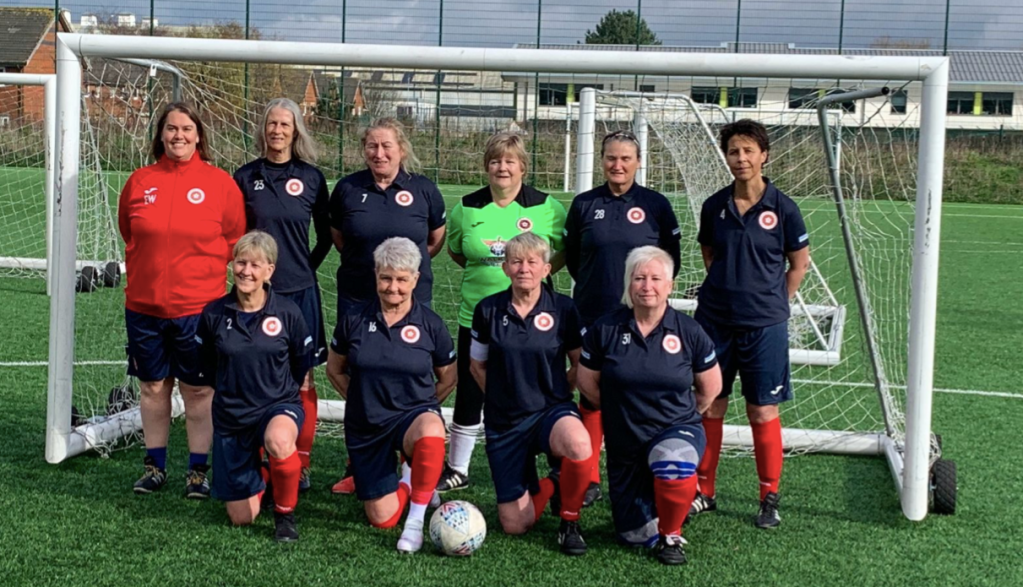
This Saturday just gone (24 February 2024) I was down in Cardiff watching the Tri-Nations Cup (a women’s international walking football tournament). The England over 55s team was captained by former Manchester Corinthian and Manchester City player Lesley Wright. Ultimately, England were successful in a tournament involving Wales and Ireland.
It was great to see England (EWFC over 55s pictured above; photo from @Eilis1979) find success, led by a former Corinthian, in a sport that promotes health, exercise and activities. Another Corinthian, Gail Redston, also played for England and it was wonderful to see the Corinthian influence still there in trophy winning teams.
There were players appearing in the tournament who had played for leading clubs across Great Britain and Ireland. This included Mac Barlow, who netted most of England’s goals. Mac’s previous eleven-a-side clubs included Preston.
The whole tournament was a positive example of walking football and supporters came from across the UK too. There was even a group of Crystal Palace season ticket holders who had sacrificed watching their Premier League match to support England.
Lesley Wright and Gail Redston both feature in my new book on Manchester Corinthians. Details here:
Continuing the series on the 1970s and to mark the anniversary of Colin Bell’s birth it’s well worth reminding ourselves of something he viewed as one of his greatest successes. It may surprise some fans… When I interviewed Colin quite a few years ago we talked about his many successes and triumphs as a player. He was as humble as ever. Then he told me something which surprised me a little and that was about Manchester City’s 1977-78 Central League title.
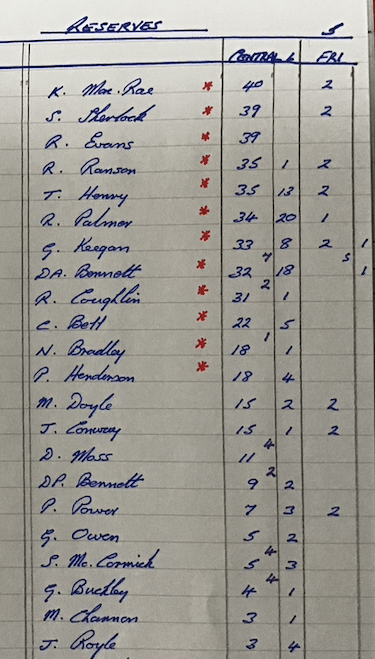
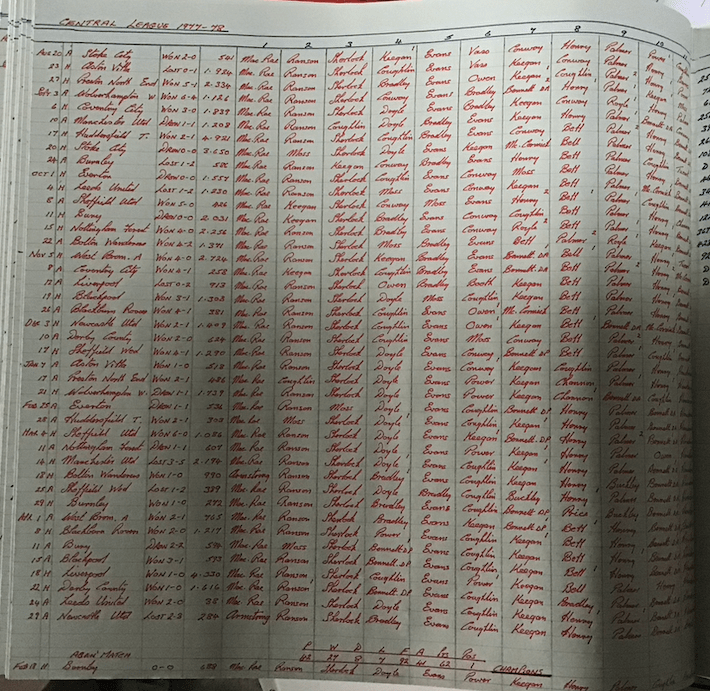
City’s reserve team played in the Central League back then and, due to his devastating injury, Colin played reserve games throughout that season as he pushed for full fitness. He started 22 of these games and scored five goals.
When I interviewed Colin he told me he was as pleased with this Central League success as he was with all his other medals. To him that season saw a return to competitive football and it was irrelevant whether it was a reserve league or the Football League. It mattered enormously.
Most posts on Colin won’t talk about the 1977-78 Central League title but, as he was so keen to ensure he mentioned it to me all those years ago, I feel it’s appropriate to give it a little focus.
His first Central League appearance of the 1977-78 season attracted almost 5,000 as many of us were determined to be there when he returned to action. For the record that game was v Huddersfield on 17th September 1977, attendance 4,921.
Colin was a wonderful player and man. Those of us who saw him play know what a great player he was; those of us who were privileged to meet him met a truly humble & wonderful human being. He was the King of our Kippax but was truly a legend of football at Bury, City and England. His name will always be remembered.
This image of my ledger for 1977-78 shows Colin in City’s Central League match records.
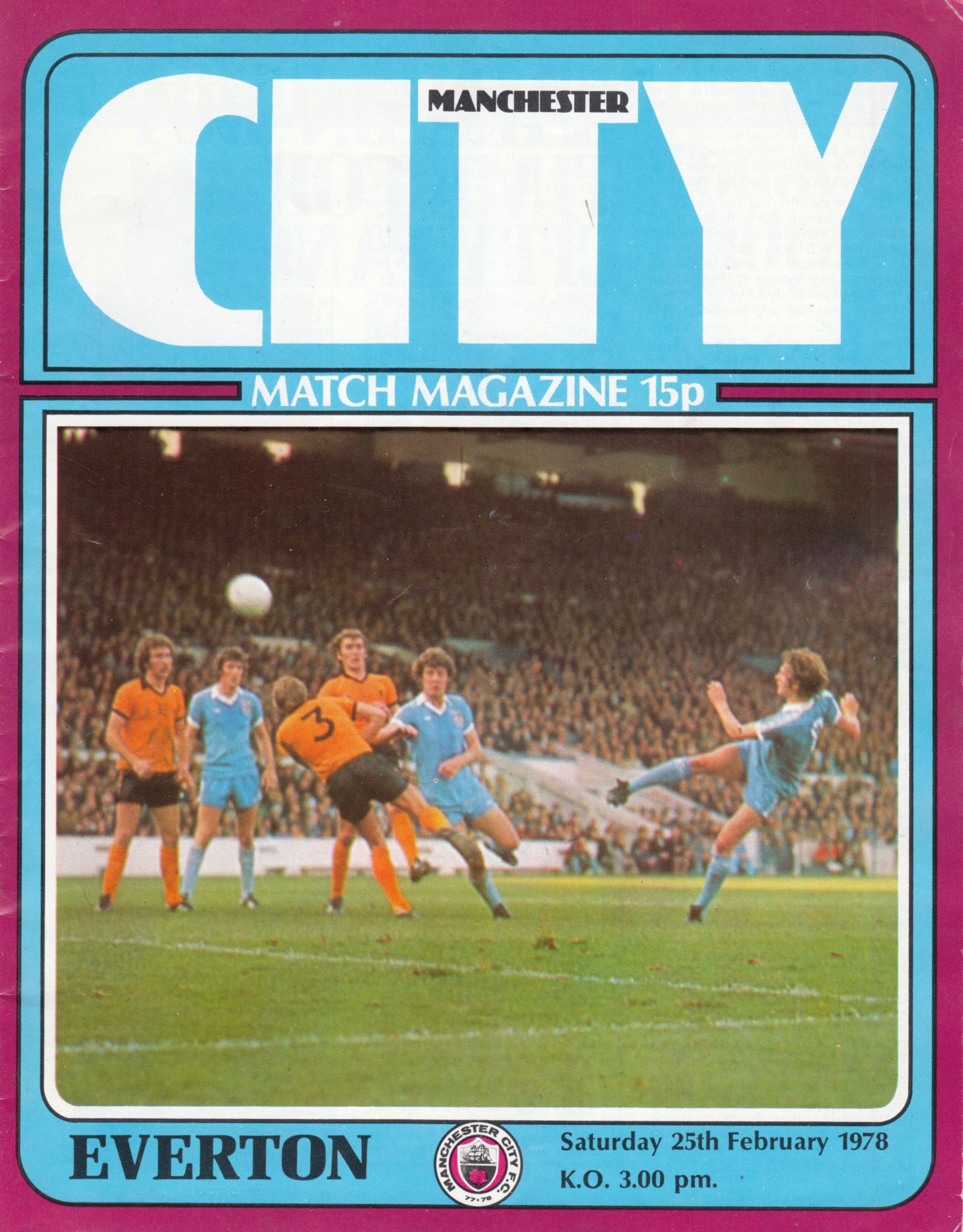
Here’s another flashback to the 1970s. This is video of Brian Kidd scoring a header v Everton on this day (25 February) in 1978. It was the only goal of the match and you can watch it here:
This is part of a series of articles and features on Manchester City in the 1970s which ran during January & February 2024 with indepth articles some days and smaller ‘on this day’ style posts on others. Subscribers can access all of these. If you want to know more on this incredible decade for Manchester City Football Club then why not subscribe and read it all? You could even subscribe for a month and see what you think. The following 3,700 word article is on the 1977-78 season and is available to subscribers below. Enjoy!
Subscribe to get access – Monthly
Read more of this content when you subscribe today. It costs £3 per month (cancel anytime) to access everything posted since 1 October 2022 or there’s a special annual rate below which gives greater access and works out much cheaper.
Read more of this content when you subscribe today. It costs £3 per month (above) or £20 a year (here) to access everything posted since the site was created in December 2020. This special rate works out about £1.67 a week and gives access to everything posted, including PDFs of 3 of my books.
If you enjoy all the free material on my website and would like to support my research and keep this website going (but don’t want to subscribe) then why not make a one-time donation (or buy me a coffee). All support for my research is valued and welcome. It allows me to keep some free material available for all. Thanks.
I’ve just heard the news of Stan Bowles’ death. He was born on 24 December 1948 and was a great maverick Mancunian footballer. Here’s a profile of him, focusing on his Manchester City days.
Bowles joined City as an amateur on 27 July 1965, becoming an apprentice on 1 October 1965 and then professional on 29 December 1966.
Then in 1967 things really began to happen and Bowles’ first game was as a substitute in a League Cup tie at home to Leicester City. He scored two goals in the second half and the following Saturday he made his League debut another memorable one. He scored two again!
Lots of stories have circulated over the years about his time at City. Like Mario Balotelli many years later some are truthful; others are exaggerations and some are completely make up.
The stories go that Bowles once missed a flight to Amsterdam where City were to play against Ajax, and that Bowles’ interest in the horses led to Joe Mercer saying: ‘If Stan could pass a betting shop like he can pass a ball, he’d be a world beater.’ Suspensions and other issues led to Stan refusing to sign a new contract and he asked to leave. That in itself led to him being suspended for 14 days on the advice of the Football League.
Inevitably Bowles moved on, first to Bury (July 1970) and then to Crewe (September 1970).
A spell at Carlisle followed and then in September 1972 a bid of £110,000 took him to Loftus Road where he won five England caps as a QPR player.
Seven years later Nottingham Forest’s Brian Clough bought him for £210,000 but sold him again less than a year later after further issues. Further spells were reported at Orient, Brentford, Hounslow and Epping.
In 2015 it was announced he was suffering with Alzheimer’s Disease, like his former boss Joe Mercer.
At City Bowles made a total of 20 first team appearances, scoring 4 goals, but he remains recognised as a hugely talented player.
There are articles on this site mentioning Bowles. Here’s a selection:
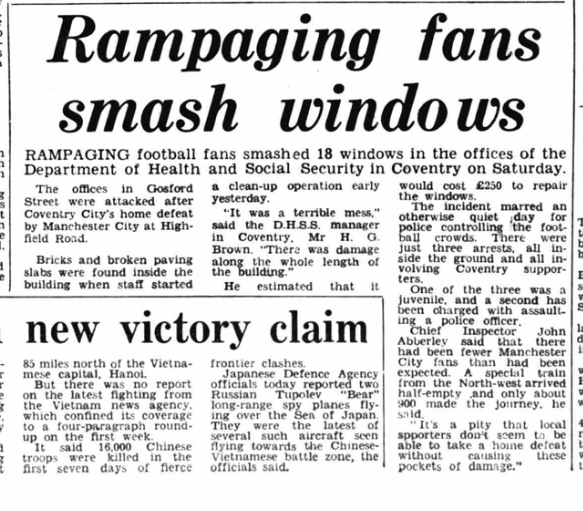
The series of features/articles covering Manchester City in the 1970s continues with this flashback to today (24 February) in 1979 when City won 3-0 at Coventry. The goalscorers were Mike Channon (2) and Brian Kidd and was City’s second successive away win by that score (the previous had been Spurs 3 weeks earlier). You can read a report of the game above but you may also be interested in this article about some ‘rampaging’ that occurred after the game. For once away fans were not blamed! Instead newspapers blamed the Coventry fans who, it was felt, couldn’t handle the defeat. All interesting stuff!
This series of articles and features on Manchester City in the 1970s has been running throughout January and into February with indepth articles some days and smaller ‘on this day’ style posts on others. Every day offered something to enjoy.
Subscribers can access everything. If you want to know more on this incredible decade for Manchester City Football Club then why not subscribe and read it all? You could even subscribe for a month and see what you think. The following 5,700 word article is on the 1978-79 season and is available to subscribers below. Enjoy!
Subscribe to get access – Monthly
Read more of this content when you subscribe today. It costs £3 per month (cancel anytime) to access everything posted since 1 October 2022 or there’s a special annual rate below which gives greater access and works out much cheaper.
Read more of this content when you subscribe today. It costs £3 per month (above) or £20 a year (here) to access everything posted since the site was created in December 2020. This special rate works out about £1.67 a week and gives access to everything posted, including PDFs of 3 of my books.
If you enjoy all the free material on my website and would like to support my research and keep this website going (but don’t want to subscribe) then why not make a one-time donation (or buy me a coffee). All support for my research is valued and welcome. It allows me to keep some free material available for all. Thanks.
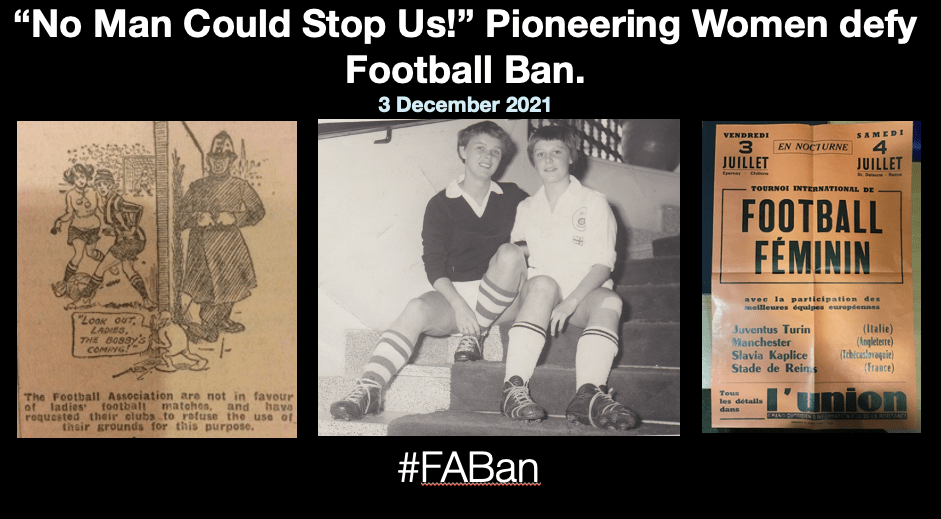
In December 2021 I staged a talk at Hebden Bridge on the FA ban of women’s football. The night was sponsored and supported by Geoff Matthews and his company Cansquared Ltd. It was a wonderful night and lots of attendees asked about the future and what they could do to help promote the stories of the women who played at a time when the FA tried to kill female participation in the sport. Well, after that night a lot has happened to recognise the Manchester Corinthians.
As part of my longstanding project into female participation and involvement in football in Manchester I have been researching and writing Manchester Corinthians: The Authorised History. The book will be of a similar scope to my Manchester City Women: An Oral History on City’s women’s team.
Margaret Shepherd and Margaret Whitworth with me prior to the Hebden Bridge event
A lot has been written on the Corinthians (see the section on women’s football on this site for a few examples) but not nearly enough, plus there are some inaccuracies out there that need to be corrected (even now there are some that keep on being repeated). Basically, this team possessed a talented group of players who toured Europe and South America promoting football, female endeavour and Manchester.
I talked quite a bit about Corinthians at Hebden Bridge and we were fortunate to have three Corinthians as guests that night. Margaret Whitworth, Margaret Shepherd and Lesley Wright between them covered every season of the club’s life from the 1950s through to its demise. Since that night I’ve also tracked down a player from the club’s very first season of 1948-49 who, together with detailed archival research, has helped me piece together for the first time several people who were instrumental in the birth of the club. Again, this is not something that has appeared in any of the articles or films connected with the club in recent years. This will be explained properly for the first time in my book.
I’m still trying to track down other Corinthians to include in the book. To date I’ve identified over 230 players. See:
After the Hebden Bridge night it was clear that we needed to recognise the Corinthian players further. On that night I mentioned my idea of having a plaque erected for the Corinthians in a significant/related location in Manchester. Several members of the audience thought this was a wonderful idea and asked if they could support the wider promotion of the Corinthians – one more or less suggested we should march on Downing Street to persuade them to do something about it!
In 2019 I’d written articles for a variety of publications suggesting the same and urging the FA and others to recognise the Corinthians. In the Manchester City men’s match programme as well I highlighted my desire to get a plaque erected about their achievements.
The talk at Hebden Bridge
Via Manchester Council I was put in contact with the Friends of Fog Lane Park and we ultimately set up a successful appeal in their name. The FA made a significant donation which funded the plaque and our fundraising efforts raised enough to allow the Friends to commission 2 murals and other tributes to the Corinthians as well.
Those present at Hebden Bridge in December 2021 helped raise the profile and that event was significant in highlighting the incredible achievements of its female footballers. Now, the authorised history of the Corinthians will tell the story of the club from its birth right through to the blue plaque appeal. It will use the voices of the women who represented Manchester and England in a positive manner and who won trophies in South America & Europe and who toured North Africa. They won a significant European competition before either Manchester men’s team yet their achievements were not recognised by the city until the blue plaque appeal started.
I am immensely proud of how this has all happened. The event at Hebden Bridge was free to attend and was made possible by the support of a locally based business, Cansquared (Geoff Matthews – who co-hosted the evening). We felt it was vital we made this free to attend to spread the word.
If anyone runs a key Manchester venue and would like a Corinthians celebration event then please get in touch. The more we can do to promote their story the better.
Thanks for reading this. If you would like to find out more about the Corinthians then follow the tabs on this site or use the search function. If you’d like to know more about the FA Ban then you can download for free an article I’ve recently co-written here:
Copies of my book on Manchester City Women are still available. This tells the history of City Women via the voices of the women (and some men) involved. The book has been heralded as a model for oral histories by the Oral History Society.
Here’s a link you can follow to order a signed copy of the City Women book:
Watch this space for more on the Corinthians and women’s football over the coming months. Thanks – now use the tabs and search to learn more on women’s football in Manchester. Ta!
Following on from the series of articles and features on the 1970s and 1980s over the last few months a new series on Manchester City in the 1990s will be starting in March. As with the 1970s & 1980s there will be different content posted each day from indepth articles on each of the seasons through to on this day reminders of games, players and more.
Some of the material will be available for subscribers only and some will be free for anyone to read. If you’d like to know how to subscribe and read all the incredible content on here then see:
Feel free to send in ideas or areas that you’d like me to discuss on 1990s Manchester City. I’m always open to adapting stories or content based on feedback. Thanks for reading.
Today we have another 1970s flashback. This is of the day when a Tueart penalty helped Manchester City to a 3-0 victory over Everton. This happened at Maine Road on this day (21 February) in 1976. You can see film of that and all the goals here:
This series of articles and features on Manchester City in the 1970s has been running throughout January and February with indepth articles some days and smaller ‘on this day’ style posts on others. Every day offered something to enjoy.
Subscribers have access to everything. If you want to know more on this incredible decade for Manchester City Football Club then why not subscribe and read it all? You could even subscribe for a month and see what you think. The following 5,320 word article is on the 1975-76 season and is available to subscribers below. Enjoy!
Subscribe to get access – Monthly
Read more of this content when you subscribe today. It costs £3 per month (cancel anytime) to access everything posted since 1 October 2022 or there’s a special annual rate below which gives greater access and works out much cheaper.
Read more of this content when you subscribe today. It costs £3 per month (above) or £20 a year (here) to access everything posted since the site was created in December 2020. This special rate works out about £1.67 a week and gives access to everything posted, including PDFs of 3 of my books.
If you enjoy all the free material on my website and would like to support my research and keep this website going (but don’t want to subscribe) then why not make a one-time donation (or buy me a coffee). All support for my research is valued and welcome. It allows me to keep some free material available for all. Thanks.
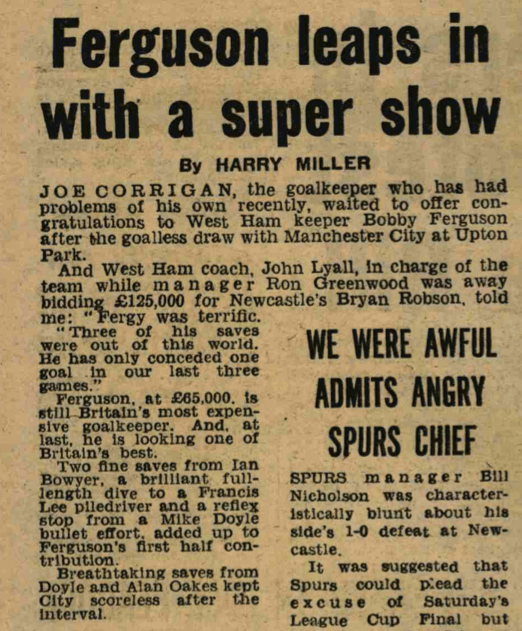
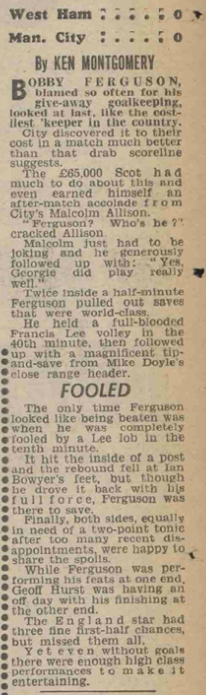
On this day (20 February) in 1971 Manchester City played out a goalless game at West Ham United. Often games without goals are perceived as dull but this match was full of goal action – even if no actual goals were scored. The brilliance of West Ham’s ‘keeper ensured Manchester City could not score and at the end of the game City’s Joe Corrigan ensured he congratulated Ferguson, even if Malcolm Allison joked that he had no idea who journalists were talking about when they asked him about the Hammers’ goalie. Here’s a report of the game:
Every day in January and February so far has offered something to enjoy in this series focusing on Manchester City in the 1970s. Subscribers can access everything. If you want to know more on this incredible decade for Manchester City Football Club then why not subscribe and read it all? You could even subscribe for a month and see what you think. The following 5,200 word article is on the 1970-71 season and is available to subscribers below. Enjoy!
Subscribe to get access – Monthly
Read more of this content when you subscribe today. It costs £3 per month (cancel anytime) to access everything posted since 1 October 2022 or there’s a special annual rate below which gives greater access and works out much cheaper.
Read more of this content when you subscribe today. It costs £3 per month (above) or £20 a year (here) to access everything posted since the site was created in December 2020. This special rate works out about £1.67 a week and gives access to everything posted, including PDFs of 3 of my books.
If you enjoy all the free material on my website and would like to support my research and keep this website going (but don’t want to subscribe) then why not make a one-time donation (or buy me a coffee). All support for my research is valued and welcome. It allows me to keep some free material available for all. Thanks.
The series of features/articles covering Manchester City in the 1970s continues with this brief flashback to today (19 February) in 1973. There wasn’t a first team game that day but the Liverpool Echo did publish this article about their local club’s frustrations at facing Manchester City. This followed a 1-1 draw at Maine Road (Tommy Booth had scored shortly before half time; Liverpool equalised in second half).
The two clubs had met three times in 2 weeks with Malcolm Allison’s Blues defeating Bill Shankly’s Liverpool 2-0 in the middle meeting and both other games ended in a draw. It’s a long time ago now but modern football tends to forget that for much of the 1970s City and Liverpool were considered major rivals, more so than LFC-MUFC for many years. In fact Shankly had already said in the late 1960s that he considered City to be Liverpool’s main rivals – it was probably all about who he saw as the greatest team LFC faced in terms of quality, but there were many seasons, including 1972-73 (through to the end of the decade except 1977-78 & 1979-80), where the Anfield crowd for the game with City was greater than it was for a game with United. In 1973-74 it was an incredible 10,000 higher for City than United and at other times around 6,000.
Ah well! Football perceptions change over time but that’s why it’s important to do the research and find contemporary material. Memories fade and change.
1,700 word article on the entire 1972-73 season – a season of major change which saw one man who didn’t want to be manager told to take the manager’s job or you’ll be leaving yourself! Oh City! You can read this below. This series of articles and features on Manchester City in the 1970s has been running throughout January with indepth articles some days and smaller ‘on this day’ style posts on others. Every day in January will offer something to enjoy.
Subscribers will get access to everything. If you want to know more on this incredible decade for Manchester City Football Club then why not subscribe and read it all? You could even subscribe for a month and see what you think. The following 1,700 word article is on the 1972-73 season and is available to subscribers below. Enjoy!
Subscribe to get access – Monthly
Read more of this content when you subscribe today. It costs £3 per month (cancel anytime) to access everything posted since 1 October 2022 or there’s a special annual rate below which gives greater access and works out much cheaper.
Read more of this content when you subscribe today. It costs £3 per month (above) or £20 a year (here) to access everything posted since the site was created in December 2020. This special rate works out about £1.67 a week and gives access to everything posted, including PDFs of 3 of my books.
If you enjoy all the free material on my website and would like to support my research and keep this website going (but don’t want to subscribe) then why not make a one-time donation (or buy me a coffee). All support for my research is valued and welcome. It allows me to keep some free material available for all. Thanks.







 Gary James' Football Archive