Manchester City 3 Fulham 1

On this day (2 September) in 1959 Ian Barton, a key member of the Manchester City Supporters Club, attended his first game. I spoke with Ian years ago about this and here’s his story of that day all those years ago: ‘It may not be the most significant game in City’s history but for me it shines out like a beacon light.  As a 5 year old – I’ve given my age away now! – it was my first ever game. I had looked forward to this more than anything I could remember, after all my Dad, cousins, uncles and everyone else in the family could go to Maine Road so it was natural for me to follow on.

‘I remember how huge the place looked.  I’d never seen anything on such a scale and I’ll never forget the smell which was a combination of tobacco, wintergreen & Bovril which always seemed to permeate around the stadium.  Then there were the floodlights.  They created a fantastic effect for a young boy and to this day I always think night games have a dramatic feel to them.  

‘Our team had the great Bert in goal, Joe Hayes up front, with Colin Barlow on the wing and Ken Barnes at wing half.  Sadly the local hero Denis Law was injured so didn’t play.  Fortunately his heal, which he put to such good use some 15 years later, was not harmed.  Although he was soon to become a firm favourite of mine, it was short-lived.  For some reason – and I’m sure all Blues agree on this one – Law seemed to disappear from the scene for most of his career only to have one glorious season before retiring in style.

‘Fulham had some names which were to become famous namely Bobby Robson, George Cohen, Alan Mullery & Jimmy Hill, but neither Hill nor Robson turned out that night.  City turned on the style and won comfortably.  I was hooked for life.

‘Since then like all City fans I have suffered the ups and downs the highs and lows which we accept as the norm.  From Rotherham to Newcastle…  from Wembley to Vienna…  from Stoke to Blackburn via Wembley… it’s been a hell of a ride and I don’t regret one moment of it.

‘I look upon this game with Fulham as the day when my lifelong passion was born.’

The Fulham consolation goal was scored by debutant Alf Stokes, who joined Fulham for £10,000 in July 1959 from Tottenham, although it’s doubtful the young Ian would have cared about the opposition of course!

Statistics:  Football League 2nd September 1959.

City 3 Fulham 1

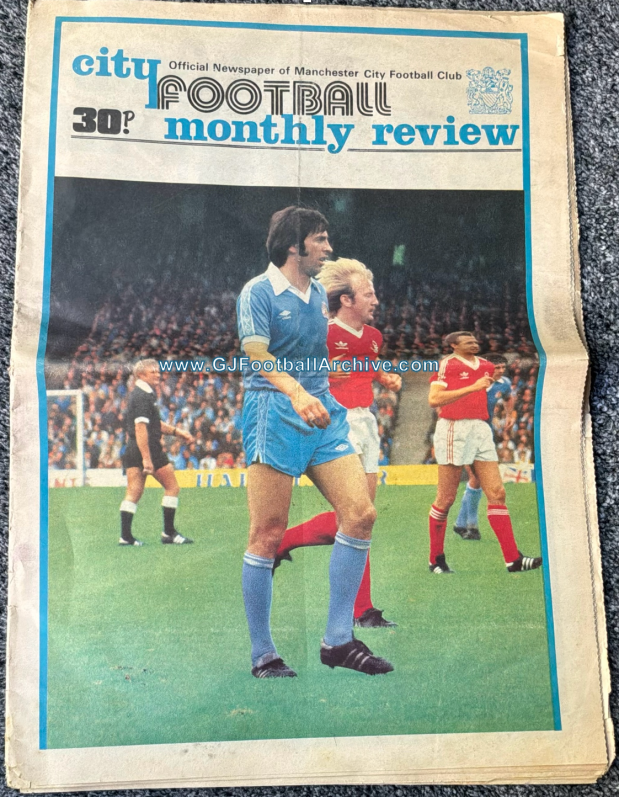
Scorers – City: McAdams (2; the image at the top of this article is of McAdams), Colbridge

Fulham: Stokes

City: Trautmann, Branagan, Kerr, Cheetham, McTavish, Barnes, Barlow, Hannah, McAdams, Hayes, Colbridge 

Fulham:  Macedo, Cohen, Langley, Mullery, Bentley, Lawler, Leggat, Stokes, Doherty, Cook, Chamberlain

Attendance: 37,485 

You can read more about Billy McAdams here:

The 1906 City-Arsenal Heatwave Game

Today is the 120th anniversary of an odd day when Manchester City and Arsenal played in a heatwave. Here’s the background and the story. I start with the 1906 close season… Following the banning of so many Manchester City players and officials (I’ll cover this another day!) the future leaked seriously bleak for the club during the summer of 1906.  Not only did the Blues have to find players, but they also had to identify a manager and some directors to help move the Club forward.  It was not easy.  Fortunately the Derby County secretary-manager Harry Newbould accepted the challenge, even though the rest of football felt that City were a dead side with no chance of resurrection.

Newbould spent the summer bringing in new players and setting a plan to avoid relegation – with so few recognisable first team players nothing more than avoiding relegation could be expected.  When Newbould joined City in July 1906, there were only eleven players of any description available.  

Somehow he pulled together a side.  Many of the players were of good quality, but when the season opened at home to Arsenal on 1 September 1906 no one could have predicted how Newbould’s first game would develop.  City’s team, including five debutants, was Frank Davies, John Christie, Tommy Kelso, Alex Steel, Jimmy Buchan, George Dorsett, George Stewart, Irvine Thornley, Robert Grieve, Billy Lot Jones, and Jimmy Conlin.  In extreme heat, the Blues took the field before a low Hyde Road crowd of around 18,000.  The weather at ninety degrees in the shade had a tremendous impact on the game as the players found it difficult to cope.

After thirty minutes Arsenal took the lead as City’s large number of debutants found it difficult to play together.  A couple of minutes later Irvine Thornley fell “prostrate and very ill” was taken from the field.  For the rest of the match he lay flat on his back trying to recover from sunstroke.  Shortly after Arsenal had scored a second Jimmy Conlin collapsed.  According to reports he had even placed a handkerchief on his head to protect him from the sun.

At half time Robert Grieve failed to reappear.  Down to eight men, with three forwards missing, the Blues stood no chance of matching the Gunners, but the referee refused to abandon the game.  Bravely the Blues fought on, and for a while Newbould pushed one of his defenders up front to compensate for the three missing men.  This gave the Blues a formation made up of three attackers, three half-backs, one full-back and a goalkeeper.  Five minutes into the half, winger Jimmy Conlin bravely returned to the pitch.

After a short spell of City pressure, George Dorsett scored for the Blues to make the score 2-1, but the effort was perhaps a little too much for the player as he collapsed with exhaustion a few moments later (see the inset part of the image at the top of this page).  Any hope of equalising disappeared at that moment, and Arsenal dominated the match completely.  Bravely City played on, but it wasn’t long before the Gunners managed to increase their lead to 4-1.  Shortly afterwards City lost Tommy Kelso, then Jimmy Buchan, leaving only six City players on the pitch.  Three of whom – including goalkeeper Davies – were making their debuts.

Somehow the six Blues held out until the final whistle, in a game that provided new secretary-manager Newbould with yet more problems.  Two days later the new look City travelled to Everton with remarkably only two changes – Albert Fisher replaced Thornley and Kelso made way for Frank Norgrove.  Unfortunately, any hope that this game would see the Blues fortunes change were quickly dashed as City suffered their heaviest defeat of all time as Everton annihilated Newbould’s side 9-1.  Debutant Fisher provided the consolation goal.

Despite the start of season struggles City ended their first season following the FA bans in 17th place, five points above the relegation zone.  Interestingly, Newbould’s old side were relegated.

Manchester City’s and Bury’s First…

Today (1 September) marks the anniversary of Manchester City’s AND Bury’s first League game and first goal scorers in the League. The two clubs played each other in this historic fixture. The game was a 4-2 defeat for City at neighbours Bury on 1 September 1894. The historic first City scorer was Tom Little, who scored the opener after eight minutes. Bury’s first scorer was Billy Barbour. Of course prior to 1894 the predecessors of City – Ardwick – had been League members from 1892-1894.

You can read all about City’s first season here:

Who Said City Couldn’t Play Chant

It looks like the 1894 group at Manchester City’s are hoping fans will re-adopt the 1930s classic song Who Said City Couldn’t Play? It’s City’s earliest recorded chant (there were earlier ones but this is the first we’ve found sound/film recordings of). Here’s a sound recording from the 1930s:

The tune used is the bit from Knees Up Mother Brown that goes: “Oh my, what a rotten song,
What a rotten song,
What a rotten song,
Oh my, what a rotten song,
And what a rotten singer too-oo-oo!”

If anyone at City wants to get the music played then dig out an instrumental version of that section of the song and get it played prematch. Just like the Viking chant it would be great to get it used in club material.

Death of Walter Chew

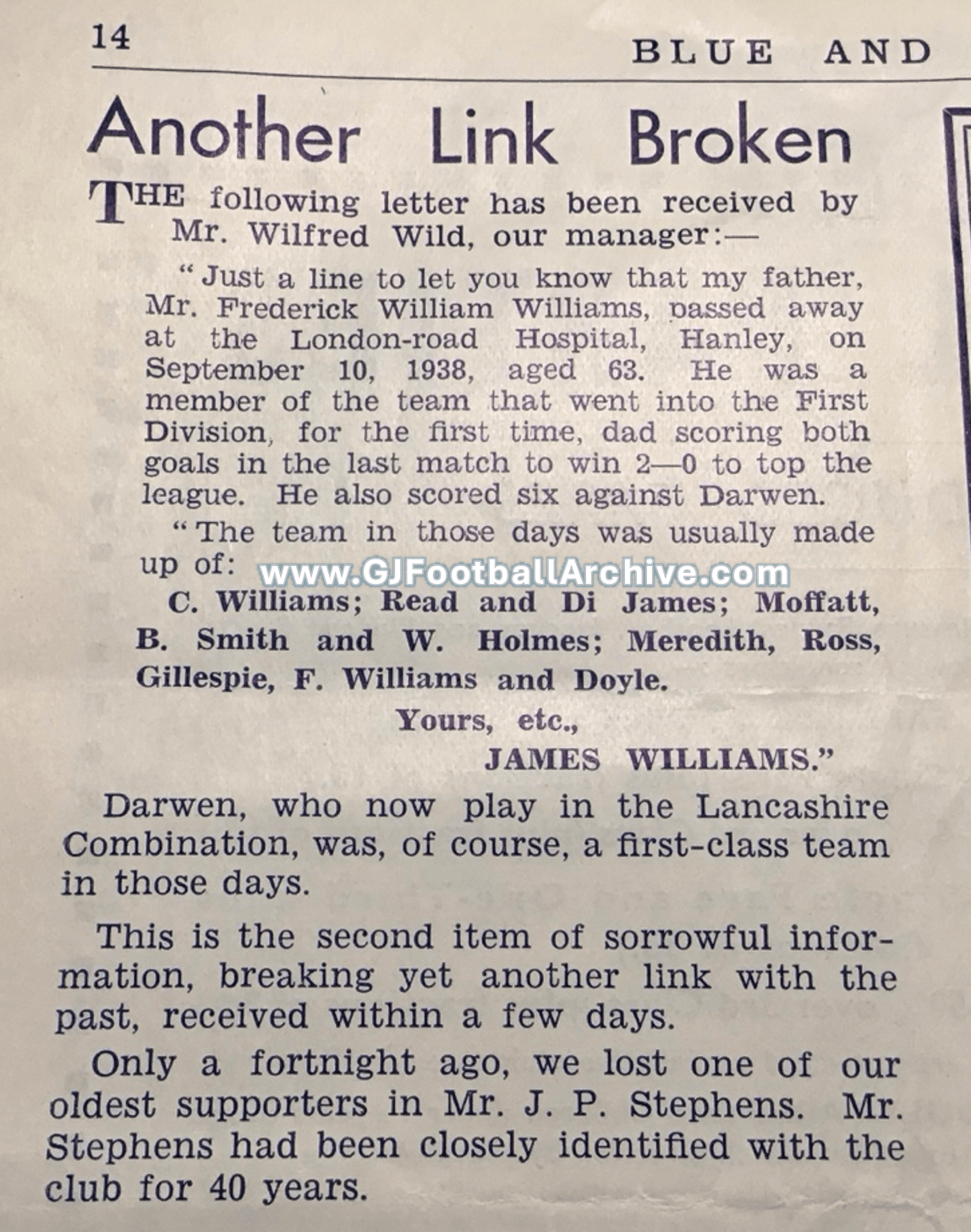
On this day (31 August) in 1948 the death was announced of Walter Chew, a man associated with the first known season of St Mark’s (though there are serious doubts on whether the 16 year old played in the earliest known game based on his own comments). St Mark’s is vital in the development of Manchester City. Chew was a key figure in the club’s formative years but there are some myths out there about him and that time. His obituary above is from August 1948 which says he was 84 at the time of his death. You can find out more about Chew and the latest research below:

Subscribe to get access – Annual

Read more of this content when you subscribe today. Annual subscribers can access all the articles, talks, books and interviews posted since December 2020 for an annual subscription of £20 (works out about £1.67 per month). There’s also a monthly subscription (see below).

Subscribe to get access – Monthly

Monthly subscribers can access all the articles, talks, books and interviews posted since 1 October 2022 for a monthly subscription of £3 (cancel any time).

Gates Closed as Manchester City Beat Aston Villa

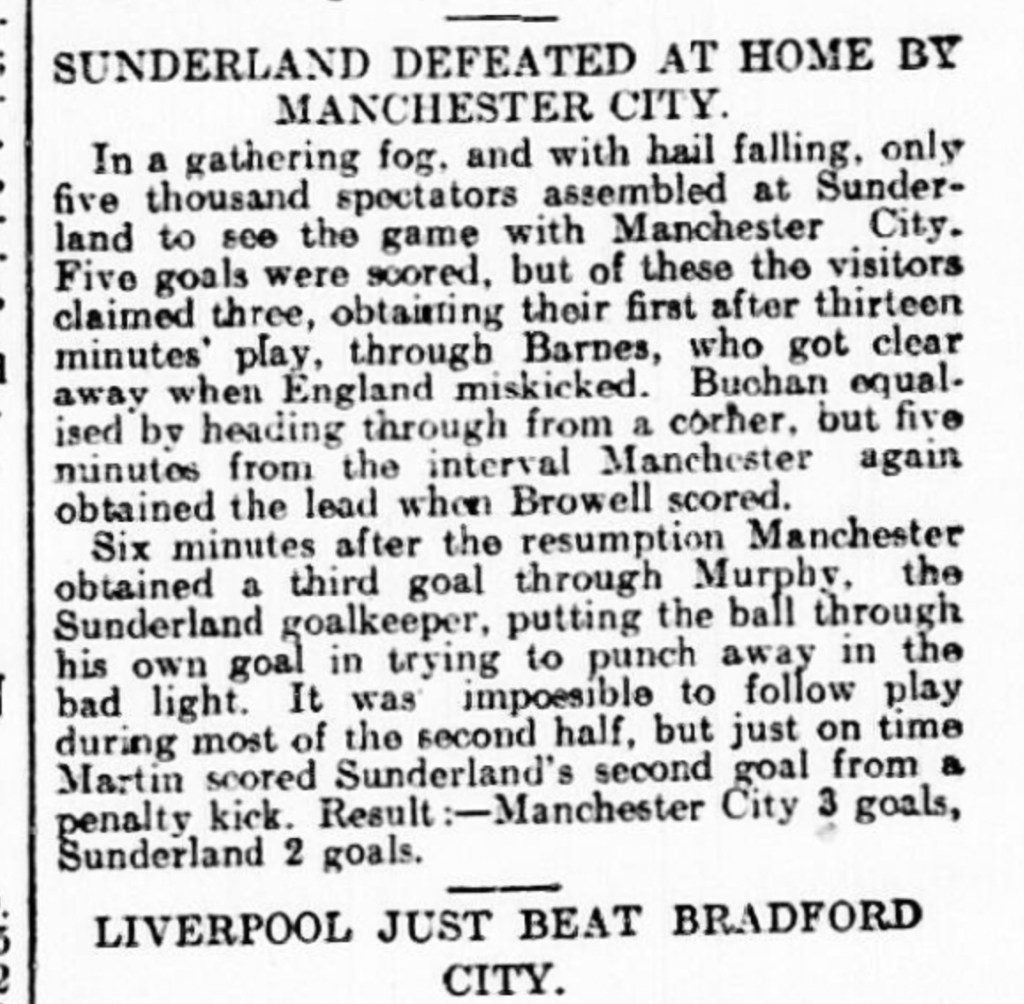
Today (30 August) in 1920 Aston Villa were defeated by Manchester City 3-1 with goals from Tommy Browell (2) and Billy Murphy. A crowd officially recorded as 40,000 at the time (it says 35,000 in this report) watched the match at Hyde Road. The turnstiles had to be closed before kick off as the ground was packed.

For more on this season why not read the following 2,350 word subscriber article. If you subscribe (see below) I hope you enjoy it. If you are not currently a subscriber then why not try it for a month (£3 per month or sign up for a year at a discounted £20 per year)?

Here’s the article:

Subscribe to get access

Read more of this content when you subscribe today. It costs £3 a month (cancel anytime) or sign up for a year at £20 per year. Subscribers have access to the 1000s of articles, features, interviews etc. posted so far and all those posted during your subscription.

As well as subscriber pieces this series on the 1920s includes some free articles. Watch out for a daily post.

Adebayor Winner at Portsmouth

On this day (30 August) in 2009 Adebayor scored the only goal of Manchester City’s victory at Portsmouth in the Premier League. A crowd of 17,826 watched this Sunday fixture.

Here’s City’s report of the game: https://www.mancity.com/news/first-team/match-report/2009/august/portsmouth-v-city

A First Three Pointer

The day after Manchester City’s latest three points earned in a game here’s a look back to the first time they earned three points for a win. That came on this day (29 August) in 1981 when City defeated West Brom 2-1. The new points system had been introduced for that season (it’s not that City had gone a decade without a win or anything!). The idea was that 3 points would encourage teams (especially away teams) to play for a win instead of a draw. The old system gave two points for a win and some teams, including several 1970s title winners, went out looking for draws away from home it was felt.

Brian Horton – New MCFC Manager

On this day (28 August) in 1993 Brian Horton officially became Manchester City’s new manager. Subscribers to this website can read all about the appointment and the 1993-94 season below. It was such an important (and at times complicated season) that this article on that season is over 9,000 words long. It’s like a book in itself! It’s available to subscribers, so why not subscribe and relive this extraordinary season? It contains material from interviews I’ve performed with key figures from that time. In particular this one contains quotes from Peter Swales and Francis Lee which they discussed with me personally.

Here’s the 9000+ word article on that season:

Subscribe to get access – Monthly

Read more of this content when you subscribe today. It costs £3 per month (cancel anytime) to access everything posted since 1 October 2022 or there’s a special annual rate below which gives greater access and works out much cheaper.

Subscribe to get access – Annual

Read more of this content when you subscribe today. It costs £3 per month (above) or £20 a year (here) to access everything posted since the site was created in December 2020. This special rate works out about £1.67 a week and gives access to everything posted, including PDFs of 3 of my books.

If you’d like to know more about subscribing then see:

Sponsorship Arrives

On this day (28 August) in 1982 Manchester City should have played their first League game with a sponsor’s name on their shirt. However the match was televised and in those days TV did not allow clubs to wear sponsors names in televised games. The match was a 2-1 win away at Norwich and City’s first sponsor was the car company Saab.

New signing David Cross scored the opener after 3 minutes and 5 seconds (below) and we all thought this was going to be a great season. I won’t spoil it by saying what happened the following May!

New signing David Cross scoring after 3 minutes and 5 seconds at Norwich, August 1982