As it had still been possible for either Manchester City or Manchester United to win the League on the final day of the 1967-68 season, the Championship trophy was left at the home of the reigning champions United.
City won the League at Newcastle while United lost 2-1 to struggling Sunderland.
You can read about that final day of the season here:
At United the Championship trophy vanished at some point during that day. The Daily Express reporter Alan Thompson set off on a mission to track it down. He started questioning the Old Trafford staff: “Secretary Les Olive was under the impression that a League official had taken it earlier in the week, Matt Busby was not at all sure what had happened to it, and for a minute or two it was lost until a member of the female staff admitted that it had been locked up ‘in the vault’. You are at liberty to allow full rein to your imaginations in concluding exactly where the ‘vault’ is at Old Trafford. But the centre of the boardroom table, where the League Championship Cup has stood proudly for the last 12 months was occupied by five shillings worth of flowers. Sit down the City fan who says symbolic.”
City still needed the trophy to be presented (Joe Mercer had offered to walk all the way from the Newcastle game to Old Trafford to collect it if he had to!) and so a friendly against Bury was hastily arranged for the Tuesday (May 14 1968) following the Newcastle game to enable the Championship trophy to be presented.
If the destination of the title was not obvious during the season, the trophy would be presented at the League’s annual dinner but as City would be on tour in America, the League agreed to present it at Maine Road. The presentation took place before the Bury game with Tony Book and the rest of the players going on a lap of honour before Mercer was handed the trophy to lift above his head. The crowd roared with delight and then witnessed a 4-2 victory.
Bury’s two goals were scored by Bobby Owen who, two months later signed for the Blues.
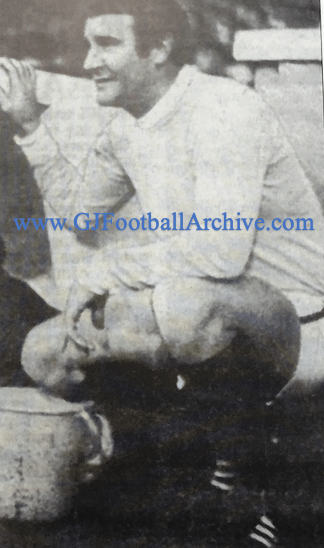
The game was noteworthy for it also included an appearance by Malcolm Allison. For much of the game he’d sat, wearing his familiar red tracksuit then, with about ten minutes left he substituted George Heslop and entered the field himself wearing the number 8 shirt. This caused a little confusion as Colin Bell remained on the pitch with the same number but nobody complained, after all it was a night to enjoy especially when Allison threw himself into the game. He forced a great save from Neil Ramsbottom, the Bury ‘keeper, and had a goal disallowed. The City supporters chanted ‘Allison for England’, and even called for Mercer to take to the field.
Tonight Manchester City take on Paris Saint Germain in the 2nd leg of the Champions League semi-final. The Blues won the first leg 2-1 and are hopeful of reaching their first Champions League final. It would not of course be their first two-legged semi-final win in Europe – that came way back in 1970.
You can read about that 1970 ECWC semi-final here:
Manchester United were the first of the region’s sides to compete in European competition and they reached a European Cup semi-final in 1956-57. They’d played their earlier rounds at Maine Road, where they’d attracted significant attendances (including their current record home European crowd) but they moved the semi-final to Old Trafford. Here for subscribers is the story of that campaign:
Subscribe to get access
Read more of this and all other content when you subscribe today.
Tonight (May 4, 2021) Manchester City will play the second leg of their Champions League semi final with PSG. It’s not the first European semi final the Blues have played of course, but for those thinking City’s European heritage began after the 2008 takeover here’s the story of City’s first European semi-final. This came way back in 1970!
In 1969-70 City, managed by Joe Mercer, played their first European semi-final. The second leg was was to be the best and most important European victory ever at Maine Road.
Here for subscribers is the story of both the first and second legs of that first European semi-final for the Blues.
Subscribe to get access
Read more of this and all other content on this site when you subscribe today.
During 2002-03 the focus for many Manchester City fans was Maine Road’s final season, especially the final month or so of the season.
With every game at the stadium a sell-out – only the size of the away support varied – supporters were desperate for the final season to see the old venue at its best. They also wanted a few memorable results in those final weeks.
Ultimately, the best Maine Road match of the final weeks came on April 21 2003 when a goal from Robbie Fowler and two from Marc-Vivien Foe brought a 3-0 win over Sunderland. The game became significant as it was to be the last City victory at the old stadium and Foe’s 80th minute goal was the last scored there by a City man.
Pre-match Sunderland presented the Blues with a rose bowl commemorating their final visit to the stadium. Significantly, the time span between their first appearance at Maine Road and their last was greater than any other visiting club. Co-incidentally City’s last victory at Hyde Road was also against Sunderland in April. You can read about that game here:
The news that Manchester City will be installing rail seats at the Etihad this summer (2021) means that for the first time since 1994 the stadium will possess a section that is designed to allow people to stand. Whether officially they’ll be allowed to depends on the legislation in place at the time but, whichever way you look at it, this is good news for those who like to stand at football matches.
It is now almost 27 years since we said goodbye to terracing in Manchester and for those of us old enough to remember those days at Maine Road there was one standing area which, above all else, represented the passion fans had for their club – The Kippax.
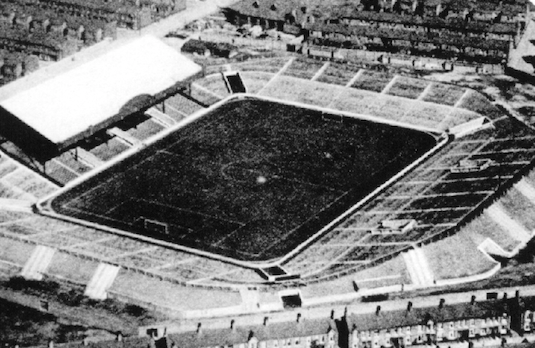
Unlike most other grounds City’s main terracing ran the full length of the pitch and wasn’t tucked away behind a goal. Because of its positioning the Kippax breathed life into every area of the stadium and was huge. Originally, it held in excess of 35,000, but even in its final days it still gave the impression of power and passion.
The Kippax was originally known as the Popular Side, matching a similarly dominant feature of the Blues’ Hyde Road ground, when it opened in 1923. That first season it held an estimated 35,000 in a crowd of 76,166 – then a national record attendance for a club ground. In 1934 when 84,569 packed into the stadium City’s vast stand may well have held almost 40,000. Incidentally, that 84,569 became the new national record attendance for a club ground (a record that still stands as Wembley is a national stadium, not officially a club ground). You can read about that crowd and game here:
Incidentally, I know City fans get a lot of abuse these days from fans of certain other clubs about filling stadia etc. Well, if you need any ammunition that 84,569 record crowd is over 22,000 higher than Liverpool’s record crowd (61,905 – a figure which wouldn’t get anywhere near City’s top ten crowds!).
Throughout the period up to the mid-50s the Popular Side developed its reputation but it was when it was roofed in 1957 that it became the true heart of the club. Back then it was extended slightly, although legislative changes had reduced terracing capacities by this time. The club announced it would be known as The Kippax Street Stand and that is what it officially remained until 1994 although most of us knew it simply as The Kippax. Its capacity by this time was about 32,000, reducing to 26,155 by the end of the 1970s.
The Kippax accommodated fans of every age and gender and, although it was a formidable place for opposition supporters, it was a welcoming stand for Manchester’s Blues. Young children would sit on the walls and railings, while older fans would find their own preferred viewing spot. Here’s a few snippets about the old stand:
Originally four vast tunnels (one in each corner and two built into the stand) and two significant stairways allowed fans to move onto the Popular Side.
A flag pole, positioned at the back of the terracing up to 1957, allowed a blue and white flag emblazoned with the words City FC to proudly fly. The flag was then re-positioned until it disappeared for good in the 1960s.
Chanters Corner, also known as The Sways, was the area where the more vocal members of City’s support gathered. Packed above a tunnel and next to the segregation fence, fans here often generated the main chants.
The 1960s saw The Kippax’s reputation grow. Fans sang their way through success after success as Joe Mercer’s Aces won the European Cup Winners’ Cup and every domestic trophy possible. The Kippax would begin every game with the chant “Bring on the Champions!” and then follow up with a song for every player as they warmed up.
The final capacity of The Kippax was 18,300 – making this the largest terraced area at a League ground on its final day (The Kop held its final game on the same day but had a smaller capacity).
The Kippax was used for the last time on 30 April 1994 for the visit of Chelsea.
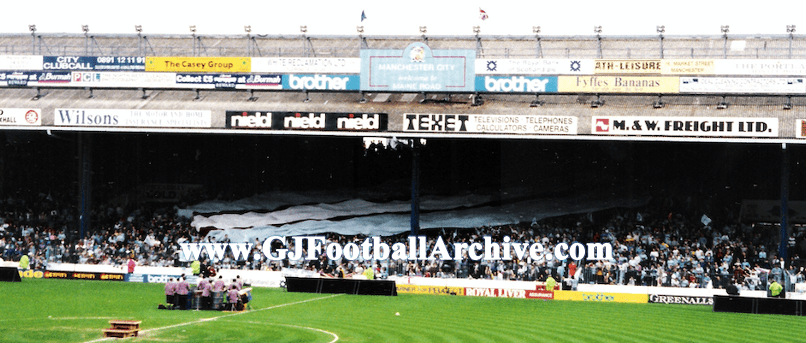
The Blue Print flag was a popular presence on many match days from the late 1980s until 1994, making its last appearance at The Kippax’s final game. The flag had been reduced in size by then. But it still covered much of the terracing. Blue Print was a City fanzine and they had paid for the flag.
Segregation was unnecessary for most of the stand’s existence, but by the end of the 1960s a rope would often be used to separate City and United fans on derby day. This was replaced by permanent barriers in the mid-70s which were increased over the years to keep home and away fans apart. Away fans were positioned at the Platt Lane end of the stand by this time.
It says much about the passion of the place that in the late 1970s the BBC came to film The Kippax chanting and in full flow.
In 1985 when City defeated Charlton 5-1 in a promotion decider on the final day of the season the Kippax was so packed that supporters remain convinced that its official capacity of 26,155 was significantly exceeded. Those of us on the terraces that day will never forget the shock we all experienced when the official crowd of 47,285 was announced – some 5,000 short of capacity!
The Kippax is no more, but those of us who experienced the stand will never forget its power, passion and presence. Its spirit lives on with thousands of Blues who stood there now bringing their own children and grandchildren to the Etihad who, if legislation allows, will soon be able to stand in a section specifically created for that purpose.
If you’re interested you can read how Maine Road got its name here:
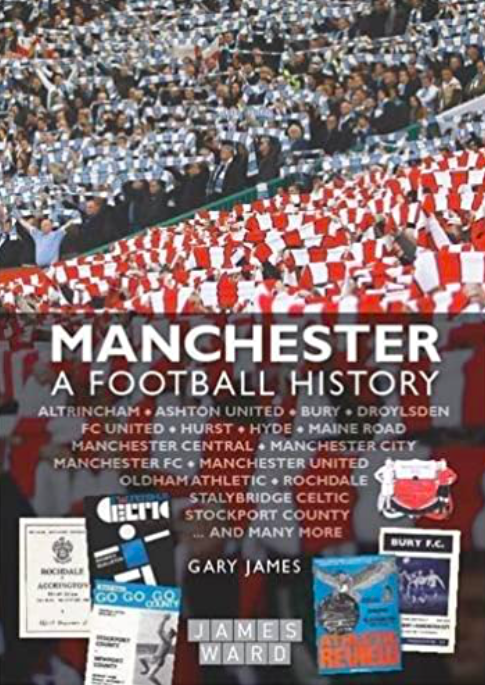
While you’re here I’d like to thank you for taking the time and trouble to visit my website. I am not employed by anyone and no one pays me to do research or interviews. I do not have sponsorship or advertising either. I’ve set up this website to help share my 32 years plus writing and research. The intention is to develop the archive and to provide access to as much of my material as possible over the coming weeks, months & years. Subscribers can already access over 280 articles/posts including the entire Manchester A Football History book and audio interviews with former City bosses Malcolm Allison and John Bond.
It costs £20 a year (it works out £1.67 a month) or £3 if you’d like to sign up a month at a time to get full access for as long as you subscribe (see below). Thanks for the support, Gary.
Subscribe to get access
This has been a sample of the material on http://www.GJFootballArchive.com If you would like to read all the in-depth articles and listen to the audio interviews then please subscribe. It works out about £1.67 a month if you take out an annual subscription (£20 per year). Each subscriber gets full access to the 280+ articles posted so far and the hundreds scheduled to be posted in the coming weeks.
The Old Trafford derby of 1974 is usually quoted as a decisive derby, however the Maine Road match was viewed at the time as being vital to United’s survival. In fact in the programme Red manager Tommy Docherty claimed: “Tonight’s game is one which decides our fate. City’s League Cup defeat is a big anti-climax for them and could help our fight for First Division survival.” Here for subscribers to this site is the story of that game – a highly controversial one that was almost abandoned due to player indiscipline!
Subscribe to read this and all other content
If you would like to read this and all the in-depth articles on this site (including the entire Manchester A Football History book and the audio interview with John Bond) then please subscribe. It works out about £1.67 a month if you take out an annual subscription (£20 per year) or £3 a month if you’d like to sign up for a month at a time. Each subscriber gets full access to the 270+ articles posted so far and the hundreds scheduled to be posted in the coming weeks.
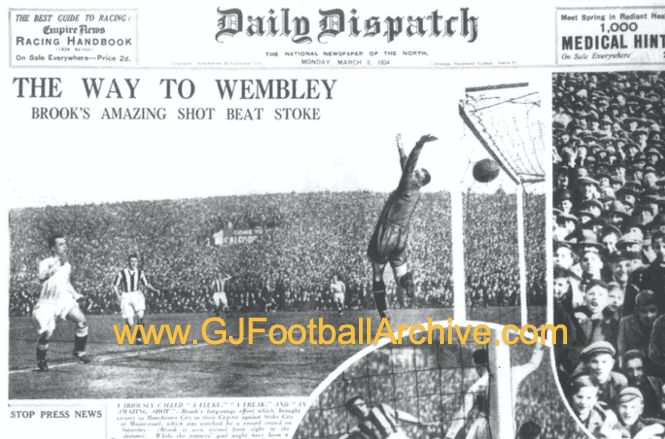
“I think Brook played in every position for the Club – he certainly went in nets once – and was a very good player. When the goal went in it was marvellous. Nirvana. On the final whistle I didn’t need to use my feet to leave I was wedged in a solid wall of human flesh and swept through the exit gate like a surfboarder.” Supporter Denis Houlston talking in 2003 about Eric Brook’s goal in the 1934 FA Cup tie with Stoke which was watched by 84,569.
It has virtually slipped out of living memory but in 1934 the largest footballing crowd ever assembled on a club ground witnessed a game that still, almost 90 years later, remains etched in the record books. 84,569 paid to watch City face Stoke in the FA Cup quarter-final at Maine Road in March 1934 – a crowd that surpassed Manchester’s previous best (also a national record at the time) by around 8,000 (set in 1924 when Cardiff faced City in another FA Cup quarter-final). Here for subscribers is a long read on the day when 84,569 gathered for a football match in Manchester:
Subscribe to get access
If you would like to read this and all the in-depth articles on this site (including the entire Manchester A Football History book and the audio interview with John Bond) then please subscribe. It works out about £1.67 a month if you take out an annual subscription (£20 per year) or £3 a month if you’d like to sign up for a month at a time. Each subscriber gets full access to the 260+ articles posted so far and the hundreds scheduled to be posted in the coming weeks.
Over the last few years there’s been a growing tendency by rival fans to mock the support of Manchester City. It’s an extremely odd thing to do, especially as for most of the period between 1981 and 2011 they talked of the loyalty of City fans. It seems, once the Blues started winning trophies again, rival supporters had to find something else to focus on.
Recently, this myth about City’s support has been used by some in extremely strange ways, for example following the Blues 4-1 thrashing of Liverpool at Anfield (see: https://gjfootballarchive.com/2021/02/07/the-last-time-mcfc-scored-4-or-more-at-anfield/ ) some Liverpool fans (and even some journalists!) started to make the point that City’s recent form is down to the fact that ‘they’re used to playing in front of no fans’ with the suggestion being that if Anfield had had fans present then City wouldn’t have won. They go on and suggest that Liverpool would have gained more wins in general and that City would not be top of the League and that Liverpool would be.
This is an extremely strange view, especially as the 2019-20 season (which included some games without fans of course) was the only time Liverpool have won the Premier League since its formation in 1992. In each of those seasons prior to LFC’s first Premier League title crowds were allowed at Anfield. During that same time City have won the League on four occasions. It’s a preposterous idea that ignores the facts.
So for this article I’ve decided to produce evidence of City support in recent decades along with a few comparisons with other leading sides. It makes interesting reading and may embarrass the supporters of certain clubs who constantly ridicule City’s fanbase, despite the evidence. The following in-depth piece can be accessed by subscribing to this blog below.
Subscribe to get access
If you would like to read this in-depth article and all the others on this site (including the entire Manchester A Football History book) then please subscribe. It works out about £1.67 a month if you take out an annual subscription (£20 per year) or £3 a month if you’d like to sign up for a month at a time. Each subscriber gets full access to the 220+ articles posted so far and the hundreds scheduled to be posted in the coming weeks.
“It was the way in which the football supporters of Manchester United and Manchester City used to dress and treat the whole match as if it were a carnival” – Iain S. P. Reid
A book is to be produced on Iain SP Reid’s photographs of City and United fans at Maine Road and Old Trafford. Paul Sorene (one of the people behind the book) has asked me to help track down anyone who appeared in these photos.
Images, like the one above of the hot dog sellers and fans on Maine Road, will be reproduced in the book with, where possible, the stories of those featured in the photos. Maybe, if circumstances allow, they’ll recreate some of the scenes within the book too.
So if you appeared in that photo or in any of the others Iain took during this period then please get in touch.
You can make contact with Paul Sorene and all involved at info@flashbak.com or through the Facebook page for Iain’s work at:
These photos were taken circa 1977. Iain believed that photography could improve lives. His work is full of joy. Sadly he died in 2000, leaving his fabulous archive of photographs filed away in boxes unseen until his family rediscovered them.
The book will be crowdfunded and we’ll all be able to spread the word but, most importantly at the moment, the people behind the book really want to hear from those Iain captured in his work. The pictures alone would make a fantastic book, but including the stories of those capture will make it a truly brilliant project.
I’m always passionate about the capturing and preservation of footballing images and stories. For me football simply isn’t about the players on the pitch but the thousands who dedicate significant time – and money – to supporting their club. If you’re a Blue or a Red who attended games around 1976-77 then take a look at Iain’s collection at https://www.facebook.com/IainSPReid and see if you’re there – or if there’s someone you recognise. The more people can do this the better. Thanks
On this day (14th January) in 1928 Manchester City faced Leeds United in a FA Cup tie. Although the result went City’s way, the game was to affect the Blues for several weeks afterwards.
The reason is that the ‘Citizens’, as they were occasionally called in the press, lost the services of Bert Gray for part of January and February following this third round cup tie with Leeds. Gray had broken a cheek bone after about thirty minutes and was replaced by winger Billy Austin, who managed to keep Leeds from scoring on a few occasions, as the Blues won 1-0. The City ‘scorer was Tommy Johnson (pictured above).
There’s film of the game here which is well worth watching for the mud. It’s difficult to tell if any of this footage shows Austin in nets (I think it does but am still studying it!):





 Gary James' Football Archive